BookBrief
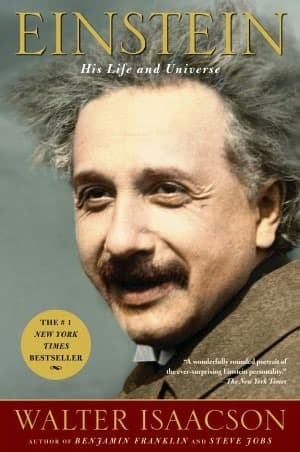
Einstein: His Life and Universe cover
Archivist's Choice

Einstein: His Life and Universe

Walter Isaacson (2007)

Genre

Biography / Memoir / History / Science

Reading Time

12 Minutes

Key Themes

See below

Track Your Reading

Sign in to track this book

Walter Isaacson's biography illuminates how Albert Einstein's rebellious spirit fueled his groundbreaking scientific discoveries and shaped his extraordinary life.

Core Idea

Walter Isaacson's "Einstein: His Life and Universe" presents a comprehensive and intimate portrait of Albert Einstein, tracing his intellectual development, personal life, and profound impact on science and the 20th century. Drawing on newly released papers, Isaacson reveals Einstein not just as a brilliant physicist but as a complex individual driven by a deep curiosity about the universe, a rebellious spirit, and a lifelong engagement with political and social issues. The book argues that Einstein's creativity stemmed from a unique blend of imagination, intuition, and a willingness to challenge established norms, making him a symbol of both scientific genius and humanistic conscience.
Difficulty
Medium

Core idea

The central argument and framework that powers the entire book.

Walter Isaacson's "Einstein: His Life and Universe" presents a comprehensive and intimate portrait of Albert Einstein, tracing his intellectual development, personal life, and profound impact on science and the 20th century. Drawing on newly released papers, Isaacson reveals Einstein not just as a brilliant physicist but as a complex individual driven by a deep curiosity about the universe, a rebellious spirit, and a lifelong engagement with political and social issues. The book argues that Einstein's creativity stemmed from a unique blend of imagination, intuition, and a willingness to challenge established norms, making him a symbol of both scientific genius and humanistic conscience.

At a glance

Difficulty

Medium

Key Takeaways

1

The Power of Playful Curiosity

Einstein's most profound insights often stemmed from 'thought experiments' rather than empirical data.

Quote

Imagination is more important than knowledge. For knowledge is limited, whereas imagination embraces the entire world, stimulating progress, giving birth to evolution.

Isaacson details how Einstein's intellectual journey involved imaginative visualization more than memorization. He pictured himself riding a light beam or considered how a clock would look if he fell from a roof. These 'thought experiments' shaped his theories. This approach, which he used from youth throughout his career, shows a key lesson: scientific discovery often comes from playful curiosity that questions basic assumptions, not just from knowing many facts. His ability to mentally change scenarios, without limits from experimen...

Supporting evidence

Isaacson describes Einstein's thought experiment of riding a light beam at age 16, which directly led to his special relativity theory years later.

Apply this

Cultivate 'what if' scenarios in problem-solving by deliberately detaching from current constraints. Encourage imaginative thinking over immediate data analysis in initial stages of ideation.

2

Rebellion as a Catalyst for Genius

Einstein's nonconformist spirit was not merely a personality quirk but a driving force behind his scientific breakthroughs.

Quote

The only thing that interferes with my learning is my education.

Einstein consistently went against established norms, from his early dislike of the strict Prussian education system to his later challenges of classical physics. Isaacson shows how this rebellious attitude allowed him to question scientific ideas others accepted without thought. His independent spirit, encouraged by his parents, made him skeptical of authority, whether academic or political. This meant he could see flaws in Newtonian mechanics when applied to the cosmos and light. While his nonconformity sometimes caused personal pro...

Supporting evidence

Einstein's expulsion from Luitpold Gymnasium and his later struggles with professors at the Swiss Federal Polytechnic for not conforming to their teaching methods.

Apply this

Encourage critical thinking and questioning of established paradigms, even at the risk of challenging conventional wisdom. Foster environments that value independent thought over strict adherence to rules.

3

The Unseen Hand of Collaboration

Despite his solitary image, Einstein's work was profoundly shaped by intellectual exchanges and personal relationships.

Quote

My scientific development was strongly influenced by a friend from the university, Michele Besso.

Isaacson debunks the idea of Einstein as a lone genius. He shows the important role of friends like Michele Besso, with whom Einstein had deep intellectual talks that helped him refine his early theories. His first wife, Mileva Marić, also a physicist, contributed significantly in the early years, though the extent of her direct help is debated. Later, his work with mathematicians like Marcel Grossmann was necessary for the complex math of general relativity. This challenges the romanticized idea of a single genius, showing that even ...

Supporting evidence

The extensive correspondence between Einstein and Michele Besso, where they discussed physics concepts for years, particularly concerning relativity.

Apply this

Actively seek diverse intellectual partners for brainstorming and critical feedback. Recognize and value the often-uncredited contributions of collaborators in any creative or scientific endeavor.

4

The Intersection of Science and Morality

Einstein's scientific insights were inseparable from his deep ethical convictions and social responsibility.

Quote

The most beautiful thing we can experience is the mysterious. It is the source of all true art and science. He to whom this emotion is a stranger, who can no longer pause to wonder and stand rapt in awe, is as good as dead: his eyes are closed.

Isaacson portrays Einstein as a scientist whose search for truth was linked with a strong sense of humanism and moral duty. His early pacifism, his support for world government, and his later warnings about nuclear weapons were not separate parts of his life. They came from the same ethical framework that guided his scientific search for universal laws. He believed understanding the universe meant a responsibility to ensure its peaceful future. While his early focus was purely scientific, his later life clearly showed a strong moral c...

Supporting evidence

Einstein's public letters to President Roosevelt warning about the potential for an atomic bomb, and his subsequent activism for nuclear disarmament.

Apply this

Integrate ethical considerations into scientific and technological development from the outset. Recognize the social responsibility that accompanies groundbreaking discoveries and innovations.

5

The Persistence of Solitary Focus

Despite collaborations, Einstein's most profound breakthroughs often required deep, sustained periods of individual concentration.

Quote

I live in that solitude which is painful in youth, but delicious in the years of maturity.

While Isaacson acknowledges the value of intellectual exchange, he also highlights Einstein's capacity for long, solitary mental effort. The 'miracle year' of 1905, when he published four important papers, came from intense, self-directed study during his patent office years. This time, with few academic distractions and a deep focus on fundamental physics, allowed him to connect different ideas. Later, the ten-year effort to create general relativity showed his individual persistence in tackling complex mathematical and conceptual pr...

Supporting evidence

His work at the Bern patent office, which provided him with the mental space and time to produce his revolutionary papers of 1905, largely outside of direct academic influence.

Apply this

Allocate dedicated, uninterrupted blocks of time for deep work and focused problem-solving. Create environments that minimize distractions to foster profound concentration.

6

The Aesthetic Drive in Science

Einstein was often guided by a profound sense of beauty and simplicity in his pursuit of physical laws.

Quote

The most incomprehensible thing about the world is that it is comprehensible.

Isaacson reveals that Einstein's scientific method was not just empirical or logical; it had an aesthetic sense. He believed the universe's basic laws must have elegance, symmetry, and simplicity. This 'gut feeling' for beauty often guided him, pushing him toward theories that felt 'right' even before all the evidence was there. For example, his preference for a unified field theory came from a desire for one beautiful explanation for all forces, even though he never found it. This shows that intuition and an appreciation for underlyi...

Supporting evidence

His lifelong quest for a unified field theory, which he pursued based on the conviction that such a theory *must* be beautiful and simple, despite experimental challenges.

Apply this

When evaluating solutions or theories, consider their elegance and simplicity alongside their functionality and empirical fit. Trust, but critically examine, your aesthetic intuition in problem-solving.

7

The Human Cost of Genius

Einstein's relentless pursuit of scientific truth often came at the expense of personal relationships and conventional family life.

Quote

The ordinary man is concerned with what he manifests, the great man with what he is.

Isaacson shows the less flattering parts of Einstein's personal life. His difficult relationships with his first wife, Mileva Marić, his distance from his sons, and his often-impersonal approach to home life show his intense focus on his work. While his second marriage to Elsa was more stable, it too was shaped by his single devotion to physics. This points to a common truth about many driven individuals: the demands of groundbreaking work can lead to significant personal sacrifices and emotional complications. The book suggests that ...

Supporting evidence

Details of his difficult divorce from Mileva and the distant relationship he maintained with his son, Hans Albert, who expressed feelings of neglect.

Apply this

Recognize the potential trade-offs between extreme professional dedication and personal well-being or relationships. Strive for balance, acknowledging that singular focus often has personal implications.

8

Relativity's Revolutionary Simplicity

The core idea of relativity, counter-intuitive as it is, rests on a surprisingly simple premise: the constancy of the speed of light.

Quote

Space and time are not conditions in which we live, but modes by which we think.

Isaacson explains the implications of special and general relativity, showing that their revolutionary nature comes from a few elegant assumptions rather than great complexity. The special theory, for instance, comes from the simple observation that light speed is constant for all observers, regardless of their relative motion. This seemingly small fact forces a radical rethinking of space and time, showing them as dynamic, interwoven parts of a single spacetime continuum. General relativity extends this by saying that gravity is not ...

Supporting evidence

The core postulates of special relativity: the principle of relativity and the constancy of the speed of light in all inertial frames.

Apply this

When confronting complex problems, seek out the foundational, often simple, underlying principles that govern the system. Question assumptions about seemingly immutable concepts.

9

The Role of Cosmic Awe

Einstein's scientific quest was deeply rooted in a spiritual, almost religious, sense of wonder at the universe's order.

Quote

The most beautiful emotion we can experience is the mystical. It is the sower of all true science.

Isaacson consistently highlights Einstein's 'cosmic religious feeling,' which he distinguished from traditional religion. This was not a belief in a personal God, but an overwhelming awe at the universe's intricate order, beauty, and comprehensibility. This wonder drove his lifelong search for a unified theory, a grand explanation that would show the elegant simplicity behind all physical phenomena. For Einstein, science was a way to understand this divine order, a spiritual journey as much as an intellectual one. This view offers a n...

Supporting evidence

Numerous quotes from Einstein throughout the book where he expresses his 'cosmic religious feeling' and his belief in the 'old one' who designed the universe.

Apply this

Cultivate a sense of wonder and curiosity about the natural world as a motivator for learning and exploration. Connect scientific inquiry with a broader appreciation for the universe's mysteries.

10

The Imperfection of Even Great Minds

Einstein's later resistance to quantum mechanics reveals the human tendency to cling to familiar paradigms, even for geniuses.

Quote

God does not play dice with the universe.

While Einstein changed physics, Isaacson also explores his intellectual limits, especially his discomfort with quantum mechanics. Despite his own contribution to quantum theory (the photoelectric effect), Einstein spent his later years trying to find a deterministic, local explanation for quantum phenomena, famously rejecting its probabilistic nature. This resistance, seen in his 'God does not play dice' quote, shows that even great minds can get stuck in their own frameworks and struggle to accept new, radically different ideas. It i...

Supporting evidence

His debates with Niels Bohr and his repeated attempts to devise thought experiments to disprove quantum mechanics' inherent uncertainty.

Apply this

Actively challenge your own deeply held assumptions and be open to new, even counter-intuitive, paradigms. Foster intellectual humility, recognizing that even foundational beliefs can be superseded by new evidence.

Critical analysis

Notable Quotes

Quiz

Test Your Knowledge

Ready to see how well you understood this book? Take our interactive quiz with 10 questions.

10
Questions
~5
Minutes
?
Best Score

Key Questions (FAQ)

Walter Isaacson's "Einstein: His Life and Universe" is a comprehensive biography that delves into the life and scientific discoveries of Albert Einstein. It explores his journey from a rebellious youth to a groundbreaking physicist, explaining the workings of his mind and his contributions to understanding the universe.

About the author