BookBrief
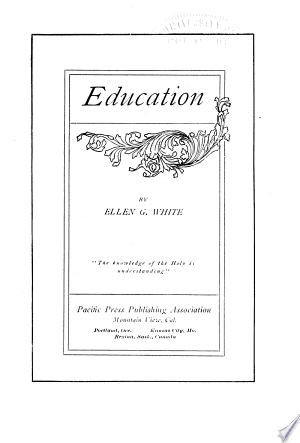
Education cover
Archivist's Choice

Education

Ellen G. White (1903)

Genre

Spirituality

Reading Time

180 min

Key Themes

See below

Track Your Reading

Sign in to track this book

Ellen G. White's "Education" describes a Christ-centered approach to learning, focusing on character and spiritual insight to prepare individuals for service.

Core Idea

Ellen G. White's "Education" says true education goes beyond academics. It includes developing physical, mental, and spiritual abilities. It promotes an educational model based on practical skills, character building, and a strong connection with nature. These things, it argues, prepare individuals not just for success in this life, but for a life of service and understanding divine principles. The book claims education's main goal is to restore humanity to its Creator's image, stressing self-control, moral honesty, and good character over worldly knowledge or wealth.
Reading time
180 min
Difficulty
Medium
✓ Read this if...
You are interested in the historical foundations of holistic education, value character development and practical skills over rote learning, or seek a spiritual perspective on the purpose and methods of education.
✗ Skip this if...
You are looking for modern pedagogical theories, secular approaches to education, or a purely academic discussion without spiritual or moralistic undertones.

Core idea

The central argument and framework that powers the entire book.

Ellen G. White's "Education" says true education goes beyond academics. It includes developing physical, mental, and spiritual abilities. It promotes an educational model based on practical skills, character building, and a strong connection with nature. These things, it argues, prepare individuals not just for success in this life, but for a life of service and understanding divine principles. The book claims education's main goal is to restore humanity to its Creator's image, stressing self-control, moral honesty, and good character over worldly knowledge or wealth.

At a glance

Reading time

180 min

Difficulty

Medium

Read this if...

You are interested in the historical foundations of holistic education, value character development and practical skills over rote learning, or seek a spiritual perspective on the purpose and methods of education.

Skip this if...

You are looking for modern pedagogical theories, secular approaches to education, or a purely academic discussion without spiritual or moralistic undertones.

Key Takeaways

1

Holistic Education: Beyond the Classroom

True education encompasses the physical, mental, and spiritual, preparing individuals for both this life and the life to come.

Quote

True education means more than the pursuit of a certain course of study. It means more than a preparation for the life that now is. It has to do with the whole being, and with the whole period of existence possible to man. It is the harmonious development of the physical, the mental, and the spiritual powers. It prepares the student for the joy of service in this world and for the higher joy of wider service in the world to come.

White argues that common education is too narrow. It is not just about learning facts or job training. Instead, it is a full process of character development that includes a person's physical health, intelligence, and spiritual connection. This complete approach aims to bring back the divine image in people, creating individuals who are good at worldly tasks, morally sound, and spiritually aware. The main goal is to prepare students for meaningful service, both in their communities and in an eternal sense, meaning education has lastin...

Supporting evidence

The entire book builds upon this foundational principle, contrasting it with the 'worldly' systems of education prevalent in her time that often neglected the spiritual or moral dimensions.

Apply this

Parents and educators should design learning environments that intentionally nourish physical well-being (healthy diet, exercise), cultivate critical thinking and intellectual curiosity, and foster spiritual growth through moral instruction and a connection with nature.


holistic-developmentcharacter-educationspiritual-growth
2

Nature as the Primary Textbook

God's creation is the most profound and accessible textbook for understanding divine principles and developing practical skills.

Quote

Nature is God's textbook. The great book of nature is opened to all. We are to learn from nature that which will teach us of God.

White highly values nature as an unmatched teaching tool. She believes the natural world—its complex systems, rhythms, beauty, and order—shows God's character and wisdom directly. So, studying nature is not just science, but a spiritual act that leads to a deeper respect for creation and its Creator. Besides spiritual understanding, being in nature also teaches practical skills, encourages observation, and promotes physical activity, all contributing to the balanced development she supports. It counters the artificial and limited natu...

Supporting evidence

She frequently references the parables of Jesus, which often drew lessons from nature (lilies of the field, birds of the air), as an example of effective teaching from the natural world.

Apply this

Integrate outdoor learning into curricula. Encourage children to spend time exploring forests, gardens, and natural landscapes, observing plants and animals, and reflecting on the patterns and design they discover. Use nature walks as opportunities for scientific inquiry and spiritual contemplation.

nature-studyexperiential-learningdivine-revelation
3

The Dignity of Manual Labor

Practical skills and manual labor are essential components of education, fostering self-reliance, character, and a balanced life.

Quote

Every child, every youth, should be taught to do some kind of useful labor. The hands, as well as the head, must be educated.

White argued against the idea that manual labor was beneath educated people. She championed its inclusion in all education. She believed practical work, whether in farming, crafts, or household tasks, was not just vocational training but built character. It taught hard work, responsibility, problem-solving, and the value of helping society. Also, it balanced intellectual pursuits, stopping students from becoming too theoretical and impractical. This mix of mental and physical work creates well-rounded individuals who are self-sufficie...

Supporting evidence

She points to the example of Jesus, who worked as a carpenter, and the biblical mandate for Adam to 'dress and keep' the Garden of Eden, highlighting the divine origin and honor of labor.

Apply this

Incorporate practical skills training into homes and schools: gardening, cooking, carpentry, sewing. Assign age-appropriate chores and projects that require physical effort and produce tangible results, emphasizing the dignity and value of such work.

vocational-trainingpractical-educationwork-ethic
4

Character Over Credentials

The ultimate measure of education is not academic achievement but the development of a noble, Christ-like character.

Quote

The greatest want of the world is the want of men—men who will not be bought or sold, men who in their inmost souls are true and honest, men who do not fear to call sin by its right name, men whose conscience is as true to duty as the needle to the pole, men who will stand for the right though the heavens fall.

White's view of education is deeply moral. She puts growing a strong, good character above everything else. Academic honors, wealth, or social standing are less important than honesty, self-control, and kindness. She regrets that society often values intelligence or material success more than moral strength. True education, then, must teach firm principles and a strong sense of duty, preparing individuals to be pillars of goodness in a flawed world. This focus on character is not just a suggestion; it is presented as humanity's most u...

Supporting evidence

Her frequent references to biblical figures (Daniel, Joseph) who maintained integrity in challenging circumstances serve as exemplars of the character she advocates.

Apply this

Focus on teaching moral principles through stories, discussions, and real-life scenarios. Model integrity, honesty, and kindness. Create opportunities for students to make ethical choices and understand the consequences, emphasizing empathy and service to others.

moral-educationintegrityvirtue-development
5

The Teacher's Sacred Calling

Teaching is more than a profession; it's a sacred trust, demanding exemplary character and a deep love for students.

Quote

The teacher's work is the most important that was ever entrusted to human beings. It is a work that demands the highest qualifications, and the greatest care.

White sees the teacher's role as almost spiritual. She views teachers not just as instructors but as people who shape destinies, greatly influencing students' character and future. This high calling needs more than intelligence; it requires patience, true love, a deep understanding of people, and an excellent moral life. A teacher's personal character, more than their teaching methods, is their most powerful tool. They are called to live as examples of the principles they teach, showing divine qualities in their interactions and creat...

Supporting evidence

She cites the example of Jesus as the 'Master Teacher,' illustrating the ideal blend of wisdom, compassion, and effective communication.

Apply this

Invest in teacher development that emphasizes character building, empathy, and spiritual growth, not just pedagogical techniques. Create supportive communities for teachers. For aspiring teachers, cultivate a deep sense of responsibility and a passion for holistic student development.

teacher-leadershipmentorshipeducational-philosophy
6

Self-Control and Discipline

True freedom comes from self-mastery, a core educational objective that empowers individuals to govern their impulses and make wise choices.

Quote

The greatest victory is the conquest of self.

A main part of White's educational philosophy is developing self-control. She argues that real freedom is not the absence of rules but the ability to choose what is right, even when it is hard. Education should help people control their desires and impulses, guiding them toward sensible, moral choices. This self-mastery does not repress but frees individuals from their lower nature. Discipline, then, is not external force but building inner strength and a strong conscience, allowing a life of purpose and honesty.

Supporting evidence

She frequently draws from biblical principles of temperance and self-governance, contrasting it with worldly indulgence and lack of restraint.

Apply this

Teach children and students to understand and manage their emotions. Implement routines and responsibilities that foster discipline. Encourage delayed gratification and conscious decision-making, providing opportunities for students to practice self-regulation and understand its long-term benefits.

self-disciplineemotional-intelligencemoral-agency
7

The Power of Influence

Every individual exerts a powerful, often unseen, influence on others, making personal example a crucial educational tool.

Quote

Every act, every word, every thought, has its influence, reaching to results of which we may have no conception.

White emphasizes how far-reaching personal influence is. She believes our actions, words, and even attitudes create effects that touch those around us, often in ways we do not immediately see. This means parents, teachers, and even friends are always teaching others through their example. This idea places a big responsibility on everyone, especially those in leadership or teaching roles, to live honest and purposeful lives. It shows that education is not only formal instruction but a continuous process of modeling and observation, mak...

Supporting evidence

She often uses the analogy of a stone cast into a lake, creating ever-widening circles, to illustrate the expansive nature of influence.

Apply this

Be consciously mindful of your behavior and language as a parent, teacher, or mentor. Create an environment where positive role models are celebrated. Encourage students to consider the impact of their actions on their community and to strive to be a positive influence.

role-modelingsocial-learningcommunity-impact
8

Redemptive Education

Education's ultimate purpose is to restore humanity to its original, divine design, overcoming the effects of sin.

Quote

The work of education and the work of redemption are one.

This is perhaps the most religious idea. White views education as a way to redeem. She believes humanity, having fallen from its original perfect state, needs to be restored. Education, then, is not just about gaining knowledge but about rebuilding character, reconnecting with God, and living a life aligned with divine principles. It is a process that changes people, designed to counter the negative influences of a fallen world and bring individuals back to spiritual and moral wholeness. This view gives education great spiritual meani...

Supporting evidence

She frames the entire narrative of education within the biblical account of creation, fall, and redemption, seeing Christ as the ultimate educator and restorer.

Apply this

Integrate spiritual principles and moral lessons into every subject and activity. Frame challenges as opportunities for growth and character refinement. Emphasize forgiveness, grace, and service as pathways to personal and communal restoration.

spiritual-restorationtheological-educationholiness
9

The Home as the First School

The family unit is the foundational and most influential educational institution, shaping a child's character and worldview.

Quote

The home is the first school, and it is here that the foundation is laid for a life of usefulness or of futility.

White strongly states that the home is the first and most important educational setting. Before formal school, children learn their basic lessons about morality, values, social interaction, and faith within the family. Parents are the child's first and most influential teachers. Their example, discipline, and care create the foundation for all future learning. A well-ordered, loving, and spiritually focused home can counter many bad outside influences, while a troubled home can harm even the best formal education. This highlights the ...

Supporting evidence

She repeatedly stresses the biblical command to parents to teach their children diligently, illustrating the divine mandate for home-based education.

Apply this

Parents should consciously cultivate a home environment that prioritizes moral instruction, spiritual devotion, practical skills, and healthy relationships. Spend quality time with children, reading, discussing, and working together. Model the values you wish to instill.

parental-educationfamily-valuesearly-childhood-education
10

The Danger of Worldly Ambition

Education driven by selfish ambition for wealth, power, or worldly acclaim ultimately fails to deliver true fulfillment or lasting good.

Quote

The world's standard of education is often the very reverse of God's. The great object of education, with many, is to secure wealth or position.

White criticizes education and personal goals driven mainly by worldly gain. She argues that pursuing education only for money, social status, or personal power is a misguided effort that ignores life's higher purposes. Such ambition, she believes, often leads to moral compromise, spiritual emptiness, and ultimately, unhappiness. True education, in contrast, should develop a spirit of service, humility, and a desire to honor God, leading to a richer, more meaningful life. She warns against the appeal of worldly wisdom that promises mu...

Supporting evidence

She contrasts the fleeting nature of earthly riches and fame with the eternal rewards of a life devoted to God and service.

Apply this

Re-evaluate personal and educational goals, shifting focus from material gain and status to character development, service, and spiritual growth. Encourage students to pursue careers and lives that contribute positively to humanity and align with their values, rather than solely chasing financial rewards.

materialismspiritual-valuespurpose-driven-life

Critical analysis

Notable Quotes

True education means more than the pursual of a certain course of study. It means more than a preparation for the life that now is. It has to do with the whole being, and with the whole period of existence possible to man. It is the development of the physical, mental, and spiritual powers. It is the fitting of the whole being for service to God and man.

Defining true education beyond mere academics.

The greatest want of the world is the want of men—men who will not be bought or sold; men who in their inmost souls are true and honest; men who do not fear to call sin by its right name; men whose conscience is as true to duty as the needle to the pole; men who will stand for the right though the heavens fall.

Describing the kind of character needed in society.

Every human being, created in the image of God, is endowed with a power akin to that of the Creator—individuality, power to think and to do. The men in whom this power is developed are the men who bear responsibilities, who are leaders in enterprise, and who influence character.

Highlighting humanity's divine potential and the importance of individual development.

The child is to be trained to be a thinker, and not a mere reflector of other men's thought.

Emphasizing critical thinking over rote learning.

The fear of the Lord is the beginning of wisdom.

Stating a fundamental principle of spiritual wisdom.

The true object of education is to restore the image of God in the soul.

Identifying the ultimate spiritual goal of education.

Nature is God's great object lesson.

Advocating for learning through observation of the natural world.

The Bible is the most ancient and the most comprehensive history that men possess. It came fresh from the fountain of eternal truth, and a divine hand has preserved its purity through all the ages.

Presenting the Bible as a primary source of knowledge and truth.

The greatest want of the world is the want of educators who will work in harmony with the divine plan of education.

Calling for teachers aligned with God's principles.

Self-control, purity, truthfulness, fortitude, perseverance, courtesy, diligence, these are among the virtues that find their place in the curriculum of true education.

Listing essential virtues to be cultivated through education.

The training that fits one for usefulness in this life is the best preparation for the life to come.

Connecting earthly service with eternal readiness.

The teacher who loves God and fears Him is better prepared for his work than if he had all the learning the world could give, without the fear of God.

Prioritizing a teacher's spiritual character over mere academic credentials.

Our God is a God of order. He has established laws to govern every part of His creation. And these laws, if obeyed, bring harmony and health.

Highlighting God's order and the benefits of obedience to divine laws.

True wisdom is not gained by seeking to rise above others, but by seeking to serve them.

Redefining wisdom in terms of humility and service.

Quiz

Test Your Knowledge

Ready to see how well you understood this book? Take our interactive quiz with 10 questions.

10
Questions
~5
Minutes
?
Best Score

Key Questions (FAQ)

'Education' emphasizes the holistic development of an individual, focusing on the harmonious growth of the physical, mental, and spiritual faculties. It argues that true education prepares one for service in this life and for the higher joy of service in the life to come, reflecting God's character.

About the author