BookBrief
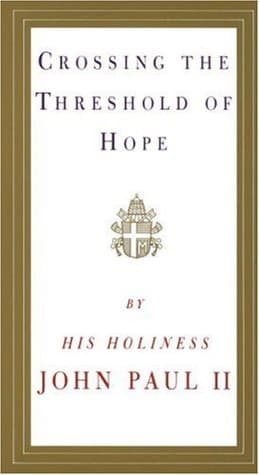
Crossing the Threshold of Hope cover
Archivist's Choice

Crossing the Threshold of Hope

Pope John Paul II (1994)

Genre

Spirituality / Philosophy

Reading Time

360 min

Key Themes

See below

Track Your Reading

Sign in to track this book

On the edge of a new millennium, Pope John Paul II directly addresses humanity's deepest spiritual concerns, exploring faith, suffering, and the enduring call to hope.

Core Idea

Pope John Paul II, in an extended interview, explains Christian anthropology built on hope, even amidst modern life's complexities. He answers basic theological and philosophical questions about God, humanity, suffering, salvation, and the Church's place in a diverse world. The book says that humanity's true fulfillment and the way to overcome despair come from accepting the saving truth in Jesus Christ. It stresses the dignity of each person and the universal call to holiness as the path to real hope and meaning. He argues that true hope is not passive optimism but an active, Christ-centered quality that clarifies the mystery of suffering, provides stability against modern relativism, and encourages believers to spread the Gospel. The Pope highlights life's eternal aspect, showing Mary as the ideal model of faith and hope. He presents the Church as the necessary means of salvation through which this hope is found and shared.
Reading time
360 min
Difficulty
Medium
✓ Read this if...
You are seeking a deeply spiritual and intellectual exploration of Christian faith, hope, and the human condition from one of the 20th century's most influential religious leaders, particularly if you appreciate a question-and-answer format that delves into theological and philosophical topics.
✗ Skip this if...
You are looking for a light, introductory text on spirituality, or if you are not interested in a detailed exposition of Catholic doctrine and papal thought on faith, suffering, and the Church's mission.

Core idea

The central argument and framework that powers the entire book.

Pope John Paul II, in an extended interview, explains Christian anthropology built on hope, even amidst modern life's complexities. He answers basic theological and philosophical questions about God, humanity, suffering, salvation, and the Church's place in a diverse world. The book says that humanity's true fulfillment and the way to overcome despair come from accepting the saving truth in Jesus Christ. It stresses the dignity of each person and the universal call to holiness as the path to real hope and meaning.

He argues that true hope is not passive optimism but an active, Christ-centered quality that clarifies the mystery of suffering, provides stability against modern relativism, and encourages believers to spread the Gospel. The Pope highlights life's eternal aspect, showing Mary as the ideal model of faith and hope. He presents the Church as the necessary means of salvation through which this hope is found and shared.

At a glance

Reading time

360 min

Difficulty

Medium

Read this if...

You are seeking a deeply spiritual and intellectual exploration of Christian faith, hope, and the human condition from one of the 20th century's most influential religious leaders, particularly if you appreciate a question-and-answer format that delves into theological and philosophical topics.

Skip this if...

You are looking for a light, introductory text on spirituality, or if you are not interested in a detailed exposition of Catholic doctrine and papal thought on faith, suffering, and the Church's mission.

Key Takeaways

1

The Primacy of Hope in Human Existence

Hope is not just an emotion, but a theological virtue that underpins human dignity and purpose.

Quote

Do not abandon yourselves to despair. We are the Easter people and hallelujah is our song.

Pope John Paul II argues that hope is essential, especially when facing suffering and uncertainty. He presents it not as simple optimism, but as a strong theological virtue based on faith in God's plan and the promise of salvation. This hope helps people overcome immediate problems and find meaning even in difficult situations. It allows believers to confront evil and despair, knowing that God will ultimately triumph. The Pope stresses that hope is a gift, but also a choice, requiring active effort and trust in a divine plan that is o...

Supporting evidence

The Pope consistently references the Paschal Mystery (Christ's suffering, death, and resurrection) as the ultimate source and model of Christian hope, demonstrating how even the greatest suffering can lead to profound redemption and new life.

Apply this

Cultivate a daily practice of reflection on divine providence, actively seeking signs of hope in everyday life. When faced with adversity, consciously reframe challenges within a broader narrative of God's plan, rather than succumbing to immediate despair.

theological-virtuespaschal-mysterydivine-providence
2

The Mystery of Suffering and Evil

Suffering, though perplexing, can be redemptive and a path to deeper communion with Christ.

Quote

Suffering is also a call to take on the cross, to accept it and carry it with Christ.

The Pope directly addresses the ongoing problem of evil and suffering, acknowledging its deep mystery and challenge to faith. He rejects simple answers, suggesting instead that suffering, when joined with Christ's Passion, can bring redemption. It is not a punishment, but a chance for cleansing, solidarity with others, and a deeper role in God's saving work. By embracing suffering with faith, people can turn it from a destructive force into a source of spiritual growth and deep connection with the divine. This view does not lessen the...

Supporting evidence

John Paul II frequently alludes to the Book of Job, not as providing easy answers, but as illustrating the limits of human understanding and the necessity of trusting God's inscrutable ways amidst inexplicable suffering. He also points to the lives of saints who found profound meaning and closeness to God through their afflictions.

Apply this

When encountering personal suffering or witnessing the suffering of others, consciously offer it up in prayer, seeking to unite it with Christ's sacrifice. Engage in acts of compassion for the suffering, recognizing this as a participation in God's redemptive love.

theodicyredemptive-sufferingproblem-of-evil
3

The Dignity of the Human Person

Every human life, from conception to natural death, possesses inherent and inalienable dignity.

Quote

Man is the only creature on earth that God has willed for its own sake.

A main part of John Paul II's philosophy is the deep dignity of every human person, made in God's image. This dignity is not earned but built-in, making each person an end in themselves, never just a means to an end. This belief forms the basis of his ethical and social teachings, supporting his strong defense of human rights, the sanctity of life, and social justice. He argues that recognizing this dignity is vital for building a just society and forming real relationships. Any action that lessens or uses a human being is a serious o...

Supporting evidence

The Pope cites the Genesis account of creation, where humanity is depicted as uniquely created in God's image (Imago Dei), thereby establishing an ontological basis for human dignity that transcends utility or societal status.

Apply this

Actively advocate for policies and practices that uphold the sanctity of life and human rights. In personal interactions, consciously treat every individual with profound respect, recognizing their inherent worth regardless of their background, beliefs, or circumstances.

imago-deihuman-rightssanctity-of-life
4

Evangelization in a Pluralistic World

While affirming the uniqueness of Christ, dialogue with other faiths is essential for mutual understanding and peace.

Quote

The Church's mission is not to condemn but to proclaim Christ, the one Savior of the world.

John Paul II addresses the complex area of evangelization in a world with many religions. He firmly states the unique and final saving role of Jesus Christ, maintaining that salvation comes only through Him. However, this belief does not prevent, but rather requires, respectful conversation with other religions and cultures. He supports interreligious dialogue as a way to build mutual understanding, promote peace, and discover shared values, even while recognizing basic theological differences. The goal is not mixing religions, but a ...

Supporting evidence

The Pope discusses his own extensive travels and meetings with leaders of other faiths, such as his historic Assisi interfaith prayer meetings for peace, as practical demonstrations of this commitment to dialogue while maintaining Christian identity.

Apply this

Engage in respectful conversations with individuals of different faiths, seeking to understand their perspectives and beliefs. Clearly articulate your own faith while listening attentively, fostering mutual respect and identifying areas of common ground for collaboration on social issues.

interreligious-dialogueevangelizationreligious-pluralism
5

The Call to Holiness for All Believers

Holiness is not reserved for a select few, but is a universal vocation for every Christian.

Quote

All the faithful, whatever their condition or state, are called by the Lord, each in his own way, to that perfect holiness whereby the Father Himself is perfect.

The Pope strongly repeats the Second Vatican Council's teaching that everyone is called to holiness. This means that holiness is not just for priests or religious, but an achievable and expected goal for every baptized person, no matter their life situation. Whether married, single, working, or retired, each person is called to live a life fully dedicated to God, striving for moral excellence and spiritual perfection within their unique circumstances. This makes holiness clear, making it a reachable and practical goal for everyone. It...

Supporting evidence

He draws upon the teachings of the Second Vatican Council, particularly *Lumen Gentium*, which explicitly articulates the universal call to holiness, emphasizing that all members of the Church are called to strive for Christian perfection.

Apply this

Identify specific areas in your daily life (work, family, relationships) where you can more intentionally practice virtues like patience, charity, or humility. Regularly examine your conscience and seek opportunities for spiritual growth through prayer, sacraments, and service.

universal-call-to-holinessvatican-iichristian-perfection
6

The Centrality of Christ in History

Jesus Christ is the definitive revelation of God and the ultimate key to understanding human history and destiny.

Quote

Christ is the answer to the question that is every human existence.

For John Paul II, Jesus Christ is not just a historical figure or a great teacher, but the very center of history, the 'alpha and omega.' He is God's final self-revelation and the one through whom humanity can truly understand itself, its beginnings, and its final destiny. All of history, both religious and secular, finds its meaning and direction in Christ. This Christ-centered worldview offers a consistent way to understand the complexities of human experience, suffering, and joy. It states that without Christ, human existence remai...

Supporting evidence

The Pope's entire theological framework is rooted in the Incarnation, emphasizing that God entered human history in Christ. He points to the historical fact of Christ's life, death, and resurrection as the pivotal event that reoriented human understanding of God and humanity.

Apply this

Regularly reflect on the life and teachings of Jesus Christ, seeing Him as the ultimate model for human flourishing. Seek to interpret current events and personal challenges through the lens of Christ's redemptive work, finding meaning and purpose in seemingly disparate occurrences.

christocentrismincarnationeschatology
7

The Power of Conscience and Truth

Conscience, when rightly formed, is the voice of God, guiding individuals towards objective moral truth.

Quote

Conscience is not a law unto itself, but the witness to the objective truth about the good.

The Pope discusses the role of conscience in moral choices, explaining that it is not a subjective judge of right and wrong, but an inner voice that, when properly formed, recognizes objective moral truth. He warns against a relativistic understanding of conscience, which can lead to moral chaos. Instead, he stresses the importance of forming one's conscience through prayer, scripture, Church teaching, and reason, ensuring it matches the truth revealed by God. A well-formed conscience helps people make morally good choices, even when ...

Supporting evidence

He often refers to the natural law, which he sees as imprinted on the human heart and accessible through reason, serving as a foundational element for a rightly formed conscience that can discern universal moral principles.

Apply this

Diligently form your conscience through ongoing study of Catholic social teaching, scripture, and prayer. When facing moral dilemmas, consult these sources and engage in reflective prayer to discern the objective moral good, rather than simply following personal inclination.

natural-lawmoral-relativismobjective-truth
8

Mary as Model of Faith and Hope

The Blessed Mother serves as an enduring exemplar of complete trust in God and unwavering hope.

Quote

Mary lived by faith, and therefore she lived by hope.

John Paul II often points to the Blessed Virgin Mary as the best example of faith, hope, and obedience to God's will. Her 'yes' at the Annunciation, her firmness at the foot of the cross, and her steady belief in the resurrection show a life lived in complete trust, even in the darkest times. Mary embodies the ideal response to God's call, showing how a person can fully cooperate with divine grace. Her life teaches a deep lesson in how to handle suffering, uncertainty, and joy with spiritual depth. She is presented not just as someone...

Supporting evidence

He extensively references the Annunciation (Luke 1:26-38) and the Crucifixion (John 19:25-27) as pivotal moments demonstrating Mary's profound faith, obedience, and enduring hope, even in the face of immense suffering and incomprehension.

Apply this

Cultivate a deeper devotion to Mary, meditating on her virtues and seeking her intercession. When faced with difficult decisions or moments of doubt, reflect on Mary's 'fiat' and her unwavering trust in God's plan, striving to emulate her complete surrender.

mariologyfiatdiscipleship
9

The Eschatological Dimension of Life

Human life is oriented towards eternal life, giving ultimate meaning to present actions and struggles.

Quote

Man is a being for whom death is not the end, but the threshold of eternal life.

The Pope consistently reminds readers of the eternal aspect of human existence, emphasizing that this earthly life prepares for eternal life with God. This view provides ultimate meaning and reason for moral living, acts of charity, and enduring suffering. It makes the temporary profoundly important, as every choice and action has eternal results. The hope of heaven and the reality of final judgment provide a framework for understanding human destiny and the importance of striving for holiness. This understanding encourages less focus...

Supporting evidence

He frequently invokes biblical passages concerning the Last Judgment, heaven, hell, and purgatory, grounding his discussion of eternal life in traditional Christian doctrine and scripture.

Apply this

Regularly reflect on your ultimate purpose and the brevity of earthly life. Make conscious choices that prioritize spiritual growth and service to others, viewing them as investments in your eternal destiny. Engage in acts of prayer for the deceased, recognizing the communion of saints.

eschatologyeternal-lifekingdom-of-god
10

The Church as Sacrament of Salvation

The Church, though imperfect, is a visible sign and instrument of God's saving grace in the world.

Quote

The Church is the universal sacrament of salvation.

John Paul II confirms the Second Vatican Council's teaching that the Church is a 'sacrament' – a visible sign and tool – of God's salvation for all humanity. While acknowledging human flaws and sin within the Church, he stresses its divine origin and mission. The Church is presented as the mystical body of Christ, through which grace is given, the Gospel is announced, and humanity is brought into communion with God. This understanding highlights the Church's vital role in the world, not as an exclusive group, but as a community called...

Supporting evidence

He references *Lumen Gentium* and *Gaudium et Spes* from Vatican II, which articulate the Church's nature as the People of God and a sacrament in the world, emphasizing its dual human and divine reality.

Apply this

Actively participate in the life of your local parish community, recognizing it as a tangible expression of the universal Church. Seek to understand and uphold the Church's teachings, and contribute your gifts to its mission of evangelization and service.

sacramentmystical-body-of-christvatican-ii

Critical analysis

Notable Quotes

The Pope must speak not only as a spiritual leader, but also as a man who knows the world, and who knows himself.

Reflecting on the role and responsibilities of the papacy.

Faith and reason are like two wings on which the human spirit rises to the realm of contemplation of truth.

Emphasizing the harmony between faith and intellectual inquiry.

Man is called to a fullness of life which far exceeds the dimensions of his earthly existence, because it consists in sharing the very life of God.

Discussing the ultimate purpose and destiny of humanity.

Hope is not a utopia. It is the expectation of a new heaven and a new earth, a new world that is already present in the heart of man.

Defining the nature of Christian hope beyond mere optimism.

To be truly human means to recognize the existence of God and to live in communion with Him.

Linking true humanity with a relationship with the divine.

The greatest poverty is not to know Christ.

Highlighting spiritual poverty as the most severe form of deprivation.

Evil is the absence of good, not a substance in itself.

Explaining the philosophical understanding of evil.

Prayer is the encounter of God’s thirst with ours.

Describing prayer as a mutual longing between God and humanity.

The future starts today, not tomorrow.

Encouraging immediate action and responsibility for one's life and faith.

Freedom consists not in doing what we like, but in having the right to do what we ought.

Offering a nuanced definition of true freedom in a moral context.

Every person is a child of God, and therefore, every person has immense dignity.

Underpinning the concept of human dignity with theological roots.

The Church lives by the Eucharist.

Emphasizing the centrality of the Eucharist to the life and identity of the Catholic Church.

Holiness does not consist in never making a mistake, but in rising up again after every fall.

Providing a practical and encouraging view of the pursuit of holiness.

The purpose of philosophy is to answer the question: 'Who is man?'

Defining the fundamental quest of philosophical inquiry.

Do not be afraid. Open wide the doors for Christ.

A general exhortation, often associated with his papacy, encouraging openness to faith.

Quiz

Test Your Knowledge

Ready to see how well you understood this book? Take our interactive quiz with 10 questions.

10
Questions
~5
Minutes
?
Best Score

Key Questions (FAQ)

The central message is one of hope and courage, urging readers not to be afraid in the face of life's challenges. Pope John Paul II shares his personal beliefs and profound theological insights to illuminate the path to a meaningful existence rooted in faith.

About the author