BookBrief
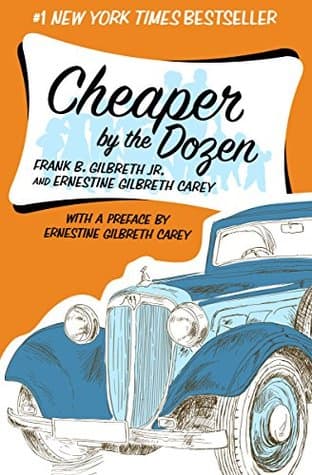
Cheaper by the Dozen cover
Archivist's Choice

Cheaper by the Dozen

Frank B. Gilbreth Jr. (1948)

Genre

Biography / Memoir / History / Children's

Reading Time

292 min

Key Themes

See below

Track Your Reading

Sign in to track this book

Meet the Gilbreths, a family of twelve children whose efficiency-expert parents apply their industrial principles to everything from chore charts to synchronized tonsillectomies, all with hilarious and heartwarming results.

Core Idea

Cheaper by the Dozen tells of the upbringing of the twelve Gilbreth children under their efficiency-expert parents, Frank and Lillian Gilbreth. The book shows how the parents used scientific management, usually for factories, in daily family life, from bathing to surgery. Beyond the funny stories, it explores the challenges and successes of keeping individuality, building family bonds, and teaching practical values in a large home run by strict, if unusual, organizational systems.
Reading time
292 min
Difficulty
Easy
✓ Read this if...
You enjoy humorous memoirs about large, eccentric families, are interested in the practical (and sometimes impractical) application of efficiency principles to daily life, or appreciate stories of unconventional parenting.
✗ Skip this if...
You prefer serious, academic analyses of management theory, or dislike lighthearted, anecdotal narratives about family life.

Core idea

The central argument and framework that powers the entire book.

Cheaper by the Dozen tells of the upbringing of the twelve Gilbreth children under their efficiency-expert parents, Frank and Lillian Gilbreth. The book shows how the parents used scientific management, usually for factories, in daily family life, from bathing to surgery. Beyond the funny stories, it explores the challenges and successes of keeping individuality, building family bonds, and teaching practical values in a large home run by strict, if unusual, organizational systems.

At a glance

Reading time

292 min

Difficulty

Easy

Read this if...

You enjoy humorous memoirs about large, eccentric families, are interested in the practical (and sometimes impractical) application of efficiency principles to daily life, or appreciate stories of unconventional parenting.

Skip this if...

You prefer serious, academic analyses of management theory, or dislike lighthearted, anecdotal narratives about family life.

Key Takeaways

1

Efficiency as a Family Value

Applying industrial engineering principles to raise twelve children.

Quote

Dad was convinced that if he could apply principles of scientific management to raising a family, he could not only make it run more smoothly but also prove the universal applicability of his theories.

The Gilbreth parents, both efficiency experts, applied their industrial management techniques to their twelve children. This was a deep belief that shaped every part of their home, from timed morning routines to charts and systems. They thought that just as factories could improve output, a family could improve its daily work, saving time and effort while increasing output and harmony. This approach, though often leading to funny mistakes and child resistance, showed a serious dedication to organization and the belief that structure c...

Supporting evidence

The detailed descriptions of Dad's time-and-motion studies within the home, such as filming the children brushing their teeth to find the most efficient method, or the systematic use of a 'family council' to address issues and assign chores.

Apply this

Identify one recurring family task or routine that feels chaotic. Implement a simple time-and-motion study for a week, observing bottlenecks and wasted effort. Then, introduce one small, actionable efficiency improvement, like a designated spot for keys or a visual checklist for morning chores.

scientific-managementtime-and-motion-studyfamily-systems
2

The Power of Playful Pedagogy

Turning education and discipline into engaging, competitive games.

Quote

Dad believed that almost anything could be taught by making a game out of it, and he was remarkably successful at it.

The Gilbreth parents used games long before the term existed. Instead of relying on rote learning or strict rules, they turned chores, learning, and self-improvement into competitive and fun games. This made everyday tasks more enjoyable and built a spirit of healthy competition and inner drive among the children. By making responsibilities challenges or records to beat, they created a home where learning was an adventure and personal responsibility led to success, showing that creative involvement can be more effective than just givi...

Supporting evidence

Examples like the children learning Morse code by sending messages through the house, learning French by only speaking it at dinner, or the competitive scoring system for chores, where points were awarded and tallied for various tasks.

Apply this

For a task your child or family member resists, try to reframe it as a game. Introduce a simple scoring system, a timer for a personal best, or a 'level-up' reward system. Focus on the fun and challenge rather than the obligation.

gamificationexperiential-learningpositive-reinforcement
3

The Unintended Consequences of Efficiency

When rigid systems clash with human nature and spontaneity.

Quote

Sometimes, Dad's efficiency methods backfired, creating more chaos than they prevented, much to Mother's exasperation and the children's amusement.

While Dad's efficiency rules often worked well, the book shows their funny and sometimes annoying downsides. The Gilbreth children often found ways to get around, misunderstand, or simply defy the carefully planned systems. This highlights a key lesson: human systems, especially with twelve different people, are rarely perfect with industrial logic. Spontaneity, personal choices, and life's unpredictability often beat the best-planned charts and schedules. The story offers a valuable counterpoint, showing that while structure helps, t...

Supporting evidence

The children's strategic use of the family council to argue for privileges or against unpopular rules, or the humorous incidents where Dad's 'perfect' systems for getting ready in the morning led to unexpected delays or mix-ups.

Apply this

Review a system you've implemented (e.g., a budget, a workout plan, a daily schedule). Identify one area where it feels too rigid or is consistently met with resistance. Experiment with introducing more flexibility or autonomy in that specific area for a week, and observe the impact.

system-designhuman-factorsorganizational-behavior
4

Parental Partnership and Complementary Strengths

How two distinct personalities harmonized to raise a large family.

Quote

Dad was the planner, the organizer, the man with the stopwatch. Mother was the quiet force, the one who made the systems work, who understood the children's hearts.

The Gilbreth home's success, despite its unusual methods, relied on the combined strengths of its two parents. Dad, Frank Sr., was the idea man, the efficiency lover, always creating new systems and tests. Mother, Lillian, also smart and a pioneer herself, was the steady force, the practical person, and the emotional support. She understood human behavior and often softened Dad's stricter statements, making sure the systems were practical and kind. Their partnership shows that successful family management, especially on a large scale,...

Supporting evidence

The frequent portrayal of Mother interceding with Dad on behalf of the children, or gently guiding him to adjust a system that wasn't working. Her quiet influence and emotional intelligence balanced his more analytical, task-oriented approach.

Apply this

In your own relationships or team, identify where your strengths lie and where others' strengths complement yours. Actively seek to leverage these differences, allowing each person to lead in areas where they naturally excel, rather than trying to force a unified approach.

parenting-stylesteam-dynamicsleadership-styles
5

Frugality and Resourcefulness as Necessities

Making do with less while raising a large family in an era of scarcity.

Quote

With twelve children, every penny counted, and every item had to serve multiple purposes or be repaired endlessly.

Beyond the efficiency experiments, 'Cheaper by the Dozen' clearly shows the need for thrift and resourcefulness to raise such a large family, especially in the early 20th century. The Gilbreths were not rich for their family size, and their new solutions to daily problems—from clothes to travel to food—came as much from need as from Dad's efficiency rules. This teaches a valuable lesson in living sustainably and solving problems creatively, showing how limits can lead to new ideas. It also reminds us that true family wealth often come...

Supporting evidence

The description of the family car, a Pierce-Arrow, being constantly repaired and adapted, or the children's clothes being passed down and mended. The sheer volume of food consumed and the logistical challenges of feeding everyone on a budget.

Apply this

Identify one area of your household spending that feels excessive. Brainstorm three creative ways to reduce costs or reuse existing items, drawing inspiration from the Gilbreths' resourcefulness (e.g., repurposing old clothes, making meals from scratch, DIY repairs).

frugal-livingresourcefulnesssustainable-practices
6

The Enduring Value of Family Traditions

Creating unique rituals that bind a large family together.

Quote

For all Dad's talk of efficiency, some things, like family traditions, were sacred and immune to his stopwatch.

Among all the scientific management and time-and-motion studies, the Gilbreth family also built strong, unique traditions that gave them a sense of identity and belonging. These rituals, from annual family council meetings to holiday customs, were often free from Dad's efficiency critiques, showing the human need for shared experiences and continuity. Traditions, even odd ones, create a shared memory and strengthen family bonds, offering stability and comfort in a busy, structured home. They show that while efficiency can improve task...

Supporting evidence

The detailed accounts of the family's annual summer trips to Nantucket, the specific roles each child played in holiday preparations, or the unique family songs and inside jokes that were passed down.

Apply this

Reflect on your family's current traditions. Are there any that feel stale or could be revitalized? Consider creating one new, small, and consistent family ritual that reflects your family's values and provides a sense of shared experience, like a weekly game night or a special Sunday breakfast.

family-ritualscultural-heritagesocial-cohesion
7

Humor as a Coping Mechanism

Navigating the chaos of a large family with laughter and wit.

Quote

Laughter was a constant in our house, often the only way to deal with the sheer absurdity of twelve children and two efficiency experts under one roof.

The main tone of 'Cheaper by the Dozen' is affectionate humor, showing how laughter helped both parents and children cope in their unusual home. From Dad's often-flawed efficiency experiments to the inevitable fights and mishaps of twelve siblings, humor released tension and created a lighthearted mood. This suggests that in any complex family or group, finding joy and fun in daily chaos is not just pleasant but important for strength and good relationships. It shows that a shared sense of humor can be one of the strongest bonds.

Supporting evidence

The numerous anecdotes of the children playing pranks on each other or on their parents, the witty banter exchanged, and the general good-natured way the family navigated challenges, often with a chuckle.

Apply this

When faced with a frustrating family situation, try to consciously find one humorous aspect or reframe it in a lighthearted way. Practice using humor to de-escalate minor conflicts or to simply bring more joy into daily interactions.

emotional-regulationpositive-psychologyfamily-communication
8

Individuality Within Conformity

How twelve children maintained unique identities within a highly structured environment.

Quote

Despite all the systems and the sheer numbers, each of us found a way to be ourselves, to carve out our own niche.

One of the most impressive things about the Gilbreth family is how each of the twelve children, despite being part of a highly structured group, developed distinct personalities and interests. The book suggests that while systems can provide a framework, they do not necessarily stop individuality; instead, they can create a secure base from which unique identities can grow. The parents, despite their focus on efficiency, seemed to value and encourage each child's talents and quirks, showing that true family harmony is not about samene...

Supporting evidence

The distinct characterizations of each sibling in the narrative, highlighting their different hobbies, academic strengths, and social inclinations, even as they participated in shared family activities.

Apply this

In your family or team, actively seek out and celebrate the unique talents and interests of each individual, even if they don't align with the group's primary focus. Create opportunities for individual expression and autonomy within shared structures.

identity-developmentsibling-dynamicsindividualism-collectivism
9

The Legacy of Innovation and Education

The lasting impact of parents who prioritized learning and problem-solving.

Quote

Dad and Mother believed that the greatest gift they could give us was an education, not just in books, but in how to think and solve problems.

The Gilbreth parents, both educated and innovative, taught their children to value learning, critical thinking, and problem-solving. Their methods, however unusual, aimed at intellectual growth and practical skill. This legacy continued long after their lives, with many Gilbreth children having successful careers and contributing to various fields. The book highlights the lasting power of parents who not only provide academic chances but also model a lifelong curiosity and a proactive way to understand and improve the world, proving t...

Supporting evidence

The parents' own professional achievements as pioneers in industrial engineering, and the fact that many of the children pursued higher education and impactful careers, often in engineering or related fields, demonstrating the long-term influence of their upbringing.

Apply this

Actively model curiosity and a growth mindset for those around you. When faced with a challenge, verbalize your thought process for solving it. Encourage questions and independent exploration of new topics, emphasizing the 'how' and 'why' over just the 'what'.

lifelong-learningcritical-thinkingintellectual-development
10

Acceptance of Imperfection

Finding beauty and joy in an imperfect, unconventional family.

Quote

For all our quirks and Dad's endless experiments, ours was a happy home, full of love, even if it wasn't always perfectly efficient.

Ultimately, 'Cheaper by the Dozen' shows that a family does not need to be perfect or perfectly efficient to be full of love and happiness. Despite Dad's many funny system failures, the occasional sibling fights, and the sheer logistical difficulties of their lives, the main message is one of warmth, affection, and strong family ties. The book celebrates the messy, human reality of family life, suggesting that real connection and mutual support are far more important than perfect execution or following an ideal. It reminds readers to ...

Supporting evidence

The affectionate tone with which the authors recount even the most chaotic or embarrassing family moments, always returning to the underlying love and unity that held them together, especially after Dad's passing.

Apply this

Identify one 'imperfection' in your family or personal life that you often try to fix or hide. Practice accepting it as part of your unique story, and consciously look for the joy or humor it brings, rather than focusing on its perceived flaw.

family-valuesself-acceptanceunconditional-love

Critical analysis

Notable Quotes

It is all right to be a little different, but it is not all right to be too different.

Reflecting on the family's unique lifestyle and their father's eccentricities.

The only difference between a rut and a grave is the depth.

A phrase often used by their father, Frank Gilbreth Sr., to encourage innovation and avoid complacency.

He believed that if you started a job you ought to finish it.

Describing their father's strong work ethic and his expectation that his children complete tasks.

With twelve children, there was always something going on.

A general observation about the constant activity and chaos in a large family.

Dad was always trying to save time and motion, even on vacation.

Highlighting Frank Gilbreth Sr.'s pervasive commitment to efficiency, even during leisure.

She was an unusual woman, but she was never dull.

Describing their mother, Lillian Moller Gilbreth, and her unique personality.

It was a wonderful life, but it certainly wasn't quiet.

A summary of the experience of growing up in the large, boisterous Gilbreth family.

Dad would stand with his stopwatch and time us.

Recalling the father's method of applying industrial efficiency principles to household chores and daily routines.

He was a great believer in charts and graphs.

Referring to Frank Gilbreth Sr.'s love for visual data and scientific management.

There was always plenty of love, but not always plenty of everything else.

Reflecting on the family's financial situation and the abundance of affection despite other limitations.

We were a family of guinea pigs.

The children often felt like subjects in their father's efficiency experiments.

Mother always said that if you have a job to do, you might as well do it cheerfully.

Lillian Gilbreth's philosophy on approaching tasks with a positive attitude.

He wanted us to be independent thinkers, but also to follow his rules.

Highlighting the paradox in their father's parenting style, encouraging individuality within his structured system.

Quiz

Test Your Knowledge

Ready to see how well you understood this book? Take our interactive quiz with 10 questions.

10
Questions
~5
Minutes
?
Best Score

Key Questions (FAQ)

'Cheaper by the Dozen' is a bestselling memoir written by two of the Gilbreth children, Frank Jr. and Ernestine. It chronicles the humorous and heartwarming experiences of growing up in a large family of twelve children, led by their efficiency-expert parents.

About the author