BookBrief
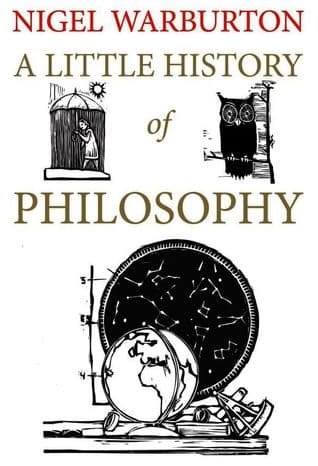
A Little History of Philosophy cover
Archivist's Choice

A Little History of Philosophy

Nigel Warburton (2011)

Genre

Biography / Reference / History / Science / Philosophy

Reading Time

250 min

Key Themes

See below

Track Your Reading

Sign in to track this book

Explore Western thought from Socrates' pursuit of truth to Peter Singer's modern ethics, as Nigel Warburton illuminates philosophy's most influential minds.

Core Idea

This book offers an accessible overview of major philosophical ideas and thinkers from ancient Greece to today. It explains complex theories, showing how philosophers addressed basic questions about reality, knowledge, ethics, and human life. Understanding these concepts provides insight into Western thought and continues to shape how we see the world and ourselves.
Reading time
250 min
Difficulty
Easy
✓ Read this if...
You want a highly accessible, engaging, and concise introduction to the major figures and ideas in Western philosophy without getting bogged down in dense academic language.
✗ Skip this if...
You are already well-versed in philosophy and are looking for a deep, critical analysis or detailed academic arguments on specific philosophical topics.

Core idea

The central argument and framework that powers the entire book.

This book offers an accessible overview of major philosophical ideas and thinkers from ancient Greece to today. It explains complex theories, showing how philosophers addressed basic questions about reality, knowledge, ethics, and human life. Understanding these concepts provides insight into Western thought and continues to shape how we see the world and ourselves.

At a glance

Reading time

250 min

Difficulty

Easy

Read this if...

You want a highly accessible, engaging, and concise introduction to the major figures and ideas in Western philosophy without getting bogged down in dense academic language.

Skip this if...

You are already well-versed in philosophy and are looking for a deep, critical analysis or detailed academic arguments on specific philosophical topics.

Key Takeaways

1

The Socratic Method: Question Everything

True wisdom begins with admitting ignorance and relentless questioning.

Quote

The unexamined life is not worth living.

Socrates, often called the father of Western philosophy, promoted a method of inquiry where one asks a series of questions to reveal contradictions or reach a deeper understanding. He believed true knowledge begins with acknowledging one's own ignorance. By constantly questioning assumptions and common beliefs, Socrates aimed to help people clarify their own ideas and understand what they imply. His method sought to encourage critical thinking and intellectual humility, urging individuals to examine their lives and values instead of s...

Supporting evidence

Socrates's trial and subsequent execution for 'corrupting the youth' and 'impiety' exemplify his unwavering commitment to his method, choosing death over abandoning his philosophical mission, as detailed in Plato's 'Apology'.

Apply this

Adopt a 'Socratic' approach to your own beliefs and those of others. When faced with a strong opinion, ask 'Why?' repeatedly. Challenge your own assumptions and seek to understand the underlying logic (or lack thereof) behind arguments. Engage in respectful but rigorous debate to clarify understanding, not just to win an argument.
socratic-methodepistemologycritical-thinkingignorance
2

Plato's Forms: Reality Beyond Perception

The true nature of reality exists in a transcendent realm of perfect, unchanging Forms.

Quote

We are like people in a cave, seeing only shadows of reality.

Plato, a student of Socrates, proposed the theory of Forms, suggesting that the physical world we experience is an imperfect copy of a higher, unchanging, and perfect realm of Forms. These Forms (like Beauty, Justice, or a perfect Circle) are the ultimate reality, existing independently of human minds and the material world. Our souls, before birth, had direct access to these Forms, and learning is essentially a process of remembering them. The famous 'Allegory of the Cave' clearly illustrates this, showing humans as prisoners mistaki...

Supporting evidence

Plato's 'Allegory of the Cave' from 'The Republic' vividly describes prisoners chained in a cave, seeing only shadows cast by objects behind them, believing these shadows to be reality, until one escapes to see the sun and true objects.

Apply this

Consider the difference between an ideal concept (like perfect justice or true love) and its imperfect manifestations in the world. When evaluating situations, ask whether you are focusing on superficial appearances or striving to understand the underlying, ideal principles. This encourages striving for ideals and recognizing the limitations of purely empirical observation.

platonismmetaphysicsallegory-of-the-caveidealism
3

Aristotle's Empiricism: Knowledge Through Observation

Understanding the world comes from careful observation and logical analysis of the natural order.

Quote

All men by nature desire to know.

In contrast to Plato's transcendent Forms, Aristotle, Plato's most famous student, based his philosophy on careful observation of the natural world. He believed that knowledge comes from sensory experience and rational analysis, not from remembering innate ideas. Aristotle developed systematic ways to categorize and understand phenomena, from biology to ethics. His emphasis on logic, cause and effect, and the concept of 'telos' (purpose) greatly influenced Western science and philosophy. He argued that to understand something, one mus...

Supporting evidence

Aristotle's extensive biological works, such as 'History of Animals' and 'Parts of Animals', showcase his detailed empirical observations and classifications of flora and fauna, demonstrating his commitment to understanding the world through direct study.

Apply this

Approach problems with an Aristotelian mindset: observe carefully, categorize systematically, and look for underlying causes and purposes. Before forming conclusions, gather data and analyze patterns. This is particularly useful in problem-solving and scientific inquiry, encouraging a data-driven, logical approach.

aristotelianismempiricismlogicteleologycausality
4

Descartes's Doubt: The Foundation of Modern Thought

Skepticism and systematic doubt lead to the undeniable certainty of one's own existence.

Quote

I think, therefore I am.

René Descartes began modern philosophy by systematically doubting everything he could—sensory perceptions, the external world, even God—in search of an undeniable truth. This radical skepticism, called methodological doubt, led him to the famous conclusion: 'Cogito, ergo sum' ('I think, therefore I am'). The very act of doubting proves the existence of a thinking self. This fundamental certainty became his starting point for rebuilding knowledge, creating a clear difference between mind (res cogitans) and body (res extensa), and great...

Supporting evidence

Descartes's 'Meditations on First Philosophy' meticulously details his process of radical doubt, including the 'evil demon' thought experiment, to arrive at the certainty of the 'cogito'.

Apply this

When confronted with complex information or a difficult decision, practice systematic doubt. Question assumptions, sources, and your own biases. Seek out the most fundamental, undeniable truths before building conclusions. This can help prevent premature judgments and foster more robust, well-founded beliefs.

descartesrationalismskepticismdualismcogito
5

Locke's Tabula Rasa: Experience Shapes Identity

At birth, the mind is a blank slate, filled only by sensory experience.

Quote

No man's knowledge here can go beyond his experience.

John Locke, an empiricist, challenged the idea of innate knowledge, arguing that the human mind at birth is a 'tabula rasa'—a blank slate. All knowledge, ideas, and even our sense of self come from sensory experience and reflecting on those experiences. This concept changed how human nature and learning were understood, stressing the role of environment and education in shaping individuals. Locke also developed influential theories of government based on natural rights and the consent of the governed, stating that individuals have inh...

Supporting evidence

Locke's 'An Essay Concerning Human Understanding' is dedicated to demonstrating how all complex ideas are ultimately derived from simple ideas gained through sensation and reflection, refuting innate ideas.

Apply this

Recognize the profound impact of experience and environment on personal development and learning. Foster diverse experiences for yourself and others. When trying to understand someone's perspective, consider the experiences that have shaped their 'blank slate'. In education, focus on providing rich, varied experiences rather than assuming pre-existing knowledge.

john-lockeempiricismtabula-rasaepistemologynatural-rights
6

Hume's Skepticism: Causality and Induction are Habits

Our belief in cause and effect, and thus much of our knowledge, is based on habit, not logical necessity.

Quote

Reason is, and ought only to be, the slave of the passions.

David Hume pushed empiricism to its skeptical limits, arguing that we cannot logically prove cause and effect. We only observe events happening together (e.g., A always follows B), and our expectation that this will continue is a psychological habit formed by experience, not a logical necessity. This radical skepticism undermined the basis of scientific inference and induction. Hume also questioned the existence of a continuous 'self' or a substance behind our perceptions. His work showed the limits of human reason and the widespread ...

Supporting evidence

In 'A Treatise of Human Nature' and 'An Enquiry Concerning Human Understanding', Hume meticulously dissects the concept of causality, arguing that we never observe a necessary connection, only constant conjunction.

Apply this

Cultivate a healthy skepticism towards assumed causal links. Before concluding that A causes B, consider alternative explanations or the possibility of mere correlation. Be aware that many of our 'rational' beliefs are deeply rooted in habit and psychological expectation. This encourages more rigorous scientific and personal reasoning.

david-humeskepticismcausalityinductionempiricism
7

Kant's Synthesis: Mind Structures Reality

Our minds actively shape our experience of reality, rather than passively receiving it.

Quote

Thoughts without content are empty, intuitions without concepts are blind.

Immanuel Kant responded to Hume's skepticism by proposing a revolutionary idea: all knowledge begins with experience (empiricism), but the mind itself actively organizes that experience (rationalism). He argued that our minds have innate categories of understanding (like causality, space, and time) that arrange raw sensory data into a coherent, knowable world. We do not perceive 'things-in-themselves' (noumena), but rather 'phenomena'—reality as it appears to us, shaped by our cognitive abilities. This 'Copernican Revolution' in philo...

Supporting evidence

Kant's 'Critique of Pure Reason' systematically lays out his transcendental idealism, explaining how categories of understanding and forms of intuition (space and time) are necessary preconditions for experience and knowledge.

Apply this

Recognize that your perception of reality is not a direct, unfiltered stream but is shaped by your inherent cognitive structures and learned frameworks. This can foster intellectual humility and an appreciation for differing perspectives, as others may organize their experiences differently. When evaluating information, consider how your mind is actively constructing its meaning.

immanuel-kanttranscendental-idealismcategories-of-understandingphenomena-noumenarationalism-empiricism
8

Nietzsche's Will to Power: Rethinking Values

Human action is driven by a fundamental will to power, prompting a revaluation of all traditional values.

Quote

God is dead. God remains dead. And we have killed him.

Friedrich Nietzsche famously declared 'God is dead,' meaning the collapse of traditional religious and moral structures in Western society. He argued that beneath rationality and morality lies a fundamental 'will to power'—a drive for growth, overcoming, and self-mastery, not just self-preservation. Nietzsche criticized 'slave morality' (e.g., Christian ethics of humility and pity) as a resentment-driven reversal of life-affirming 'master morality.' He called for a 'revaluation of all values,' urging individuals to create their own me...

Supporting evidence

Nietzsche's 'Thus Spoke Zarathustra' introduces the concept of the Übermensch and the 'will to power', while 'On the Genealogy of Morality' meticulously traces the origins of moral concepts to 'master' and 'slave' mentalities.

Apply this

Examine the origins of your own moral values and question whether they truly serve life and growth or are remnants of outdated systems. Identify areas where you can exercise your 'will to power' by overcoming challenges and creating your own meaning. This encourages personal responsibility for value creation and a critical stance towards inherited moral codes.

nietzschewill-to-powernihilismübermenschmaster-slave-morality
9

Existentialism: Freedom, Responsibility, Anguish

We are condemned to be free, meaning we are solely responsible for creating our own meaning in an absurd world.

Quote

Existence precedes essence.

Existentialism, particularly through figures like Jean-Paul Sartre, holds that 'existence precedes essence.' Unlike objects designed for a purpose, humans are born without inherent meaning or a predetermined nature (essence). We are 'condemned to be free,' meaning we must create our own essence through our choices and actions. This radical freedom brings great responsibility and often leads to 'anguish,' 'forlornness,' and 'despair'—the realization that we are solely accountable for our lives in a universe without inherent meaning. De...

Supporting evidence

Sartre's lecture 'Existentialism Is a Humanism' directly articulates the core tenets of existentialism, emphasizing freedom, responsibility, and the creation of meaning through choice.

Apply this

Embrace your radical freedom and take full responsibility for your choices and their consequences. Recognize that you are the author of your own meaning and purpose; don't wait for it to be given to you. Confront moments of 'existential anguish' by making conscious, authentic choices that align with your deepest values, rather than succumbing to 'bad faith' by blaming external circumstances.

existentialismsartrefreedommeaning-of-lifeauthenticitybad-faith
10

Utilitarianism: The Greatest Good for the Greatest Number

Moral actions are those that maximize overall happiness and minimize suffering.

Quote

The greatest happiness of the greatest number is the foundation of morals and legislation.

Utilitarianism, supported by Jeremy Bentham and John Stuart Mill, is an ethical theory that judges an action's morality based on its outcome. The main principle is to achieve 'the greatest good for the greatest number,' meaning actions are right if they promote happiness and wrong if they cause unhappiness. This theory requires calculating the potential results of actions and choosing the one that yields the highest overall benefit (utility) for everyone affected. While seemingly simple, utilitarianism faces challenges in defining hap...

Supporting evidence

Bentham's 'An Introduction to the Principles of Morals and Legislation' explicitly lays out the 'principle of utility' and proposes a 'felicific calculus' to quantify pleasure and pain.

Apply this

When facing an ethical dilemma, consider the potential impact of your choices on all stakeholders. Try to quantify or qualitatively assess the happiness and suffering your actions might cause. This encourages a broad, impartial perspective and a focus on outcomes, particularly useful in policy-making and group decisions, though always consider potential ethical pitfalls like sacrificing minority interests.

utilitarianismconsequentialismethicsjeremy-benthamjohn-stuart-millhappiness

Critical analysis

Notable Quotes

Philosophy isn't just about abstract ideas; it's about how we should live.

Introduction to the book's purpose.

The unexamined life is not worth living.

Attributed to Socrates, discussing his trial and commitment to philosophical inquiry.

All we know is that we know nothing.

A Socratic paradox, emphasizing the limits of human knowledge.

Plato thought that there was a perfect version of everything, what he called a Form, existing in a realm beyond our senses.

Explaining Plato's Theory of Forms.

Man is by nature a political animal.

Attributed to Aristotle, discussing the inherent social nature of humans.

Cogito, ergo sum (I think, therefore I am).

Descartes' foundational statement in his quest for certain knowledge.

Experience is the source of all our knowledge.

Summarizing the empiricist viewpoint, particularly associated with Locke and Hume.

Is life just 'nasty, brutish, and short'?

Referring to Thomas Hobbes' description of life in a state of nature without government.

The greatest good for the greatest number.

Introducing the core principle of utilitarianism, often associated with Bentham and Mill.

Act only according to that maxim whereby you can at the same time will that it should become a universal law.

Kant's formulation of the Categorical Imperative.

God is dead. God remains dead. And we have killed him.

Nietzsche's declaration regarding the decline of traditional religious belief and its implications.

We are condemned to be free.

Sartre's concept of radical freedom and responsibility in existentialism.

The limits of my language mean the limits of my world.

Wittgenstein's insight on the relationship between language and reality.

What is it like to be a bat?

Thomas Nagel's famous thought experiment exploring the limits of objective knowledge and subjective experience.

Philosophy is not a theory but an activity.

A quote reflecting the practical and ongoing nature of philosophical inquiry, often associated with Wittgenstein.

Quiz

Test Your Knowledge

Ready to see how well you understood this book? Take our interactive quiz with 10 questions.

10
Questions
~5
Minutes
?
Best Score

Key Questions (FAQ)

This book offers a chronological tour through Western philosophy, introducing major thinkers from Socrates to Peter Singer and exploring their most compelling ideas about reality and how to live. It makes complex philosophical concepts accessible through engaging narratives and biographical details.

About the author