BookBrief
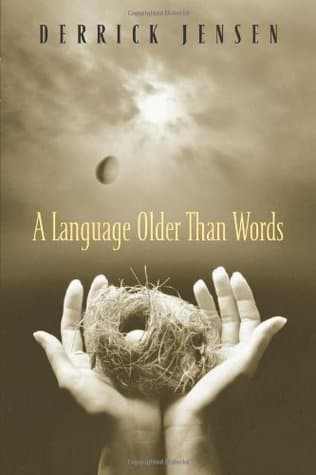
A Language Older Than Words cover
Archivist's Choice

A Language Older Than Words

Derrick Jensen (2000)

Genre

Biography / Memoir / History / Spirituality / Philosophy

Reading Time

10-14 hours (approx. 418 pages at ~40 pages/hour)

Key Themes

See below

Track Your Reading

Sign in to track this book

Jensen's memoir explores the ancient roots of violence, from childhood abuse to societal structures, urging us to find a language of connection older than our destructive habits.

Core Idea

Derrick Jensen's "A Language Older Than Words" suggests that widespread violence, both among people and against nature, comes from a basic separation from the living world and an internalized oppression that mirrors civilization's destructive patterns. Through personal stories, history, and philosophy, Jensen argues that this separation means we cannot see or respond to the suffering we cause, leading to self-hatred and a culture built on exploitation. The book calls for a fundamental change in awareness, asking readers to reclaim their inherent wildness and reconnect with the ancient, wordless language of the natural world. This path leads to true connection, healing, and a necessary, active love that goes beyond typical ideas of hope and despair.
Reading time
10-14 hours (approx. 418 pages at ~40 pages/hour)
Difficulty
Hard
✓ Read this if...
You are grappling with the systemic roots of violence, feel a deep concern for the environment, and are open to an intense, challenging exploration of personal and societal disconnection, and the nature of oppression.
✗ Skip this if...
You prefer light reading, are uncomfortable with confrontational prose, or are seeking a purely academic or optimistic self-help guide without deep dives into trauma, history, and the darker aspects of civilization.

Core idea

The central argument and framework that powers the entire book.

Derrick Jensen's "A Language Older Than Words" suggests that widespread violence, both among people and against nature, comes from a basic separation from the living world and an internalized oppression that mirrors civilization's destructive patterns. Through personal stories, history, and philosophy, Jensen argues that this separation means we cannot see or respond to the suffering we cause, leading to self-hatred and a culture built on exploitation. The book calls for a fundamental change in awareness, asking readers to reclaim their inherent wildness and reconnect with the ancient, wordless language of the natural world. This path leads to true connection, healing, and a necessary, active love that goes beyond typical ideas of hope and despair.

At a glance

Reading time

10-14 hours (approx. 418 pages at ~40 pages/hour)

Difficulty

Hard

Read this if...

You are grappling with the systemic roots of violence, feel a deep concern for the environment, and are open to an intense, challenging exploration of personal and societal disconnection, and the nature of oppression.

Skip this if...

You prefer light reading, are uncomfortable with confrontational prose, or are seeking a purely academic or optimistic self-help guide without deep dives into trauma, history, and the darker aspects of civilization.

Key Takeaways

1

The Root of Violence: Disconnection

Violence stems from a profound severance from the natural world and our authentic selves.

Quote

The problem is not simply that we forget who we are, but that we are never taught. We are taught to be disconnected.

Jensen argues that violence, both personal and systemic, is not an inherent human trait but a result of our deep separation from the living world and our true, intuitive selves. He believes that modern society actively encourages this separation, teaching us to value abstract ideas, industrial systems, and intellectualizing over direct experience, emotional understanding, and ecological connection. This separation creates a spiritual emptiness that makes us prone to exploiting others and the environment, as we no longer see their intr...

Supporting evidence

Jensen frequently references indigenous cultures' deep reverence for nature and community as a stark contrast to Western industrialized societies, where the exploitation of resources and people is normalized. He points to the systematic destruction of ecosystems and the prevalence of domestic abuse as symptoms of this underlying disconnection.

Apply this

Cultivate daily practices that foster reconnection with nature (e.g., walking barefoot, observing local wildlife, gardening). Prioritize direct experience and sensory input over screen time and abstract thought. Engage in practices that help you feel your emotions fully, rather than intellectualizing or suppressing them.


ecological-disconnectionsystemic-violencespiritual-alienation
2

The Language of the Living World

Beyond human words, the natural world communicates through a profound, embodied language we've forgotten.

Quote

There is a language older than words, and it is the language of the living world. It is the language of feeling, of instinct, of being.

Jensen introduces the idea of a 'language older than words' – an intuitive, non-verbal communication system common to all living beings. This language is about direct knowing, empathy, instinct, and the felt experience of being connected. He suggests that humans, especially in modern Western cultures, have suppressed this innate ability, favoring verbal language and rational thought. To relearn this older language means tuning into our senses, our bodies, and subtle environmental cues, allowing us to see the world not as objects but a...

Supporting evidence

Jensen's personal anecdotes often describe moments of profound connection with animals or landscapes where he feels a direct, non-verbal understanding. He also draws parallels to indigenous knowledge systems that emphasize listening to the land and its creatures.

Apply this

Spend time in nature without distraction, focusing on sensory input: the sounds, smells, textures. Practice mindfulness and meditation to quiet the rational mind and open to intuitive perception. Pay attention to your gut feelings and bodily sensations as sources of information.

non-verbal-communicationecological-intelligenceintuitive-knowing
3

Internalized Oppression and Self-Hatred

The violence we experience often becomes internalized, leading to self-destructive patterns and complicity.

Quote

The structure of our society is such that it forces us to internalize our own oppression, to hate ourselves for not being able to conform to its demands.

Jensen connects the experience of domestic abuse to broader societal violence and oppression. He argues that those who suffer abuse often internalize the abuser's logic, leading to self-blame, self-hatred, and a reduced sense of worth. This internalized oppression can appear as a belief that one deserves the abuse or is flawed. On a societal level, this translates into going along with destructive systems: we internalize the idea that endless growth is good, that nature is a resource to be exploited, and that violence is sometimes nec...

Supporting evidence

Jensen's own memoir details his struggle with internalized shame and self-hatred following childhood abuse, and how this made him initially complicit in destructive behaviors and thought patterns. He extends this to how society internalizes the 'right' of corporations to destroy forests or pollute rivers.

Apply this

Identify and challenge internalized narratives of self-blame or inadequacy. Seek therapy or support groups to process past trauma. Critically examine societal narratives that normalize exploitation or violence, and actively resist internalizing them.

internalized-traumaself-blamesocietal-complicity
4

The Personal is Planetary

Individual trauma and global ecological destruction are deeply intertwined, mirroring each other.

Quote

The same pathology that allows a man to beat his wife is what allows us to destroy the planet.

A main idea in Jensen's work is the link between personal violence and planetary destruction. He states that the mindset allowing a person to abuse another—seeing them as an object, denying their feelings, asserting dominance—is the same mindset allowing industrial society to exploit the natural world. Both situations involve a lack of empathy, a disregard for the other's inherent value, and a belief in the right to control and consume. The book argues that addressing one without addressing the other is pointless; true healing require...

Supporting evidence

Jensen draws direct parallels between the psychological mechanisms of an abuser (dehumanization, control, denial) and the actions of corporations or governments destroying ecosystems (viewing nature as a 'resource,' externalizing costs, denying consequences). His personal story of abuse is a microcosm of global exploitation.

Apply this

Approach environmental activism with an understanding of its psychological and emotional dimensions. Recognize how personal healing can inform and strengthen your commitment to ecological justice. See the fight for personal autonomy and planetary health as one unified struggle.

ecopsychologyinterconnectednesstrauma-and-ecology
5

The Sickness of Civilization

Modern industrial civilization itself is a pathological system that perpetuates violence and disconnection.

Quote

This culture, this civilization, is not merely flawed; it is insane. It is designed to destroy.

Jensen does not just critique individual acts of violence but calls modern industrial civilization pathological. He argues that this civilization is built on ideas of separation, progress, and human exceptionalism that lead to exploitation and destruction. Its institutions—economic, political, and social—are designed to extract, control, and dominate, both people and nature. This system discourages empathy, promotes consumption, and punishes those who resist its destructive path. He states that to truly address violence, we must confr...

Supporting evidence

Jensen points to the relentless expansion of industrial capitalism, the historical colonization of lands and peoples, and the ongoing ecological collapse as evidence of civilization's destructive core. He contrasts this with pre-civilized or indigenous societies that lived in relative harmony with their environments.

Apply this

Question the fundamental assumptions of progress and growth in modern society. Engage in forms of resistance that challenge systemic structures, not just individual behaviors. Support and learn from alternative, more sustainable ways of living outside the dominant paradigm.

civilizational-critiqueindustrial-pathologysystemic-destruction
6

The Power of Bearing Witness

To truly see and acknowledge suffering is the first, crucial step towards healing and resistance.

Quote

To bear witness is to make a commitment. It is to say, 'I see you, and your suffering is real, and I will not look away.'

Jensen stresses the importance of bearing witness—not just observing, but truly seeing, feeling, and acknowledging the pain and destruction around us, both personal and planetary. He argues that much societal violence relies on denial; if we refuse to see, we cannot act. Bearing witness is an act of courage and empathy that breaks through numbness and allows for genuine connection and responsibility. It means allowing ourselves to feel the grief, rage, and despair that come from facing harsh realities, rather than turning away or inte...

Supporting evidence

Jensen's memoir is a testament to bearing witness to his own past trauma and the ongoing destruction of the natural world. He describes the emotional toll and transformative power of allowing himself to feel the pain rather than suppress it.

Apply this

Consciously practice acknowledging difficult truths, both personal and global, without immediately seeking solutions or distractions. Allow yourself to feel emotions like grief or anger in response to suffering. Engage in direct observation of damaged ecosystems or communities to foster empathy.

empathyacknowledgmentecological-grief
7

Beyond Hope and Despair

True action stems not from naive hope or paralyzing despair, but from love and fierce commitment.

Quote

Hope is a crutch. It makes us wait for someone else to save us. Despair paralyzes. What we need is love, and courage.

Jensen critiques traditional ideas of hope and despair, arguing that both can stop us from acting. Naive hope can lead to passivity, waiting for an external savior or a miracle. Despair, conversely, can lead to paralysis and a feeling of futility. He suggests moving beyond this, advocating instead for action rooted in a deep love for the living world and a strong commitment to defending it. This commitment comes from a clear assessment of the situation, an acceptance of grief, and a determination to act regardless of the chances of 's...

Supporting evidence

Jensen's writing often challenges environmentalists to move beyond feel-good narratives and confront the severity of ecological collapse. He advocates for direct action and resistance, even when the odds seem insurmountable, drawing strength from a deep connection to what is being defended.

Apply this

Identify what you genuinely love and are committed to protecting, rather than focusing solely on 'solving' problems. Engage in actions that align with your values, even if they feel small or don't promise immediate victory. Cultivate resilience by accepting uncertainty and focusing on the process of engagement.

active-engagementfierce-loveecological-resistance
8

Reclaiming Our Wildness

Healing involves reconnecting with our intrinsic, untamed, and intuitive nature.

Quote

We are not meant to be domesticated. We are meant to be wild, to be free, to be part of the living world.

Jensen argues that modern civilization has 'domesticated' humans, separating us from our wildness, instincts, and deep connection to the Earth. This domestication makes us compliant, controllable, and numb to the destruction around us. Reclaiming our wildness means shedding the societal conditioning that has made us afraid of our emotions, our bodies, and our intuitive knowledge. It involves embracing our innate capacity for fierce love, protective rage, and untamed creativity. This process is not about returning to a primitive state,...

Supporting evidence

Jensen's personal journey of healing from abuse involves reconnecting with his own primal responses and instincts, often through direct engagement with nature. He contrasts this with the societal pressure to be 'civilized' and suppress strong emotions.

Apply this

Engage in activities that allow for spontaneous, non-structured movement and expression. Spend time in genuinely wild places. Challenge societal norms that shame or suppress natural emotions. Trust your intuition and gut feelings more often.

wildnessinstinctual-selfde-domestication
9

The Necessity of Actionable Love

Love for the world requires defending it, even through confrontational and disruptive means.

Quote

Love is not a passive emotion. It is a verb. It demands action. And sometimes, that action is resistance.

For Jensen, love is not a sentimental or passive feeling, but a powerful force that demands action. If we truly love something—our children, our community, a forest, a river—we will defend it when it is threatened. This 'actionable love' often requires moving beyond polite discussion or typical activism and engaging in more direct, even confrontational, forms of resistance. He suggests that those who truly love the Earth cannot stand by while it is systematically destroyed. This might involve civil disobedience, direct intervention, o...

Supporting evidence

Jensen frequently discusses the need for militant defense of the Earth, drawing parallels to how one would defend a loved one from an attacker. He critiques the effectiveness of purely symbolic or legalistic forms of environmentalism that fail to halt destruction.

Apply this

Identify what you are willing to actively defend. Research and consider participating in forms of direct action or civil disobedience that align with your values. Support organizations that engage in confrontational resistance against ecological destruction. Understand that love sometimes requires disruption.

ecological-defensedirect-actionradical-love

Critical analysis

Notable Quotes

The problem is not that we are using the wrong means to achieve the right ends. The problem is that we are using the wrong ends.

Reflecting on societal approaches to environmental and social problems.

Love does not require you to give up your boundaries. Love requires you to know them.

Discussing healthy relationships and the nature of love, often in the context of abuse.

If we are going to make a garden, we must take the side of the soil, not the side of the weed.

Metaphorically arguing for active defense of the natural world against destructive forces.

Civilization, in short, is not a thing, but a process: the process of making people safe from the natural world.

Defining civilization in terms of its relationship to nature and its inherent violence.

The primary cause of violence is the belief that violence is a legitimate response to suffering.

Examining the roots of violence, both personal and systemic.

If you don't know the names of the plants and animals, you don't know the place. And if you don't know the place, you can't love it. And if you don't love it, you won't save it.

Emphasizing the importance of intimate knowledge and connection to one's local environment.

The greatest gift we can give to the future is to live as if it matters.

A call to action and responsibility for future generations and the planet.

One of the primary functions of privilege is to allow us to be oblivious to the suffering of others.

Analyzing the role of privilege in perpetuating injustice and lack of empathy.

The truth is not a thing to be found, but a thing to be made.

Discussing the subjective and constructed nature of truth, especially in personal narratives.

We are all born into a world that is already broken. Our task is not to fix it, but to mend it.

Distinguishing between 'fixing' (often implying control) and 'mending' (implying care and restoration).

What happens to the land happens to the people.

Highlighting the deep interconnectedness between human well-being and ecological health.

Despair is not an option; it is a choice. And it is a choice that leads to inaction.

Challenging the idea of passive despair and advocating for active engagement.

The ability to speak does not mean that you have something to say. It means that you can make sounds.

Critiquing superficial communication and emphasizing the importance of substance.

The first step toward freedom is to recognize that you are not free.

Discussing the process of awakening to systemic oppression and personal constraint.

To be truly alive is to feel everything, even the pain, even the sorrow, even the rage.

Advocating for full emotional presence and acceptance, rather than numbing oneself.

Quiz

Test Your Knowledge

Ready to see how well you understood this book? Take our interactive quiz with 10 questions.

10
Questions
~5
Minutes
?
Best Score

Key Questions (FAQ)

Derrick Jensen's 'A Language Older Than Words' is a powerful memoir that intertwines his personal experiences with domestic abuse with a broader philosophical exploration of violence in society and its impact on the natural world. It delves into the roots of violence and offers insights into fostering healthier communities.

About the author

Derrick Jensen

Derrick Jensen is an American author and environmental, social, and political activist. He is best known for his books "A Language Older Than Words" and "The Culture of Make Believe," which explore themes of environmental destruction and societal control. Jensen's work is characterized by its critical examination of modern civilization and its impact on the natural world.