BookBrief
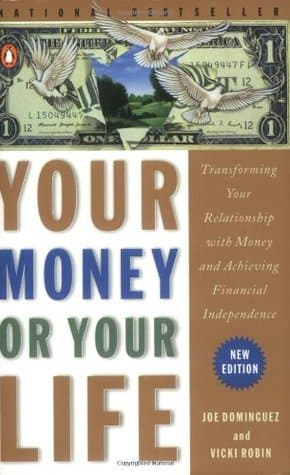
Your Money or Your Life cover
Archivist's Choice

Your Money or Your Life

Vicki Robin (1992)

Genre

Business / Psychology / Economics / Finance / Self-Help

Reading Time

10-12 hours

Key Themes

See below

Track Your Reading

Sign in to track this book

This guide helps you redefine your relationship with money, escape the rat race, and align your finances with your values for a life of purpose.

Core Idea

This book offers a nine-step program to change how you relate to money. It helps you move from just earning a living to designing a life of financial independence and personal satisfaction. It questions the idea that more money always means more happiness. Instead, it suggests that true wealth is measured in life energy—your time and vital force. By understanding how much of your life energy you trade for money, and then aligning your spending with your values, you can reach a 'crossover point.' This is when your passive income covers your monthly expenses, freeing you to pursue your purpose beyond a paycheck. The goal is not just financial freedom, but a life of integrity, meaning, and conscious consumption, where money helps you, rather than controls you.
Reading time
10-12 hours
Difficulty
Medium
✓ Read this if...
You feel trapped by the cycle of earning and spending, are curious about financial independence, or want a practical framework to align your money with your life values.
✗ Skip this if...
You are looking for quick wealth schemes, highly advanced investment strategies, or a book that avoids personal introspection and lifestyle changes.

Core idea

The central argument and framework that powers the entire book.

This book offers a nine-step program to change how you relate to money. It helps you move from just earning a living to designing a life of financial independence and personal satisfaction. It questions the idea that more money always means more happiness. Instead, it suggests that true wealth is measured in life energy—your time and vital force. By understanding how much of your life energy you trade for money, and then aligning your spending with your values, you can reach a 'crossover point.' This is when your passive income covers your monthly expenses, freeing you to pursue your purpose beyond a paycheck. The goal is not just financial freedom, but a life of integrity, meaning, and conscious consumption, where money helps you, rather than controls you.

At a glance

Reading time

10-12 hours

Difficulty

Medium

Read this if...

You feel trapped by the cycle of earning and spending, are curious about financial independence, or want a practical framework to align your money with your life values.

Skip this if...

You are looking for quick wealth schemes, highly advanced investment strategies, or a book that avoids personal introspection and lifestyle changes.

Key Takeaways

1

The Life Energy Equation

Your job isn't just a paycheck; it's a direct exchange of your finite life energy.

Quote

Our life energy is our time, our energy, our very life. It is finite. And it is our most precious resource.

The main idea of 'Your Money or Your Life' is that money is not an end in itself. Instead, it is stored 'life energy' – the time and effort you spend to earn it. The book asks readers to rethink work and earnings, looking beyond hourly wages to the real cost of their income. This includes not only work hours, but also time and money spent commuting, relaxing after work, and buying work-related items. By tracking all these hidden costs, people can figure out their 'real wage' and understand how much of their limited life energy goes in...

Supporting evidence

The book introduces a detailed accounting method where individuals calculate their true hourly wage by dividing their take-home pay by the actual hours worked, then subtracting all work-related expenses (commute, work clothes, de-stressing activities). This often reveals a significantly lower effective hourly wage than perceived.

Apply this

Track all income and work-related expenses (including time and money spent commuting, unwinding from work, and buying work-specific items) for at least three months. Calculate your 'real hourly wage' to understand the true cost of your money in terms of life energy. This will likely reveal surprising inefficiencies.

life-energyreal-wagefinancial-freedom
2

The Fulfillment Curve Paradox

Beyond a certain point, more spending doesn't increase happiness, it often decreases it.

Quote

There is a point beyond which money cannot buy you more satisfaction. In fact, it can begin to buy you less satisfaction.

The Fulfillment Curve shows that while spending on basic needs brings much satisfaction, there is a point where more spending no longer increases happiness. Instead, too much consumption, often from social pressure or a desire to fill an inner lack, can lead to clutter, stress, environmental guilt, and feeling trapped by possessions. This 'point of enough' is different for everyone, but it generally means when material things stop adding to well-being and start taking away from it. The book challenges the consumer idea that more is al...

Supporting evidence

The book presents a visual 'Fulfillment Curve' graph. It starts with low satisfaction at low spending (survival), rises steeply through comfort, plateaus at 'enough' (where needs are met), and then declines into 'clutter' or 'dissatisfaction' as spending increases beyond the point of true need or enjoyment.

Apply this

Draw your own Fulfillment Curve. Reflect on your past purchases and identify the point where spending genuinely increased your satisfaction versus when it started to create stress, clutter, or debt. Use this insight to inform future spending decisions, prioritizing experiences and genuine needs over superfluous acquisitions.

fulfillment-curveenoughmindful-consumption
3

Track Every Penny: The Monthly Statement

Conscious awareness of your money flow is the first step to gaining control.

Quote

Until you know exactly how much money is coming in and exactly how much is going out, you are flying blind.

A key part of the 'Your Money or Your Life' method is carefully tracking every penny earned and spent. This is not about strict budgeting, but about becoming fully aware. By creating a 'Monthly Statement' that lists all income and expenses, people clearly see where their life energy goes. This process often uncovers hidden spending, waste, and unconscious habits that drain money without giving much value. The authors say that this detailed tracking, far from being boring, empowers people to match their spending with their values and m...

Supporting evidence

The book instructs readers to create a 'Monthly Statement' by listing all income sources and every single expense, categorized (e.g., housing, food, transportation, entertainment). This is then used to calculate the 'real hourly wage' and identify discrepancies between values and spending.

Apply this

For at least three months, track every dollar earned and spent. Categorize each expense. Review your monthly statement and ask yourself: 'Did this expense bring me true fulfillment? Was it aligned with my values?' This exercise provides a clear snapshot of your financial reality.

financial-trackingbudgetingfinancial-awareness
4

Reframe Your Debt: A Negative Investment

Debt is not just a burden; it's a negative return on your life energy.

Quote

Debt is future consumption paid for with past life energy, plus interest, which is more future life energy.

The book offers a strong and often overlooked view on debt: it is not just a financial duty, but a claim on your future life energy. Every dollar of debt, especially high-interest consumer debt, means you will have to spend life energy later, often at a rate much higher than the original value received. This view highlights how damaging debt can be, as it forces people to keep working and giving up their time long after the first purchase has lost its appeal. The authors suggest paying down debt quickly, seeing it as freeing up future...

Supporting evidence

The authors encourage readers to calculate the true cost of their debt, including all interest payments, and then convert that total into 'life energy' hours. This stark calculation reveals how much future work is required to service past consumption.

Apply this

List all your debts, their interest rates, and calculate the total interest you will pay over the life of each loan. Then, convert that total interest into 'life energy' hours using your real hourly wage. This vivid visualization will motivate aggressive debt repayment, starting with the highest interest rates.

debt-freedomlife-energy-debtfinancial-liberation
5

The Crossover Point: Financial Independence Achieved

When passive income surpasses expenses, you gain true freedom.

Quote

The Crossover Point is when your monthly income from your capital (investments) equals your monthly expenses.

The Crossover Point is the main goal of the 'Your Money or Your Life' program: when your monthly passive income from investments is more than your monthly expenses. This marks true financial independence, as you no longer need active work to cover your basic needs. The book explains how to track your accumulated capital (savings and investments) and how much income it can generate, while also lowering expenses to reach this point faster. It is not about becoming a millionaire, but about having enough invested money to create enough in...

Supporting evidence

The book provides a clear tracking system for monthly expenses and monthly investment income. The 'Crossover Point' is graphically represented as the intersection where the rising line of investment income crosses the declining line of expenses, signifying financial independence.

Apply this

Continuously track your total monthly expenses and your passive income (from investments, dividends, etc.). Work towards increasing the latter and decreasing the former. Chart these two lines on a graph to visually track your progress towards the Crossover Point, which signals financial independence.

financial-independencepassive-incomecrossover-point
6

Value Your Life Energy: The Power of 'Is It Worth It?'

Every purchase is a trade-off of your precious life energy; make it count.

Quote

Is this purchase worth the hours of my life energy it took to earn the money for it?

The book encourages a deep change in how we see purchases by always asking: 'Is this worth the life energy I gave for it?' This question makes you directly face the real cost of consumer goods, looking beyond the price to the hours of your life that were given up. This view naturally leads to more thoughtful spending, less impulse buying, and a greater appreciation for truly valuable items and experiences. It is about matching what you buy with your personal values and getting the most from your life energy, instead of just buying thi...

Supporting evidence

The core of the book's 'Nine Steps' involves converting every expense into 'life energy hours' and then consciously evaluating if that exchange was worth it. This is not just a one-time exercise but a continuous practice.

Apply this

Before every significant purchase, calculate the 'life energy hours' it will cost you (using your real hourly wage). Then, pause and genuinely ask yourself: 'Is this item or experience truly worth X hours of my finite life?' Practice this consistently.

conscious-spendingvalue-alignmentlife-energy-exchange
7

The Power of Frugality & DIY

Reducing consumption isn't deprivation; it's reclaiming your life energy and creativity.

Quote

Frugality is not about deprivation. It is about maximizing the return on your life energy.

Far from being about sacrifice, the book sees saving as a way to gain power and be resourceful. By choosing to buy less, fix items, and do things yourself, people not only save money but also learn new skills, lessen their environmental impact, and get back time and creativity. This idea challenges the consumer message that happiness comes from buying new things. Instead, it suggests that deeper satisfaction can be found in being self-sufficient, connecting with others, and making the most of what you have. It frees up life energy tha...

Supporting evidence

The book provides numerous examples of how embracing frugality (e.g., repairing clothes, cooking at home, growing food, using public transport) directly reduces expenses, thus lowering the amount of life energy needed to cover costs, and often leads to increased self-reliance and skill development.

Apply this

Identify three areas in your life where you can embrace frugality or a DIY approach this month (e.g., cooking more meals at home, repairing a broken item, finding free entertainment). Track the money and life energy saved, and notice any unexpected benefits like increased skills or satisfaction.

frugalitydiy-cultureconscious-living
8

Your Purpose Beyond the Paycheck

Financial independence reveals what you truly want to do with your one wild and precious life.

Quote

When you no longer have to work for money, you discover what you would do with your time if money were no object.

One of the deepest lessons is that financial independence is not just about getting rich; it is about getting the freedom to follow your true purpose. By removing the financial need to work, people face the question of what they would do if money were not a main concern. This often leads to rethinking career paths, getting more involved in hobbies, volunteering, or creative activities that were previously put aside. The book says that this search for purpose is the ultimate reward of the 'Your Money or Your Life' journey, turning fina...

Supporting evidence

The book outlines the 'Nine Steps' which culminate in identifying and acting on one's purpose after achieving financial independence. It shares anecdotes of individuals who, after reaching the Crossover Point, transitioned into entirely new, passion-driven endeavors.

Apply this

Begin journaling about what truly excites you, what problems you'd like to solve, or what skills you'd love to develop if you didn't need to work for money. Even before reaching financial independence, start dedicating small amounts of 'life energy' to these passions to test them out.

purpose-driven-lifepost-fi-lifeself-discovery
9

Invest in Low-Cost, Long-Term Index Funds

Grow your capital passively and efficiently to secure your financial future.

Quote

The simplest and most effective way to grow your capital is through low-cost, broad-market index funds.

While 'Your Money or Your Life' mostly focuses on the mental and behavioral parts of money, it also gives practical advice on how to grow your savings. The authors strongly suggest investing in low-cost, diversified, broad-market index funds. This approach keeps fees low, reduces the need for constant management, and uses the power of compound interest over time. This aligns with the book's idea of simplicity and efficiency, letting your accumulated life energy (invested money) work for you without needing constant attention or specia...

Supporting evidence

The book dedicates a section to investment strategies, specifically recommending index funds due to their historically strong returns, low fees, and diversification, citing examples of how they outperform most actively managed funds over the long run.

Apply this

If you haven't already, open a brokerage account and begin investing a portion of your savings into a low-cost, diversified total market index fund or ETF. Set up automated contributions to ensure consistent investment over time.

index-fundspassive-investingcompound-interest
10

The Nine Steps: A Transformative Journey

Financial independence is a systematic process, not an overnight event.

Quote

This program is not a quick fix. It is a systematic process that transforms your relationship with money.

The book has 'Nine Steps' that guide readers through a full journey toward financial independence. These steps build on each other, starting with full awareness (tracking income/expenses), moving through rethinking (calculating real wages, understanding the fulfillment curve), and ending with reaching the crossover point and living a purposeful life. Each step adds to the last, creating a complete way to understand and manage one's financial life. It stresses that this is a process needing dedication and steady effort, not a one-time ...

Supporting evidence

The entire book is organized around these 'Nine Steps,' with each chapter dedicated to explaining and guiding the reader through one of them, providing exercises and examples for practical application.

Apply this

Commit to working through the 'Nine Steps' outlined in the book sequentially. Don't skip steps, as each builds foundational understanding for the next. Treat it as a structured program for financial and personal transformation.

nine-stepsfinancial-transformationsystematic-change

Critical analysis

Notable Quotes

Your life energy is finite and precious. How you use it is how you use your life.

Introducing the concept of 'life energy' as a key metric beyond monetary value.

Money is something we choose to trade our life energy for.

Defining money as a direct exchange for our limited life force.

Fulfillment is knowing you are enough, you have enough.

Contrasting the pursuit of more with the internal state of contentment.

The amount of stuff you have is inversely proportional to the amount of freedom you have.

Arguing that excessive possessions can lead to less freedom due to maintenance and desire for more.

Our culture's definition of success often comes with a hefty price tag in terms of life energy.

Critiquing societal norms around success and their hidden costs.

Financial independence is the experience of having your relationship with money be one of conscious choice.

Redefining financial independence beyond just having a large sum of money.

The first step to financial integrity is knowing how much money comes into your life and how much goes out.

Emphasizing the importance of tracking income and expenses.

Money is a tool, not an end in itself.

A foundational principle reminding readers of money's true purpose.

The amount of life energy you spend on your job is more important than your hourly wage.

Encouraging a holistic view of work beyond just monetary compensation.

Waste is just stuff in the wrong place.

A simple yet profound statement about consumption and environmental impact.

When you value your life energy, you automatically begin to value the natural resources that sustain all life.

Connecting personal financial transformation to broader ecological awareness.

Your fulfillment curve peaks and then declines as you accumulate more stuff.

Illustrating the diminishing returns of material possessions on happiness.

The whole point of money is to have enough to live the life you want, not to accumulate it for its own sake.

Challenging the conventional goal of endless accumulation.

Frugality is not about deprivation; it's about maximizing life energy.

Redefining frugality as a positive strategy for life enhancement.

Quiz

Test Your Knowledge

Ready to see how well you understood this book? Take our interactive quiz with 10 questions.

10
Questions
~5
Minutes
?
Best Score

Key Questions (FAQ)

The book's core philosophy centers on financial independence and questioning the conventional pursuit of money. It encourages readers to align their spending with their values and life energy, rather than mindlessly accumulating wealth.

About the author