BookBrief
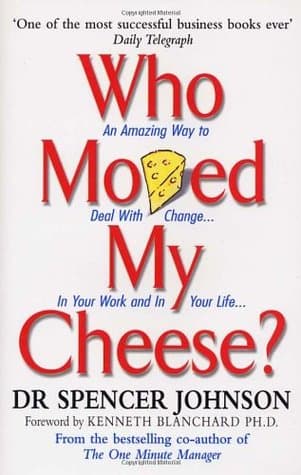
Who Moved My Cheese? cover
Archivist's Choice

Who Moved My Cheese?

Spencer Johnson (1998)

Genre

Business / Psychology / Leadership / Philosophy / Self-Help

Reading Time

30 min

Key Themes

See below

Track Your Reading

Sign in to track this book

Four tiny maze-dwellers scramble to adapt when their beloved cheese supply vanishes, revealing a timeless parable about embracing change rather than fearing its inevitable relocation.

Core Idea

Change is a constant part of life and work. Many resist it because they fear the unknown, cling to the past, or feel entitled. The book says that by recognizing change, watching for shifts, and adapting quickly, people can do well during disruption. It focuses on taking immediate, small actions to find new 'cheese' instead of holding onto old sources.
Reading time
30 min
Difficulty
Easy
✓ Read this if...
You are facing a significant change in your personal or professional life and feel stuck, fearful, or resistant to adapting. Also good if you need a quick, encouraging push to embrace new opportunities.
✗ Skip this if...
You are looking for deep academic research, complex psychological theories, or detailed strategies for organizational change. This book is a simple parable, not a comprehensive guide.

Core idea

The central argument and framework that powers the entire book.

Change is a constant part of life and work. Many resist it because they fear the unknown, cling to the past, or feel entitled. The book says that by recognizing change, watching for shifts, and adapting quickly, people can do well during disruption. It focuses on taking immediate, small actions to find new 'cheese' instead of holding onto old sources.

At a glance

Reading time

30 min

Difficulty

Easy

Read this if...

You are facing a significant change in your personal or professional life and feel stuck, fearful, or resistant to adapting. Also good if you need a quick, encouraging push to embrace new opportunities.

Skip this if...

You are looking for deep academic research, complex psychological theories, or detailed strategies for organizational change. This book is a simple parable, not a comprehensive guide.

Key Takeaways

1

Embrace the Inevitability of Change

Anticipate that your 'cheese' will move, and prepare to adapt.

Quote

Life is not a straight line. It is a maze, and the cheese will move.

The main idea of 'Who Moved My Cheese?' is that change is a constant, unavoidable force in life, both personally and professionally. Many people and groups become too comfortable, thinking their current 'cheese' — like a steady job, a good product, or a familiar routine — will last forever. This causes shock and paralysis when change happens. The book says that expecting change and even looking for it is important for long-term success and happiness. Instead of holding onto the past, we need to be able to see early signs of change and...

Supporting evidence

The initial discovery by Sniff and Scurry that the cheese at Station C has run out, while Hem and Haw, despite seeing the dwindling supply, remain in denial and frustration.

Apply this

Regularly assess your current situation (job, relationships, skills) for signs of decline or impending shifts. Proactively learn new skills, network, or explore alternative opportunities before your current 'cheese' fully disappears.

change-managementadaptabilityproactive-thinking
2

Monitor Your Environment Relentlessly

Stay vigilant for subtle cues indicating impending shifts.

Quote

Sniff and Scurry had simple brains, but they had a keen instinct for observing things.

The characters Sniff and Scurry, despite their simple nature, show a key lesson: the importance of always being watchful and noticing things early. They don't overthink; they observe and act. In contrast, Hem and Haw are so focused on their routines and beliefs about the cheese staying put that they miss the slow but clear signs it is running out. This points out a common human fault: we tend to get comfortable and ignore difficult truths. Dealing with change well means having a 'Sniff and Scurry' mindset – being very aware of our sur...

Supporting evidence

Sniff 'sniffing out' new opportunities and Scurry 'scurrying ahead' to explore, long before the cheese completely vanished, while Hem and Haw were still enjoying the last crumbs.

Apply this

Dedicate time each week to 'scan the horizon' in your professional and personal life. Read industry news, talk to diverse people, and critically evaluate your own routines and assumptions. Look for small, seemingly insignificant changes that might indicate a larger trend.

situational-awarenessearly-warning-systemsenvironmental-scanning
3

Overcome Fear and Inaction

Fear of the unknown is often more paralyzing than the change itself.

Quote

When you change your beliefs, you change your behavior.

One of the biggest problems with adapting to change is fear – fear of the unknown, fear of failing, or fear of losing what we have. Hem and Haw's first reaction to the missing cheese comes from this fear. It leads to them doing nothing, getting angry, and refusing to move. They make up reasons to stay where they are, becoming trapped by their own worries. The book shows that often, the dangers we imagine in a new situation are much worse than what actually happens. Haw's breakthrough happens when he realizes his fear is self-made and ...

Supporting evidence

Haw's internal struggle and his eventual decision to venture into the maze, despite Hem's protests and his own initial terror, finding that the new paths were not as dangerous as he imagined.

Apply this

Identify specific fears associated with a potential change. Challenge these fears by asking 'What's the worst that could happen?' and 'How likely is that outcome?' Take a small, manageable step towards the change to build confidence and gather real-world data.

fear-of-changecognitive-restructuringcourage
4

Visualize New Success

Imagining positive outcomes fuels motivation for change.

Quote

Imagining myself enjoying new cheese, even before I found it, led me to it.

Haw's journey of adapting is helped a lot by his ability to imagine 'New Cheese.' While Hem stays focused on the lost cheese, Haw intentionally shifts his mind to the possible rewards of finding something better. This mental exercise is more than just wishful thinking; it is a strong psychological tool for overcoming inaction and building motivation. By clearly imagining the good things about a new job, a new skill, or a new way of doing things, people can create a strong internal pull that counters the fear of the unknown. This takea...

Supporting evidence

Haw's writing on the wall: 'The quicker you let go of old cheese, the sooner you find new cheese,' and his subsequent experience of feeling energized by the thought of new cheese.

Apply this

When facing a change, dedicate time to visualize in detail what success or happiness would look like in the new situation. Create a mental picture of yourself thriving, enjoying new benefits, and overcoming challenges. Use this visualization to reframe your perspective.

positive-visualizationgoal-settingoptimism
5

Move Beyond Blame and Entitlement

Dwelling on what was lost hinders progress toward what can be gained.

Quote

What would you do if you weren't afraid?

Hem's character reminds us of the dangers of feeling entitled and having a victim mentality. He thinks he 'deserves' the cheese to be where it always was and blames outside forces for its disappearance. This mindset is a big barrier to adapting, as it takes energy away from solving problems and puts it into useless anger and self-pity. The book quietly says that while feeling loss is natural, prolonged blame and a sense of entitlement are destructive. Real progress starts when people take personal responsibility for their situation an...

Supporting evidence

Hem's repeated complaints about the injustice of the cheese moving and his refusal to leave Cheese Station C, despite hunger and Haw's encouragement.

Apply this

When faced with an unexpected change, acknowledge your feelings of loss or frustration, but consciously pivot away from blaming others or feeling entitled. Ask yourself, 'What can I do now to improve my situation?' rather than 'Who is responsible for this?'

personal-responsibilityvictim-mentalityresilience
6

Small Steps Lead to Big Changes

Don't wait for perfect conditions; just start moving.

Quote

It is safer to search in the maze than remain in a cheeseless station.

The journey from doing nothing to finding new cheese often feels overwhelming. Haw at first struggles with how big the unknown maze seems. However, he makes progress not with a grand plan, but by taking small, careful steps. He goes a short distance, then a little further, learning and adapting with each move. This takeaway emphasizes the power of small, steady progress. Many people are stuck by how big they think change is, waiting for a clear, no-risk path. The book suggests that acting, even imperfectly, is better than doing nothin...

Supporting evidence

Haw's initial timid forays into the maze, where he found only small bits of cheese, but each discovery encouraged him to keep going and explore further.

Apply this

Break down any large change into the smallest possible actionable steps. Don't aim for perfection on the first try. Focus on completing one small task, then the next, gradually building momentum and confidence in your ability to navigate the change.

incremental-changeaction-biasmomentum
7

Continuously Learn and Adapt

The maze is a dynamic environment; static strategies fail.

Quote

When you see that changing and enjoying new cheese is better, you become more open to finding more.

The maze itself is a symbol for an environment that is always changing. What worked yesterday might not work today. Haw's success is not just about moving; it is about learning while moving. He watches the maze, changes how he searches, and learns from both successes and failures. This shows how important continuous learning and adaptability are in a world that is always in flux. Organizations and individuals who hold onto old methods or beliefs will surely be left behind. The book promotes being curious all the time and being willi...

Supporting evidence

Haw's realization that he needed to keep checking for new cheese and not get too comfortable in one spot, even after finding a new supply.

Apply this

After implementing a change, regularly review its effectiveness. What worked? What didn't? What new information have you gathered? Be prepared to adjust your strategy, learn new skills, and even change direction based on your ongoing experiences.

lifelong-learningagile-mindsetcontinuous-improvement
8

Share Your Learnings

Helping others adapt strengthens collective resilience.

Quote

He knew he would feel better if he wrote what he had learned on the wall, so that others could read it.

Haw's journey ends not just with him finding new cheese for himself, but with his wish to share what he learned with Hem and others who might be lost. He writes messages on the maze walls, hoping to guide them. This highlights the community aspect of dealing with change. While individual adaptation is important, group resilience is stronger when knowledge and experiences are shared. In organizations, this means creating a culture where people openly talk about problems, share good practices, and support each other through changes. Iso...

Supporting evidence

Haw's various writings on the maze walls, such as 'Smell the cheese often so you know when it is getting old,' and 'Move with the cheese.'

Apply this

When you successfully navigate a change, share your lessons learned with colleagues, friends, or family. Be open about your struggles and successes. Mentor others or offer advice based on your experience to foster a more adaptable environment for everyone.

knowledge-sharingmentorshiporganizational-culture
9

Don't Overthink It: Act!

Analysis paralysis is a greater threat than imperfect action.

Quote

The quicker you let go of old cheese, the sooner you find new cheese.

Sniff and Scurry, with their simple, natural approach, find new cheese much faster than Hem and Haw. Hem and Haw are slowed down by overthinking, fear, and doing nothing. This takeaway is a key idea against too much planning or thinking about change. While strategic thinking is valuable, the book strongly favors taking action. In fast-changing situations, waiting for perfect information or a guaranteed result often means missing chances. The act of moving, even without a complete map, creates new information and opens up possibilities...

Supporting evidence

Sniff and Scurry immediately and instinctively setting off into the maze after discovering the cheese was gone, without any debate or elaborate planning.

Apply this

When faced with a decision about change, set a reasonable deadline for analysis. If you have 70-80% of the information, consider taking action. Prioritize taking a first step, even a small one, over endless deliberation, and be prepared to adjust as you go.

bias-for-actionanalysis-paralysisintuition

Critical analysis

Notable Quotes

What would you do if you weren't afraid?

A question posed to the characters, encouraging them to consider action despite fear.

The quicker you let go of old cheese, the sooner you find new cheese.

A key lesson learned by the characters about adapting to change.

Movement in a new direction helps you find New Cheese.

Hinting that proactive exploration is essential when old situations change.

Smell the cheese often so you know when it is getting old.

A practical tip for anticipating change and not being caught off guard.

When you change what you believe, you change what you do.

Reflecting on how one's mindset directly impacts their behavior.

Imagining myself enjoying New Cheese even before I find it, leads me to it.

Highlighting the power of positive visualization and expectation.

Noticing small changes early helps you adapt to the bigger changes that are to come.

Emphasizing the importance of observing subtle shifts in one's environment.

The fear you let build up in your mind is worse than the situation that actually exists.

Realizing that internal fear can be more debilitating than external reality.

Old beliefs do not lead you to new cheese.

A realization that clinging to outdated paradigms hinders progress.

It is safer to search in the maze than remain in a cheeseless situation.

Encouraging proactive searching rather than passively suffering from lack.

The fear of what you imagine is always worse than what actually happens.

A character's personal realization about the nature of fear and its impact.

They keep moving the cheese.

A simple, yet profound statement about the constant nature of change in life.

The more important your cheese is to you, the more you want to hold on to it.

Explaining the psychological resistance people have to change, especially regarding valued things.

Enjoy New Cheese soon.

A final encouraging message to embrace and savor new opportunities.

Quiz

Test Your Knowledge

Ready to see how well you understood this book? Take our interactive quiz with 10 questions.

10
Questions
~5
Minutes
?
Best Score

Key Questions (FAQ)

'Who Moved My Cheese?' delivers a powerful message about adapting to change, both personal and professional. It illustrates how individuals react differently to unexpected shifts in their circumstances and emphasizes the importance of anticipating, monitoring, and embracing change rather than resisting it.

About the author