BookBrief
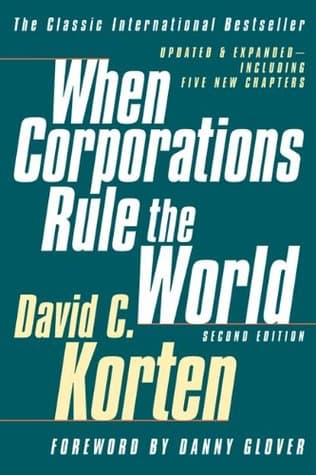
When Corporations Rule the World cover
Archivist's Choice

When Corporations Rule the World

David C. Korten (1995)

Genre

Business / Politics / History / Economics / Finance

Reading Time

1000 min

Key Themes

See below

Track Your Reading

Sign in to track this book

Korten's book analyzes multinational corporations' growing global power and introduces the Living Democracy movement as a hopeful alternative to a system that favors profit over people and the planet.

Core Idea

David C. Korten's "When Corporations Rule the World" argues that the global economic system, driven by transnational corporations and neoliberal policies, harms democracy, increases inequality, and damages the environment. Korten states that this system, based on constant growth and market fundamentalism, puts corporate profits ahead of human well-being and ecological health, corrupting societal values and governance. The book shows how corporate power has weakened national sovereignty, made economies unstable through financialization, and spread a consumerist culture that separates individuals and communities. Korten calls for a shift from a money-focused economy to a life-focused one, supporting local, democratically controlled systems that build true community, ecological sustainability, and fair resource distribution. He challenges the legal and ideological foundations of corporate personhood and global corporate rule.
Reading time
1000 min
Difficulty
Hard
✓ Read this if...
You are concerned about the pervasive influence of corporations on politics, economics, and society, and seek a comprehensive critique of global capitalism with proposed systemic alternatives.
✗ Skip this if...
You believe that free-market capitalism, as currently structured, is the optimal path to global prosperity and individual liberty, or you are not interested in a detailed, critical analysis of corporate power structures.

Core idea

The central argument and framework that powers the entire book.

David C. Korten's "When Corporations Rule the World" argues that the global economic system, driven by transnational corporations and neoliberal policies, harms democracy, increases inequality, and damages the environment. Korten states that this system, based on constant growth and market fundamentalism, puts corporate profits ahead of human well-being and ecological health, corrupting societal values and governance.

The book shows how corporate power has weakened national sovereignty, made economies unstable through financialization, and spread a consumerist culture that separates individuals and communities. Korten calls for a shift from a money-focused economy to a life-focused one, supporting local, democratically controlled systems that build true community, ecological sustainability, and fair resource distribution. He challenges the legal and ideological foundations of corporate personhood and global corporate rule.

At a glance

Reading time

1000 min

Difficulty

Hard

Read this if...

You are concerned about the pervasive influence of corporations on politics, economics, and society, and seek a comprehensive critique of global capitalism with proposed systemic alternatives.

Skip this if...

You believe that free-market capitalism, as currently structured, is the optimal path to global prosperity and individual liberty, or you are not interested in a detailed, critical analysis of corporate power structures.

Key Takeaways

1

The Grand Delusion of Growth

Unchecked economic growth is a destructive myth, not a path to prosperity.

Quote

The belief that economic growth is the primary path to human well-being is a grand delusion. True prosperity requires ecological balance and equitable distribution, not just an ever-expanding GDP.

Korten argues that the current economic system, focused on endless growth, is flawed and harmful to the environment. This focus on accumulating capital and material wealth ignores Earth's limited resources and the social costs. The pursuit of growth at any cost leads to environmental damage, more inequality, and weaker communities. He suggests that true well-being is not measured by GDP, but by healthy ecosystems, strong social connections, and fair access to basic needs. This idea challenges modern capitalist thinking, urging a shift...

Supporting evidence

Korten details how the global economy's relentless pursuit of growth has led to the depletion of natural resources, climate change, and the destruction of biodiversity, citing numerous environmental reports and economic analyses that demonstrate the planet's finite carrying capacity being exceeded.

Apply this

Support policies and businesses that prioritize ecological sustainability and social equity over pure profit maximization. Advocate for alternative economic indicators that measure well-being and environmental health, rather not just economic output. Invest in local, circular economies.

sustainable-developmentdegrowthecological-economics
2

Corporate Imperialism's Iron Grip

Multinational corporations have usurped democratic power, dictating global policy for private gain.

Quote

Corporations have evolved from instruments of commerce into dominant institutions that effectively rule the world, often at the expense of democracy, people, communities, and the planet.

Korten's main argument is that multinational corporations have become the real rulers of the world, holding great power that often exceeds that of independent nations. Through lobbying, influencing regulations, and international trade agreements (like those creating the WTO), corporations shape laws and policies to serve their own interests—mainly profit and market expansion—rather than the public good. This corporate control weakens democratic accountability, as corporate executives make decisions instead of citizens or their represe...

Supporting evidence

Korten provides extensive documentation of how international trade agreements, such as NAFTA and those overseen by the WTO, grant corporations unprecedented rights and protections, often allowing them to challenge national regulations that impede their profits, even if those regulations are designed to protect public health or the environment.

Apply this

Support movements advocating for corporate accountability and stronger regulatory frameworks. Educate yourself on the influence of corporate lobbying and vote for politicians committed to reining in corporate power. Demand transparency in corporate political spending.

corporate-powerglobalizationregulatory-captureneoliberalism
3

Financialization's Folly

The dominance of speculative finance over productive enterprise destabilizes economies and exacerbates inequality.

Quote

The global casino economy, driven by speculative finance, extracts wealth from real production and transfers it to a tiny elite, creating immense instability and deepening social divides.

Korten examines the rise of a 'casino economy' where financial speculation and short-term gains have overshadowed finance's traditional role in supporting productive businesses. This shift, called 'financialization,' means wealth increasingly comes from complex financial tools, currency speculation, and mergers, rather than from creating goods and services. This system is unstable, prone to crises, and concentrates wealth at the top, as financial elites profit from speculative activities while the real economy and ordinary citizens fa...

Supporting evidence

Korten highlights the rapid increase in global capital flows dedicated to speculative trading versus direct investment in productive assets, demonstrating how financial markets have become detached from the real economy, leading to boom-bust cycles and increased financial instability, such as the Asian financial crisis of the late 1990s.

Apply this

Advocate for policies that regulate financial markets, such as a Tobin tax on financial transactions, and support local banks and credit unions that invest in community development. Discourage investment in highly speculative financial instruments and prioritize ethical, long-term investments.

financializationspeculative-capitalinequalitycapitalism
4

The Market's Moral Blindness

Unregulated markets inherently fail to account for social and environmental costs, prioritizing profit over people.

Quote

The market, left to its own devices, is morally blind. It cannot account for externalities, public goods, or the intrinsic value of life, leading to the destruction of the very foundations of human well-being.

Korten argues that the unquestioning belief in the 'free market' is dangerous because markets are naturally amoral. They are good at allocating resources based on prices for private goods, but they fail to account for 'externalities'—social and environmental costs (like pollution, resource depletion, or social inequality) not reflected in prices. Also, markets struggle to provide public goods (like clean air, education, or justice) because they lack direct profit motives. This moral blindness means that without strong regulation and e...

Supporting evidence

Korten points to the widespread environmental destruction caused by industries that externalize costs, such as the pollution of rivers by factories or the clear-cutting of forests for short-term timber profits, where the long-term ecological and social costs are borne by society, not the corporations.

Apply this

Demand government regulation that internalizes environmental and social costs into market prices. Support businesses with strong ethical and sustainability practices. Advocate for policies that protect public goods and common resources from market exploitation.

market-failureexternalitiespublic-goodsethical-economics
5

The Myth of the Global Village

Globalization, as currently structured, destroys local economies and cultural diversity, creating a homogenized dependency.

Quote

The promise of a global village has devolved into a global mall, where local economies are dismantled, cultures are homogenized, and communities are left dependent on distant, unaccountable powers.

Korten criticizes the dominant form of globalization, saying it does not create a kind 'global village' but rather a 'global mall' controlled by a few powerful corporations. This process breaks down local economies, forcing communities to compete globally, often leading to lower wages and environmental standards. It makes cultures uniform, replacing diverse local traditions and products with standardized global brands. This results in greater reliance on distant, often exploitative, supply chains and a loss of local self-reliance and ...

Supporting evidence

Korten details how multinational corporations enter developing countries, outcompeting local businesses with their scale and marketing power, leading to the collapse of local industries and the displacement of local farmers and producers, making these regions dependent on global corporations for food and goods.

Apply this

Prioritize buying local products and supporting local businesses. Advocate for fair trade practices and policies that protect local economies from predatory global competition. Celebrate and preserve local cultural traditions and unique community assets.

anti-globalizationlocal-economiescultural-homogenizationeconomic-dependency
6

Reclaiming Democracy from the Corporation

True democracy requires shifting power from corporations back to citizens and communities.

Quote

Reclaiming our democracy means more than just voting; it means challenging the very legal and cultural structures that grant corporations undue power over our lives and our planet.

A main message of Korten's work is the urgent need to regain democratic control from corporations. This means not just electoral politics, but also basic changes in legal frameworks, cultural values, and economic structures. It involves challenging corporate personhood, limiting corporate political donations, and strengthening regulatory bodies. More deeply, it requires a cultural shift where citizens prioritize civic engagement and community well-being over consumerism and corporate loyalty. Reclaiming democracy means empowering loca...

Supporting evidence

Korten highlights the burgeoning 'Living Democracy movement,' which emphasizes citizen participation, local self-reliance, and a fundamental reordering of power relationships away from centralized corporate control towards community-based governance and economic models.

Apply this

Participate in local governance and community organizing. Advocate for campaign finance reform and the overturning of corporate personhood. Support movements that champion local control over resources and decision-making. Engage in citizen activism to hold corporations accountable.

corporate-accountabilityparticipatory-democracycitizen-activismlocal-governance
7

Life-Centered Values vs. Money-Centered Values

A fundamental shift in values is required to build a sustainable and equitable future.

Quote

The crisis we face is ultimately a crisis of values. We must transition from a money-centered society that prioritizes profit and material accumulation to a life-centered society that values people, community, and the natural world.

Korten argues that many global problems stem from a value system that prioritizes money, material gain, and corporate profit above all else. This 'money-focused' view leads to exploitation, inequality, and environmental destruction. He advocates for a shift to 'life-focused' values, where the well-being of people, communities, and nature are the top priorities. This means valuing cooperation over competition, stewardship over extraction, and enough over endless consumption. Such a shift would reshape economic and political systems, mo...

Supporting evidence

Korten contrasts indigenous cultures and various spiritual traditions that emphasize interconnectedness and stewardship with the modern industrial growth society's focus on individualistic material gain, illustrating how different value systems lead to vastly different societal outcomes.

Apply this

Reflect on and consciously adopt life-centered values in your personal choices and interactions. Support organizations and movements that promote ethical consumption, environmental stewardship, and social justice. Engage in public discourse to challenge dominant money-centered narratives.

value-systemsethical-livingsustainability-valuesstewardship
8

The Power of Local Economies

Building resilient, localized economies is key to fostering true prosperity and democratic control.

Quote

The path to a just and sustainable future lies in relocalizing our economies, strengthening community bonds, and reclaiming local control over resources and decision-making.

In contrast to harmful globalization, Korten promotes the idea of relocalizing economies. This involves strengthening local production, consumption, and ownership, which reduces reliance on distant, often exploitative, global supply chains. Local economies are more resilient, less vulnerable to global shocks, and more responsive to community needs. They foster stronger social bonds, create meaningful local jobs, and allow for greater democratic control over economic decisions. By keeping capital within the community, relocalization bu...

Supporting evidence

Korten cites examples of communities that have successfully implemented local currency systems, farmer's markets, and community-owned businesses, demonstrating how these initiatives keep wealth circulating locally and build community resilience against global economic pressures.

Apply this

Actively support local businesses, farmers' markets, and community-supported agriculture (CSAs). Invest in local co-ops and credit unions. Advocate for policies that support local economic development and discourage corporate sprawl. Learn skills for self-sufficiency.

localismcommunity-economicseconomic-resiliencerelocalization
9

Challenging Corporate Personhood

Revoking the legal fiction of corporate personhood is essential for reining in corporate power.

Quote

The legal fiction of corporate personhood has granted artificial entities rights and powers originally intended for human beings, enabling them to dominate our political and economic systems.

Korten highlights the problematic legal concept of corporate personhood, which grants corporations many rights similar to individual citizens, including free speech (often seen as the right to unlimited political spending) and due process. This legal idea allows corporations to exert great political influence, challenge regulations, and operate with a degree of freedom that undermines democratic principles. By treating profit-driven entities as 'persons,' the law unintentionally puts corporate interests above the public good and the r...

Supporting evidence

Korten references legal precedents and historical shifts that led to the granting of personhood rights to corporations, illustrating how this has empowered them to influence elections, lobby extensively, and challenge environmental and labor laws under the guise of 'rights.'

Apply this

Support organizations and legal efforts working to amend or overturn corporate personhood doctrines. Educate others on the implications of corporate personhood. Advocate for constitutional amendments or legislative changes that clearly define corporations as artificial entities with limited legal rights.

corporate-personhoodcorporate-rightsconstitutional-reformlegal-reform
10

The Imperative of Global Citizen Action

Collective citizen action across borders is the most potent force for systemic change.

Quote

Hope lies not in waiting for corporations to self-regulate, but in the burgeoning power of an informed and engaged global citizenry demanding a world based on life-centered values.

Despite the bleak picture of corporate dominance, Korten offers a hopeful message: the growing 'Living Democracy movement.' He stresses that systemic change will not come from corporations or governments alone, but from the collective, organized action of global citizens. This involves individuals and communities connecting across borders to challenge corporate power, advocate for life-focused policies, and build alternative, sustainable systems. This movement shares a commitment to ecological sustainability, social justice, and democ...

Supporting evidence

Korten documents the rise of international NGOs, grassroots movements, and global solidarity networks that are actively resisting corporate exploitation, advocating for human rights and environmental protection, and building alternative economic models, demonstrating the collective power of organized citizens.

Apply this

Join or support organizations engaged in social and environmental justice. Participate in protests, boycotts, and advocacy campaigns. Connect with global citizen networks to share knowledge and coordinate actions. Educate yourself and others about systemic issues and potential solutions.

citizen-engagementsocial-movementsglobal-activismcollective-action

Critical analysis

Notable Quotes

The corporate-led global economy is not sustainable. It is destroying the environment, increasing inequality, and undermining democracy.

A central thesis of the book, critiquing the current economic system.

We have been conditioned to believe that economic growth is always good, and that the market will solve all our problems. This is a dangerous myth.

Challenging conventional economic wisdom and the primacy of growth.

The real wealth of nations is not measured in GDP, but in the health and well-being of their people and the natural systems that sustain them.

Proposing an alternative measure of national success beyond traditional economic indicators.

Corporations are not people. They are legal fictions designed to concentrate wealth and power, often at the expense of human and environmental well-being.

Critiquing the legal status and inherent nature of corporations.

The greatest danger we face is not from external enemies, but from an economic system that is devouring the planet and our future.

Highlighting the existential threat posed by the current economic model.

Democracy requires a vibrant civil society and a balanced distribution of economic power, not its concentration in the hands of a few global corporations.

Connecting economic power distribution to the health of democratic institutions.

Localization, not globalization, is the path to sustainable prosperity and genuine human liberation.

Advocating for local economic systems as an alternative to globalized ones.

The market is a powerful tool, but it is a tool to be managed, not a master to be served.

Clarifying the proper role of markets within a broader societal framework.

True progress is measured by our ability to live in harmony with nature and with each other, not by endless consumption.

Redefining the concept of progress away from material accumulation.

The challenge is not to fix the system, but to create a new one based on ecological realities and human needs.

Emphasizing the need for systemic transformation rather than mere reform.

We need to reclaim our economies from corporate control and put them back in service to life.

Calling for a shift in economic ownership and purpose.

The illusion of endless growth on a finite planet is the most dangerous fantasy of our time.

Addressing the fundamental incompatibility of infinite growth with planetary limits.

Our current economic system is a war against life, a war we are losing.

A stark characterization of the destructive nature of the prevailing economic model.

The shift from a corporate-ruled world to an Earth-centered civilization is the defining challenge of our era.

Framing the overarching task for humanity in the 21st century.

When wealth becomes concentrated, so does political power, leading to a vicious cycle of corporate dominance and democratic decline.

Explaining the feedback loop between economic and political power.

Quiz

Test Your Knowledge

Ready to see how well you understood this book? Take our interactive quiz with 10 questions.

10
Questions
~5
Minutes
?
Best Score

Key Questions (FAQ)

David Korten argues that multinational corporations have gained excessive global power, leading to a decline in democracy, community well-being, and environmental health. The book details how this corporate dominance prioritizes financial gain over life-centered values.

About the author

David C. Korten

David C. Korten is a prominent author and advocate for economic and social change. His influential book, "When Corporations Rule the World," critiques globalization and corporate power, advocating for a more just and sustainable economy. Korten's work draws on his background in international business and public policy.