BookBrief
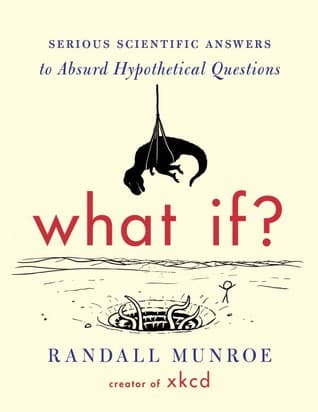
What If? Serious Scientific Answers to Absurd Hypothetical Questions cover
Archivist's Choice

What If? Serious Scientific Answers to Absurd Hypothetical Questions

Randall Munroe (2014)

Genre

Reference / Science

Reading Time

240 min

Key Themes

See below

Track Your Reading

Sign in to track this book

This book explores the dangerous scientific realities behind absurd 'what if' questions, explained with humor and simple illustrations.

Core Idea

This book examines the line between the absurd and the scientifically possible by applying physics, chemistry, biology, and engineering to ridiculous hypothetical questions. It shows that even outlandish scenarios, when studied scientifically, offer insights into the universe's basic laws, the scale of cosmic and terrestrial forces, and the unexpected results of changing reality. Through these investigations, it supports using simple calculations and the scientific process to understand the world, no matter how strange the starting point.
Reading time
240 min
Difficulty
Medium
✓ Read this if...
You enjoy science, humor, and critical thinking, and wonder about the 'what ifs' of the universe, no matter how silly they seem.
✗ Skip this if...
You prefer traditional narrative non-fiction, dislike mathematical reasoning or physics concepts, or are looking for a deep dive into a single scientific topic.

Core idea

The central argument and framework that powers the entire book.

This book examines the line between the absurd and the scientifically possible by applying physics, chemistry, biology, and engineering to ridiculous hypothetical questions. It shows that even outlandish scenarios, when studied scientifically, offer insights into the universe's basic laws, the scale of cosmic and terrestrial forces, and the unexpected results of changing reality. Through these investigations, it supports using simple calculations and the scientific process to understand the world, no matter how strange the starting point.

At a glance

Reading time

240 min

Difficulty

Medium

Read this if...

You enjoy science, humor, and critical thinking, and wonder about the 'what ifs' of the universe, no matter how silly they seem.

Skip this if...

You prefer traditional narrative non-fiction, dislike mathematical reasoning or physics concepts, or are looking for a deep dive into a single scientific topic.

Key Takeaways

1

The Catastrophic Power of Scale

Small changes at vast scales lead to unimaginable destruction.

Quote

Everyday physics, when extrapolated to absurd scales, becomes a recipe for global catastrophe.

Munroe clearly shows that our basic understanding of physics often fails when applied to extreme situations. A small change in a system, when scaled up to cosmic levels or applied to fundamental forces, always causes a chain reaction of destructive results. This point highlights how fragile our planet's systems are and how much power is in seemingly simple physical laws. It is a reminder that the universe works on principles that do not always match our human ideas of 'big' or 'small.' The humor in Munroe's explanations often comes fr...

Supporting evidence

The 'What if the Earth stopped spinning?' scenario, where the atmosphere continues at 1000 mph, scouring the surface clean of everything, including mountains, and the planet transforms into a flattened ellipsoid with oceans migrating to the poles. Or the 'What if you gathered all the world's humans in one place and jumped?' calculation, which, despite the massive number of people, barely registers as an impact on the Earth.

Apply this

When considering complex systems, always think about the potential for exponential or cascading effects. Don't underestimate the power of seemingly small variables when they are part of a larger, interconnected whole. This applies to everything from ecological systems to economic models.


scale-effectscatastrophic-failuresystems-thinking
2

The Ubiquity of Heat Death

Most extreme scenarios inevitably end in extreme thermal energy.

Quote

When you put a lot of energy into a small space, you get a really big explosion.

A repeated idea in 'What If?' is that no matter the initial absurd premise — whether it is a bullet hit by lightning, throwing a baseball at light speed, or draining the oceans — the final result often involves a huge release of energy, usually as heat and light, leading to an explosion or burning. This emphasizes the basic law of energy conservation and how efficiently different forms of energy turn into heat when pushed to extremes. It is a reminder that many hypothetical scenarios, no matter how strange, end with the same destructi...

Supporting evidence

The 'What if you tried to hit a baseball pitched at 90% the speed of light?' answer details how the ball would create a nuclear fireball, consuming the air and vaporizing the bat and batter, followed by a massive shockwave. The 'What if all the world's lightning struck one spot?' scenario also leads to an immense thermal event.

Apply this

When evaluating any high-energy system or potential disaster, prioritize understanding the mechanisms of energy conversion and dissipation. Recognize that extreme energy events often manifest as heat, light, and pressure waves, leading to widespread destruction. This is crucial for engineering safety and disaster preparedness.

energy-conservationthermal-dynamicsnuclear-physics
3

The Resilience (and Fragility) of Life

Life's ability to persist is astounding, but also highly dependent on specific conditions.

Quote

Life is tenacious, but the conditions required for complex life are surprisingly narrow.

Munroe's hypotheticals often explore the limits of what life can survive. Some scenarios show life's surprising ability to recover from problems (e.g., how long we would live without cell division), while others quickly show its extreme weakness when basic environmental conditions change. This contrast highlights the delicate balance that allows complex life to grow on Earth. It emphasizes that while individual organisms can be very strong, the planetary ecosystem that supports them is very sensitive to large disruptions, often leadin...

Supporting evidence

The 'What if your cells lost the power to divide?' question details a surprisingly long survival time (weeks to months) due to the body's existing cell reserves, but ultimately leads to organ failure. Conversely, the 'What if the moon went away?' scenario quickly leads to extreme tidal shifts, altered axial tilt, and devastating climate change, making Earth uninhabitable for complex life.

Apply this

Appreciate the finely tuned conditions that support life on Earth. Advocate for and support efforts to maintain environmental stability and biodiversity, recognizing that even seemingly minor changes can have cascading effects on ecosystems. Understand that resilience has limits.

environmental-stabilitybiodiversityplanetary-ecology
4

The Absurdity of Human Endurance

Our bodies are surprisingly tough, but physics always wins.

Quote

The human body can endure a lot, but there's always a point where physics simply says 'no'.

Many of Munroe's questions directly challenge human limits, often with funny and gruesome results. He carefully calculates the forces, temperatures, and pressures a human body can withstand, showing that while we are surprisingly strong in many ways, there are clear limits beyond which survival is impossible. These limits are often much lower than we might imagine. This point shows the unforgiving nature of physical laws and reminds us that our bodies, though complex, are ultimately subject to the same universal rules as everything el...

Supporting evidence

The 'How fast can you hit a speed bump and live?' answer calculates the G-forces required to cause fatal injuries, concluding that even at relatively low speeds (around 65 mph for a sharp bump), internal organs would be ripped apart. The 'What if you jumped off a building with a full tank of helium?' scenario explains how a human would still hit the ground at terminal velocity, only slightly slower, with the same fatal outcome.

Apply this

Respect the physical limits of the human body and avoid situations that expose you to extreme forces or environments. When designing safety equipment or protocols, always factor in the maximum tolerable physical loads and recognize the point of inevitable failure. Don't rely on intuition alone when assessing risk.

human-physiologybiomechanicsterminal-velocity
5

The Power of Back-of-the-Envelope Calculations

Complex problems can often be approximated with simple physics.

Quote

A good approximation can often tell you more than a precise but misguided calculation.

A key part of Munroe's method is his ability to break down very complex, often strange, scenarios into manageable, solvable physics problems using basic principles and reasonable guesses. This shows the great power of 'Fermi problems' or 'back-of-the-envelope' calculations. He shows that you do not always need supercomputers or advanced degrees to get a surprisingly accurate, and often amazing, answer to a difficult question. This point promotes a practical, first-principles way to solve problems, emphasizing that understanding the co...

Supporting evidence

Many of his calculations, like estimating the power generated by gym-goers (only enough for a tiny fraction of global energy needs), or the impact of everyone jumping (negligible), rely on basic mass, energy, and force equations, often with humorous but justifiable simplifications.

Apply this

Practice breaking down large, intimidating problems into smaller, more manageable components. Learn to make educated guesses and use fundamental principles to derive approximate answers quickly. This skill is invaluable for rapid prototyping, initial feasibility studies, and developing a deeper intuitive understanding of systems.

fermi-problemsestimationfirst-principles
6

The Unintended Consequences of 'Fixing' Things

Interfering with natural systems often creates worse problems.

Quote

Attempting to 'improve' a stable system without understanding its intricacies often leads to unforeseen and disastrous side effects.

Munroe often shows how attempts to 'solve' a problem or make a seemingly good change in a large system can lead to much worse, and often unexpected, negative results. This highlights how natural and engineered systems are connected and how hard it is to isolate variables. It is a warning against arrogance and incomplete understanding, emphasizing that complex systems often have unexpected behaviors that are not immediately clear. Good intentions can lead to total destruction when basic physical laws are ignored or misunderstood.

Supporting evidence

The 'What if we drained the oceans?' scenario, where the initial problem (lack of land) is 'solved,' but the resulting atmospheric pressure changes, climate collapse, and eventual evaporation of the remaining water create a Venus-like wasteland far worse than the original. Or the 'What if you removed all the atoms from the Earth's core?' which results in the planet collapsing into a black hole.

Apply this

Before implementing large-scale changes, conduct thorough impact assessments that consider all potential downstream and upstream effects. Adopt a holistic view of systems rather than focusing on isolated components. Be wary of 'silver bullet' solutions that promise to fix complex problems easily.

systems-interconnectednessunintended-consequencescomplex-adaptive-systems
7

The Sheer Emptiness of Space

The vastness of space makes most human-scale events utterly insignificant.

Quote

Space is mostly nothing, and that nothing is very, very good at staying nothing.

While Munroe often deals with earthly disasters, he also frequently reminds us of how empty and harsh space is. Many questions about space travel or celestial mechanics quickly turn into discussions about the vacuum, radiation, and huge distances that make even the most powerful human efforts seem small. This point offers a humbling view of our place in the universe, highlighting that even our biggest explosions are barely a whisper against the background of interstellar distances and the basic laws governing galaxies. It is a stark r...

Supporting evidence

The 'What if you made a periodic table out of actual elements and blasted it into space?' answer, which explains how quickly the elements would disperse and how astronomically unlikely it would be for them to ever coalesce or be found. Or the 'What if you flew a plane to the edge of the solar system?' where the sheer scale of the journey and the vacuum of space make it absurd.

Apply this

Maintain a sense of cosmic perspective. When faced with seemingly overwhelming problems, remember the vastness of the universe and the relative insignificance of many human concerns. This can help to reframe challenges and reduce stress, while also fostering an appreciation for the unique conditions on Earth.

cosmic-perspectivespace-vacuuminterstellar-distances
8

The Inevitability of Entropy

Disorder always increases, often with dramatic flair.

Quote

The universe tends towards messiness, and our attempts to impose order often just accelerate the process.

The second law of thermodynamics, entropy, is an unstated but always present force in Munroe's analyses. Many of the absurd hypotheticals, especially those involving large amounts of energy or matter, show how quickly order breaks down into chaos. Whether it is a carefully built object falling apart into dust, or a stable system turning into a turbulent mess, the tendency towards increased disorder is constant. This point highlights that the universe naturally favors disorganization and that any system, left alone or subjected to extr...

Supporting evidence

The 'What if the Earth stopped spinning?' scenario, where the structured world is immediately torn apart into a chaotic storm of debris and atmosphere. Or the 'What if you gathered all the world's humans in one spot and jumped?' where the initial order of the crowd quickly disperses due to the impact and resulting chaos.

Apply this

Recognize that maintaining order requires constant energy input and effort. When designing systems, anticipate and plan for entropy; design for graceful degradation rather than catastrophic failure. Understand that perfect order is often an illusion and that some level of disorder is inherent in all systems.

entropythermodynamicsdisorder
9

The Interplay of Science and Imagination

Absurd questions can illuminate fundamental scientific principles.

Quote

The best way to understand how the world works is sometimes to ask what happens when it breaks in the most ridiculous ways.

Munroe uses absurd, often humorous, hypothetical questions to explain complex scientific concepts in an easy and interesting way. This shows that imagination, even when it is ridiculous, can be a strong tool for scientific study and teaching. By pushing the limits of what 'could' happen, he makes the reader face basic laws of physics, chemistry, and biology, showing their strength and their limits. This point emphasizes that curiosity, no matter how strange its origin, drives scientific understanding and can make even the most difficu...

Supporting evidence

Every single 'What If?' question serves this purpose, from the 'bullet struck by lightning' to the 'draining the oceans.' Each seemingly silly premise is meticulously analyzed using real scientific principles, revealing deep insights into fluid dynamics, thermodynamics, orbital mechanics, and more.

Apply this

Encourage and cultivate curiosity, even for 'silly' questions. Use thought experiments and extreme scenarios to test your understanding of concepts. Recognize that engaging with unconventional ideas can often lead to deeper insights and a more robust understanding of scientific principles.

scientific-literacythought-experimentscuriosity

Critical analysis

Notable Quotes

The good news is that the Sun is not going to explode for another five billion years. The bad news is that when it does, it will take the Earth with it.

Discussing the Sun's life cycle and its eventual demise.

If every person on Earth stood in one place and jumped at the same time, what would happen?

The opening of a hypothetical question about collective human action.

There are only two things that can go wrong when you're making a hydrogen bomb: you can make it too big, or you can make it not explode at all.

Explaining the complexities and dangers of building a nuclear device.

The problem with having a big enough rocket to launch a house into orbit is that it would probably be too big to fit inside a house.

Considering the practicalities of launching large objects into space.

If you want to know how to build a nuclear bomb, you can find the instructions on the internet. But it's not going to be easy.

Addressing the availability of sensitive information and the difficulty of execution.

The Earth is mostly empty space. If you took all the atoms in your body and squeezed them together, you'd be smaller than a grain of sand.

Illustrating the vast emptiness at the atomic level.

If you could suck all the air out of the world, it would be a very bad day.

A concise summary of the catastrophic effects of a global vacuum.

If you were to take a swim in a spent nuclear fuel pool, you would probably die. But not from radiation.

Dispelling common misconceptions about the immediate dangers of nuclear waste.

The fastest way to travel from one point to another is to not move at all.

A humorous and counter-intuitive take on relativistic travel and the nature of space-time.

It's a good thing we don't have to worry about the moon falling out of the sky. Because if it did, we'd have bigger problems than just a bad day.

Considering the gravitational stability of celestial bodies and the implications if it failed.

If you piled all the humans in the world into a single cube, it would be surprisingly small.

Visualizing the collective volume of humanity.

The universe is full of amazing things, and most of them are trying to kill you.

A humorous but scientifically grounded perspective on the dangers of the cosmos.

There are a lot of ways to die in space. Most of them involve a lack of oxygen, extreme temperatures, or being hit by something very fast.

Listing the numerous hazards of extraterrestrial environments.

Quiz

Test Your Knowledge

Ready to see how well you understood this book? Take our interactive quiz with 10 questions.

10
Questions
~5
Minutes
?
Best Score

Key Questions (FAQ)

'What If?' tackles absurd, hypothetical questions with serious scientific analysis. These range from everyday scenarios like swimming in a thunderstorm to more extreme ones involving celestial bodies or human biology, often with humorous and unexpected outcomes.

About the author