BookBrief
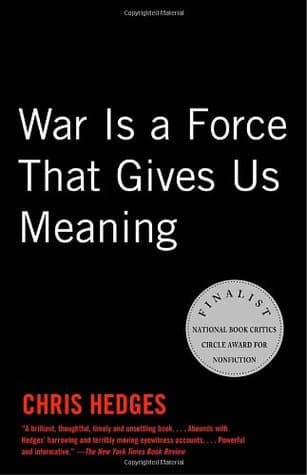
War Is a Force That Gives Us Meaning cover
Archivist's Choice

War Is a Force That Gives Us Meaning

Chris Hedges (2002)

Genre

Politics / Psychology / Memoir / History / Philosophy

Reading Time

240 min

Key Themes

See below

Track Your Reading

Sign in to track this book

A veteran war correspondent and former divinity student examines war's seductive, addictive, and destructive nature, showing how it corrupts individuals and societies by offering a false sense of meaning.

Core Idea

Chris Hedges argues that war is a seductive and destructive force that distorts truth, morality, and human nature. Drawing on his experience as a war correspondent, Hedges contends that war offers a powerful, almost religious, sense of meaning, purpose, and community to those caught within it. This masks war's true horrors and corrupts individuals and societies. This manufactured meaning, he asserts, erodes empathy, glorifies violence, and perpetuates cycles of destruction, leaving behind trauma and moral decay.
Reading time
240 min
Difficulty
Medium
✓ Read this if...
You want a raw, unflinching, and philosophical examination of the psychological and moral impact of war on individuals and society, challenging conventional narratives of heroism and sacrifice.
✗ Skip this if...
You are looking for a historical account of specific conflicts, a policy analysis, or a book that avoids graphic descriptions of human suffering and moral compromise.

Core idea

The central argument and framework that powers the entire book.

Chris Hedges argues that war is a seductive and destructive force that distorts truth, morality, and human nature. Drawing on his experience as a war correspondent, Hedges contends that war offers a powerful, almost religious, sense of meaning, purpose, and community to those caught within it. This masks war's true horrors and corrupts individuals and societies. This manufactured meaning, he asserts, erodes empathy, glorifies violence, and perpetuates cycles of destruction, leaving behind trauma and moral decay.

At a glance

Reading time

240 min

Difficulty

Medium

Read this if...

You want a raw, unflinching, and philosophical examination of the psychological and moral impact of war on individuals and society, challenging conventional narratives of heroism and sacrifice.

Skip this if...

You are looking for a historical account of specific conflicts, a policy analysis, or a book that avoids graphic descriptions of human suffering and moral compromise.

Key Takeaways

1

The Siren Song of War

War offers a seductive escape from the banality of modern life, promising purpose and meaning.

Quote

War exposes the capacity for evil that lurks not far below the surface within all of us. But it also exposes the capacity for goodness, the heroism and the self-sacrifice.

Hedges argues that war, despite its horrors, has a strong appeal, especially in societies dealing with spiritual emptiness and a lack of shared purpose. It removes the ordinary, offering a heightened sense of existence, false moral clarity, and a powerful, temporary communal bond. This mix of adrenaline, perceived heroism, and a clear 'enemy' can be addictive, contrasting with the often-meaningless routines of civilian life. The book examines how this psychological pull can change individuals and societies, making them vulnerable to r...

Supporting evidence

Hedges's own experience as a war correspondent, describing the 'rush' and the 'high' that combat can induce, even among those reporting on it. He also references the myth-making around soldiers and the glorification of battle in national narratives.

Apply this

Recognize the psychological void that war exploits. Actively seek and cultivate meaning and purpose in peaceful endeavors, fostering strong community ties and engaging in service that provides genuine, constructive purpose, rather than destructive, manufactured ones.


meaninglessnessexistential-vacuumwar-addictionmyth-of-war
2

The Corruption of Truth

War necessitates the systematic distortion of reality, transforming truth into a casualty long before the first shot is fired.

Quote

The truth is always the first casualty in war.

Hedges details how war requires a complete change in societal narratives. Facts are manipulated, dissent is suppressed, and complex realities become simple good-versus-evil stories. The enemy is dehumanized, and one's own side is seen as morally perfect. This propaganda is not just external but deeply internalized, shaping individual perceptions and collective memory. The result is a population deluded by jingoism, unable to assess the true costs and motivations of conflict. This makes it easier for leaders to perpetuate violence and ...

Supporting evidence

Hedges recounts how governments and media outlets create elaborate fictions to justify conflict, citing examples from various wars where misinformation was rampant and critical voices were silenced or demonized. He mentions the simplistic portrayal of 'the enemy' in wartime media.

Apply this

Cultivate radical skepticism towards official narratives during times of conflict. Actively seek out diverse, independent news sources and perspectives, and prioritize critical thinking over emotional appeals, especially those that demonize entire groups of people.

propagandadehumanizationwartime-censorshipmedia-manipulation
3

The Erosion of Morality

War systematically dismantles moral frameworks, compelling individuals to commit acts they would deem abhorrent in peace.

Quote

War exposes the capacity for evil that lurks not far below the surface within all of us.

One of Hedges's observations is how war demands a suspension of ordinary morality. The battlefield becomes a place where conventional ethics are reversed: killing is a duty, compassion can be a weakness, and brutality is often rewarded. Soldiers are trained to dehumanize the enemy, making violence easier. This moral degradation extends beyond the battlefield, affecting civilian populations who become desensitized to suffering and complicit in atrocities through silence or support. The book shows how individuals, even those with strong...

Supporting evidence

Hedges's accounts of witnessing child soldiers commit atrocities, the casual brutality he observed in conflicts like the Balkans, and the psychological impact on soldiers who return home haunted by their actions.

Apply this

Understand the profound psychological and moral pressures war exerts. Advocate for robust international humanitarian law and support organizations that work to protect civilians and promote ethical conduct even in conflict zones, recognizing the thin veneer of civilization.

moral-injurydehumanizationwartime-ethicsatrocity-justification
4

The Addiction to Combat

For some, the intensity and clarity of combat become an intoxicating, almost spiritual experience, difficult to relinquish.

Quote

War is a force that gives us meaning.

Hedges explores the psychological phenomenon where war's extreme conditions—constant threat of death, intense camaraderie, clear objectives—create an unparalleled sense of vitality and purpose. For those who experience it, especially in long engagements, returning to civilian life can feel profoundly anticlimactic. The 'high' of combat, the feeling of being truly alive in the face of death, becomes an addiction. This leads some veterans to struggle with reintegration, seeking to recreate that intensity or feeling lost without it. This...

Supporting evidence

Hedges details conversations with veterans who express a longing for the 'clarity' and 'brotherhood' of war, finding civilian life dull and purposeless in comparison. He draws parallels to other high-risk, high-reward activities that create similar psychological dependence.

Apply this

Develop comprehensive support systems for veterans that address not only physical and mental health but also the existential void that can follow combat. Create opportunities for veterans to channel their skills and desire for purpose into constructive, high-impact civilian roles.

PTSDveteran-reintegrationcombat-highexistential-crisis
5

The Infantilization of Society

War fosters a collective regression, where societies embrace simplistic narratives and hero worship, avoiding complex truths.

Quote

War turns us into children. We are swept away by the emotional power of belonging, the intoxication of the crowd, the sense of moral superiority.

Hedges observes that during wartime, societies often regress to a childlike state, demanding simple answers, clear villains, and infallible heroes. Nuance and critical thought are discarded for jingoistic slogans and emotional appeals. This infantilization allows for the suspension of moral judgment and the unquestioning acceptance of state propaganda. Leaders become paternal figures, and citizens, in their collective fervor, willingly give up individual autonomy for the perceived security and unity of the war effort. This regression ...

Supporting evidence

The unquestioning support for military actions, the demonization of dissenters as 'unpatriotic,' and the simplistic, often cartoonish, portrayal of the enemy in popular culture during conflicts.

Apply this

Foster intellectual independence and critical thinking from a young age. Promote education that emphasizes historical complexity, ethical reasoning, and media literacy to inoculate against simplistic wartime narratives and collective emotional manipulation.

collective-psychologyjingoismnationalismcritical-thinking-failure
6

The Myth of Glory

The romanticized image of war, detached from its brutal reality, serves to perpetuate its horrors.

Quote

The myth of war, the belief that it is noble and glorious, is perhaps the most dangerous lie.

Hedges dissects the myth of war as a glorious, heroic endeavor, arguing that this myth drives perpetual conflict. From ancient epics to modern Hollywood, war is often portrayed as a crucible of courage, sacrifice, and triumph, sanitizing its true nature. This romanticized vision obscures the suffering, disfigurement, psychological trauma, and moral compromises inherent in combat. By perpetuating this myth, societies encourage new generations to volunteer for what they see as a noble quest, only to discover a brutal reality. The book c...

Supporting evidence

Hedges contrasts the heroic narratives found in literature and film with the grim realities he witnessed: the random nature of death, the psychological breakdown of soldiers, and the profound moral ambiguity of combat.

Apply this

Actively challenge and deconstruct romanticized portrayals of war in media and education. Demand and support narratives that truthfully depict the physical, psychological, and moral costs of conflict, focusing on the suffering of all involved.

war-romanticismanti-war-literaturehero-mythhistorical-revisionism
7

The Cycle of Violence

Unresolved trauma and the perpetuation of grievance ensure that war begets more war.

Quote

War is a disease. It is a pathology. It is a form of collective suicide.

Hedges argues that war is not an isolated event but often part of a self-perpetuating cycle. The trauma inflicted, the grievances created, and the hatreds fostered during one conflict set the stage for the next. Victors often impose punitive measures that breed resentment, while the vanquished seek revenge. This historical amnesia, along with the glorification of past conflicts and the demonization of former enemies, ensures that societies remain ready for the next 'inevitable' war. Breaking this cycle requires a reckoning with histor...

Supporting evidence

Hedges points to the historical cycles of conflict in regions like the Balkans and the Middle East, where ancient hatreds and recent traumas continually reignite violence, showing how unresolved issues from one war directly lead to the next.

Apply this

Support peacebuilding initiatives, truth and reconciliation commissions, and educational programs that foster empathy and understanding across historical divides. Advocate for diplomatic solutions and conflict resolution that address root causes rather than merely suppressing symptoms.

intergenerational-traumapeacebuildingconflict-resolutionhistorical-grievances
8

The Profound Isolation of the Survivor

Those who witness and survive war often return profoundly alienated from a society that cannot comprehend their experience.

Quote

The memory of combat is a wound that never heals.

A theme in Hedges's work is the deep divide between those who have experienced war's brutality and those who have not. Veterans often cannot articulate the horrors they've witnessed, and civilian society, shielded by propaganda and ignorance, is often unwilling or unable to truly listen. This leads to profound isolation, as survivors carry the burden of their memories in silence, feeling misunderstood or judged. This alienation can worsen psychological trauma, making reintegration into civilian life difficult and highlighting society'...

Supporting evidence

Hedges's own struggles with PTSD and the difficulty he faced in explaining his experiences to friends and family who had not been to war, alongside accounts of veterans who feel like outsiders in their own communities.

Apply this

Create spaces for veterans to share their experiences without judgment, fostering empathy and understanding within civilian communities. Support mental health services specifically tailored to the unique traumas of combat, acknowledging the long-term impact on the psyche.

veteran-isolationmoral-injurypost-traumatic-stresssocietal-disconnect
9

The Empathy Deficit

War thrives on the suppression of empathy, making it easier to inflict and tolerate suffering.

Quote

Empathy is the antidote to war.

Hedges argues that war cannot exist without a systematic suppression of empathy. For soldiers to kill and for societies to support such killing, the 'enemy' must be dehumanized, stripped of shared humanity. This lack of empathy allows atrocities to be committed, civilian casualties to be rationalized, and the suffering of others to be dismissed. The book suggests that cultivating empathy—recognizing shared humanity in all people, even those on the 'other side'—is the most potent weapon against the forces that drive war. Without empath...

Supporting evidence

The constant portrayal of the enemy as barbaric, less human, or inherently evil in wartime propaganda. Hedges contrasts this with moments of unexpected human connection he witnessed even across enemy lines, which were quickly suppressed.

Apply this

Promote education and cultural exchange programs that foster cross-cultural understanding and empathy. Encourage media that humanizes all sides of a conflict and challenges simplistic 'us vs. them' narratives. Practice active listening and seek to understand diverse perspectives.

dehumanizationcompassion-fatiguemoral-disengagementintergroup-empathy
10

The False Promise of Sacrifice

The rhetoric of noble sacrifice often masks the cynical manipulation of individuals for political ends.

Quote

We are told that we fight for freedom, for democracy, for God. We are not told that we fight for oil, for power, for the illusions of our leaders.

Hedges critiques the narrative that soldiers die for noble ideals like freedom, democracy, or national honor. While individual soldiers may believe in these causes, Hedges argues that this rhetoric often serves as a tool for political leaders to mobilize populations and justify conflicts driven by less altruistic motives: economic gain, geopolitical power, or personal ambition. The 'sacrifice' of soldiers, especially the young, is then used to silence dissent and perpetuate the war, making it seem disrespectful to question the cause f...

Supporting evidence

Hedges contrasts the official justifications for various wars with the often-hidden economic or political interests at play, and how the deaths of soldiers are then used to sanctify these conflicts, making them immune to criticism.

Apply this

Critically analyze the stated reasons for war against potential underlying economic, political, or ideological motivations. Honor the individual sacrifices of soldiers while simultaneously challenging the systems and narratives that send them to war for questionable reasons.

political-manipulationmilitary-industrial-complexrhetoric-of-warfalse-pretext

Critical analysis

Notable Quotes

War is a force that gives us meaning.

The central thesis of the book, reflecting on the seductive power of war.

The rush of battle is often a potent and lethal addiction, for war is a drug, a terribly potent and often lethal one.

Describing the intoxicating nature of combat for soldiers and societies.

The state, in wartime, becomes the sole arbiter of truth. It determines what we can and cannot see, what we can and cannot know.

Discussing government control over information and perception during conflict.

We are taught to see the world in binary terms: good and evil, us and them, black and white. This simplistic worldview is a prerequisite for war.

Analyzing how dualistic thinking facilitates the justification of war.

The moral line that separates us from the enemy is often blurred, sometimes erased, by the brutal logic of war.

Reflecting on the ethical compromises and moral degradation inherent in conflict.

War exposes the capacity for evil in all of us, even those who believe themselves to be righteous.

A harsh observation about human nature under the pressures of war.

The true nature of war is not heroism or glory, but destruction, suffering, and the systematic dismantling of human dignity.

Contrasting the romanticized view of war with its grim reality.

Those who have not seen war up close often have a romanticized, sanitized vision of it.

Highlighting the disconnect between those who experience war and those who only perceive it from afar.

Propaganda does not deceive people; it merely helps them to deceive themselves.

Exploring the role of propaganda in war and its psychological impact.

The only way to cope with the insanity of war is to embrace a kind of madness yourself.

Describing the psychological adaptations necessary for survival in war zones.

In war, the first casualty is truth.

A classic observation reiterated, emphasizing the pervasive nature of lies and misinformation in conflict.

The memory of war, like all memory, is a construction, a narrative we tell ourselves to make sense of the past.

Discussing the subjective and often manipulated nature of historical memory, particularly concerning war.

To forget the past is to condemn ourselves to repeat it.

A warning about the dangers of historical amnesia, especially regarding the lessons of war.

The capacity for empathy is a formidable barrier to war. It is why those who wage war so often seek to dehumanize the enemy.

Explaining how the suppression of empathy is crucial for enabling violence.

Quiz

Test Your Knowledge

Ready to see how well you understood this book? Take our interactive quiz with 10 questions.

10
Questions
~5
Minutes
?
Best Score

Key Questions (FAQ)

Chris Hedges argues that war, despite its horrors, can provide individuals and societies with a powerful sense of purpose, meaning, and even exhilaration, making it seductive and addictive. He explores how this allure corrupts politics, culture, and fundamental human desires.

About the author

Chris Hedges

Chris Hedges is a Pulitzer Prize-winning journalist, author, and ordained Presbyterian minister. His work often focuses on war, politics, and religion, with his notable book "War Is a Force That Gives Us Meaning" exploring the seductive nature of conflict. Hedges brings a critical and often somber perspective to contemporary social and political issues.