“People should not be afraid of their governments. Governments should be afraid of their people.”
— V explains his philosophy to Evey, challenging the authoritarian Norsefire regime.

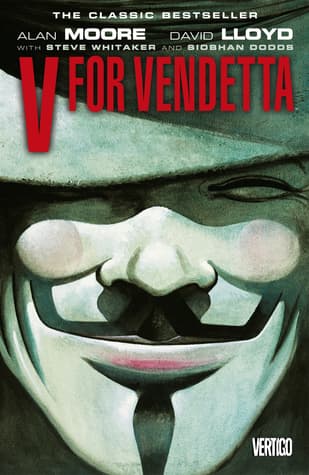
Alan Moore (1990)
Genre
Politics / Fantasy / Science Fiction
Reading Time
296 min
Key Themes
See below
Sign in to track this book
In a dystopian Britain ruled by a fascist regime, a mysterious anarchist in a Guy Fawkes mask sparks a rebellion against oppression, forcing a young woman to confront the cost of freedom and identity.
On November 4th, 1997, in a dystopian London controlled by the fascist Norsefire regime, sixteen-year-old Evey Hammond tries to prostitute herself to survive. Two 'Fingermen' (secret police) attack her, planning to rape and murder her. A mysterious anarchist in a Guy Fawkes mask, V, rescues her easily. V then takes Evey to a rooftop to watch him destroy the Houses of Parliament on November 5th, set to Tchaikovsky's 1812 Overture. After this act of rebellion, V takes Evey back to his hidden lair, 'The Shadow Gallery,' a large underground bunker with art, books, and explosives. There, he reveals his plan to dismantle the Norsefire government.
V starts his campaign against the Norsefire regime, targeting people he holds responsible for his past suffering. He first kills Lewis Prothero, the former commander of the Larkhill resettlement camp and now the 'Voice of Fate' on the state's propaganda network. V drives him insane by re-enacting his past cruelties. Next, he murders Bishop Anthony Lilliman, a pedophile priest also involved with Larkhill, by making him confess his sins before poisoning him. His third target is Delia Surridge, the former chief medical researcher at Larkhill. V poisons her after she confesses her remorse and reveals details about the camp, including names of others involved and the nature of the experiments.
After Evey betrays V to Eric Finch, the Head of the Norsefire police force 'The Finger,' V stages her capture and imprisonment. Evey is put in solitary confinement, her head is shaved, and she is tortured. Her only comfort is a letter left by a fellow prisoner, Valerie Page, a lesbian actress imprisoned and killed at Larkhill. This experience breaks Evey, removing her identity and fear. When she is 'released,' she discovers that V himself orchestrated her entire ordeal. He had imprisoned her in a simulated cell within the Shadow Gallery. He reveals that this 'imprisonment' was to free her from her fears and the system, mirroring his own transformation. Initially angry, Evey eventually understands the experience's deep impact.
Detective Chief Inspector Finch, assigned to find V, begins to investigate the connections between V's victims. His investigation leads him to the ruins of the Larkhill resettlement camp. There, he discovers the truth: Larkhill was a concentration camp where political dissidents, homosexuals, and other 'undesirables' were imprisoned and experimented on. He learns that V was one of the survivors of these experiments. V gained enhanced physical and mental abilities and a strong desire for revenge against his captors and the system that created them. Finch's understanding of V's reasons grows, making him doubt the regime he serves.
V continues to destabilize Norsefire by taking over the 'Fate' propaganda network and interrupting its broadcasts with his own message. He urges the people to reject the government, to think for themselves, and to embrace freedom. This act, along with the earlier destruction of Parliament, creates widespread fear and chaos. The government, especially Adam Susan, the 'Leader,' struggles to maintain control as public trust erodes. V then destroys the Post Office Tower, the central hub of Norsefire's surveillance network, crippling the government's ability to monitor citizens and further plunging the city into anarchy.
As London falls into anarchy, Adam Susan, the Leader, withdraws further into isolation, finding comfort only in his computer, 'Fate.' He expresses his deep despair and fear of the chaos V has caused. Meanwhile, Finch, having understood V's origin and reasons, confronts Susan. He expresses his disappointment with the regime and reveals that V is not just a madman but a result of their own atrocities. Finch's loyalty is tested, and he questions the foundations of Norsefire's rule. He understands that V's actions, though violent, are a response to an even greater violence done by the state.
V plants explosives under Jordan Tower, the headquarters of the 'Eye' (the government's surveillance department), and Westminster Abbey, the seat of the 'Head' (the government's central command). He sends a message to Finch, inviting him to meet at the abandoned London Underground station that leads to the Shadow Gallery. Finch, having taken a hallucinogenic drug to sharpen his senses and overcome fear, tracks V there. They have a brief, philosophical talk, where V expresses his belief in the power of ideas and the certainty of change. V then provokes Finch into shooting him, fulfilling his own plan.
Mortally wounded by Finch, V stumbles back to the Shadow Gallery where Evey waits. He dies in her arms, his last words stressing the importance of continuing the fight for freedom. Evey, heartbroken but determined, puts on V's mask and costume, accepting his role. She places V's body on a bomb-laden train, which she sends to destroy the final symbolic targets: Jordan Tower and Westminster Abbey. This act completes V's plan to bring down the physical structures of Norsefire's power, leaving the people to build a new society from the old. Finch, witnessing the destruction, understands V's victory.
After V's death and the destruction of the main government buildings, London is in total anarchy. Evey, now fully taking on the identity of V, appears before the people, offering them hope and a vision of freedom. She inspires a young woman named Rose, who had been a victim of the regime, to join her cause. Evey also confronts Finch, who, disappointed with the Norsefire regime and seeing the power of V's ideas, decides not to oppose her. London's future is uncertain, but Evey, as the new V, is ready to guide it towards a free society, embodying the idea that 'ideas are bulletproof'.
The Protagonist/Anarchist
From a vengeful, solitary anarchist, V becomes a mentor who sacrifices himself to pass on his ideology and the mantle of 'V' to Evey, ensuring his idea lives on.
The Protagonist/Disciple
Evey transforms from a fearful, victimized girl into a resilient, independent anarchist who fully embodies the ideals of V and becomes his successor.
The Supporting/Investigator
Finch evolves from a loyal servant of the state to a disillusioned figure who understands V's cause and ultimately chooses not to oppose the new 'V'.
The Antagonist/Leader
Susan's reign from absolute control descends into paranoid isolation and utter despair as V systematically dismantles his regime.
The Supporting/Head of the Finger
Creedy remains a static figure of brutality, ultimately succumbing to the chaos he helped create.
The Supporting/Propagandist
Prothero descends from a powerful propagandist to a broken, insane victim of V's revenge.
The Supporting/Corrupt Cleric
Lilliman's corrupt life is cut short by V's vengeful justice, exposing the regime's moral bankruptcy.
The Supporting/Doctor
Surridge lives with the burden of her past until V brings her a peaceful, albeit forced, end.
The Mentioned/Inspiration
Valerie's spirit, preserved in her letter, inspires Evey to overcome fear and embrace freedom, extending her legacy beyond death.
The main theme of the book is the conflict between absolute state control (totalitarianism, represented by Norsefire) and radical individual freedom (anarchy, represented by V). Moore explores the appeal and dangers of both. Norsefire promises order and security at the cost of all personal liberty. V argues that true freedom can only exist without any government, even if it means temporary chaos. The story asks readers to consider the value of security versus freedom and what makes authority legitimate. V's actions aim not just to destroy a government but to inspire the people to self-govern.
“''People shouldn't be afraid of their government. Governments should be afraid of their people.'”
Many characters change in the story, especially Evey and V. V sheds his former identity to become a symbol, saying that 'underneath this mask there is more than just flesh. Beneath this mask there is an idea, Mr. Creedy, and ideas are bulletproof.' Evey's staged imprisonment and torture are meant to strip her of her old fears and self, letting her create a new, strong identity. This theme explores how people define themselves in oppressive societies, how trauma can change identity, and the power of taking on a new persona or ideal to make change. Finch also changes, questioning his identity as a loyal state servant.
“'Everybody is a book of blood; wherever we're opened, we're red.'”
V's initial reasons are deeply rooted in personal revenge for the atrocities committed against him and others at Larkhill. His systematic targeting of the camp's former officials is a clear act of retribution. However, the story also looks at the complex nature of justice. Is V's violent retribution justice, or just another cycle of violence? The story suggests that while revenge might start things, V's ultimate goal goes beyond personal revenge to achieve a larger form of societal justice—the liberation of the populace. Finch's investigation into Larkhill also questions the state's 'justice' versus V's.
“'Because while the truncheon may be used in lieu of conversation, words will always retain their power.'”
The book strongly emphasizes that ideas are more powerful and lasting than individuals or physical structures. V, by wearing a mask and adopting the persona of Guy Fawkes, intentionally becomes a symbol, not a man. This ensures his legacy can be carried on by anyone. His actions are theatrical and symbolic, meant to inspire the people and dismantle the symbolic pillars of the Norsefire regime (Parliament, Post Office Tower, Jordan Tower, Westminster Abbey). The idea of 'V' is ultimately passed to Evey, showing that the revolutionary spirit can be transferred and continue, proving that 'ideas are bulletproof'.
“'Anarchy wears two faces, both of them are mine. Despair alone is for the weak, the resigned, the acquiescent.'”
Norsefire keeps its power through widespread propaganda (the 'Voice of Fate'), constant surveillance (the 'Eye'), and a brutal secret police (the 'Finger'). The regime controls information, manipulates public opinion, and instills fear to prevent dissent. V directly challenges this control by taking over the 'Fate' network to broadcast his own message of freedom and by destroying the surveillance infrastructure. The book shows how easily a population can be manipulated and how important control over information is for a totalitarian state, making V's counter-propaganda and destruction of media hubs very effective.
“'Our masters have not been chosen by us... they are people who have stolen the world and become its kings.'”
A potent symbol of anonymity, rebellion, and the enduring power of an idea.
The Guy Fawkes mask is the central visual symbol of V. It serves multiple purposes: it conceals V's identity, allowing him to embody an idea rather than a specific person; it connects him to historical acts of rebellion against oppressive governments; and it becomes a powerful, recognizable icon for the revolutionary movement he inspires. By wearing the mask, V ensures that his message is bigger than himself, and that anyone can become 'V,' thus making the idea 'bulletproof.' Evey's adoption of the mask at the end signifies the continuation of this symbolic legacy.
V's hidden lair, representing his intellect, artistic sensibility, and the repository of lost culture.
The Shadow Gallery is V's vast, hidden underground bunker, filled with books, art, music, and the tools for his revolutionary acts. It serves as V's sanctuary, his base of operations, and a symbol of the culture and humanity that the Norsefire regime has suppressed. It showcases V's refined tastes and intellect, contrasting sharply with his violent methods. The gallery is a metaphor for the preservation of human creativity and knowledge against totalitarian censorship, and it is where Evey undergoes her transformative 'imprisonment,' learning from V's vast collection.
A catalyst for Evey's transformation and a symbol of enduring human spirit.
Valerie Page's letter, a testament of love, hope, and defiance written by a lesbian actress imprisoned at Larkhill, is a crucial plot device. Discovered by Evey during her 'imprisonment,' the letter provides Evey with a profound connection to human suffering and resilience. It serves as a moral compass and a source of strength, enabling Evey to overcome her fear and embrace her newfound freedom. The letter embodies the enduring power of individual spirit and identity even in the face of brutal oppression, directly inspiring Evey's transformation and her eventual embrace of V's ideals.
V's use of dramatic, symbolic acts to inspire fear and rebellion.
V's entire campaign is characterized by its theatricality and symbolic nature. From the synchronized destruction of Parliament with Tchaikovsky's 1812 Overture, to his carefully staged assassinations and his takeover of the 'Fate' network, V's actions are designed to be spectacles. This theatricality serves to both terrify the regime and inspire the populace, turning acts of terrorism into acts of liberation. It highlights V's understanding of mass psychology and the power of symbols to communicate complex messages and ignite revolutionary fervor, making his attacks not just physical but psychological.
A symbol of the regime's control over information and public perception.
The 'Fate' computer system and its associated propaganda network (the 'Voice of Fate') represent the Norsefire regime's absolute control over information, media, and public consciousness. Adam Susan, the Leader, is deeply attached to 'Fate,' viewing it as a symbol of his control and even a surrogate for affection. V's acts of taking over the network and later destroying the Post Office Tower (which houses the 'Eye' surveillance) directly challenge this control, aiming to dismantle the regime's ability to manipulate its citizens and force them to confront reality. It underscores the battle for truth and narrative in a totalitarian state.
“People should not be afraid of their governments. Governments should be afraid of their people.”
— V explains his philosophy to Evey, challenging the authoritarian Norsefire regime.
“Artists use lies to tell the truth, while politicians use them to cover the truth up.”
— V discusses the nature of deception and truth with Evey.
“There is no certainty, only opportunity.”
— V reflects on the unpredictable nature of life and revolution.
“A building is a symbol, as is the act of destroying it. Symbols are given power by people. Alone, a symbol is meaningless, but with enough people, blowing up a building can change the world.”
— V justifies his destruction of the Old Bailey to Evey.
“Happiness is the most insidious prison of all.”
— V critiques the complacency that allows tyranny to thrive.
“Our integrity sells for so little, but it is all we really have. It is the very last inch of us, but within that inch, we are free.”
— V speaks to Evey about maintaining personal freedom under oppression.
“The past can't hurt you anymore. Not unless you let it.”
— V encourages Evey to move beyond her traumatic past.
“We are told to remember the idea, not the man, because a man can fail. He can be caught, he can be killed and forgotten, but 400 years later, an idea can still change the world.”
— V explains the power of ideas over individuals, referencing Guy Fawkes.
“Violence can be used for good.”
— V defends his use of violence against the oppressive state.
“This visage, no mere veneer of vanity, is a vestige of the vox populi, now vacant, vanished.”
— V introduces himself with alliterative flair, emphasizing his role as a voice for the people.
“You wear a mask for so long, you forget who you were beneath it.”
— V reflects on identity and the effects of living a hidden life.
“The only verdict is vengeance; a vendetta, held as a votive, not in vain, for the value and veracity of such shall one day vindicate the vigilant and the virtuous.”
— V declares his mission of vengeance against those who wronged him.
“Ideas are bulletproof.”
— V asserts the enduring power of ideas, even in the face of physical destruction.
“Behind this mask there is more than flesh. Behind this mask there is an idea, Mr. Creedy, and ideas are bulletproof.”
— V's final words to Creedy, emphasizing his symbolic nature.
Ready to see how well you understood this book? Take our interactive quiz with 10 questions.
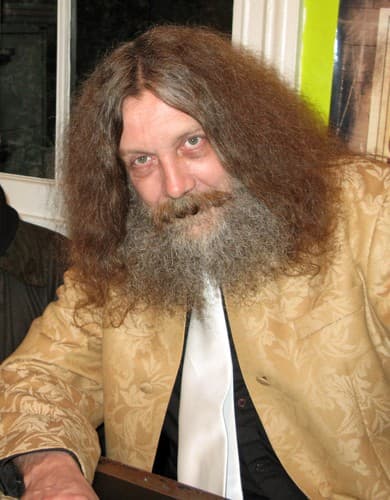
Alan Moore is an English author known primarily for his work in comic books including Watchmen, V for Vendetta, The Ballad of Halo Jones, Swamp Thing, Batman: The Killing Joke, and From Hell. He is widely recognised among his peers and critics as one of the best comic book writers in the English language. Moore has occasionally used such pseudonyms as Curt Vile, Jill de Ray, Brilburn Logue, and Translucia Baboon; also, reprints of some of his work have been credited to The Original Writer when Moore requested that his name be removed.

Brett Casper
5.0
Dirk Uffelmann
4.7

Winston S. Churchill
4.5

Chimamanda Ngozi Adichie
4.5
Will Durant
4.4
Thomas Sowell
4.4
W.E.B. Du Bois
4.3

Erich Fromm
4.3