BookBrief
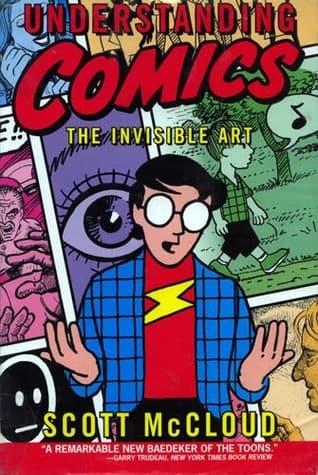
Understanding Comics: The Invisible Art cover
Archivist's Choice

Understanding Comics: The Invisible Art

Scott McCloud (1992)

Genre

Reference / History / Creativity

Reading Time

12 Minutes

Key Themes

See below

Track Your Reading

Sign in to track this book

Core Idea

Scott McCloud's "Understanding Comics" is a groundbreaking exploration of the medium of comics, arguing for its recognition as a unique and sophisticated art form rather than a mere genre or subset of literature/art. McCloud meticulously deconstructs the fundamental principles that govern how comics work, from the sequential nature of panels and the power of 'closure' (the mental act of perceiving the parts as a whole) to the symbolic language of lines, colors, and word balloons. He demonstrates that the 'invisible art' lies in the reader's active participation in bridging the gaps between panels, creating a dynamic narrative experience that leverages both visual and textual information in ways distinct from film, prose, or traditional painting. The book itself is a comic, using its own medium to illustrate its points, making it a meta-commentary on visual communication and storytelling.
Difficulty
Medium

Core idea

The central argument and framework that powers the entire book.

Scott McCloud's "Understanding Comics" is a groundbreaking exploration of the medium of comics, arguing for its recognition as a unique and sophisticated art form rather than a mere genre or subset of literature/art. McCloud meticulously deconstructs the fundamental principles that govern how comics work, from the sequential nature of panels and the power of 'closure' (the mental act of perceiving the parts as a whole) to the symbolic language of lines, colors, and word balloons. He demonstrates that the 'invisible art' lies in the reader's active participation in bridging the gaps between panels, creating a dynamic narrative experience that leverages both visual and textual information in ways distinct from film, prose, or traditional painting. The book itself is a comic, using its own medium to illustrate its points, making it a meta-commentary on visual communication and storytelling.

At a glance

Difficulty

Medium

Key Takeaways

1

Defining Comics Beyond Genre

Comics are a medium, not a genre, characterized by 'juxtaposed pictorial and other images in deliberate sequence.'

Quote

Comics as a whole is a medium. Like film and literature, it is a vessel that can hold any number of ideas and images.

McCloud's main point redefines comics, moving past common ideas that limit them to children's entertainment or just superheroes. He says comics are a distinct medium, like film or books, able to express any story or idea. This difference is important because it frees comics from narrow genre expectations, allowing a wider view of their artistic potential. By focusing on 'juxtaposed pictorial and other images in deliberate sequence,' McCloud gives a flexible definition that includes everything from newspaper strips to graphic novels, s...

Supporting evidence

McCloud dedicates the entire first chapter, 'Setting the Record Straight,' to meticulously defining comics, presenting various historical examples from ancient Egyptian hieroglyphs to the Bayeux Tapestry to illustrate the enduring principle of sequential art.

Apply this

When evaluating or creating sequential art, focus on the deliberate arrangement of images and text to convey meaning, rather than being constrained by genre conventions. Consider how different sequences evoke varied emotional responses or narrative pacing.

2

The Power of Closure

Readers actively participate in creating meaning by bridging the gaps between panels, a process called 'closure.'

Quote

The reader plays an important part in every comic. By taking very different images and mentally transforming them into a single continuous reality.

Closure is McCloud's most well-known idea, showing the unspoken agreement between creator and reader. It describes how the reader sees individual parts (panels) but understands them as a whole, filling in missing information or action between each panel. This active role makes the reader a key co-creator of the story. McCloud sorts different types of panel-to-panel changes (moment-to-moment, action-to-action, subject-to-subject, scene-to-scene, aspect-to-aspect, non-sequitur), showing how each type guides the reader's closure process ...

Supporting evidence

McCloud devotes Chapter 3, 'Blood in the Gutter,' to a detailed exploration of closure, using numerous examples of panel transitions to illustrate how readers mentally complete actions or bridge time and space.

Apply this

As a creator, strategically use different panel transitions to control pacing, evoke emotions, or encourage reader engagement. As a reader, become more aware of how your mind fills the 'gutter' and how creators guide that process.

3

The Icon and the Abstract

The simplicity of cartooning allows for universal identification and deep reader immersion.

Quote

When you enter the world of the cartoon, you grant it a portion of your identity. You see yourself in the cartoon.

McCloud argues that simple, iconic cartoon characters, often seen as 'less realistic,' actually help readers identify more. Unlike very detailed, realistic drawings that show specific people, abstract cartoons become a 'mask' readers can wear, putting themselves in the character's place. This idea explains why characters like Mickey Mouse or Charlie Brown are popular everywhere; their simplicity allows for a broader, more universal connection. This concept questions the common belief that realism equals immersion, showing that abstrac...

Supporting evidence

Chapter 2, 'The Vocabulary of Comics,' extensively discusses the 'triangle of reality,' illustrating how characters range from realistic (photographic) to iconic (cartoons), arguing for the immersive power of the latter.

Apply this

When designing characters, consider the balance between detail and abstraction. For universal appeal and reader identification, simpler, more iconic designs can often be more effective than hyper-realistic ones.

4

Time and Space in the Panel

Comics manipulate both time and space within and between panels, creating unique narrative rhythms.

Quote

Comics panels are not merely containers for information. They are also containers for time.

McCloud carefully explains how comics control the reader's experience of time. Unlike film, where time moves in a line, comics allow for a flexible, non-linear flow. A single panel can show a frozen moment, a long period, or even multiple moments at once. The space between panels (the 'gutter') signals the passage of time, which the reader actively interprets. This control of time and space is a main part of comics' unique storytelling power, letting creators set the pace, build tension, or highlight specific moments in ways different...

Supporting evidence

Chapter 4, 'Time Frames,' analyzes various methods of depicting time within and across panels, including techniques like motion lines, multiple images in a single panel, and the strategic use of panel shape and size.

Apply this

Experiment with panel layout, size, and content to control the reader's perception of time. Use smaller, numerous panels for quick action, or larger, fewer panels for extended moments of contemplation or dramatic pauses.

5

The Six Steps of Creativity

Artistic creation follows a hierarchical process from idea to surface.

Quote

Every act of creation follows a path. From the most abstract to the most concrete.

McCloud outlines a general model of artistic creation, useful beyond comics, with six steps: Idea/Purpose, Form, Idiom, Structure, Craft, and Surface. This order suggests that a strong creative work starts with a clear purpose and slowly takes shape through choices of medium, style, story structure, execution skills, and finally, the physical presentation. This framework is very practical, giving creators a guide and critics a way to analyze creative works. While the ordered nature might be debated (creativity is often non-linear), it...

Supporting evidence

Chapter 7, 'The Six Steps,' details each stage with examples, from the abstract concept of 'purpose' to the concrete 'surface' of the finished art, using famous comic artists' work as illustrations.

Apply this

When embarking on a creative project, consciously move through these steps. Start with a clear 'idea' and then make deliberate choices about 'form' (medium), 'idiom' (style), 'structure' (narrative), 'craft' (skills), and 'surface' (presentation).

6

Word and Picture Integration

Comics uniquely combine words and pictures in a symbiotic relationship, enhancing meaning beyond either element alone.

Quote

In comics, words and pictures are like partners in a dance, each responding to the other, each adding to the other's meaning.

McCloud looks at how words and pictures interact in comics, going beyond simple repetition where text just describes what's seen. He names seven types of word-picture combinations: Word Specific, Picture Specific, Duo-Specific, Additive, Parallel, Montage, and Interdependent. The 'Interdependent' category is especially insightful, showing cases where words and pictures contribute equally to a meaning neither could convey alone. This combined relationship is a defining feature of comics, allowing for a richness and layering of informat...

Supporting evidence

Chapter 5, 'A Word About Words,' meticulously categorizes and illustrates the seven types of word-picture combinations, providing numerous comic strip examples to clarify each relationship.

Apply this

When creating comics, consciously consider how words and pictures can complement, contradict, or transform each other's meaning, striving for interdependent relationships to create deeper impact. As a reader, analyze how the interplay of text and image shapes your interpretation.

7

The Invisible Art

The true artistry of comics often lies in the un-drawn, the unseen, and the reader's mental participation.

Quote

The art of comics is not just in what is drawn, but in what is left out. The invisible art.

This concept, central to the book's title, sums up McCloud's idea that comics' power largely comes from what is not directly shown. The 'invisible art' refers to the mental work the reader does through closure, identifying with abstract characters, and interpreting implied time and space. The gutters between panels, the simplified faces, the suggested actions—these are all deliberate omissions that invite the reader's imagination to complete the story. This makes comics a uniquely participatory art form, where the audience actively ...

Supporting evidence

This theme is woven throughout the book, particularly in discussions of closure (Chapter 3) and the iconic nature of cartoons (Chapter 2), where the reader's mental contribution is emphasized as paramount.

Apply this

As a creator, embrace the power of suggestion and omission. Trust your audience to fill in gaps, allowing for a more engaging and personal experience. As a reader, be mindful of your own active role in constructing the narrative.

8

Line as Emotion and Meaning

The physical characteristics of lines and art styles convey emotional and conceptual information.

Quote

Every line drawn is a choice. A choice that can communicate not just form, but feeling, speed, and even sound.

McCloud explores how lines themselves can express meaning, beyond just depicting objects. He shows how different line thickness, texture, direction, and shape can communicate speed, mood, sound, and even abstract ideas. A jagged line might suggest anger or impact, while a smooth, flowing line implies grace or calm. This analysis highlights how the 'surface' of a comic, the actual drawing, is full of meaning, acting as a direct channel for emotional and sensory information. This detailed look at visual communication shows McCloud's ana...

Supporting evidence

Chapter 6, 'Show and Tell,' examines how various artistic conventions, including line quality, color, and lettering, contribute to the emotional and sensory experience of comics, with numerous visual examples.

Apply this

When drawing, consciously consider the emotional weight and communicative power of your lines. Experiment with different line qualities to evoke specific feelings or sensations in your audience. As a reader, pay attention to how the artist's line work influences your emotional response.

9

Comics as a Universal Language

The visual nature of comics allows for communication across linguistic and cultural barriers.

Quote

The language of comics is a truly universal one. It transcends words, embracing readers of all nations and ages.

McCloud proposes that because comics rely heavily on visual communication, they have a unique ability to cross language and cultural barriers. While text is specific to a language, images often carry more universal meaning, allowing stories to be understood by diverse audiences without translation. This inherent universality makes comics a strong tool for cross-cultural communication and education. Although cultural differences in visual symbols can still exist, the basic principles of sequential art and iconic representation offer an...

Supporting evidence

McCloud frequently references the global reach and historical use of sequential imagery, from ancient Egyptian art to international comics, to support the idea of a universal visual language, particularly in Chapter 8, 'A Revolution in Progress.'

Apply this

When creating comics for a global audience, prioritize clear visual storytelling and iconic imagery. When consuming comics from different cultures, appreciate how the visual narrative communicates even when textual elements are unfamiliar.

10

The Future of Comics is Limitless

Comics are an evolving art form with untapped potential for digital and interactive innovation.

Quote

The future of comics is not in replicating the past, but in exploring the vast, uncharted territory that lies ahead.

Written in 1992, McCloud's forward-thinking analysis predicts the digital revolution, imagining how new technologies could expand comics. He discusses concepts like infinite canvases, interactive narratives, and non-linear storytelling, all of which have become more relevant with webcomics, digital comics, and multimedia experiences. This foresight shows his deep understanding of the medium's core principles, which remain adaptable regardless of the platform. While the book mainly focuses on print comics, its closing arguments emphasi...

Supporting evidence

Chapter 9, 'Comics and the Digital Revolution,' speculates on the future of comics, anticipating technological advancements like digital distribution, hypertext narratives, and interactive elements, proving remarkably prescient.

Apply this

As creators, embrace new technologies and platforms to push the boundaries of sequential art, experimenting with non-linear narratives, animation, and interactivity. As enthusiasts, seek out and support innovative digital comic experiences.

Critical analysis

Notable Quotes

Quiz

Test Your Knowledge

Ready to see how well you understood this book? Take our interactive quiz with 10 questions.

10
Questions
~5
Minutes
?
Best Score

Key Questions (FAQ)

'Understanding Comics' is a seminal examination of comics art, exploring its rich history, technical components, and cultural significance. It delves into the visual language and storytelling techniques unique to the medium, making it a foundational text for understanding comics.

About the author