“The wild is not a place, but a process.”
— A foundational idea throughout the collection, emphasizing dynamic interaction over static location.

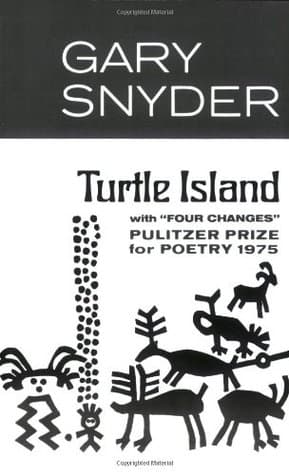
Gary Snyder (1974)
Genre
Philosophy
Reading Time
180 min
Key Themes
See below
Sign in to track this book
Gary Snyder's "Turtle Island" asks readers to let go of a colonizer's mindset and reconnect with North America, using poetry, myth, and a strong call for environmental action.
“The wild is not a place, but a process.”
— A foundational idea throughout the collection, emphasizing dynamic interaction over static location.
“We are all an intelligent part of the earth.”
— Highlighting human embeddedness within the natural world, rather than separation.
“The most important thing is to be in touch with the sources of life.”
— A call to reconnect with fundamental natural rhythms and energies.
“To live lightly on the earth.”
— A concise expression of ecological responsibility and sustainable living.
“Walk out on the tongue of the land and feel the great earth breathing.”
— An evocative image of direct sensory engagement with the living planet.
“The house is the human body, the yard is the universe.”
— A poetic metaphor for the interconnectedness of self and cosmos.
“Find your place on the planet. Dig in, and take responsibility from there.”
— An exhortation to local engagement and bioregional awareness.
“Culture is the way you work with the land.”
— Redefining culture as an ecological practice, not just an artistic or social construct.
“We are creatures of the earth, and to deny that is to deny our own nature.”
— Emphasizing the biological and ecological basis of human existence.
“The work of the poet is to bring the world alive.”
— Speaking to the role of art and language in fostering ecological awareness.
“Turtle Island, the old name for the continent, is a name for where we live.”
— Introducing the central metaphor of the book, a call for a new, indigenous-inspired identity for North America.
“The earth is not a platform for human life. It is a living being of which we are a part.”
— Challenging anthropocentric views and advocating for a biocentric perspective.
“To be truly alive, one must be in touch with the flow of the seasons, the cycles of life and death.”
— Underlining the importance of natural cycles for human vitality and understanding.
“The liberation of the wild is the liberation of ourselves.”
— Suggesting that ecological freedom is inextricably linked with human freedom and well-being.
Ready to see how well you understood this book? Take our interactive quiz with 10 questions.

Biography coming soon.

Jeff Olson
4.4
Thomas Sowell
4.4
Walter Brueggemann
4.3
Rhonda Byrne
4.3

Robin Wall Kimmerer
4.3
George S. Clason
4.3
Elliot Aronson
4.3
Joseph Campbell
4.3