BookBrief
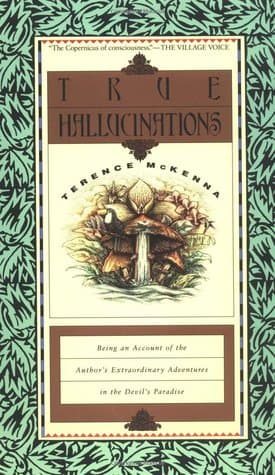
True Hallucinations cover
Archivist's Choice

True Hallucinations

Terence McKenna (1993)

Genre

Lifestyle / Biography / Memoir / Science / Philosophy

Reading Time

6-8 hours

Key Themes

See below

Track Your Reading

Sign in to track this book

Terence McKenna recounts his Amazonian journey with psychoactive plants, exploring the line between madness and enlightenment and questioning our ideas about time and consciousness.

Core Idea

Terence McKenna's 'True Hallucinations' tells of his 1971 trip to La Chorrera, Colombia, with his brother Dennis and others, where they took large doses of psilocybin mushrooms. This event, called 'The Strophariad,' led to a shared hallucinatory 'Logos' experience. They believed they contacted an intelligent, hyper-dimensional entity speaking through the mushroom. The book looks at the intellectual results of this event, which formed the basis for McKenna's later theories. These include 'Novelty Theory' and 'Time Wave Zero,' which suggest an accelerating increase in complexity and newness, ending in a transcendental point at the close of history. The book argues that psychedelics can show us the true, hyper-connected nature of reality, challenge common scientific and historical views, and propose a new way to understand human consciousness and its possibilities.
Reading time
6-8 hours
Difficulty
Hard
✓ Read this if...
You are fascinated by psychedelic experiences, speculative philosophy, alternative theories of time and consciousness, or the intersection of ethnobotany, mysticism, and science. You enjoy narrative memoirs that delve deep into subjective, mind-altering journeys and their profound philosophical implications.
✗ Skip this if...
You prefer empirically grounded science, are uncomfortable with detailed accounts of drug-induced altered states, or find highly speculative, non-linear philosophical discourse challenging or unconvincing. This book is not for those seeking conventional memoir or objective scientific analysis.

Core idea

The central argument and framework that powers the entire book.

Terence McKenna's 'True Hallucinations' tells of his 1971 trip to La Chorrera, Colombia, with his brother Dennis and others, where they took large doses of psilocybin mushrooms. This event, called 'The Strophariad,' led to a shared hallucinatory 'Logos' experience. They believed they contacted an intelligent, hyper-dimensional entity speaking through the mushroom. The book looks at the intellectual results of this event, which formed the basis for McKenna's later theories. These include 'Novelty Theory' and 'Time Wave Zero,' which suggest an accelerating increase in complexity and newness, ending in a transcendental point at the close of history. The book argues that psychedelics can show us the true, hyper-connected nature of reality, challenge common scientific and historical views, and propose a new way to understand human consciousness and its possibilities.

At a glance

Reading time

6-8 hours

Difficulty

Hard

Read this if...

You are fascinated by psychedelic experiences, speculative philosophy, alternative theories of time and consciousness, or the intersection of ethnobotany, mysticism, and science. You enjoy narrative memoirs that delve deep into subjective, mind-altering journeys and their profound philosophical implications.

Skip this if...

You prefer empirically grounded science, are uncomfortable with detailed accounts of drug-induced altered states, or find highly speculative, non-linear philosophical discourse challenging or unconvincing. This book is not for those seeking conventional memoir or objective scientific analysis.

Key Takeaways

1

The Archaic Revival

Reconnecting with ancient shamanic practices as a path to planetary healing.

Quote

The Archaic Revival is a clarion call to re-embrace the shamanic worldview, to heal the rift between humanity and nature, and to reawaken our collective connection to the numinous.

McKenna believes modern society suffers from a spiritual illness, a disconnect from nature and our inner selves. He argues that ancient shamanic cultures, especially those using psychedelic plants, held keys to a more balanced life. The 'Archaic Revival' is his idea for society to return to these basic ways of seeing reality, focusing on direct spiritual experience, ecological awareness, and bringing altered states of consciousness back into culture. He thinks this revival is essential for the planet's survival, offering a solution to...

Supporting evidence

McKenna's entire Amazonian journey, particularly his experiences with ayahuasca and psilocybin, serve as the foundational evidence. He points to the ecological wisdom of indigenous tribes and their respectful relationship with plant teachers as a model for the West.

Apply this

Explore ethnobotanical literature and history. Consider responsible, guided experiences with entheogens (where legal) to gain personal insight. Engage in practices that foster a deeper connection to nature, such as forest bathing or permaculture. Support indigenous rights and traditional ecological knowledge.

archaic-revivalshamanismethnobotany
2

The Strophariad and the Mushroom

Psilocybin mushrooms as a catalyst for human evolution and consciousness.

Quote

The mushroom is not merely a drug; it is a teacher, a guide, a sentient entity capable of communicating profound truths about the universe and our place within it.

McKenna gives psilocybin mushrooms (Stropharia cubensis) an important role in the development of human consciousness and language. He called this the 'Stoned Ape' theory. While not fully detailed in this memoir, the book vividly shows his deep experiences with these fungi. He describes the mushroom as a conscious entity, a 'teacher' that provides information, creates synesthesia, and dissolves ego boundaries, leading to direct encounters with archetypes and new insights. His experiences in La Chorrera, in particular, highlight the mus...

Supporting evidence

Chapters 19 and 20, 'The Coming of the Strophariad' and 'The Hawaiian Connection,' detail his personal and collective experiences with psilocybin. His descriptions of 'machine elves' and the 'logos' are direct results of these encounters.

Apply this

Approach altered states with reverence and a set intention for learning. Research the historical and cultural significance of psilocybin. Engage in deep introspection and journaling after such experiences (if undertaken responsibly and legally) to integrate insights.

psilocybinstoned-ape-theoryentheogens
3

The Logos and Hyper-Dimensionality

Direct experience of a conscious, communicating principle underlying reality.

Quote

The Logos is not merely an idea; it is a living, breathing, communicating intelligence that can be directly apprehended in states of profound psychedelic ecstasy.

A repeated theme in McKenna's Amazonian journey is the direct understanding of the 'Logos'—a universal, self-expressing, and often visual language or intelligence he found during his deepest psychedelic states. This Logos appeared as 'machine elves,' quickly changing fractal patterns, or a clear sense of information being downloaded into his mind. He sees this not as mere hallucination, but as a glimpse into a higher dimension of reality, where information and meaning are perceived in their rawest form, beyond the limits of linear tho...

Supporting evidence

His descriptions in 'A Violet Psychofluid,' 'The Opus Clarified,' and 'In the Vortex' are replete with encounters with the Logos, characterized by rapid-fire visual and auditory information, often described as 'self-transforming, self-dribbling, self-illuminating jewel-like structures.'

Apply this

Practice meditation and mindfulness to cultivate heightened awareness. Explore non-linear thinking and creative expression. Be open to experiences that challenge conventional notions of reality and communication. Read about theories of consciousness and information.

logoshyperdimensionalityconsciousness
4

Time Wave Zero and Novelty Theory

A fractal model of time predicting an accelerating increase in novelty.

Quote

History is the shockwave of eschatology. It is the unfolding of a process that is moving toward a point of infinite novelty, a singularity at the end of time.

While not fully detailed in its mathematical complexity, the start of McKenna's 'Time Wave Zero' and 'Novelty Theory' is tied to his psychedelic experiences, especially the 'I Ching' insights from his La Chorrera experiment. He suggests that time is not linear but fractal, marked by an accelerating increase in 'novelty'—the density of interconnectedness, complexity, and unique events. This theory proposes that history is moving towards a singularity, a point of infinite novelty, which he initially linked to December 21, 2012. The book...

Supporting evidence

Chapters 10, 'More on the Opus,' and 11, 'The Experiment at La Chorrera,' describe the intellectual ferment and 'I Ching' calculations that led to the initial formulation of his time theory, born from his intense psychedelic insights.

Apply this

Study fractal geometry and complex systems theory. Reflect on historical patterns of innovation and societal change. Consider how personal and collective experiences of time might be non-linear. Avoid dogmatic adherence to specific end dates, focusing instead on the underlying concept of accelerating change.

time-wave-zeronovelty-theoryeschatology
5

The Amazon as a Living Library

The rainforest as a repository of immense biological and spiritual wisdom.

Quote

The Amazon is not just a collection of trees and animals; it is a vast, interconnected intelligence, a living library of solutions to biological and spiritual problems.

McKenna shows the Amazon Basin not just as a setting for his adventures, but as a dynamic, conscious entity, a 'living library' of unmatched biodiversity and ethnobotanical knowledge. His search for psychoactive plants came from a deep respect for the rainforest's wisdom, seeing its plants as teachers and its indigenous people as guardians of ancient secrets. He regrets the destruction of this vital ecosystem, knowing that with every lost species, humanity loses valuable potential insights into medicine, consciousness, and sustainable...

Supporting evidence

The entire journey, from 'Into the Devil's Paradise' to 'At Play in the Fields of the Lord,' is an exploration of the Amazon's botanical wonders and the indigenous knowledge surrounding them, particularly regarding ayahuasca and psilocybin.

Apply this

Support rainforest conservation efforts. Learn about ethnobotanical research and traditional plant medicines. Advocate for sustainable practices and indigenous rights. Spend time in nature to cultivate a deeper appreciation for biodiversity.

ethnobotanyamazon-conservationbiodiversity
6

The Role of the Shaman

The shaman as a cartographer of consciousness and bridge to other realities.

Quote

The shaman is not a priest or a guru; they are a scientist of the spirit, a voyager who maps the unseen dimensions of reality for the benefit of their community.

McKenna's personal journey reflects the role of a shaman, though he is a self-taught, Westernized one. He sees the shaman as a key figure in society, one who deliberately enters altered states of consciousness to gather information, heal, and guide their community. Unlike Western science, which dissects and analyzes, the shamanic approach involves direct, hands-on engagement with the unknown. McKenna's own experiences with powerful plant teachers turned him into a 'cartographer of consciousness,' providing detailed accounts of his inn...

Supporting evidence

His interactions with indigenous shamans (though briefly mentioned) and his own deep dives into psychedelic states, particularly in chapters like 'A Brush with the Other' and 'In the Vortex,' illustrate this role of the voyager and interpreter of non-ordinary reality.

Apply this

Study comparative religion and anthropology, particularly shamanic traditions. Cultivate intuition and symbolic thinking. Understand that altered states are not just recreational but can be profound learning environments when approached with respect and intention. Seek out modern 'guides' or therapists who understand psychedelic integration.

shamanismaltered-statesconsciousness-exploration
7

Language as a Psychedelic Product

The idea that language itself emerged from psychedelic experiences.

Quote

Language is not merely a tool for communication; it is a psychedelic artifact, a direct product of our ancestors' encounters with mind-altering plants.

While often linked to his 'Stoned Ape' theory, McKenna's memoir implies that language, and the very structure of human thought, was greatly influenced by psychedelic experiences. He describes how the Logos he encountered felt like a direct, visual, and auditory stream of information, a 'proto-language' that bypassed normal syntax. This suggests that early humans, experiencing similar things through entheogens, might have been prompted to develop complex symbolic communication to describe these ineffable experiences. His own difficulti...

Supporting evidence

The intense synesthesia and direct information transfer described during his peak psychedelic experiences, particularly in 'A Violet Psychofluid' and 'The Opus Clarified,' where he perceives 'meaning' as a directly felt, visual, and auditory phenomenon, provides experiential evidence for this idea.

Apply this

Reflect on the power and limitations of language. Experiment with different forms of communication beyond words, such as art, music, or non-verbal cues. Consider the evolutionary origins of human cognition and creativity. Explore linguistic anthropology.

language-evolutionsynesthesiacognitive-origins
8

The Nature of Reality and Belief

Challenging conventional notions of objective reality through subjective experience.

Quote

Reality is not a fixed, objective construct, but a fluid, mutable landscape that can be re-perceived and re-negotiated through the lens of altered consciousness.

McKenna consistently questions the Western scientific paradigm's claim to be the only way to understand reality. His psychedelic experiences repeatedly show that 'reality' is far more complex, subjective, and changeable than commonly thought. He suggests that our everyday consensus reality is just one possible 'channel' of perception, and that psychedelics allow access to other, equally valid, or even more fundamental, channels. This doesn't mean everything experienced is 'real' in a conventional sense, but that the *experience itself...

Supporting evidence

Throughout the book, particularly in chapters like 'A Conversation Over Saucers' and 'Say What Does It Mean?', McKenna grapples with the implications of his experiences, questioning the nature of what he saw and heard, and how it relates to 'ordinary' reality. The sheer intensity and consistency of his visions, across multiple experiences, challenge simple dismissals as mere fantasy.

Apply this

Cultivate a healthy skepticism towards dogmatic beliefs, both scientific and spiritual. Explore philosophical concepts like idealism and solipsism. Engage in practices that expand your perception, such as lucid dreaming or sensory deprivation. Be open to the idea that your personal reality is constructed and can be deconstructed.

subjective-realityepistemologyconsciousness-studies
9

The Transformative Power of Crisis

Profound personal and collective crises as catalysts for growth and insight.

Quote

Sometimes, you have to be completely unhinged to truly see the hinges of the universe.

McKenna's Amazonian journey was not just a series of pleasant trips; it was a deep, often frightening, dive into the unknown, full of psychological and physical challenges. The 'experiment at La Chorrera,' in particular, pushed him and his companions to their limits, blurring the lines between sanity and madness. Yet, it was precisely in these moments of intense crisis and confusion that the most profound insights were gained, leading to his most important theories. He suggests that both individually and collectively, humanity often n...

Supporting evidence

The intense, often overwhelming and disorienting experiences described in 'The Experiment at La Chorrera' and 'In the Vortex,' where the group faced extreme psychological pressure and existential questioning, directly led to the breakthroughs in their understanding of time and the Logos.

Apply this

View personal challenges not just as obstacles, but as opportunities for profound learning and transformation. Embrace discomfort and uncertainty as potential catalysts for growth. Reflect on historical periods of crisis and their role in societal evolution. Develop resilience and practices for navigating intense experiences.

personal-transformationcrisis-as-opportunitypsychological-resilience
10

The End of History and the Human Future

The potential for a collective, consciousness-driven evolution beyond current human limitations.

Quote

We are standing at the edge of history, at the brink of a new kind of human being, one capable of directly apprehending the universe and steering its own evolution.

McKenna's story, especially in later chapters, hints at a radical future for humanity. Influenced by his Time Wave Zero theory and insights from his psychedelic explorations, he envisions an 'end of history' not as an apocalypse, but as a transition into a hyper-connected, high-novelty state of being. This future involves a collective awakening to our true potential, perhaps helped by entheogens, leading to an intuitive understanding of the universe and conscious participation in our own evolution. He suggests that humanity is close t...

Supporting evidence

His discussions in 'Say What Does It Mean?' and 'The Coming of the Strophariad' about the potential for human consciousness to evolve, and his broader theories of accelerating novelty leading to a singularity, all point to this optimistic yet radical vision for the future.

Apply this

Engage in critical thinking about technological and spiritual evolution. Consider the ethical implications of consciousness-altering substances and practices. Foster global cooperation and collective problem-solving. Cultivate a long-term, visionary perspective on humanity's potential.

posthumanismcollective-consciousnessfuture-of-humanity

Critical analysis

Notable Quotes

The cost of sanity in this society is a certain level of alienation.

Reflecting on the nature of 'normalcy' and the price of conformity.

Nature is not our enemy, to be raped and conquered. Nature is ourselves, to be cherished and explored.

A philosophical stance on humanity's relationship with the natural world.

The world is not made of atoms, it is made of stories.

Expressing a deeply subjective and narrative view of reality.

Psychedelics are illegal not because a loving government is concerned that you may jump out of a third-story window. Psychedelics are illegal because they dissolve opinion structures and cultural models.

Critiquing the societal and political reasons behind the prohibition of psychedelics.

The Archaic Revival is a call to break through the conditioning of history and to return to an archaic state of mind, one that is more in tune with nature and the collective unconscious.

Introducing the concept of the 'Archaic Revival' as a cultural and psychological movement.

Culture is not your friend.

A provocative statement challenging the inherent value and benefit of cultural constructs.

Ego is a structure built around a wound.

A psychological insight into the origins and nature of the ego.

The mushroom is a tool for the shaman, the psychonaut, the explorer of inner space.

Describing the role of psilocybin mushrooms in spiritual and exploratory contexts.

The alien is not 'out there,' but 'in here.'

Suggesting that the experience of the 'alien' is an internal, psychological phenomenon.

If the doors of perception were cleansed, everything would appear to man as it is, infinite.

Quoting William Blake, but using it to frame the potential of psychedelic experiences.

We are not to be saved by the government or by science or by a new religion. We are to be saved by ourselves, by our own consciousness, by our own awakening.

Emphasizing individual responsibility and internal transformation as the path to salvation.

The syntactical nature of reality, the real secret of magic, is that the world is made of words. And if you know the words, you can make of the world whatever you choose.

Exploring the idea that language and perception fundamentally shape reality.

History is the nightmare from which we are trying to awaken.

A critical view of history as a oppressive and limiting narrative.

Only in a world of illusion is it possible to speak of truth.

A paradoxical statement on the relationship between truth and illusion.

The universe is a 'novelty-generating engine.'

Describing the fundamental drive of the cosmos towards increasing complexity and newness.

Quiz

Test Your Knowledge

Ready to see how well you understood this book? Take our interactive quiz with 10 questions.

10
Questions
~5
Minutes
?
Best Score

Key Questions (FAQ)

'True Hallucinations' is Terence McKenna's memoir recounting his experiences with psychoactive plants in the Amazon Basin, exploring themes of mind, time, and the nature of reality through a highly personal and philosophical lens. It blends adventure, scientific inquiry, and profound speculation.

About the author