“I like work: it fascinates me. I can sit and look at it for hours.”
— Jerome reflecting on his approach to work and manual labor.

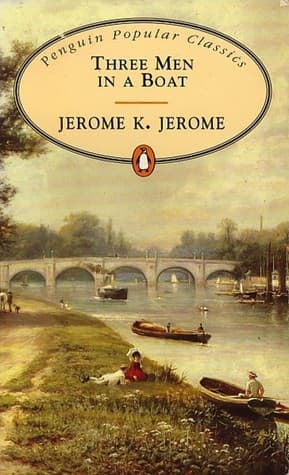
Jerome K. Jerome (1889)
Genre
Lifestyle
Reading Time
240 min
Key Themes
See below
Sign in to track this book
Three hypochondriac friends and a fox-terrier take a funny, disastrous trip on the Thames, dealing with bad weather and lost pineapple chunks, all while showing the fun of late-Victorian getaways.
The narrator, J., starts the story by describing a meeting with his friends, George and Harris, and his dog, Montmorency, in his room. All three men are sure they have various serious illnesses, which they diagnose themselves using medical books. J. thinks he has every known disease except housemaid's knee. George is sure he has worked too much, and Harris feels generally 'unwell.' After much talk about their terrible health, J. suggests that their real problem is 'overwork' and that a relaxing trip up the Thames is the only good cure. They reject a sea trip because of possible seasickness and the perceived boredom of land travel, eagerly choosing the river journey.
The men begin the difficult task of packing for their trip. J. remembers a bad past experience trying to pack a bag for a journey, where he carefully packed and repacked, only to find important items missing or misplaced. This time, the packing is just as messy. They argue about what to bring, often choosing unnecessary items and forgetting important ones. Harris takes charge of packing the food basket, which results in a funny jumble. Montmorency, J.'s fox-terrier, adds to the confusion by getting in the way, pretending to be packed, and generally causing trouble, much to the men's frustration. The process is full of disorganization, lost items, and general inefficiency, setting the tone for their journey.
The three friends, with Montmorency, finally leave Kingston. George will join them later because of work. J. and Harris, left alone, immediately face small problems. J. struggles with the tow-rope, getting tangled and causing some initial embarrassment. As they move along the river, J. mixes in historical stories and comments about the places they pass, often going into funny side stories about historical figures and events connected to the Thames. They pass Hampton Court, which makes J. recall its rich history, especially the story of Cardinal Wolsey and the various kings and queens who lived there, creating a clear picture of the past as their present journey continues.
As they go on, J. and Harris show a clear lack of skill in handling a boat. J. tells about his own earlier tries at learning to row, which always ended badly, often with him falling into the water or hitting other boats. Harris, though perhaps a bit more able, also makes mistakes. They struggle with simply mooring the boat, often floating past their planned spots. J. also thinks about river manners and the different kinds of people one meets, often with a funny, critical eye. Their combined inexperience leads to several close calls and small embarrassments, showing their amateur status on the water and giving J. plenty of material for his observant humor.
The first night of camping is hard. The men struggle to put up the tent, resulting in a funny mess of poles and canvas. Their attempts at cooking are even worse. They decide to make Irish stew, but their idea of 'stew' is very broad, including almost every leftover item they have, even a half-eaten plum pudding. The resulting mix is, to say the least, unappetizing. Later, they try to boil water for tea, but the kettle stubbornly refuses to boil, leading to much frustration and a funny discussion about kettles and the rules of heat. These household difficulties highlight their general clumsiness outside their city comfort zones.
George finally joins J. and Harris, bringing his banjo and a sense of calm, though he is not immune to the group's general clumsiness. Soon after he arrives, the men decide to open a tin of pineapple chunks. What should be a simple task turns into a long, funny fight. They try various tools – a penknife, scissors, a hammer, even their teeth – but the tin cannot be opened. Their frustration grows with each failed try, leading to tiredness and a feeling of defeat. Eventually, they smash it open with a large stone, only to find the pineapple inside is bruised and unappetizing. The event shows their wider struggles with simple tasks.
As they continue their journey, the men meet various people and problems common to river travel. They have a memorable interaction with a very slow and uncaring lock-keeper, whose relaxed pace tests their patience. The tow-rope often causes them trouble. They struggle with getting the rope tangled, finding good paths for towing, and dealing with its general inconvenience. J. often uses these moments to go into funny side stories about the perceived laziness or inefficiency of certain people they meet, or the natural difficulties of moving along the river with such a clumsy way of moving. These encounters show the charming, if sometimes annoying, realities of their adventure.
One of their planned stops is the Hampton Court Maze. J. tells a funny story about a man who confidently offered to guide a group through the maze, only to get completely lost himself, much to the amusement of those watching. The three friends decide to try it themselves, sure they can succeed where others failed. As expected, they too get lost almost immediately, wandering aimlessly through its twisting paths. Their initial confidence quickly disappears, replaced by frustration and a feeling of confused helplessness. The experience is another example of their overconfidence and later failure when faced with practical challenges, supporting the funny tone of their journey.
The nice weather they first had turns bad, bringing rain and discomfort. This change makes the men look for shelter and warmth. J. tells a funny story about a bottle of whisky. They think they have lost or run out of their whisky, leading to a frantic search. The search becomes increasingly desperate and over-the-top, with each man sure the other is to blame for its disappearance. The solution is anticlimactic and funny, showing the bottle was simply overlooked in a clear spot. This event, like many others, shows their collective forgetfulness and their habit of making minor problems seem like big dramas.
After several days on the river, marked by minor accidents, bad cooking, and general discomfort, the men decide they have had enough. The constant rain and the growing frustrations of river life weigh heavily on them. They conclude that the 'rest' they wanted has become harder than their 'overwork.' They choose to leave their boat and go home by train, a decision they make with relief and resignation. J. thinks about the trip, acknowledging its problems but also the friendship and funny memories made. Despite the mishaps, the experience has been memorable, if not entirely restful, and they return with a new appreciation for their comfortable city lives.
The Protagonist
J. starts as a self-absorbed hypochondriac but ends with a slightly more grounded, though still humorous, perspective on life's simple pleasures and challenges.
The Supporting
George maintains a relatively stable personality, serving as a foil to the more eccentric J. and Harris, but still succumbs to the overall comedic incompetence.
The Supporting
Harris's overconfidence is consistently undermined by his practical failures, highlighting the humor in his character without significant personal growth.
The Supporting
Montmorency remains consistently mischievous and trouble-seeking throughout the journey, a constant source of minor chaos.
The Mentioned
The lock-keepers serve as static, recurring comedic elements, embodying the minor frustrations of the journey.
The Mentioned
These figures are static and serve primarily as subjects for J.'s observational humor.
The whole idea of the trip, coming from imagined illnesses and a wish to escape 'overwork' that doesn't really exist, sets a silly tone. The men constantly make simple tasks too complicated, from packing a bag to opening a tin of pineapple, turning everyday activities into huge struggles. Their tries at camping, cooking, and navigating are full of funny failures, showing the common human tendency to mess up even the simplest plans. This theme is everywhere, appearing in almost every mishap and mistake, such as Harris's terrible packing or the kettle's refusal to boil, highlighting the funny uselessness of much human effort.
“It is a most extraordinary thing, but I never read a patent medicine advertisement without being impelled to the conclusion that I am suffering from the particular disease therein dealt with in its most virulent form.”
The Thames River itself is almost a character, shown with both respect for its beauty and a real look at its problems. J. often speaks highly of the beautiful scenery and historical importance of the riverbanks, enjoying the calm and natural beauty. However, this perfect vision is always set against the practical problems of river travel: unpredictable weather, difficult locks, the hard work of towing, and the general discomfort of camping. The river offers both escape and annoyance, reminding the reader that nature, though beautiful, is not always easy or helpful to human wishes, as seen when their clear skies turn to constant rain.
“How calm, how peaceful, how far removed from the toil and turmoil of the struggling world, seem the sleepy waters of the Thames!”
Despite their frequent arguments, mistakes, and frustrations with each other, the friendship between J., George, and Harris is central to the story. Their shared experiences, good and bad, make their connection stronger. They tease, argue, and sometimes blame each other, but they ultimately rely on one another. The humor often comes from their interactions and how they all react to problems. The journey, while physically challenging, ultimately strengthens their friendship, proving that shared difficulty, when seen with humor, can create lasting memories and stronger bonds. Their ability to laugh at themselves and each other is key to their lasting friendship.
“We are very good friends, we three. We are all of us, always, very pleased to see each other.”
The men start the trip looking for rest and an escape from 'overwork,' but the journey itself becomes a source of much hard work and stress. What begins as an ideal search for relaxation quickly turns into a series of physical and mental challenges, from the hard task of pitching a tent to the struggle with a stubborn kettle. The irony is that their pursuit of leisure leads to more work and discomfort than their supposed city problems. This theme shows the human tendency to romanticize escape, only to find that reality often interferes, making even 'rest' an effort. Their decision to return by train instead of continuing by boat shows this ironic truth.
“We had started that trip for rest and a change, and we had got them. And we had come to the conclusion that, so far as rest was concerned, there was a good deal to be said for the comforts of home.”
The narrator frequently deviates from the main plot to share humorous stories or historical facts.
J.'s narrative style is characterized by frequent digressions and anecdotes. These are often triggered by a current event or observation during the trip but quickly spiral into unrelated personal reminiscences, historical facts about the Thames, or humorous philosophical musings. For example, passing Hampton Court leads to a detailed account of Cardinal Wolsey. This device serves multiple purposes: it provides a break from the main plot's continuous action, allows J. to showcase his wit and erudition (or perceived erudition), and adds layers of humor and social commentary, often contrasting the past with the present or highlighting the absurdities of human nature.
The use of extreme overstatement for comedic effect.
Jerome K. Jerome frequently employs hyperbole to enhance the comedic effect of the men's predicaments. Their perceived illnesses are exaggerated to an absurd degree, as are the difficulties they face with simple tasks like packing or opening a tin of pineapple. The 'struggles' become epic battles, and minor inconveniences are blown out of proportion. This exaggeration highlights the men's impracticality and their dramatic reactions to the challenges of their journey, making their experiences far more humorous than they would be if described realistically. It transforms everyday blunders into memorable comedic set pieces.
A discrepancy between expectation and reality, often for humorous effect.
Situational irony is a core comedic device throughout the book. The men embark on a trip for 'rest' and 'cure,' only to find it more arduous and stress-inducing than their daily lives. They expect an idyllic river journey but encounter constant mishaps, bad weather, and their own incompetence. For instance, their confident attempts at simple tasks, like navigating a maze or cooking, invariably lead to failure. This contrast between their high expectations and the often-humbling reality of their experiences drives much of the humor, underscoring the theme of the absurdity of human endeavor and the unpredictable nature of life.
Attributing human characteristics or behavior to animals or inanimate objects.
While Montmorency is a dog, his actions are often described with human-like mischievous intent and understanding, contributing to the humor. More subtly, J. sometimes anthropomorphizes inanimate objects or abstract concepts, such as the 'obstinate' kettle that refuses to boil or the 'lazy' river. This device injects personality into the non-human elements of the story, making them active participants in the comedic chaos rather than passive backdrops. It allows J. to further exaggerate the men's struggles by portraying objects as actively working against them, adding to the whimsical tone.
“I like work: it fascinates me. I can sit and look at it for hours.”
— Jerome reflecting on his approach to work and manual labor.
“How many people, for instance, are aware that if you sit on a pin, you will get a pain in your back?”
— Jerome discussing the self-diagnosis of an illness by reading a medical dictionary.
“I have come to the conclusion that one of the most exasperating things in life is to be compelled to listen to a story which you know by heart, and which the narrator insists on telling you as if it were a new invention.”
— Jerome commenting on the tediousness of hearing familiar stories.
“It is a most extraordinary thing, but I never read a patent medicine advertisement without being impelled to the conclusion that I am suffering from the particular malady therein dealt with in its most virulent form.”
— Jerome humorously describing his hypochondria after reading medical advertisements.
“Let your boat of life be light, packed with only what you need - a homely home and simple pleasures, one or two friends, worth the name, someone to love and someone to love you, a cat, a dog, and a pipe or two, enough to eat and enough to wear, and a little more than enough to drink; for thirst is a dangerous thing.”
— Jerome offering a philosophy for a simple, fulfilling life.
“We are a nation of grumblers. We grumble at our food, we grumble at our climate, we grumble at our government, we grumble at ourselves.”
— Jerome observing the national characteristic of complaining.
“There were, of course, no children in our party. We were all bachelors, and therefore, of course, all exceedingly wise.”
— Jerome introducing the group of friends, with a touch of self-deprecating humor.
“It is impossible to get a boat's crew to pull together unless they are all of one mind, and that mind usually belongs to the cox.”
— Jerome reflecting on the challenges of teamwork, particularly in rowing.
“The greatest charm of the river is that it is always there, and always the same, and always different.”
— Jerome expressing his fondness and appreciation for the Thames River.
“I can resist everything except temptation.”
— A general humorous statement about human weakness, attributed to a character's thought process.
“It is a thing that always strikes me that the best type of man is he who can make a joke out of his own troubles.”
— Jerome reflecting on the resilience and humor of people in difficult situations.
“It is very easy to say that all you need is a good heart and a clear conscience; but if you go for a walk on a wet day, you will find that you need waterproof boots as well.”
— Jerome contrasting idealistic notions with practical necessities.
“One day, when the world is wide awake, and there is no more room for doubt, then men will understand that the only true wisdom is kindness.”
— A rare moment of serious reflection on the ultimate value of kindness.
“I wonder what we should do without the river. It is the only friend we have in this part of the world.”
— George expressing his affection for the river during their journey.
Ready to see how well you understood this book? Take our interactive quiz with 10 questions.
Biography coming soon.