BookBrief
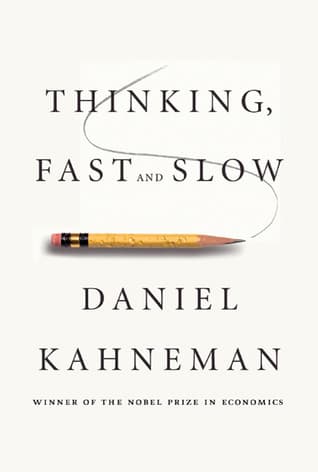
Thinking, Fast and Slow cover
Archivist's Choice

Thinking, Fast and Slow

Daniel Kahneman (2011)

Genre

Business / Economics / Science / Philosophy / Self-Help

Reading Time

12-15 hours

Key Themes

See below

Track Your Reading

Sign in to track this book

Explore how your mind's fast intuition clashes with slow logic, revealing the hidden biases that shape every decision, from investing to vacation planning.

Core Idea

The mind uses two systems: System 1 (quick, intuitive, emotional) and System 2 (slow, thoughtful, logical). System 1 is efficient but prone to biases that cause errors in judgment. System 2, though rational, often accepts System 1's suggestions without careful review. Understanding these systems and their biases helps individuals and organizations identify and reduce errors, improving decisions in all areas of life, from personal finance to public policy.
Reading time
12-15 hours
Difficulty
Hard
✓ Read this if...
You want to understand the fundamental psychological mechanisms behind human judgment and decision-making, and learn how to identify and potentially mitigate your own cognitive biases.
✗ Skip this if...
You are looking for a quick self-help guide with actionable bullet points for immediate life improvement, or you prefer fictional narratives over dense scientific exposition.

Core idea

The central argument and framework that powers the entire book.

The mind uses two systems: System 1 (quick, intuitive, emotional) and System 2 (slow, thoughtful, logical). System 1 is efficient but prone to biases that cause errors in judgment. System 2, though rational, often accepts System 1's suggestions without careful review. Understanding these systems and their biases helps individuals and organizations identify and reduce errors, improving decisions in all areas of life, from personal finance to public policy.

At a glance

Reading time

12-15 hours

Difficulty

Hard

Read this if...

You want to understand the fundamental psychological mechanisms behind human judgment and decision-making, and learn how to identify and potentially mitigate your own cognitive biases.

Skip this if...

You are looking for a quick self-help guide with actionable bullet points for immediate life improvement, or you prefer fictional narratives over dense scientific exposition.

Key Takeaways

1

Two Systems: Fast & Slow

Our minds operate with an intuitive System 1 and a deliberate System 2, each with unique strengths and pitfalls.

Quote

System 1 is fast, intuitive, and emotional; System 2 is slower, more deliberative, and more logical.

Kahneman introduces the idea that our minds use two systems. System 1 works automatically and quickly, with little effort or conscious control. It handles instant judgments, gut feelings, and many daily actions like driving or understanding simple sentences. System 2 focuses attention on mental tasks that require effort, such as complex calculations. It handles self-control, deliberate choices, and focusing on one voice in a noisy room. While System 1 is efficient, it is also prone to biases and shortcuts, which can mislead System 2 i...

Supporting evidence

The Stroop effect, where identifying the color of a word (e.g., 'red' written in blue ink) is difficult due to System 1's automatic reading, illustrates the conflict between the systems.

Apply this

When facing significant decisions, consciously pause and engage System 2. Ask probing questions, seek diverse perspectives, and challenge initial impressions to counteract System 1's biases. For routine tasks, trust System 1, but be aware of its potential for error.

system-1system-2cognitive-bias
2

The Power of Heuristics

Mental shortcuts (heuristics) simplify complex decisions but often lead to predictable errors and biases.

Quote

The lazy System 2 often endorses opinions of System 1 with little scrutiny.

Heuristics are mental shortcuts System 1 uses to make quick judgments and decisions, especially when things are uncertain. While often efficient, they can systematically differ from logic and probability, leading to cognitive biases. For example, the availability heuristic makes us overestimate the likelihood of events that are easily remembered (e.g., dramatic accidents over common illnesses). The representativeness heuristic causes us to judge probability by how much something matches a stereotype, ignoring basic rates. Kahneman exp...

Supporting evidence

The 'Linda problem,' where people judge it more probable that Linda is a bank teller *and* a feminist than just a bank teller, demonstrates the representativeness heuristic and the conjunction fallacy.

Apply this

Before making quick judgments, especially about people or probabilities, consider if you're falling prey to a common heuristic. Actively seek out base-rate information and challenge your initial prototypes. For example, when hiring, don't rely solely on a candidate's 'fit' with a stereotype; focus on objective criteria.

heuristicsavailability-heuristicrepresentativeness-heuristiccognitive-bias
3

Loss Aversion's Grip

The pain of losing is psychologically more powerful than the pleasure of gaining, profoundly shaping our choices.

Quote

The response to losses is stronger than the response to gains.

Loss aversion is a key concept in prospect theory, showing that people prefer avoiding losses over gaining an equivalent amount. The psychological effect of losing something is about twice as strong as the pleasure of gaining the same thing. This difference has significant effects across personal finance, business strategy, and even daily negotiations. It explains why people hold onto losing investments too long, why employees resist pay cuts more strongly than they want equivalent raises, and why consumers are more sensitive to price...

Supporting evidence

Studies showing that people are less willing to give up a mug they've been given than they are to pay for an identical mug, even if the values are objectively the same (endowment effect, a manifestation of loss aversion).

Apply this

When presenting options, frame them in terms of potential gains and avoided losses to influence decisions. For personal finance, be aware of loss aversion when considering selling investments; set clear exit strategies. In negotiations, understand that concessions will feel like greater losses to the other party than they feel like gains to you.

loss-aversionprospect-theoryendowment-effectframing
4

Overconfidence & Illusion of Control

We systematically overestimate our abilities and the predictability of the future, leading to risky decisions.

Quote

The confidence that individuals have in their beliefs depends mostly on the quality of the story they can tell about what they see, even if they see little.

Kahneman details how overconfidence affects human judgment, especially among experts. We tend to believe we control outcomes more than we do and are too optimistic about our predictions, even when evidence suggests otherwise. This 'illusion of control' and 'planning fallacy' leads to failed projects, over-budget spending, and missed deadlines. The narrative fallacy adds to this, as we create clear stories from limited information, mistaking a clear story for an accurate one. This overconfidence is often strengthened by 'hindsight bias...

Supporting evidence

Studies of financial analysts consistently showing that their predictions for stock performance are no better than chance, despite their high confidence. Also, the planning fallacy, where large public projects almost always go over budget and time.

Apply this

Before committing to a plan, conduct a 'premortem' exercise: imagine the project has failed a year from now and brainstorm all the reasons why. Seek external, objective data and 'outside view' statistics rather than relying solely on internal, 'inside view' projections. Actively solicit dissenting opinions to challenge your assumptions.

overconfidenceplanning-fallacyhindsight-biasillusion-of-control
5

The Framing Effect

How information is presented significantly alters our choices, even if the underlying facts remain the same.

Quote

The framing of choices matters.

The framing effect shows that how options are presented can greatly change preferences, even if the actual outcomes are the same. For example, a treatment described as having a '90% survival rate' is more appealing than one with a '10% mortality rate,' even though both mean the same thing. This bias happens because System 1 processes information quickly and emotionally, often reacting to the positive or negative words used rather than logically evaluating the facts. Understanding framing is important for anyone involved in communicati...

Supporting evidence

The 'Asian Disease Problem' experiment, where people chose different public health programs based on whether outcomes were framed in terms of lives saved (gain frame) or lives lost (loss frame), even when the statistical outcomes were identical.

Apply this

When making important decisions, reframe the options yourself. Consider both positive and negative framings to ensure you're making a choice based on the substance, not just the presentation. When communicating, be mindful of how your framing influences others and strive for neutral presentation where objectivity is paramount.

framing-effectcognitive-biasprospect-theorydecision-making
6

Anchoring's Subtle Pull

An initial piece of information (the anchor) disproportionately influences subsequent judgments, even if irrelevant.

Quote

The anchoring effect is one of the most reliable and robust findings of experimental psychology.

Anchoring describes our tendency to rely too much on the first piece of information given (the 'anchor') when making decisions. Even random or irrelevant numbers can strongly influence our later estimates and judgments. For instance, if asked to guess the age of a historical figure after being shown a high or low random number, our guess will lean towards that initial number. This bias occurs because System 1 quickly accepts the anchor as a reasonable starting point, and System 2 then does not adjust enough away from it. This has majo...

Supporting evidence

Experiments where participants spun a 'wheel of fortune' with numbers 0-100, then were asked to estimate the percentage of African countries in the UN. Their estimates were strongly correlated with the randomly generated number they landed on.

Apply this

When negotiating, be aware of the initial offer or counter-offer as an anchor. If you're the seller, consider setting a high anchor; if you're the buyer, be prepared to make a strong counter-anchor. When making estimates, actively consider alternative starting points and challenge initial numbers to avoid undue influence.

anchoring-effectcognitive-biasnegotiationpricing
7

Remembered vs. Experienced Utility

Our memory of an experience (remembered utility) often distorts the actual pleasure or pain we felt (experienced utility).

Quote

We don't choose between experiences, we choose between memories of experiences.

Kahneman distinguishes between the 'experiencing self' (who lives in the present and feels pleasure and pain) and the 'remembering self' (who keeps track, tells stories, and makes future decisions). The remembering self is heavily influenced by two biases: the 'peak-end rule' (how an experience felt at its most intense point and at its end) and 'duration neglect' (the length of the experience has little effect on memory). This means we often choose future experiences based on flawed memories, not on what truly brought us pleasure or p...

Supporting evidence

The colonoscopy experiment: patients rated their pain during the procedure and then recalled it later. Those whose procedures ended less painfully, even if they were longer, reported less overall remembered pain than those with shorter, more painful ends.

Apply this

To improve your 'experienced utility,' focus on the present moment and savor positive experiences. To improve your 'remembered utility,' try to end experiences on a positive note. When planning, consider how an experience will *feel* throughout, not just how it will look in retrospect or at its peak.

experiencing-selfremembering-selfpeak-end-ruleduration-neglecthappiness
8

The Narrative Fallacy

We crave coherent stories to make sense of the world, often at the expense of accuracy and statistical reality.

Quote

The ultimate test of an explanation is whether it would have made the event predictable in advance.

The narrative fallacy is our tendency to create clear, believable stories from limited information, even when those stories oversimplify complex realities or ignore randomness. System 1 dislikes uncertainty and seeks meaning, so it quickly weaves different facts into a compelling story. This often leads to hindsight bias, where events that were truly unpredictable seem obvious later. We give credit for skill where luck was a major factor, and we underestimate the role of chance in success and failure. This bias makes us too confident ...

Supporting evidence

The consistent tendency to attribute the success of companies or individuals solely to their character traits or strategic decisions, overlooking the significant role of luck, market conditions, and unpredictable external factors.

Apply this

Be skeptical of overly simple explanations for complex events, especially those that attribute success or failure entirely to individual agency. Actively seek out alternative narratives and consider the role of randomness. When evaluating past decisions, try to recall what you knew *before* the outcome, not after.

narrative-fallacyhindsight-biascausalityrandomness
9

Recognizing Expertise vs. Illusion

True intuition comes from predictable environments and extensive practice, not just confidence or experience.

Quote

Intuition is nothing more and nothing less than recognition.

Kahneman differentiates between true expert intuition and the illusion of intuition. Real expertise, like that of a chess master or a firefighter, develops in predictable environments where there is plenty of chance for repeated practice and immediate, clear feedback. In such areas, System 1 can learn to recognize patterns and make accurate, quick judgments. However, in low-validity environments (e.g., long-term stock market predictions, political forecasting), where randomness plays a large role and feedback is delayed or unclear, ev...

Supporting evidence

Studies showing that the accuracy of clinical psychologists' long-term predictions for patient outcomes is often no better than statistical algorithms, despite their extensive experience and confidence. Conversely, the accurate, rapid decisions of experienced chess players or highly trained nurses in predictable environments.

Apply this

Before trusting an expert's intuition, assess the validity of their domain. Is it a predictable environment with clear, immediate feedback? If not, rely more on statistical models and objective data than on confident gut feelings, even from seasoned professionals.

expert-intuitionpredictabilityfeedbackskill-vs-luck
10

Improving Decisions: Engage System 2

While biases are inherent, conscious strategies can mitigate their impact and foster better decision-making.

Quote

The way to block errors that originate in System 1 is to recognize the signs that you are in a cognitive minefield, and slow down and ask for System 2’s help.

Kahneman concludes that while we cannot eliminate all cognitive biases, we can learn to recognize situations where they are most likely to occur and use strategies to reduce their impact. The key is to consciously use System 2. This involves slowing down, questioning first impressions, seeking different viewpoints, and using structured decision-making processes. For organizations, this means creating a culture that encourages critical thinking, uses checklists, and applies 'outside view' analysis. For individuals, it means practicing ...

Supporting evidence

The effectiveness of checklists in reducing errors in complex fields like aviation and medicine, by forcing a structured, System 2 approach to critical tasks.

Apply this

Before making significant decisions, implement a structured process: define the problem, generate multiple options, evaluate them using objective criteria, and consider potential biases at each step. In group settings, assign a 'devil's advocate' to challenge assumptions and prevent groupthink. Regularly reflect on past decisions to learn from both successes and failures.

decision-makingdebiasingcritical-thinkingself-awarenessorganizational-behavior

Critical analysis

Notable Quotes

A reliable way to make people believe in falsehoods is frequent repetition, because familiarity is not easily distinguished from truth.

Discussing the availability heuristic and the power of repetition in forming beliefs.

The test of whether you have an opinion is not whether you can express it, but whether you can act on it.

Reflecting on the difference between stated preferences and actual behavior, particularly in economic contexts.

Our comforting conviction that the world makes sense rests on a secure foundation: our almost unlimited ability to construct coherent stories out of scraps of data.

Explaining the narrative fallacy and our mind's tendency to create causal explanations, even from random events.

Nothing in life is as important as you think it is, while you are thinking about it.

Introducing the focusing illusion, where we overestimate the impact of a single factor on our well-being.

The gorilla study illustrates two important facts about our minds: we are blind to the obvious, and we are also blind to our blindness.

Referencing the famous 'invisible gorilla' experiment to highlight inattentional blindness and overconfidence.

System 1 is fast, intuitive, and emotional; System 2 is slower, more deliberative, and more logical.

Introducing the core concept of the two systems of thinking that form the book's framework.

The amount of effort System 2 will exert is determined by the effort conservation principle.

Explaining that System 2 is inherently lazy and will only engage if necessary, preferring to defer to System 1.

Loss aversion refers to the strong tendency to prefer avoiding losses to acquiring gains.

Defining a key concept in Prospect Theory, explaining why losses feel more impactful than equivalent gains.

We are prone to overestimate the probability of unlikely events and to underestimate the probability of likely events.

Discussing probability weighting in Prospect Theory, where extreme probabilities are often misjudged.

Optimism is highly valued, is generally a good thing, but can also be dangerous.

Exploring the advantages and disadvantages of the optimistic bias, particularly in entrepreneurship and planning.

The halo effect is a good name for the common tendency to like (or dislike) everything about a person—including things you have not observed.

Explaining how an initial impression of a person or thing can influence subsequent judgments across various attributes.

The statement that 'the world is more random than you think' is a profound truth.

Underscoring our human tendency to find patterns and causal links even in purely random sequences.

Experienced skill is the ability to make a good decision quickly; this skill is intuitive, but not magical.

Distinguishing between genuine expertise (reliable intuition) and illusory intuition, emphasizing the need for regular feedback.

The ultimate test of an explanation is whether it would have allowed us to predict the event in advance.

Highlighting the hindsight bias and the difficulty of truly understanding past events without falling into determinism.

Quiz

Test Your Knowledge

Ready to see how well you understood this book? Take our interactive quiz with 10 questions.

10
Questions
~5
Minutes
?
Best Score

Key Questions (FAQ)

The book explores two systems of thinking: System 1, which is fast, intuitive, and emotional, and System 2, which is slower, more deliberate, and logical. Kahneman explains how these two systems interact to shape our judgments and decisions, often leading to predictable biases.

About the author

Daniel Kahneman

Daniel Kahneman was a Nobel Prize-winning psychologist and author, best known for his seminal work 'Thinking, Fast and Slow.' His research, often in collaboration with Amos Tversky, revolutionized the understanding of judgment and decision-making, introducing concepts like heuristics and biases. Kahneman's work has profoundly influenced fields ranging from economics to public policy.