BookBrief
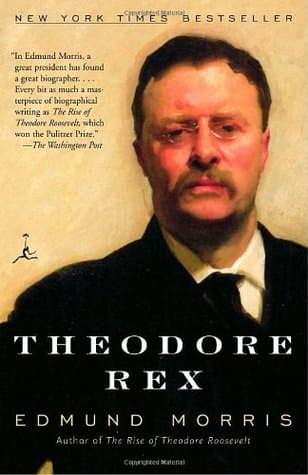
Theodore Rex cover
Archivist's Choice

Theodore Rex

Edmund Morris (2001)

Genre

Politics / Biography / History

Reading Time

15-20 hours (approx. 565 pages)

Key Themes

See below

Track Your Reading

Sign in to track this book

Edmund Morris's biography shows how Theodore Roosevelt's two-term presidency used 'big stick' diplomacy to handle corporate trusts, global conflicts, and conservation, shaping America as a rising world power.

Core Idea

Edmund Morris's "Theodore Rex" details Theodore Roosevelt's presidency, arguing that his unexpected rise to office led to an intentional use of executive power. This changed American domestic policy and its global standing. Roosevelt, an energetic intellectual and nationalist, used his personality and political skill to support reforms, break monopolies, assert American influence with 'Big Stick' diplomacy, and start modern conservation. The book shows how Roosevelt's strong leadership and moral beliefs helped him manage labor disputes, racial tensions, and Gilded Age politics. This defined the modern presidency as a strong force for national good. Morris suggests that Roosevelt's time in office was a key moment where the American 'can-do' spirit was seen in a leader who not only imagined a stronger and fairer America but actively worked to make it happen, leaving a lasting mark on governance, foreign policy, and environmental protection.
Reading time
15-20 hours (approx. 565 pages)
Difficulty
Medium
✓ Read this if...
You want a comprehensive, deeply researched, and engaging narrative of Theodore Roosevelt's presidency, focusing on his policy achievements, personal character, and impact on American and world history.
✗ Skip this if...
You prefer a concise overview of Roosevelt's life rather than a detailed, multi-volume biographical account, or are looking for a critical analysis rather than a largely admiring portrayal.

Core idea

The central argument and framework that powers the entire book.

Edmund Morris's "Theodore Rex" details Theodore Roosevelt's presidency, arguing that his unexpected rise to office led to an intentional use of executive power. This changed American domestic policy and its global standing. Roosevelt, an energetic intellectual and nationalist, used his personality and political skill to support reforms, break monopolies, assert American influence with 'Big Stick' diplomacy, and start modern conservation.

The book shows how Roosevelt's strong leadership and moral beliefs helped him manage labor disputes, racial tensions, and Gilded Age politics. This defined the modern presidency as a strong force for national good. Morris suggests that Roosevelt's time in office was a key moment where the American 'can-do' spirit was seen in a leader who not only imagined a stronger and fairer America but actively worked to make it happen, leaving a lasting mark on governance, foreign policy, and environmental protection.

At a glance

Reading time

15-20 hours (approx. 565 pages)

Difficulty

Medium

Read this if...

You want a comprehensive, deeply researched, and engaging narrative of Theodore Roosevelt's presidency, focusing on his policy achievements, personal character, and impact on American and world history.

Skip this if...

You prefer a concise overview of Roosevelt's life rather than a detailed, multi-volume biographical account, or are looking for a critical analysis rather than a largely admiring portrayal.

Key Takeaways

1

The Accidental President's Intentional Power

TR's unexpected ascent to the presidency was met with a decisive and transformative approach to national leadership.

Quote

President McKinley's assassination brought the 43-year-old TR a challenging presidency, one to which Morris is a clearsighted guide.

Theodore Roosevelt's presidency, which began unexpectedly after an assassination, was purposeful in its actions. At 43, the youngest president, Roosevelt took office in a nation dealing with industrialization, growing international duties, and social problems. Morris shows how Roosevelt, despite the suddenness of his new role, immediately began to shape the office to his will. He did not just fill the presidency; he gave it his energy and a clear vision for American progress, both at home and abroad. This time marks a shift from a mor...

Supporting evidence

Morris's narrative details the immediate aftermath of McKinley's death and TR's rapid assumption of power, showcasing how he quickly moved from Vice President to a commanding executive, facing a skeptical Congress and an expectant public.

Apply this

Leaders facing unexpected responsibilities should embrace the challenge with a clear vision and decisive action, understanding that even an unplanned ascent can be an opportunity for profound impact. TR's example highlights the importance of preparedness and an inherent leadership philosophy.


presidential-successionexecutive-poweraccidental-leadership
2

Taming the Trusts: A Domestic Crusade

TR boldly confronted monopolistic corporations, establishing a precedent for government regulation in the public interest.

Quote

At home, TR had to persuade Congress to curb competition-stifling corporate trusts, monopolistic transcontinental railroads, and unhygienic food industries that saw consumers as sheep.

The early 20th century saw American capitalism with few rules, as powerful trusts and railroads controlled industries and often exploited consumers and workers. Morris clearly shows Roosevelt's domestic fight against these 'malefactors of great wealth.' Unlike earlier presidents, Roosevelt did more than just talk; he started major anti-trust actions, famously breaking up J.P. Morgan's Northern Securities Company. This was not just about economic fairness; it was about the government protecting the public from uncontrolled corporate po...

Supporting evidence

The book details TR's legislative battles and legal actions against trusts and railroads, including specific examples of his confrontations with figures like J.P. Morgan and E.H. Harriman, and the push for legislation addressing food safety.

Apply this

Modern policymakers can learn from TR's courage in challenging entrenched economic interests for the greater good. It underscores the necessity of robust regulatory oversight to prevent monopolies and protect consumer welfare in complex markets.

anti-trustcorporate-regulationprogressive-era
3

The 'Big Stick' Diplomacy: A New Global Posture

TR's foreign policy introduced a muscular American presence on the world stage, balancing diplomacy with the credible threat of force.

Quote

His famous maxim, of course, was 'Speak softly but carry a big stick.'

'Big Stick' was a key part of Theodore Roosevelt's foreign policy, moving away from America's traditional isolation. Morris shows how Roosevelt used this idea to manage complex international relations, from helping end the Russo-Japanese War to asserting American influence in the Caribbean and Latin America. The 'big stick' meant being ready to use military and economic power if diplomacy failed, but it also stressed the 'speak softly' part—a preference for negotiation and peaceful solutions. This approach not only raised America's st...

Supporting evidence

Morris recounts TR's mediation of the Russo-Japanese War, his intervention in Cuba and the Philippines, and the strategic decisions surrounding the Panama Canal, all illustrating the practical application of 'Big Stick' diplomacy.

Apply this

Contemporary international relations can draw lessons from TR's approach: the importance of maintaining a strong defense while prioritizing diplomatic solutions. It's about having the capability to act but choosing restraint and negotiation first.

foreign-policygunboat-diplomacyinternational-relations
4

The Panama Canal: Engineering a Continent's Destiny

TR's decisive leadership secured the construction of the Panama Canal, dramatically reshaping global trade and naval power.

Quote

a politically and financially fraught decision on the Central American canal route - Panama or Nicaragua? - had to be made. TR rose to every challenge.

Building the Panama Canal is one of Theodore Roosevelt's most ambitious and important achievements. Morris details the political moves, engineering problems, and diplomatic efforts Roosevelt made to complete this huge project. Faced with a choice between Nicaragua and Panama, and then dealing with Colombia, Roosevelt's 'can-do' attitude and willingness to push limits were essential. The canal was not just an engineering success; it was strategically important, cutting shipping times, boosting global trade, and strengthening America's ...

Supporting evidence

The book covers the intense debate over the canal's route, TR's direct involvement in supporting the Panamanian revolution, and the subsequent diplomatic and logistical efforts to begin and oversee the canal's construction.

Apply this

Large-scale infrastructure projects require bold vision, political will, and the ability to navigate complex international and logistical hurdles. TR's canal project demonstrates the profound, long-term impact of such decisive leadership.

panama-canalinfrastructuregeopolitics
5

Conservation: A Lasting Legacy for Nature

TR pioneered the conservation movement, permanently enshrining the protection of natural resources in the national agenda.

Quote

Not least, TR put national parks and conservation of natural resources on the legislative agenda.

While often known for his 'big stick' and trust-busting, Theodore Roosevelt's dedication to conservation was just as important and perhaps his most lasting domestic legacy. Morris highlights how Roosevelt, an avid outdoorsman and naturalist, saw the urgent need to protect America's natural areas from overuse. He did not just talk about it; he acted, creating many national parks, forests, and wildlife refuges, and forming the U.S. Forest Service. His work with people like John Muir and John Burroughs showed a scientific approach to man...

Supporting evidence

The book details TR's personal passion for nature, his establishment of national parks and forests, his collaboration with prominent naturalists, and the legislative efforts to create the U.S. Forest Service.

Apply this

Leaders today can draw inspiration from TR's foresight in environmental protection. It emphasizes the critical role of government in safeguarding natural resources and promoting sustainability for long-term societal well-being.

conservationnational-parksenvironmentalism
6

Navigating Labor and Racial Strife

TR confronted deep-seated social divisions, seeking solutions to industrial unrest and racial injustice, albeit with mixed results.

Quote

He also faced labor and racial strife.

Theodore Roosevelt's presidency happened during a time of labor unrest and deep racial inequality. Morris explores how Roosevelt dealt with these difficult issues, showing his willingness to step in where previous presidents had not. In the 1902 anthracite coal strike, he famously did not side with labor or management but pushed both to negotiate, showing a new role for the presidency as a neutral mediator in industrial disputes. Regarding race, his public invitation of Booker T. Washington to the White House was a groundbreaking, tho...

Supporting evidence

The book recounts the details of the 1902 anthracite coal strike and TR's unprecedented intervention, as well as the societal reaction to his dinner with Booker T. Washington.

Apply this

Leaders must be prepared to confront deep social divisions and act as mediators or catalysts for change. TR's example highlights the courage required to address uncomfortable truths, even when solutions are complex and imperfect.

labor-relationscivil-rightssocial-justice
7

The Intellectual President: A Life of Mind and Action

Beyond his political prowess, TR was a voracious reader, prolific writer, and an intellectual force, embodying a rare blend of thought and action.

Quote

Despite the demands of family and social life, he read, wrote, and traveled extensively.

Edmund Morris shows Theodore Roosevelt as more than just a politician; he was an impressive intellectual. In a time when presidents were not usually known for scholarly work, Roosevelt stood out as a polymath: a historian, naturalist, author, and avid reader. His large library, his published books, and his engagement with leading thinkers of his time—from Henry Adams to Oliver Wendell Holmes—reveal a mind always seeking knowledge. This intellectual curiosity was not a distraction; it was part of his leadership, shaping his policies an...

Supporting evidence

Morris frequently references TR's personal library, his writings, his correspondence with intellectuals, and his ability to quote historical texts and scientific principles in his public discourse.

Apply this

Leaders should cultivate a broad intellectual curiosity, recognizing that continuous learning and deep understanding enhance decision-making and provide a richer context for leadership. It’s a powerful reminder that action without thought can be blind.

intellectualismrenaissance-manleadership-development
8

Shaping the Modern Presidency

TR fundamentally redefined the scope and power of the executive branch, setting a precedent for active presidential leadership.

Quote

Morris presents eyewitness history through the voices of the makers and shakers. His exhilarating narrative will captivate readers, providing welcome confirmation that this nation can produce presidents who bring leadership to great issues, hold to their purpose, and shape the destinies of nations.

Theodore Roosevelt's two terms changed the nation and the presidency itself. Morris's story shows how Roosevelt, through his personality and a broad reading of executive power, increased the office's influence at home and abroad. He was the first president to consistently use the 'bully pulpit' to gather public support, sometimes bypassing Congress. His involvement in economic, social, and foreign affairs created a model of active, engaged presidential leadership that changed the balance of power in the U.S. government. Roosevelt's pr...

Supporting evidence

The book details TR's frequent use of public addresses, his direct interventions in national crises (like the coal strike), and his assertive foreign policy decisions, all demonstrating an expansion of presidential authority.

Apply this

Understanding TR's expansion of presidential power is crucial for appreciating the evolution of American governance. It prompts reflection on the appropriate scope of executive authority and the role of presidential leadership in a democracy.

presidential-powerexecutive-branchbully-pulpit
9

The American 'Can Do' Spirit Personified

TR embodied the quintessential American spirit of optimism, resilience, and a boundless belief in the nation's potential.

Quote

TR typifies the 'can do' American; his famous maxim, of course, was 'Speak softly but carry a big stick.'

Theodore Roosevelt was, in many ways, the embodiment of the American 'can do' spirit. Morris captures Roosevelt's constant energy, his hope in the face of big challenges, and his strong belief in the nation's ability to progress. Whether it was charging up San Juan Hill, confronting powerful trusts, or building a canal, Roosevelt approached every task with a strong determination that inspired both respect and occasional frustration. This spirit was not just personal; it was projected onto the nation, creating a feeling that America co...

Supporting evidence

Morris consistently highlights TR's personal drive, his adventurous spirit, and his confident, often forceful, approach to problem-solving in both his public and private life, as well as his inspiring rhetoric.

Apply this

Individuals and organizations can draw inspiration from TR's 'can do' attitude, recognizing that optimism, resilience, and a clear sense of purpose are essential for overcoming challenges and achieving ambitious goals.

american-exceptionalismoptimismresilience

Critical analysis

Notable Quotes

Speak softly and carry a big stick; you will go far.

A proverb Roosevelt often used to describe his foreign policy approach.

It is not the critic who counts; not the man who points out how the strong man stumbles, or where the doer of deeds could have done them better. The credit belongs to the man who is actually in the arena, whose face is marred by dust and sweat and blood; who strives valiantly; who errs, who comes short again and again, because there is no effort without error and shortcoming; but who does actually strive to do the deeds; who knows great enthusiasms, the great devotions; who spends himself in a worthy cause; who at the best knows in the end the triumph of high achievement, and who at the worst, if he fails, at least fails while daring greatly, so that his place shall never be with those cold and timid souls who neither know victory nor defeat.

Part of his 'Citizenship in a Republic' speech in Paris, April 23, 1910.

I have always been fond of the West African proverb: 'The child of a cat will kill a mouse.'

Roosevelt reflecting on the inherent nature or destiny of individuals, often in the context of his own actions.

I am an American and I am a Free Man.

A declaration of his identity and principles, often used in moments of conviction.

The only man who makes no mistakes is the man who never does anything.

Roosevelt's belief in the necessity of action, even with the risk of error.

A man who is good enough to shed his blood for his country is good enough to be given a square deal afterward.

Advocating for fair treatment and social justice for veterans and all citizens.

We must dare to be great; and we must remember that greatness is never achieved without daring to be great.

A call to ambition and the pursuit of significant achievements.

Of course, I am an optimist. I am in favor of life.

Roosevelt's inherent positive outlook and zest for life.

The joy of living is his who has the heart to demand it.

Emphasizing the active pursuit and embrace of life's pleasures.

Order without liberty and liberty without order are equally destructive.

Highlighting the delicate balance between societal structure and individual freedom.

Big business is not dangerous because it is big, but because of the power it wields.

Reflecting on his concerns about corporate power and trusts during his presidency.

I took the Canal Zone and let Congress debate; and while the debate goes on, the Canal does also.

Roosevelt's candid admission about his decisive action in acquiring the Panama Canal Zone.

The greatest good for the greatest number.

A utilitarian principle often guiding his policy decisions, particularly in conservation and public welfare.

The things that will destroy America are prosperity at any price, peace at any price, safety first instead of duty first, and love of soft living and the get-rich-quick theory of life.

Roosevelt's warning against complacency and moral decay in a prosperous nation.

Quiz

Test Your Knowledge

Ready to see how well you understood this book? Take our interactive quiz with 10 questions.

10
Questions
~5
Minutes
?
Best Score

Key Questions (FAQ)

'Theodore Rex' chronicles Theodore Roosevelt's two-term presidency from 1901 to 1909, exploring his leadership in domestic and foreign policy, his personal life, and his lasting impact on American society and the world.

About the author

Edmund Morris

Edmund Morris was a Pulitzer Prize-winning author renowned for his biographies of Theodore Roosevelt. His seminal works, "The Rise of Theodore Roosevelt" and "Theodore Rex," offered vivid portraits of the 26th U.S. President. Morris's meticulous research and engaging narrative style cemented his reputation as a leading historical biographer.