BookBrief
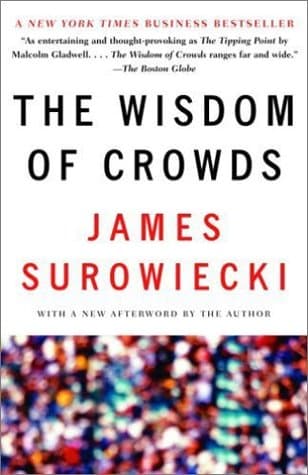
The Wisdom of Crowds cover
Archivist's Choice

The Wisdom of Crowds

James Surowiecki (2004)

Genre

Business / Leadership / Economics / Science / Philosophy

Reading Time

360 min

Key Themes

See below

Track Your Reading

Sign in to track this book

Many people, not just a few, are key to solving problems, gaining knowledge, and making accurate predictions in all areas of life and leadership.

Core Idea

When conditions are right, groups are smart, often smarter than their smartest members. This collective intelligence comes from different opinions, independent judgment, spread-out knowledge, and good ways to combine ideas. When these conditions are met, groups can make accurate predictions, better decisions, and solve hard problems more effectively than individuals or top-down systems. The book shows how and why this happens, applying it to areas from markets to politics to daily life, while also pointing out the risks of groups that are too similar, dependent, or controlled from the top.
Reading time
360 min
Difficulty
Medium
✓ Read this if...
You are interested in how collective intelligence works, the benefits of diversity and decentralization, or want to understand why groups sometimes make surprisingly good decisions.
✗ Skip this if...
You prefer prescriptive self-help guides over analytical explorations of social phenomena, or are looking for a simple guide to managing teams.

Core idea

The central argument and framework that powers the entire book.

When conditions are right, groups are smart, often smarter than their smartest members. This collective intelligence comes from different opinions, independent judgment, spread-out knowledge, and good ways to combine ideas. When these conditions are met, groups can make accurate predictions, better decisions, and solve hard problems more effectively than individuals or top-down systems. The book shows how and why this happens, applying it to areas from markets to politics to daily life, while also pointing out the risks of groups that are too similar, dependent, or controlled from the top.

At a glance

Reading time

360 min

Difficulty

Medium

Read this if...

You are interested in how collective intelligence works, the benefits of diversity and decentralization, or want to understand why groups sometimes make surprisingly good decisions.

Skip this if...

You prefer prescriptive self-help guides over analytical explorations of social phenomena, or are looking for a simple guide to managing teams.

Key Takeaways

1

The Power of Diversity

Homogeneity stifles wisdom; true collective intelligence demands varied perspectives.

Quote

The best decisions are a product of disagreement and debate, not consensus or compromise.

The idea of crowd wisdom is not just about large numbers, but about the variety within those numbers. A group of people who all think alike, no matter how many, will likely make the same mistakes. True group intelligence appears when individuals bring unique information, different ways of thinking, and varied problem-solving methods. This mental variety prevents groupthink, challenges assumptions, and expands the range of possible solutions. Without it, the 'crowd' is just an echo chamber, making individual biases stronger instead of ...

Supporting evidence

Surowiecki highlights the example of how juries with diverse backgrounds tend to deliberate more thoroughly and reach more accurate verdicts than homogenous ones, illustrating how varied perspectives uncover more facts and scrutinize arguments more effectively.

Apply this

When forming teams or seeking advice, prioritize intellectual and experiential diversity over perceived 'expertise' or social cohesion. Actively solicit dissenting opinions and create mechanisms for anonymous input to encourage genuine, unfiltered contributions.

cognitive-diversitygroupthinkcollective-intelligence
2

Independence is Paramount

For wisdom to emerge, individual judgments must be formed without undue influence from others.

Quote

The more influence people have on each other, the less likely the crowd is to be wise.

Independent opinions are key for a crowd to be wise. If people base their judgments on what others are saying or doing, the 'crowd' quickly becomes a mob, easily swayed by trends, panics, and errors. Independence ensures that errors are not linked; one person's mistake does not automatically spread to others. This unlinked error distribution allows the group average to cancel out individual biases and find a more accurate answer. Information cascades, where individuals ignore their own private information for public signals, go agains...

Supporting evidence

Surowiecki discusses Solomon Asch's conformity experiments, where individuals often conformed to obviously incorrect group answers, demonstrating how easily independence can be compromised by social pressure. He contrasts this with situations like predicting the weight of an ox, where individuals make independent guesses.

Apply this

Design decision-making processes to collect individual inputs before group discussion. For example, use anonymous polling, 'write-first' brainstorms, or tools that reveal individual estimates only after everyone has submitted their own. Avoid 'show of hands' votes or open discussions early in the process.

information-cascadesconformityuncorrelated-errors
3

Decentralization for Local Knowledge

Distributed decision-making leverages local, tacit knowledge often inaccessible to central authorities.

Quote

Decentralization is valuable because it allows people to specialize and make use of local knowledge that is difficult to transfer.

Decentralization is more than an organizational choice; it is a way to use crowd wisdom by tapping into scattered, specialized, and often unspoken knowledge. Centralized systems, no matter how advanced, struggle to handle the large amount and complexity of information available at the 'edges' of an organization or society. By letting individuals or smaller groups at the local level make decisions for their area, organizations can use unique insights, adapt faster to changes, and encourage new ideas. This does not mean chaos; instead, ...

Supporting evidence

The success of open-source software like Linux, where thousands of independent developers contribute to a complex project, exemplifies how decentralized problem-solving can outperform highly centralized, proprietary development models. Wikipedia is another strong example.

Apply this

Delegate decision-making authority to the lowest possible level within an organization. Empower front-line employees with the agency and resources to solve problems directly, rather than requiring escalation for every minor issue. Foster internal marketplaces for ideas and resources.

tacit-knowledgedistributed-cognitionemergent-systems
4

Aggregation Mechanisms Matter

The method of combining individual judgments critically determines the wisdom of the collective.

Quote

The wisdom of the crowd is not some magical property that automatically emerges whenever a lot of people are gathered in one place.

While variety, independence, and decentralization are necessary, they are not enough without good ways to combine individual judgments into a group decision. Simply having a crowd does not guarantee wisdom; how opinions are gathered and put together is most important. Different methods of combining ideas—like averaging, voting, prediction markets, or simple majority rule—have different strengths and weaknesses depending on the problem. A poorly chosen method can hide valuable insights, increase noise, or lead to bad outcomes, even wit...

Supporting evidence

Surowiecki details the success of prediction markets (like the Iowa Electronic Markets) in forecasting elections and other events, often outperforming professional pollsters and experts. These markets aggregate information through price signals, incentivizing accurate predictions.

Apply this

Carefully choose the aggregation method based on the problem type. For factual estimates, averaging is often superior. For preferences or choices, voting might be appropriate, but consider preference-ranking systems. For predictions, explore prediction markets or structured forecasting techniques like the Delphi method.

prediction-marketsdelphi-methodinformation-aggregation
5

The Pitfalls of Homogeneity and Conformity

When a crowd lacks diversity or succumbs to social pressure, it becomes susceptible to errors and irrationality.

Quote

If diversity and independence are the two most important characteristics of a wise crowd, then homogeneity and interdependence are the two most important characteristics of a foolish one.

The conditions that create group wisdom—variety, independence, decentralization, and good combination—are the opposite of those that lead to group foolishness. Sameness, where people share similar biases and limited views, means errors are linked rather than canceled out. Conformity, driven by social pressure or a wish to fit in, weakens independence, leading to information cascades where people ignore their own better judgment. Centralized decision-making, without ways for local input, can lead to blind spots and an inability to adap...

Supporting evidence

The dot-com bubble and the Challenger disaster are presented as stark examples where groupthink, lack of dissenting voices, and a failure to properly aggregate disparate information led to disastrous outcomes, despite the presence of highly intelligent individuals.

Apply this

Actively challenge consensus, especially when it feels too easy or uniform. Assign a 'devil's advocate' role, encourage anonymous feedback channels, and create safe spaces for dissenting opinions. Regularly audit decision-making processes for signs of conformity or lack of diversity.

groupthinkinformation-cascadescollective-folly
6

Markets as Information Aggregators

Well-designed markets can efficiently aggregate vast amounts of dispersed information into price signals.

Quote

Markets are, at their heart, information-processing devices. They are designed to take dispersed, private information and aggregate it into a single, usable number: the price.

Beyond simple averages or voting, financial markets are powerful, though not perfect, ways to combine crowd wisdom. The price of a stock, a commodity, or a future contract shows the combined, though noisy, judgment of millions of participants, each acting on their own information and self-interest. This combination happens through the constant give and take of supply and demand, with prices changing to reflect new information. While markets can have irrational excitement and panic, their ability to condense vast amounts of spread-out ...

Supporting evidence

Surowiecki cites the efficiency of financial markets in reflecting available information, often making them better predictors of company performance or economic trends than individual experts. He also discusses prediction markets like the Iowa Electronic Markets, which often outperform traditional polling in predicting election outcomes.

Apply this

For organizational forecasting, consider implementing internal prediction markets where employees can 'bet' on project completion times, sales targets, or product success. Use market prices as a valuable, though not exclusive, input for strategic decision-making.

efficient-market-hypothesisprediction-marketsprice-discovery
7

The Role of Experts and Leaders

Experts are valuable, but their power is amplified when they facilitate collective wisdom, not dictate it.

Quote

The wisdom of crowds is not antithetical to the idea of expertise. It is, rather, a way of thinking about how best to use it.

Crowd wisdom does not remove the need for experts; instead, it changes their role. Experts are important for providing basic knowledge, structuring problems, finding key information, and understanding complex data. However, giving all decision-making power to a few experts can lead to blind spots, overconfidence, and a failure to adapt. The best situation involves experts acting as helpers, designers of combination methods, and people who bring together group input, rather than being the only judges of truth. Leaders, similarly, shoul...

Supporting evidence

Surowiecki discusses how companies that empower employees to contribute ideas (e.g., through suggestion boxes or internal forums) often outperform those with rigid, top-down expert-driven innovation processes. He also notes how scientific consensus, while expert-driven, is built on a distributed, peer-reviewed process.

Apply this

Leaders should shift from being sole decision-makers to 'architects of participation.' Design processes where experts present findings, but the final decision or solution incorporates input from a broader, diverse group. Use experts to frame questions, not necessarily to provide all the answers.

distributed-leadershipfacilitationcollective-intelligence
8

The Cognitive Benefits of Averaging

Simple aggregation methods, like averaging, effectively cancel out random errors and biases.

Quote

The reason the crowd is wise is not that it contains a few extraordinarily smart people but that, by aggregating all the information, it cancels out the errors.

One of the most surprising ideas is that a simple average of many independent guesses can be very accurate, often better than any single expert's estimate. The math works because individual errors are random and spread around the true value. Some will guess too high, some too low, but on average, these errors cancel each other out, leaving a surprisingly precise group estimate. This 'magic' of averaging supports many forms of group intelligence, from predicting an ox's weight to forecasting complex events. It shows that the value is n...

Supporting evidence

The famous example of Francis Galton's ox weight estimation at a country fair, where the median guess of 800 villagers was within 1% of the actual weight, far more accurate than many individual butchers, perfectly illustrates this principle.

Apply this

When seeking estimates for quantities (e.g., project timelines, sales forecasts, market size), collect independent estimates from a diverse group and average them. Do not allow individuals to influence each other's initial guesses. This is often more reliable than relying on a single 'expert' projection.

statistical-aggregationerror-cancellationcentral-tendency
9

Beyond Rationality: Emotional Crowds

While rational crowds are wise, emotional crowds, driven by fear or greed, can lead to irrational herd behavior.

Quote

The wisdom of crowds is fundamentally about rational crowds. Irrational crowds, by contrast, are often very foolish.

It is important to tell the difference between 'wise' crowds and 'emotional' crowds. The conditions for wisdom (variety, independence, decentralization, combination) are often broken by strong emotional spread. When fear, greed, panic, or excitement goes through a group, individual clear thinking is stopped, and people start to copy each other's behavior, leading to self-reinforcing cycles of irrationality. Stock market bubbles and crashes, mass hysteria, and social trends are clear examples of emotional crowds acting foolishly. Under...

Supporting evidence

Surowiecki uses examples like the Dutch Tulip Mania or various stock market bubbles to illustrate how collective irrationality can take hold when emotions override independent judgment and information cascades amplify speculative behavior.

Apply this

Implement circuit breakers in systems susceptible to emotional contagion (e.g., trading halts in financial markets). Encourage critical thinking and independent verification of information during periods of high excitement or panic. Leaders should actively model calm, rational decision-making and provide objective data to counter emotional narratives.

herd-behavioremotional-contagionirrational-exuberance

Critical analysis

Notable Quotes

Under the right circumstances, groups are remarkably intelligent, and are often smarter than the smartest people in them.

Introducing the core thesis of the book.

The four conditions that seem to be necessary for a crowd to be wise are diversity of opinion, independence, decentralization, and a mechanism for aggregating private judgments.

Outlining the key conditions for a wise crowd.

The best way for a group to be smart is for each person in it to think and act as independently as possible.

Emphasizing the importance of independence.

Diversity matters for two reasons. First, it brings new information and perspectives. Second, and more subtly, it also encourages people to restate their own arguments and to think more clearly.

Explaining the benefits of diversity.

The fact that no one is in charge, in other words, doesn't mean that chaos will ensue.

Discussing decentralization and its implications.

It's the independence of the people in the crowd that makes the crowd wise, not the 'smartness' of the individual people in it.

Further clarifying the source of collective intelligence.

The wisdom of crowds is not merely the aggregation of individual estimates, but a dynamic, self-organizing process.

Highlighting the dynamic nature of collective intelligence.

The problem with committees is that they're too often designed to foster agreement, not to tap into genuine collective intelligence.

Critiquing traditional committee structures.

The more specialized a group is, the better it will be at solving specialized problems. But the less specialized it is, the better it will be at solving general problems.

Discussing the trade-offs of specialization in groups.

Information markets have consistently proven to be more accurate than polls, pundits, and experts.

Providing an example of successful crowd wisdom in practice.

The real argument for democracy is not that it is a perfect system of rule, but that it is a powerful way of aggregating information and making good decisions.

Connecting crowd wisdom to democratic principles.

The ideal decision-making environment is one in which people are free to make their own choices, and those choices are then effectively aggregated into a collective decision.

Describing an optimal decision-making environment.

Too much communication, paradoxically, can actually make a group less intelligent.

Warning against excessive communication and its potential pitfalls.

The wisdom of crowds is not about finding the average, but about finding the best way to combine diverse perspectives into a superior collective judgment.

Distinguishing between averaging and true collective wisdom.

Quiz

Test Your Knowledge

Ready to see how well you understood this book? Take our interactive quiz with 10 questions.

10
Questions
~5
Minutes
?
Best Score

Key Questions (FAQ)

The book argues that under certain conditions, large groups of people are collectively smarter than even individual experts at solving problems, making decisions, and predicting outcomes. It suggests that decentralized decision-making can often lead to more accurate and innovative results.

About the author