BookBrief
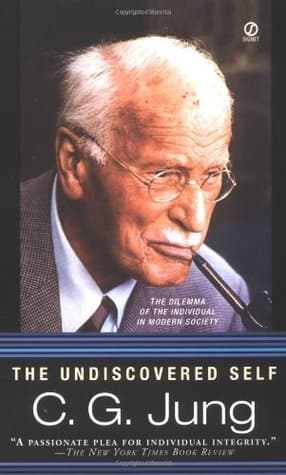
The Undiscovered Self cover
Archivist's Choice

The Undiscovered Self

C.G. Jung (2006)

Genre

Politics / Psychology / Spirituality / Science / Philosophy

Reading Time

120 min

Key Themes

See below

Track Your Reading

Sign in to track this book

Jung asks individuals to resist mass movements and societal conformity by seeking their unique self, or risk becoming an unthinking part of a totalitarian system.

Core Idea

Jung says the biggest threat to human freedom and civilization today is the growth of the collective, especially totalitarian states, which suppress individuals. He believes the only defense against this tyranny is realizing and integrating the individual self, including its unconscious parts. Jung emphasizes that the individual, not the state or the group, carries life and meaning. A healthy society depends on healthy individuals who understand their unique psyche, including their 'shadow' side and their religious instinct. He criticizes modern science for not understanding the subjective reality of the mind. He also highlights the role of individual suffering and self-knowledge in developing psychological and moral strength, which can resist the appeal of mass movements and ideas.
Reading time
120 min
Difficulty
Hard
✓ Read this if...
You are concerned about the erosion of individuality in modern society, interested in Jung's perspective on the individual vs. the collective, or seeking a deeper understanding of psychological and spiritual autonomy in the face of political and social pressures.
✗ Skip this if...
You are looking for a light read, prefer practical self-help over dense psychological and philosophical inquiry, or are uncomfortable with Jungian concepts like the unconscious and the religious instinct.

Core idea

The central argument and framework that powers the entire book.

Jung says the biggest threat to human freedom and civilization today is the growth of the collective, especially totalitarian states, which suppress individuals. He believes the only defense against this tyranny is realizing and integrating the individual self, including its unconscious parts. Jung emphasizes that the individual, not the state or the group, carries life and meaning. A healthy society depends on healthy individuals who understand their unique psyche, including their 'shadow' side and their religious instinct. He criticizes modern science for not understanding the subjective reality of the mind. He also highlights the role of individual suffering and self-knowledge in developing psychological and moral strength, which can resist the appeal of mass movements and ideas.

At a glance

Reading time

120 min

Difficulty

Hard

Read this if...

You are concerned about the erosion of individuality in modern society, interested in Jung's perspective on the individual vs. the collective, or seeking a deeper understanding of psychological and spiritual autonomy in the face of political and social pressures.

Skip this if...

You are looking for a light read, prefer practical self-help over dense psychological and philosophical inquiry, or are uncomfortable with Jungian concepts like the unconscious and the religious instinct.

Key Takeaways

1

The Tyranny of the Collective

Mass movements erode individual consciousness and moral responsibility.

Quote

The mass man is a robot, and robots have no conscience.

Jung says that modern society, especially under totalitarian rule, focuses too much on the collective at the expense of the individual mind. When people identify too strongly with a group, they give up their personal judgment and moral sense, becoming mere parts of a larger, often destructive, system. This group identity creates the idea of shared responsibility, which actually spreads out individual accountability, leading to a lack of ethics. The individual's moral struggle and the development of their conscience are important for a...

Supporting evidence

Jung's observations of totalitarian states in the 20th century, where individuals committed atrocities under the guise of collective duty, and the rise of mass movements that demand conformity over individual thought.

Apply this

Cultivate a strong sense of individual identity and moral autonomy. Question collective narratives, even those presented as benevolent, and always evaluate actions based on personal ethical principles rather than group consensus. Engage in self-reflection to distinguish personal values from societal pressures.


collective-unconsciousmass-psychologyindividuation
2

The Shadow of the State

Unacknowledged collective evil manifests through the state's power.

Quote

The state has taken the place of God and therefore, in the eyes of the individual, it is God.

Jung suggests that the state, especially when it becomes all-encompassing, acts as a screen for humanity's unacknowledged collective shadow. When people deny their own capacity for badness or project it onto outside enemies, this repressed darkness can come together and appear through the immense power of the state. The state, then, becomes an entity capable of great cruelties, not because its leaders are worse, but because it channels the unintegrated aggression and unconscious issues of its citizens. This worship of the state frees ...

Supporting evidence

The historical examples of state-sanctioned violence and genocide in the 20th century, where ordinary citizens became complicit in horrific acts, often believing they were serving a higher, state-defined purpose.

Apply this

Recognize the potential for evil within oneself and within any collective. Never grant absolute moral authority to the state or any external institution. Maintain a critical perspective on state narratives and be vigilant against propaganda that demonizes specific groups or rationalizes oppression.

shadow-selfstate-powerauthoritarianism
3

The Primacy of the Individual

True societal health depends on the moral integrity of each person.

Quote

The salvation of the world consists in the number of individuals who have the courage to make a stand for themselves.

Jung states that the only real defense against collective madness and totalitarianism is the morally aware individual. Society is not separate from its members; its health and ethical direction directly reflect the moral integrity and self-awareness of its individual members. When individuals develop their inner life, face their own shadow, and build a strong sense of personal responsibility, they help create a stronger, more stable society. In contrast, a society made of unthinking, conforming people is weak and easily manipulated. T...

Supporting evidence

Jung's argument that no system, however well-intentioned, can guarantee freedom or morality if the individuals within it lack personal consciousness and moral courage. He implies that historical figures who stood against oppressive regimes exemplify this principle.

Apply this

Prioritize personal growth, self-reflection, and the development of a strong moral compass. Practice independent thought and resist pressures to conform when they conflict with your values. Understand that your individual choices have a collective impact, however small.

individuationmoral-courageconscience
4

Science's Blind Spot

Empirical science often overlooks the subjective reality of the psyche.

Quote

Science cannot replace the inner life.

Jung criticizes modern science's tendency to explain reality only by what can be objectively measured. This approach ignores the importance of subjective experience, consciousness, and the mind. While acknowledging science's successes, he says its focus on material things means it cannot fully understand humans, especially their spiritual and psychological parts. This creates a dangerous emptiness, as the human need for meaning, purpose, and connection to something larger is not met by a purely empirical view. This scientific oversigh...

Supporting evidence

Jung's consistent emphasis on the reality of dreams, symbols, and archetypes, which cannot be directly measured by scientific instruments but profoundly influence human behavior and experience. He points out that psychology, in its attempt to be 'scientific,' often fails to grasp the essence of the soul.

Apply this

Recognize the limits of purely empirical approaches to understanding human existence. Cultivate an appreciation for subjective experience, intuition, and symbolic meaning. Integrate scientific knowledge with spiritual or philosophical inquiry to form a more holistic worldview.

reductionismmaterialismsubjectivity
5

The Religious Instinct

Humanity possesses an innate drive for meaning beyond the material.

Quote

Man is a religious animal.

Jung states that humanity has an inherent 'religious instinct' – a deep need to connect with something beyond, to find meaning and purpose beyond the material world. This is not necessarily about following a specific religion, but a basic psychological drive for a worldview that provides order and a feeling of belonging to something greater than the individual ego. When this instinct is denied or suppressed by secular ideas or a purely materialistic view, it does not disappear. Instead, it reappears in changed forms, often as fanatica...

Supporting evidence

Jung's extensive work on archetypes and the collective unconscious, which reveal universal patterns of symbolic and mythological thinking across cultures and throughout history, all pointing to a transcendent dimension.

Apply this

Explore your own sense of meaning and purpose, whether through traditional spirituality, philosophy, art, or connection to nature. Be wary of ideologies or movements that demand absolute devotion and promise ultimate meaning, as they can exploit this innate need for unhealthy ends. Nurture your inner life.

archetypescollective-unconsciousspirituality
6

Consciousness and Unconsciousness

Ignoring the unconscious leads to collective psychological projection.

Quote

The individual is much too small to be the cause of all evil.

Jung emphasizes the role of the unconscious mind, both personal and collective, in shaping human behavior. He argues that what we do not acknowledge and integrate within ourselves—our personal shadow, our repressed desires, and the darker aspects of the collective unconscious—does not just go away. Instead, it is projected onto others, leading to blame, prejudice, and external conflicts. When a society collectively represses its own shadow, it finds an external enemy onto whom all evil can be projected, creating dangerous divisions an...

Supporting evidence

The historical phenomenon of 'enemy images' and the demonization of specific groups or nations, which Jung would argue are manifestations of collective shadow projection. The psychological mechanisms behind prejudice and xenophobia.

Apply this

Practice self-reflection and introspection to become aware of your own biases, prejudices, and unacknowledged negative traits (your personal shadow). Be critical of narratives that simplify complex issues into 'good vs. evil' and be suspicious of any group that attributes all societal ills to an external 'other.'

shadow-selfprojectioncollective-unconscious
7

The Role of Suffering

Confronting inner darkness is essential for psychological growth.

Quote

One does not become enlightened by imagining figures of light, but by making the darkness conscious.

Jung challenges the idea that psychological well-being comes from simply seeking happiness or avoiding discomfort. Instead, he says that confronting one's inner darkness, weaknesses, and painful truths is a necessary part of the individuation process. This 'suffering' is not about self-harm, but a necessary encounter with the shadow, with one's limits, and with the inherent contradictions of existence. Avoiding this difficult inner work leads to a shallow and unintegrated personality, which is more easily manipulated and swayed by col...

Supporting evidence

Jung's clinical experience with patients who achieved greater wholeness by confronting their repressed traumas and unconscious complexes, rather than trying to suppress them or distract from them.

Apply this

Embrace discomfort and challenges as opportunities for growth. Engage in practices like journaling, therapy, or deep introspection to explore your shadow self and confront difficult emotions. Do not shy away from the 'dark night of the soul' experiences, as they often precede significant personal transformation.

individuationshadow-selfspiritual-growth
8

The Undiscovered Self

The unique individual is the ultimate unknown and most vital truth.

Quote

The 'self' is not only the center but also the whole circumference which embraces both conscious and unconscious.

The 'undiscovered self' refers to the whole individual mind – the conscious ego, the personal unconscious, and the collective unconscious – which most people know little about. Jung says that real freedom and meaning come not from outside conformity or following group ideas, but from the difficult journey of self-discovery and integration, a process he called individuation. This journey involves facing one's own issues, integrating the shadow, and recognizing the deeper patterns of the collective unconscious. This 'self' is the unique...

Supporting evidence

The entire premise of Jungian analytical psychology, which centers on the individuation process and the exploration of the unconscious through dreams, active imagination, and symbolic interpretation.

Apply this

Embark on a lifelong journey of self-exploration and introspection. Pay attention to your dreams, intuitions, and recurring patterns in your life. Seek to understand your unique psychological makeup rather than trying to fit into predefined molds. Prioritize authentic self-expression over societal expectations.

individuationself-actualizationarchetypes
9

The Threat of Mass-Mind

Statistical thinking obscures the unique value of the individual.

Quote

The statistical average is not the individual, but a hypothetical average that has a rather misleading air of reality.

Jung criticizes the modern trend of reducing individuals to statistical averages. He says this approach, while useful in some scientific areas, harms human beings. When society sees people mainly as group members or data points, it ignores and undervalues the unique nature of each person. This 'mass-mind' view encourages conformity, suppresses individual expression, and makes it easier for totalitarian systems to manipulate populations. The individual's distinct consciousness, moral ability, and spiritual needs are lost in the group a...

Supporting evidence

The rise of demography, opinion polls, and other statistical analyses that categorize and generalize human populations, often leading to policy decisions that disregard individual circumstances or minority voices.

Apply this

Resist being defined solely by your demographic or group affiliations. Cultivate critical thinking that goes beyond statistical generalizations to appreciate individual stories and perspectives. Advocate for policies and systems that recognize and protect the rights and dignity of each unique person, not just the 'average.'

mass-psychologydehumanizationconformity
10

The Unconscious God-Image

The individual carries an innate, though unconscious, image of God.

Quote

The God-image is not a fixed, dogmatic concept, but an experience of the psyche.

Jung suggests that within the human mind, there is an inherent 'God-image' or archetype of completeness and ultimate meaning. This is not necessarily a religious statement but a psychological observation that humans are inclined to seek and create symbols of the divine, a drive rooted in the collective unconscious. When traditional religious forms decline or are rejected, this powerful archetype does not disappear; it seeks new ways to express itself. If not consciously integrated, it can appear in destructive ways, such as the worshi...

Supporting evidence

Jung's extensive studies of world religions, mythologies, and spiritual traditions, which reveal universal patterns and symbols (archetypes) related to the divine and the transcendent, present in the human psyche across cultures.

Apply this

Explore your personal relationship with concepts of the divine, ultimate meaning, or wholeness, whether through traditional religion, spirituality, philosophy, or personal symbolism. Be aware of how you might unconsciously project this inner 'God-image' onto external figures or ideologies, and strive to integrate it consciously for personal growth and spiritual autonomy.

archetypescollective-unconsciousspirituality

Critical analysis

Notable Quotes

The individual is the only reality.

Jung argues against collectivism, emphasizing the primacy of individual consciousness.

The mass crushes out the insight and reflection that are still possible with the individual.

Critique of mass movements and their suppression of personal thought.

The psychic conditions which breed demons are as actively at work as ever.

Warning about the unconscious forces that drive destructive human behavior.

The great decisions of human life have as a rule far more to do with the instincts and other mysterious unconscious factors than with conscious will and well-meaning reasonableness.

Exploration of how unconscious elements dominate critical life choices.

Science has destroyed even the refuge of the inner life.

Critique of scientific materialism encroaching on spiritual and psychological realms.

The true leader is always led.

Paradoxical insight into leadership as being guided by unconscious or collective forces.

The unconscious is not just evil by nature, it is also the source of the highest good.

Balanced view of the unconscious as containing both destructive and creative potentials.

Without consciousness there would, practically speaking, be no world.

Emphasis on the role of human perception in constructing reality.

The modern man does not understand how much his 'rationalism' has put him at the mercy of the psychic 'underworld'.

Warning about the dangers of overvaluing rationality while ignoring the unconscious.

The State has taken the place of God.

Observation about how political structures assume spiritual authority in modern society.

The individual who is not anchored in God can offer no resistance on his own resources to the physical and moral blandishments of the world.

Argument for spiritual grounding as essential for personal integrity.

Knowledge does not enrich us; it removes us more and more from the mythic world in which we were once at home by right of birth.

Reflection on how intellectual advancement can create spiritual alienation.

The gigantic catastrophes that threaten us are not elemental happenings but psychic events.

Assertion that humanity's greatest dangers originate in psychological rather than external forces.

A man without a shadow is just as incomplete as a man without a body.

Metaphor for the necessity of integrating the unconscious 'shadow' aspects of personality.

Quiz

Test Your Knowledge

Ready to see how well you understood this book? Take our interactive quiz with 10 questions.

10
Questions
~5
Minutes
?
Best Score

Key Questions (FAQ)

The book explores the tension between the individual and mass society, arguing that true self-knowledge through psychology and spirituality is essential to resist dehumanizing political and scientific systems. Jung emphasizes integrating the unconscious to achieve wholeness.

About the author

C.G. Jung

Carl Jung was a Swiss psychiatrist and psychoanalyst who founded analytical psychology. His extensive writings, including "Man and His Symbols" and "The Archetypes and the Collective Unconscious," explored the human psyche, dreams, and the concept of the collective unconscious. Jung's work profoundly influenced depth psychology, philosophy, and comparative religion.