BookBrief
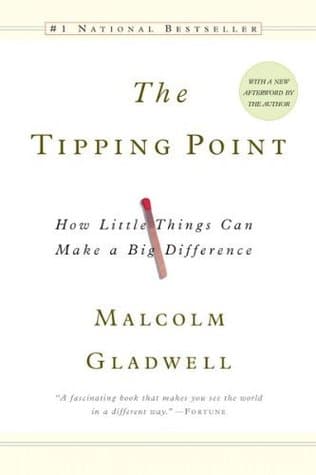
The Tipping Point: How Little Things Can Make a Big Difference cover
Archivist's Choice

The Tipping Point: How Little Things Can Make a Big Difference

Malcolm Gladwell (2000)

Genre

Business / Leadership / Economics / Science / Philosophy

Reading Time

240 min

Key Themes

See below

Track Your Reading

Sign in to track this book

Malcolm Gladwell explains how small, targeted actions can start widespread changes in trends, behaviors, and ideas.

Core Idea

The Tipping Point says that social epidemics—like the spread of diseases, fads, or crime waves—do not grow slowly. Instead, they reach a critical point where they suddenly spread fast. Gladwell argues these sudden changes are not random but follow patterns. Three factors drive them: the Law of the Few (the strong influence of specific people like Connectors, Mavens, and Salesmen), the Stickiness Factor (how memorable a message or idea is), and the Power of Context (the important role of environmental conditions and small details in starting or stopping change). The book shows how understanding these factors can create positive social change or predict how trends will move.
Reading time
240 min
Difficulty
Easy
✓ Read this if...
You're curious about the hidden mechanisms behind social trends, viral phenomena, and the sudden spread of ideas, and want to understand how small changes can lead to large-scale impact.
✗ Skip this if...
You prefer deep dives into statistical analysis or rigorous academic studies over illustrative anecdotes and a more narrative-driven approach to social science.

Core idea

The central argument and framework that powers the entire book.

The Tipping Point says that social epidemics—like the spread of diseases, fads, or crime waves—do not grow slowly. Instead, they reach a critical point where they suddenly spread fast. Gladwell argues these sudden changes are not random but follow patterns. Three factors drive them: the Law of the Few (the strong influence of specific people like Connectors, Mavens, and Salesmen), the Stickiness Factor (how memorable a message or idea is), and the Power of Context (the important role of environmental conditions and small details in starting or stopping change). The book shows how understanding these factors can create positive social change or predict how trends will move.

At a glance

Reading time

240 min

Difficulty

Easy

Read this if...

You're curious about the hidden mechanisms behind social trends, viral phenomena, and the sudden spread of ideas, and want to understand how small changes can lead to large-scale impact.

Skip this if...

You prefer deep dives into statistical analysis or rigorous academic studies over illustrative anecdotes and a more narrative-driven approach to social science.

Key Takeaways

1

The Law of the Few

Success of social epidemics relies on a handful of exceptional people.

Quote

The success of any kind of social epidemic is heavily dependent on the involvement of people with a particular and rare set of social gifts.

Gladwell says that certain individuals play very big roles in how ideas, products, and behaviors spread. These 'connectors,' 'mavens,' and 'salesmen' are not just influential; they are necessary for an idea to 'tip.' Connectors have large social networks, linking many different groups. Mavens are experts who collect and share knowledge. Salesmen are charming persuaders, good at making an idea appealing. Understanding these personality types is important for anyone wanting to start or speed up a social epidemic. It shows that not all p...

Supporting evidence

Gladwell illustrates this with Paul Revere's famous ride, demonstrating how Revere, as a Connector, was uniquely positioned to spread the alarm due to his extensive social ties across various colonial factions, unlike William Dawes, who rode a similar route but lacked Revere's diverse network.

Apply this

Identify the Connectors, Mavens, and Salesmen within your target audience or community. Instead of broad-brush marketing, focus your initial efforts on engaging these key individuals, empowering them to spread your message more effectively through their natural social mechanisms.

connectorsmavenssalesmensocial-networks
2

The Stickiness Factor

For an idea to spread, it must be memorable and actionable.

Quote

There are specific ways to make a message so memorable that it will tip.

The Stickiness Factor refers to the specific qualities that make a message or idea memorable and effective, causing people to act on it. It is not enough for an idea to be spread by the right people; it must also be presented in a way that truly stays in people's minds. This often means making small, unexpected changes to how it is presented or what it says, which greatly increases its impact. Gladwell says that small adjustments, such as how information is framed or given, can change how much it persuades and how memorable it is, mak...

Supporting evidence

Gladwell examines the success of 'Sesame Street,' which, unlike previous children's programming, meticulously researched and tested its content to ensure maximum engagement and educational impact, making its lessons 'sticky' for young viewers through repetition and engaging formats.

Apply this

Before launching an idea or product, rigorously test its messaging for 'stickiness.' Focus groups, A/B testing, and direct feedback can reveal what resonates most effectively. Simplify your message, make it emotionally resonant, and provide clear, actionable steps for adoption.

message-designpersuasionmemorabilitycommunication-strategy
3

The Power of Context

Environmental cues and subtle influences can trigger tipping points.

Quote

Epidemics are sensitive to the conditions and circumstances of the times and places in which they occur.

The Power of Context says that human behavior is much more affected by its environment than we often think. Small changes in our immediate surroundings, or 'context,' can greatly affect our actions and choices, sometimes starting a tipping point. This challenges the idea that behavior comes only from personality or inner drive. It suggests that outside cues, even small ones, can greatly shift social norms and individual conduct. Understanding these contextual factors gives a strong way to start positive social change or fight negative...

Supporting evidence

The 'Broken Windows Theory' is a prime example: the idea that visible signs of crime and disorder (like a broken window) create an environment that encourages further, more serious crime. Gladwell discusses how New York City's crime rate dropped significantly after implementing policies like cleaning up graffiti and cracking down on fare-beating, demonstrating how small environmental changes can have a large impact on overall behavior.

Apply this

To encourage a desired behavior, look beyond individual motivation and examine the surrounding environment. Identify and modify contextual cues that either hinder or support the behavior. For example, if you want to promote cleanliness, address small instances of litter immediately to prevent larger problems.

broken-windows-theoryenvironmental-psychologysocial-normsbehavioral-economics
4

The 150 Rule (Dunbar's Number)

There's a natural limit to the size of effective social groups.

Quote

The maximum number of individuals with whom we can maintain a social relationship is 150.

Gladwell introduces Dunbar's Number, which says that humans can only keep stable social relationships with about 150 people. Beyond this number, how a group works changes, often leading to a loss of unity and shared purpose. This limit affects everything from how organizations are set up to how communities are built. It means that once a group gets bigger than this, it usually needs more formal rules, hierarchies, and less personal connections to work. Recognizing this natural limit is important for designing good organizations and bu...

Supporting evidence

Gladwell cites observations of various groups, from Hutterite communities (which divide once they reach around 150 members) to military units, all demonstrating this organizational threshold. He argues that companies that grow too large too quickly often lose their initial culture and cohesion because they exceed this natural limit for close-knit social networks.

Apply this

When building teams or communities, be mindful of the 150-person threshold. For larger organizations, consider structuring them into smaller, autonomous units or 'tribes' to maintain intimacy, trust, and effective communication. Foster strong personal connections within these smaller subgroups to retain the benefits of a tight-knit community.

dunbars-numbergroup-dynamicsorganizational-structurecommunity-building
5

Tipping Points are Often Non-Linear

Small inputs can lead to massive, unpredictable outputs.

Quote

The world does not always operate on an intuitive, linear cause-and-effect model.

A main idea of 'The Tipping Point' is that social change is rarely smooth or even. Instead, it often follows an epidemic model where small changes build up unnoticed until a critical point—the 'tipping point'—is reached. Then, an idea or behavior spreads very quickly. This non-linear pattern means that small actions can sometimes produce big, widespread effects, while large efforts might do little if the conditions for tipping are not met. It challenges the common belief that big problems need big solutions, suggesting that focused, s...

Supporting evidence

The dramatic decline in syphilis rates in Baltimore after a targeted public health intervention, which focused on a small number of core transmitters, illustrates how a concentrated effort on a 'few' can lead to a rapid, non-linear drop in incidence across the entire population, once the transmission chain is sufficiently disrupted.

Apply this

Instead of overwhelming problems with brute force, look for the leverage points where small, targeted interventions can have disproportionate effects. Focus on identifying the key variables (Law of the Few, Stickiness Factor, Power of Context) that, when addressed, can push a situation past its tipping point. Embrace experimentation and observation to find these critical thresholds.

exponential-growthsystems-thinkingepidemic-modelnon-linear-change
6

The Importance of Authenticity and Trust

Ideas spread when delivered by credible sources in believable ways.

Quote

We are more likely to be persuaded by someone we like and trust.

Gladwell shows that the effectiveness of the 'Law of the Few' and the 'Stickiness Factor' depends on authenticity and trust. Mavens are trusted for their knowledge, Connectors for their real relationships, and Salesmen for their believable charm. An idea, no matter how clever or well-packaged, struggles to tip if it lacks credibility or seems fake. Trust helps social epidemics flow freely and be accepted without resistance. Without it, even the best-designed message will fail. This emphasizes the human element in successful spreading.

Supporting evidence

Gladwell discusses the success of Hush Puppies in the mid-1990s, which tipped not through traditional advertising but through a grassroots, word-of-mouth phenomenon. The shoes were adopted by a small group of influential, trend-setting individuals in New York's downtown scene, who lent them an aura of authenticity and coolness that couldn't be manufactured by a marketing campaign.

Apply this

Prioritize building genuine relationships and establishing credibility. Instead of simply pushing a message, cultivate trust within your network. For products or ideas, aim for organic endorsement from respected figures or communities rather than relying solely on paid promotions, which can often be perceived as less authentic.

credibilityword-of-mouthsocial-proofbrand-trust
7

The Power of Small Details

Often, the most impactful changes are subtle and overlooked.

Quote

It is the little things that can make a big difference.

The book's main theme is that big changes often come from seemingly small details. These 'little things' are not random; they are the exact elements that, when found and used correctly, can push an idea, product, or social behavior past its tipping point. This idea encourages looking closely at things, urging us to look beyond obvious causes and effects to understand how social epidemics work. It suggests that strong influence can come from strategic, often small, actions rather than grand gestures. This shows the butterfly effect in ...

Supporting evidence

Gladwell's analysis of Bernard Goetz's subway shooting and the subsequent drop in New York City crime rates, alongside the 'Broken Windows Theory,' demonstrates how seemingly minor quality-of-life offenses were, in fact, crucial indicators and enablers of larger criminal behavior. Addressing these 'small details' had a disproportionately large impact.

Apply this

When facing a complex problem, resist the urge to immediately implement large-scale, costly solutions. Instead, conduct a thorough analysis to identify the 'small details' or subtle levers that, if adjusted, could significantly alter the outcome. Focus on precision and strategic intervention over sheer effort.

butterfly-effectmicro-interventionsnuancestrategic-thinking
8

Epidemics Can Be Engineered

Understanding the elements allows for intentional social change.

Quote

If we understand the mechanics of an epidemic, we can then engineer epidemics of our own.

One of the most useful ideas is that tipping points are not random; they can be understood, predicted, and even made to happen on purpose. By breaking down the three rules of epidemics—the Law of the Few, the Stickiness Factor, and the Power of Context—Gladwell gives a way to intentionally create and manage social change. This idea turns the seemingly magical spread of ideas into a science, offering practical tools for anyone wanting to start a successful movement, product, or idea. It changes the view from hoping for change to active...

Supporting evidence

The entire book serves as evidence, breaking down various case studies (e.g., Hush Puppies, 'Sesame Street,' New York crime reduction) into their constituent 'epidemic' parts to show how specific actions and conditions led to their tipping. The implication is that these components can be replicated.

Apply this

When planning any initiative, explicitly consider each of the three rules: Who are your Connectors, Mavens, and Salesmen? How can you make your message 'sticky'? What contextual factors can you modify to facilitate adoption? Design your strategy around these principles to maximize your chances of achieving a tipping point.

social-engineeringchange-managementdesign-thinkingstrategic-planning
9

The Limits of Intuition

Common sense often misleads us about how change happens.

Quote

Our world is not always what it seems.

Gladwell often challenges how we intuitively understand how social change works. We often assume that the biggest problems need the biggest solutions, or that popularity is simply about how good something is. However, 'The Tipping Point' shows that these assumptions can be wrong. The book demonstrates that often, the most effective actions are unexpected, focusing on small, specific elements rather than broad changes. This shows the importance of careful analysis and an open mind, urging readers to question common beliefs and look for...

Supporting evidence

The 'Broken Windows Theory' directly contradicts the intuitive idea that serious crime requires serious, large-scale policing efforts. Instead, it suggests that addressing minor infractions (which seems counter-intuitive for fighting major crime) is more effective. Similarly, the impact of a few key individuals (Connectors, Mavens, Salesmen) challenges the intuitive belief that broad-based efforts are always superior.

Apply this

Before making decisions based on 'common sense,' pause and consider if a counter-intuitive approach might be more effective. Conduct experiments, gather data, and challenge your assumptions about cause and effect. Be open to the idea that small, targeted changes can yield disproportionately large results.

cognitive-biascritical-thinkingevidence-based-decisionssystems-complexity
10

Empathy and Understanding are Key Catalysts

Effective persuasion often stems from deep insight into human nature.

Quote

The message must be presented in a way that truly connects with people.

While Gladwell focuses on how things work, an underlying idea throughout the book is the power of understanding human psychology and behavior. The 'Stickiness Factor' is not just about clever design; it is about connecting with what truly affects people emotionally and mentally. Salesmen succeed because they understand human needs and desires, and Mavens are effective because they grasp what information others want. This suggests that successful epidemics are not just about structure; they need a deep understanding of the target audie...

Supporting evidence

The discussion of the 'power of context' in the spread of teen smoking highlights how the social and emotional needs of adolescents (e.g., rebellion, fitting in) were exploited by cigarette advertising, making the habit 'sticky' by appealing to deeper psychological drives rather than just product features. Similarly, 'Sesame Street's' success came from deeply understanding child psychology.

Apply this

Before attempting to spread an idea or product, invest time in deeply understanding your audience's motivations, fears, desires, and current context. Craft your message and strategy not just for logical appeal, but for emotional resonance and psychological connection. Think about the 'why' behind their potential adoption or resistance.

consumer-psychologyemotional-intelligencebehavioral-insightshuman-centered-design

Critical analysis

Notable Quotes

The Tipping Point is the moment of critical mass, the threshold, the boiling point.

Defining the central concept of the book.

The success of any kind of social epidemic is heavily dependent on the involvement of people with a particular and rare set of social skills.

Introducing the role of 'Connectors', 'Mavens', and 'Salesmen'.

Connectors are people who link us up with the world... people who have a gift for bringing the world together.

Describing the first type of exceptional individual.

Mavens are information specialists... people we rely on to connect us with new information.

Describing the second type of exceptional individual.

Salesmen are persuaders... they have a way of talking that makes you want to agree with them.

Describing the third type of exceptional individual.

The Law of the Few says that a tiny percentage of people do the lion's share of the work.

Summarizing the importance of Connectors, Mavens, and Salesmen.

The Stickiness Factor is a specific way of making a message memorable.

Explaining the second rule of epidemics.

The Broken Windows theory... is an epidemic theory of crime, based on the notion that the street environment plays a role in encouraging crime.

Illustrating the power of context with a real-world example.

The Power of Context says that human beings are a lot more sensitive to their environment than they may seem.

Explaining the third rule of epidemics.

The lesson of the Tipping Point is that you don't have to be a genius or a visionary to make a difference. You just have to be a little bit clever, and a little bit lucky.

Concluding thought on the accessibility of creating change.

Small changes, made at the right time and in the right place, can have a disproportionately large impact.

Reinforcing the core message about the power of little things.

To engineers, the world is a giant complicated machine, and if you want to change it, you just have to pull the right lever.

Introducing the perspective of how complex systems are often viewed.

Look at the world around you. It may seem like an immovable, implacable place. It is not. With the slightest push—in just the right place—it can be tipped.

An empowering call to action about understanding and influencing social change.

The way to make a given message stick is to make a small change in its presentation.

Further detailing the application of the Stickiness Factor.

Quiz

Test Your Knowledge

Ready to see how well you understood this book? Take our interactive quiz with 10 questions.

10
Questions
~5
Minutes
?
Best Score

Key Questions (FAQ)

The Tipping Point explores how ideas, trends, or social behaviors can spread like wildfire once they reach a critical mass, or 'tipping point.' It argues that a small, precisely targeted push can initiate widespread adoption and change.

About the author