BookBrief
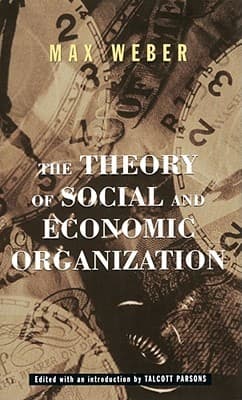
The Theory of Social and Economic Organization cover
Archivist's Choice

The Theory of Social and Economic Organization

Max Weber (1947)

Genre

Politics / History / Economics / Philosophy

Reading Time

1500 min

Key Themes

See below

Track Your Reading

Sign in to track this book

Weber's essential work critiques societal structures, examining the foundations of modern order and the interplay between power, rationality, and human action.

Core Idea

Weber's major work provides the basis for modern sociological analysis, defining its concepts, methods, and subject matter. He introduces methodological individualism as the way to understand social phenomena, stressing that collective ideas must relate to the actions of individuals. Key to his theory are the four types of social action (traditional, emotional, value-rational, and instrumental-rational) and the three types of legitimate authority (rational-legal, traditional, and charismatic). These are 'ideal types'—analytical tools for comparison, not perfect representations of reality. Weber argues that modern society increasingly features rational-legal authority, seen in bureaucracy, and is driven by a broader process of rationalization that leads to the 'disenchantment of the world.' The book distinguishes between power (the ability to impose one's will) and authority (the likelihood that commands will be obeyed). It states that sociology's main job is to understand authority through the lens of legitimacy. Weber advocates for sociology as a value-free science, separate from moral or political judgment. Its goal is to establish provisional sociological 'laws' by interpreting the subjective meaning individuals give to their actions in specific social contexts. This work offers a necessary set of ideas for analyzing social and economic systems.
Reading time
1500 min
Difficulty
Hard
✓ Read this if...
You are a serious student or scholar of sociology, political science, economics, or organizational theory looking for the foundational conceptual framework from one of the discipline's most influential thinkers. Essential for understanding modern bureaucracy, types of authority, and the rationalization process in society.
✗ Skip this if...
You prefer light reading, introductory texts, or a narrative history. This is a dense, theoretical, and methodologically rigorous work that demands careful, focused study, not a casual read.

Core idea

The central argument and framework that powers the entire book.

Weber's major work provides the basis for modern sociological analysis, defining its concepts, methods, and subject matter. He introduces methodological individualism as the way to understand social phenomena, stressing that collective ideas must relate to the actions of individuals. Key to his theory are the four types of social action (traditional, emotional, value-rational, and instrumental-rational) and the three types of legitimate authority (rational-legal, traditional, and charismatic). These are 'ideal types'—analytical tools for comparison, not perfect representations of reality. Weber argues that modern society increasingly features rational-legal authority, seen in bureaucracy, and is driven by a broader process of rationalization that leads to the 'disenchantment of the world.'

The book distinguishes between power (the ability to impose one's will) and authority (the likelihood that commands will be obeyed). It states that sociology's main job is to understand authority through the lens of legitimacy. Weber advocates for sociology as a value-free science, separate from moral or political judgment. Its goal is to establish provisional sociological 'laws' by interpreting the subjective meaning individuals give to their actions in specific social contexts. This work offers a necessary set of ideas for analyzing social and economic systems.

At a glance

Reading time

1500 min

Difficulty

Hard

Read this if...

You are a serious student or scholar of sociology, political science, economics, or organizational theory looking for the foundational conceptual framework from one of the discipline's most influential thinkers. Essential for understanding modern bureaucracy, types of authority, and the rationalization process in society.

Skip this if...

You prefer light reading, introductory texts, or a narrative history. This is a dense, theoretical, and methodologically rigorous work that demands careful, focused study, not a casual read.

Key Takeaways

1

Methodological Individualism

Understanding society by analyzing individual actions and their subjective meanings.

Quote

Sociology... is a science concerning itself with the interpretive understanding of social action and thereby with a causal explanation of its course and consequences.

Weber supports methodological individualism. He argues that collective ideas like 'state' or 'society' can be broken down into the meaningful actions of individual people. He insists on understanding social events by interpreting the subjective meanings individuals attach to their actions, rather than seeing society as an organic whole or a deterministic system. This approach is key for creating causal explanations, as it connects abstract social structures to the concrete motivations of actors. It moves beyond simple observation to a...

Supporting evidence

Weber's foundational definition of sociology itself, emphasizing 'interpretive understanding of social action' as its primary task, rather than grand historical laws or super-individual forces.

Apply this

When analyzing a social issue, don't just look at statistics or institutional structures. Try to understand the individual motivations, beliefs, and meanings that drive the behavior of the people involved. For example, when studying voter turnout, go beyond economic factors and consider individual perceptions of civic duty, political efficacy, or party loyalty.

methodological-individualismverstehensocial-action
2

Four Types of Social Action

Categorizing human behavior based on its underlying motivation and rationality.

Quote

Social action, like all action, may be... (1) instrumentally rational (zweckrational), (2) value-rational (wertrational), (3) affectual (affectual), and finally, (4) traditional (traditional).

Weber proposes types of social action to frame the different reasons for human behavior. Instrumentally rational action is goal-oriented; actors figure out the most efficient ways to reach a desired outcome (e.g., an engineer designing a bridge). Value-rational action is driven by a belief in the inherent value of an action itself, regardless of its result (e.g., a captain staying with his ship). Emotional action is based on feelings (e.g., a spontaneous act of revenge). Traditional action comes from ingrained habits or long-standing ...

Supporting evidence

The explicit categorization of social action into Zweckrationalität, Wertrationalität, Affektuelles Handeln, and Traditionelles Handeln, each with specific examples provided by Weber.

Apply this

When trying to understand a decision or behavior, consider which type of rationality or non-rationality is primarily at play. For instance, when analyzing a company's strategy, discern if it's purely profit-driven (instrumentally rational), guided by ethical principles (value-rational), or simply following industry norms (traditional).

social-actionzweckrationalwertrationalaffectual-actiontraditional-action
3

The Ideal Type

A conceptual tool for sociological analysis, not a perfect reflection of reality.

Quote

An ideal type is formed by the one-sided accentuation of one or more points of view and by the synthesis of a great many diffuse, discrete, more or less present and occasionally absent concrete individual phenomena, which are arranged according to those one-sidedly emphasized viewpoints into a unified analytical construct.

Weber introduces the 'ideal type' as a key method for sociological research. It is an analytical construct, a conceptual model made by highlighting certain features of a phenomenon to create a consistent, exaggerated, but logical picture. An ideal type is not an average, a moral ideal, or a perfect representation of reality. It is a tool used to measure and compare real situations. By building ideal types (e.g., 'bureaucracy,' 'charismatic leadership'), sociologists can systematically analyze real-world examples, showing differences, ...

Supporting evidence

Weber's detailed explanation of 'ideal types' and his subsequent application of them to concepts like bureaucracy, authority, and types of social action.

Apply this

When studying a complex social phenomenon (e.g., a political movement, an organization), construct an 'ideal type' of that phenomenon by identifying its defining, exaggerated characteristics. Then, use this ideal type as a benchmark to compare and contrast with real-world examples, understanding where they conform and where they diverge, and why.

ideal-typemethodologyheuristic
4

Three Types of Legitimate Domination

Explaining the foundations of political and social authority.

Quote

There are three pure types of legitimate domination. The validity of the claims to legitimacy may be based on: 1. Rational grounds... 2. Traditional grounds... 3. Charismatic grounds...

Weber identifies three ideal types of legitimate authority to explain why people obey commands. Rational-legal authority comes from a belief in the legality of rules and the right of those appointed under these rules to issue commands (e.g., modern bureaucracy, elected officials). Traditional authority is based on a belief in the sacredness of old traditions and the legitimacy of those in charge under them (e.g., monarchies, tribal elders). Charismatic authority comes from devotion to an individual's exceptional sanctity, heroism, or ...

Supporting evidence

Weber's explicit enumeration and detailed description of legal-rational, traditional, and charismatic authority as ideal types of legitimate domination.

Apply this

When analyzing a political system or an organization, identify the primary source of its authority. Is it based on rules and procedures (rational-legal), long-standing customs (traditional), or the compelling personality of a leader (charismatic)? This helps understand its strengths, weaknesses, and potential for change.

legitimate-dominationauthorityrational-legal-authoritytraditional-authoritycharismatic-authority
5

Bureaucracy as Rational-Legal Domination

The defining organizational form of modern society, characterized by efficiency but also rigidity.

Quote

The fully developed bureaucratic apparatus compares with other organizations exactly as does the machine with non-mechanical modes of production. Precision, speed, unambiguity, knowledge of the files, continuity, discretion, unity, strict subordination, reduction of friction and of material and personal costs – these are raised to the optimum point in the strictly bureaucratic administration.

Weber identifies bureaucracy as the clearest example of rational-legal authority and the most efficient type of organization. It has a hierarchy, division of labor, formal rules, impersonality, and technical skill. Bureaucracy aims for maximum efficiency and predictability. While acknowledging its technical superiority, Weber also saw its potential downsides. The 'iron cage' of rationality can make individuals feel like cogs in a machine, leading to depersonalization, rigidity, and a loss of individual freedom and meaning. This idea i...

Supporting evidence

Weber's extensive analysis of the characteristics of bureaucracy, including its hierarchical structure, written rules, impersonality, and specialized training, and his comparison of its efficiency to a machine.

Apply this

When encountering an inefficient or overly rigid organization, analyze it through the lens of bureaucracy. Is it suffering from an overemphasis on rules, lack of flexibility, or depersonalization? Conversely, when designing an organization, consider how to balance the efficiency of bureaucratic principles with the need for adaptability and human agency.

bureaucracyrational-legal-authorityrationalizationiron-cage
6

Rationalization and Disenchantment

The increasing dominance of calculability and efficiency, eroding traditional values and meaning.

Quote

The fate of our times is characterized by rationalization and intellectualization and, above all, by the 'disenchantment of the world.'

A main idea in Weber's work is rationalization, which he sees as the defining feature of Western modernity. Rationalization means applying calculation, predictability, and efficiency more and more to all parts of life, from economics and politics to art and religion. This leads to the 'disenchantment of the world' (Entzauberung der Welt), where magical, mystical, and traditional explanations are replaced by scientific, technical, and logical ones. While this brings progress and efficiency, it also removes inherent meaning and spiritua...

Supporting evidence

Weber's discussion of the historical shift from magical/religious worldviews to scientific/rational ones, the rise of bureaucracy, and the calculability of modern capitalism as expressions of rationalization and disenchantment.

Apply this

Reflect on how areas of your life or society have become more 'rationalized.' For example, how has dating moved from traditional courtship to algorithm-driven apps? Consider the gains in efficiency but also the potential loss of spontaneity or deeper meaning. Seek ways to re-enchant aspects of your life that feel overly mechanical.

rationalizationdisenchantmentmodernityinstrumental-reason
7

The Economy and Social Action

Economic action is embedded in and shaped by broader social and cultural contexts.

Quote

Economic action is human action which is concerned with the provision of utilities... It is, therefore, always social action.

Weber rejects a purely materialist or economic view of society. While he acknowledges the strong influence of economic factors, he insists that economic action itself is a type of social action, full of subjective meaning and shaped by non-economic factors like religion, culture, and legal systems. For Weber, economic behavior is not just about rational utility maximization; it is influenced by values, traditions, and the desire for social recognition. This view allows him to explore the relationship between economic structures and ot...

Supporting evidence

Weber's argument that economic action must be understood through the lens of social action and his later detailed analysis in 'The Protestant Ethic and the Spirit of Capitalism' (though not directly in *Theory*), which illustrates the non-economic origins of economic behavior.

Apply this

When analyzing economic phenomena (e.g., consumer behavior, labor relations), look beyond purely financial incentives. Consider the cultural norms, social expectations, and individual values that also drive economic decisions. For example, why might people choose a less profitable job if it aligns with their values or offers better work-life balance?

economic-sociologysocial-actionprotestant-ethiccultural-influence
8

Power vs. Domination

Distinguishing between the mere ability to impose will and the legitimate right to command obedience.

Quote

Power (Macht) is the probability that one actor within a social relationship will be in a position to carry out his own will despite resistance, regardless of the basis on which this probability rests. Domination (Herrschaft)... is the probability that a command with a given specific content will be obeyed by a given group of persons.

Weber makes a key difference between 'power' (Macht) and 'authority' (Herrschaft). Power is a broad concept, referring to an actor's ability to impose their will even against resistance, regardless of the source (e.g., physical force, wealth, charisma). Authority, however, is a more specific sociological concept. It means legitimate authority, the likelihood that a command will be obeyed by a specific group of people because they believe in the legitimacy of the command and the commander. This difference is fundamental because it mo...

Supporting evidence

Weber's precise definitions and differentiation of 'Macht' and 'Herrschaft' at the beginning of his discussion on domination.

Apply this

When observing a leader or an institution, ask whether their influence stems from raw power (coercion, financial leverage) or from legitimate domination (people willingly obey due to rules, tradition, or belief in the leader). Understanding this difference can reveal the true stability and nature of their authority.

powerdominationlegitimacyauthority
9

Sociology as a Value-Free Science

Sociologists must strive for objectivity, separating facts from personal values.

Quote

An empirical science cannot tell anyone what he *should* do, but rather what he *can* do, and under certain circumstances, what he *will* do.

Weber advocates for a 'value-free' (Wertfreiheit) sociology. He argues that sociologists must separate factual analysis from value judgments. While acknowledging that the choice of research topics often comes from a researcher's values, the conduct of the research and the presentation of findings should be objective and free from personal biases or moral rules. Sociology's role is to explain what is and what will be under certain conditions, not to say what should be. This commitment to objectivity is key for establishing soci...

Supporting evidence

Weber's explicit methodological discussions on the separation of facts and values, and the role of the sociologist as an objective analyst rather than a moral arbiter.

Apply this

When conducting any analysis, be it in personal or professional life, consciously separate your factual observations and logical deductions from your personal opinions, moral judgments, or desired outcomes. Strive to present the 'what is' before introducing the 'what should be,' if at all.

value-free-sociologyobjectivitymethodologywertfreiheit
10

The Provisional Nature of Sociological Laws

Sociological generalizations are probabilistic and subject to change, not universal laws.

Quote

The development of the sciences of culture is proceeding in a direction which makes it more and more difficult to believe that the goal of these sciences is the reduction of empirical reality to 'laws'.

Unlike natural sciences, Weber argues that sociology cannot find universal, deterministic laws that control human behavior with absolute certainty. Because of the complexity of social action, the subjective meanings involved, and the historical nature of social events, sociological 'laws' are probabilistic generalizations or 'adequate causal explanations.' They describe tendencies and probabilities, not strict necessities. This view highlights the unique challenges and limits of social science, stressing the importance of historical c...

Supporting evidence

Weber's consistent emphasis on 'adequate causal explanation' and 'probability' when discussing sociological insights, contrasting it with the deterministic laws sought by some natural sciences.

Apply this

When interpreting social trends or making predictions about human behavior, always consider the inherent uncertainty and the probabilistic nature of your conclusions. Avoid making absolute statements and remain open to alternative explanations or unforeseen variables, acknowledging the limits of social scientific prediction.

sociological-lawsprobabilitycausal-explanationhistorical-contingency

Critical analysis

Notable Quotes

The state is a human community that (successfully) claims the monopoly of the legitimate use of physical force within a given territory.

Defining the modern state in 'Politics as a Vocation,' often included with this work.

Bureaucracy is the most rational known means of exercising authority over human beings.

Discussing the characteristics and efficiency of bureaucratic administration.

An (associative) social relationship will be called a 'society' if and in so far as the orientation of social action within it rests on a rationally motivated agreement.

Defining the concept of 'society' based on rational agreement.

Action is social in so far as by virtue of the subjective meaning attached to it by the acting individual (or individuals), it takes account of the behavior of others and is thereby oriented in its course.

Introducing the fundamental concept of 'social action' in sociology.

The fate of our times is characterized by rationalization and intellectualization and, above all, by the 'disenchantment of the world.'

Reflecting on the impact of modernity and scientific progress.

Legitimacy means that the validity of the order is recognized by the actors.

Explaining the basis for legitimate authority and social order.

The primary task of a genuine science of society is the understanding of the subjective meaning of social action.

Emphasizing the interpretative (verstehende) approach to sociology.

Power is the probability that one actor within a social relationship will be in a position to carry out his own will despite resistance, regardless of the basis on which this probability rests.

Defining power as a key concept in social relations.

Every bureaucracy seeks to increase the superiority of the professionally informed by keeping their knowledge and intentions secret.

Highlighting a characteristic tendency of bureaucratic organizations.

The purely economic orientation of action, for example, is a marginal case of rational action, and even then only if it is completely rational in the choice of means.

Discussing the limitations of purely economic rationality in social action.

For the purpose of a sociological analysis, the state cannot be defined in terms of its ends.

Arguing against defining the state by its purposes, instead focusing on its means (monopoly of force).

The term 'charisma' will be applied to a certain quality of an individual personality by virtue of which he is set apart from ordinary men and treated as endowed with supernatural, superhuman, or at least specifically exceptional powers or qualities.

Defining charismatic authority as one of the three pure types of legitimate domination.

Economic action is primarily oriented to the problem of choosing the end to which a given set of means is to be applied.

Characterizing economic action as a form of rational action focused on resource allocation.

The most fundamental tendency of bureaucracy is to level differences of social status and to create a highly specialized and technically trained officialdom.

Describing the homogenizing and professionalizing effects of bureaucracy.

Quiz

Test Your Knowledge

Ready to see how well you understood this book? Take our interactive quiz with 10 questions.

10
Questions
~5
Minutes
?
Best Score

Key Questions (FAQ)

This book serves as the fullest general statement of Max Weber's sociological theory, introducing his comprehensive comparative study of the sociological and institutional foundations of the modern economic and social order. It aims to clarify his analytical methods while critiquing prevailing sociological theories of his time.

About the author