BookBrief
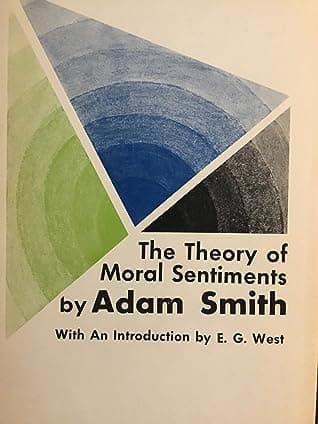
The Theory of Moral Sentiments cover
Archivist's Choice

The Theory of Moral Sentiments

Adam Smith (1986)

Genre

Business / Politics / History / Economics / Philosophy

Reading Time

15-20 hours (due to its length and density)

Key Themes

See below

Track Your Reading

Sign in to track this book

Adam Smith's foundational work explains that true virtue and a moral life go beyond self-interest, coming instead from our human ability for sympathy and the judgments of an 'impartial spectator'.

Core Idea

Adam Smith says human morality comes from our ability to feel 'sympathy' or fellow-feeling, not just reason or self-interest. We want 'mutual sympathy' from others and seek approval by imagining an 'impartial spectator' who watches our actions and motives. This internal spectator helps us judge our own conduct and others', leading to 'propriety'—actions that suit and please others. Our moral judgments come from our social nature, our desire for approval, and our ability to step outside ourselves to judge our behavior objectively. Smith describes how virtues like prudence, justice, and beneficence come from these sympathetic processes. Justice prevents harm, while beneficence promotes happiness. He also explores how external things like wealth and rank can change our moral feelings, making us admire the rich and powerful even when their actions are not virtuous. The book says a good society depends on people developing their moral feelings through the impartial spectator, aiming for actions that an objective, informed observer would approve.
Reading time
15-20 hours (due to its length and density)
Difficulty
Hard
✓ Read this if...
You are interested in the philosophical underpinnings of human morality, the origins of ethical judgment, or want to understand Adam Smith's broader thought beyond 'The Wealth of Nations'.
✗ Skip this if...
You are looking for a practical guide to modern ethics, prefer contemporary philosophical language, or are not inclined towards detailed 18th-century philosophical discourse.

Core idea

The central argument and framework that powers the entire book.

Adam Smith says human morality comes from our ability to feel 'sympathy' or fellow-feeling, not just reason or self-interest. We want 'mutual sympathy' from others and seek approval by imagining an 'impartial spectator' who watches our actions and motives. This internal spectator helps us judge our own conduct and others', leading to 'propriety'—actions that suit and please others. Our moral judgments come from our social nature, our desire for approval, and our ability to step outside ourselves to judge our behavior objectively. Smith describes how virtues like prudence, justice, and beneficence come from these sympathetic processes. Justice prevents harm, while beneficence promotes happiness. He also explores how external things like wealth and rank can change our moral feelings, making us admire the rich and powerful even when their actions are not virtuous. The book says a good society depends on people developing their moral feelings through the impartial spectator, aiming for actions that an objective, informed observer would approve.

At a glance

Reading time

15-20 hours (due to its length and density)

Difficulty

Hard

Read this if...

You are interested in the philosophical underpinnings of human morality, the origins of ethical judgment, or want to understand Adam Smith's broader thought beyond 'The Wealth of Nations'.

Skip this if...

You are looking for a practical guide to modern ethics, prefer contemporary philosophical language, or are not inclined towards detailed 18th-century philosophical discourse.

Key Takeaways

1

The Impartial Spectator

Our inner moral compass, refined by societal observation.

Quote

We endeavor to examine our own conduct as we imagine any other fair and impartial spectator would examine it.

Smith introduces the 'impartial spectator' as the basis of our moral judgment. This is not an outside judge, but an internal ideal observer, formed from our experiences of watching and being watched by others. We learn to judge our own actions and feelings by imagining how this impartial, informed, and sympathetic observer would see them. This internal conversation helps us move past self-interest and align our behavior with what is socially acceptable and morally good. It is a way to correct ourselves and develop a conscience, which ...

Supporting evidence

Smith's extensive discussions on how children learn moral rules by observing parental reactions and the judgments of their peers, gradually internalizing these external perspectives into an 'inner man' or conscience.

Apply this

Before making a significant decision, especially one with ethical implications, pause and consider how an objective, well-meaning third party, fully aware of all facts and intentions, would view your choice. This mental exercise can help identify biases and promote more virtuous conduct.

sympathyconsciencemoral-judgment
2

Sympathy as Fellow-Feeling

More than pity, it's our capacity to imagine and share others' emotions.

Quote

Though our brother is upon the rack, as long as we ourselves are at our ease, our senses will never inform us of what he suffers.

Smith's idea of sympathy is more than just pity or compassion. It is the imaginative act of putting ourselves in another's situation to understand and share their feelings. We do not feel the exact same intensity, but we can 'enter into' their sentiments. This imaginative projection is basic to social connection and moral understanding. It lets us approve or disapprove of others' actions based on whether we can easily sympathize with their motives. How easily we can sympathize with someone's joy or sorrow affects our judgment of their...

Supporting evidence

Smith's detailed examples of how we sympathize with the joy of a bride or the grief of a mourner, even if we haven't experienced those exact circumstances ourselves, by imagining ourselves in their shoes.

Apply this

When encountering someone experiencing strong emotions, instead of immediately judging or offering advice, try to genuinely imagine yourself in their exact circumstances. What would you feel? This practice deepens empathy and improves communication.

empathyimaginationsocial-connection
3

The Desire for Mutual Sympathy

Our deep-seated need to have our feelings understood and approved.

Quote

The greatest joy of man is the experience of mutual sympathy.

A main human drive, Smith says, is the desire for mutual sympathy – wanting others to understand and share our feelings. When our joy is shared, it grows; when our sorrow is sympathized with, it lessens. This desire for agreement in feelings motivates much of our social behavior. We often lessen our strong emotions to make them more acceptable and relatable to others, seeking that point where others can easily share our feelings. This constant adjustment helps social connection and keeps people from being isolated in their own emotion...

Supporting evidence

Smith's observation that we often temper our joy in the presence of those who are not equally delighted, and our grief in the presence of those who cannot fully comprehend our suffering, all in an effort to achieve mutual sympathy.

Apply this

When sharing personal news, positive or negative, consider how your audience might receive it. Frame your emotions in a way that invites understanding and connection, rather than alienating others with unmoderated intensity. Seek to build bridges of shared feeling.

social-harmonyemotional-regulationconformity
4

Propriety and Moral Approval

Judging actions based on the 'suitableness' of their underlying sentiments.

Quote

To approve of the passions of another, as suitable to their objects, is the same thing as to observe that we entirely sympathize with them.

Moral approval, for Smith, is not just about results but about the 'propriety' of the feelings that drive an action. We approve of an action when we can easily sympathize with the person's motives and feelings in a situation. If the emotion shown seems 'suitable' or 'proportionate' to the reason, we consider it proper. This means an action driven by too much anger or not enough gratitude, even if it leads to a good result, might still be judged as improper. This detailed understanding shows that morality is tied to our emotional lives...

Supporting evidence

Smith's distinction between approving of the 'propriety' of an agent's sentiments (e.g., appropriate anger at injustice) and approving of the 'merit' of an action (e.g., the good it brings about).

Apply this

When evaluating someone's behavior, go beyond the superficial action. Try to understand the underlying motivations and emotions. Ask yourself: 'Are these feelings proportionate and suitable to the situation?' This can lead to more compassionate and accurate judgments.

moral-judgmentvirtueemotion
5

The Two Sources of Self-Approval

The desire for praise and the desire to be praise-worthy.

Quote

Man naturally desires, not only to be loved, but to be lovely; or to be that thing which is the natural and proper object of love.

Smith separates the surface desire for actual praise from the deeper desire to be praiseworthy. The first can lead to vanity and insincere behavior, as one seeks applause no matter what. The second, however, is a good and virtuous drive. It is the goal of acting so that the impartial spectator would truly approve, even if no one else is watching. This internal standard, developed through self-reflection and learning societal norms, is the base of true virtue and self-respect. It keeps us from being controlled by public opinion and i...

Supporting evidence

Smith's discussion of the 'man of ambition' who seeks only external acclaim versus the 'man of virtue' who seeks internal self-approbation from his conscience.

Apply this

When faced with a choice, ask yourself: 'Am I acting to gain external approval, or am I acting in a way that my internal, impartial spectator would genuinely deem praiseworthy, even if no one ever knew?' Prioritize the latter to build genuine character.

virtueself-respectconscience
6

The Role of Custom and Fashion

Societal norms shape our moral judgments, sometimes for good, sometimes for ill.

Quote

The power of custom and fashion over our moral sentiments is not less than over our tastes and manners.

While the impartial spectator provides an ideal standard, Smith acknowledges the great influence of custom and fashion on our moral judgments. What is considered 'proper' or 'improper' can differ greatly across cultures and times. These societal norms, though often random in origin, become deeply ingrained and shape our sympathetic responses. This shows a conflict: while we seek an objective moral standard, our perceptions are filtered through our social environment. This idea is important for understanding cultural relativism in mora...

Supporting evidence

Smith's examples of how different cultures might judge the same act (e.g., infanticide in ancient societies versus modern ones) or how fashion dictates what is considered beautiful or appropriate attire, influencing even our moral aesthetics.

Apply this

When encountering moral views different from your own, pause to consider the customs and social norms that might be shaping those perspectives. This doesn't mean abandoning your own principles but fosters understanding and reduces hasty judgment.

cultural-relativismsocial-normsmoral-diversity
7

The Virtue of Prudence

Self-interest as a foundation, not the pinnacle, of moral life.

Quote

The care of the health, of the fortune, of the rank and reputation of the individual, the objects upon which his comfort and happiness in this life are supposed principally to depend, is regarded as the proper business of prudence.

Smith, often thought to only support self-interest, describes 'prudence' as a basic virtue, but not the final one. Prudence is the wise and careful management of one's own affairs – health, wealth, reputation – to get basic needs and personal well-being. This is necessary, as one cannot help others or contribute to society if one is struggling. However, prudence is just the first step. It provides the stable base from which higher virtues like benevolence and justice can grow. It is a 'cooler' virtue, driven by reason, but necessary f...

Supporting evidence

Smith's detailed discussion of the 'prudent man' who diligently works, saves, and avoids unnecessary risks, not out of greed, but out of a desire for security and the ability to fulfill future obligations.

Apply this

Ensure your basic needs and responsibilities are met through diligent planning and effort. Recognize that this foundational self-care isn't selfish, but a necessary prerequisite for being able to genuinely contribute to the well-being of others and pursue higher moral goals.

self-interestbenevolenceeconomics
8

Justice as a Negative Virtue

Protecting individuals from harm, enforced by resentment and punishment.

Quote

Justice, on the contrary, is the main pillar that upholds the whole edifice. If it is removed, the great, the immense fabric of human society, that fabric which to raise and support seems in this world, if I may say so, to have been the peculiar and darling care of Nature, must in a moment crumble into atoms.

Smith defines justice as a 'negative' virtue, meaning it mainly involves not harming others. Unlike benevolence, which is admirable but not strictly enforceable, justice is necessary for society to exist. Breaking justice naturally causes anger and deserves punishment. This focus on preventing harm – to life, body, property, or reputation – forms the base of law and order. Without justice, society would become chaotic, as people would always fear aggression. The impartial spectator easily sympathizes with the anger of the harmed party...

Supporting evidence

Smith's argument that violating justice (e.g., murder, theft) evokes universal disapproval and a strong desire for retribution, which is the basis for legal systems and punishment.

Apply this

Prioritize actions that uphold justice by actively avoiding harm to others and respecting their rights. Understand that societal stability depends on this fundamental principle, and contribute to its enforcement, even if it means upholding rules you personally find inconvenient.

law-and-orderpunishmentsocial-contract
9

The Allure of Wealth and Rank

Our tendency to admire the rich and despise the poor, a moral corruption.

Quote

It is the rich and the powerful who are chiefly the objects of our attention, and whose conduct we are most apt to consider as the standard of propriety.

Smith observes a common human weakness: our tendency to admire the wealthy and powerful, and often to ignore or even look down on the poor and unknown. We tend to sympathize more with the joy of the successful and less with the suffering of the unfortunate. This 'corruption of our moral sentiments' makes us mistakenly think wealth means virtue and poverty means vice. It distorts our impartial spectator, making us less critical of the powerful and more judgmental of those struggling. This idea is very insightful, predicting modern crit...

Supporting evidence

Smith's vivid descriptions of how people fawn over the rich and ignore the poor, even when the wealthy are morally corrupt and the poor are virtuous, demonstrating a fundamental flaw in human social psychology.

Apply this

Consciously challenge your inherent biases when evaluating individuals. Make an effort to judge people based on their character and actions, rather than their material possessions or social standing. Actively seek to sympathize with those in less fortunate circumstances.

social-inequalitystatusbias
10

Virtue as the Middle Ground

Moral excellence lies in moderation and the 'amiable' and 'respectable' virtues.

Quote

The perfection of human nature, he says, consists in the proper balance of all our affections.

Using classical philosophy, Smith says virtue often lies in a 'middle ground' or moderation of passions. Too much emotion is improper, as is its complete absence. The truly virtuous person knows how to feel and express emotions in a way the impartial spectator can easily sympathize with. He distinguishes between 'amiable' virtues (like compassion and generosity), which make us loved, and 'respectable' virtues (like self-command and justice), which make us esteemed. A virtuous person has a balance of these qualities, showing both a war...

Supporting evidence

Smith's discussion of various virtues and vices, consistently advocating for a balanced and proportionate emotional response, avoiding both extremes of insensitivity and excessive passion.

Apply this

Cultivate both your capacity for empathy and your ability for self-control. Strive for a balanced emotional life where your reactions are appropriate to the situation, making you both genuinely kind and reliably principled.

moderationtemperancecharacter

Critical analysis

Notable Quotes

How selfish soever man may be supposed, there are evidently some principles in his nature, which interest him in the fortune of others, and render their happiness necessary to him, though he derives nothing from it except the pleasure of seeing it.

Opening lines of the book, introducing the concept of sympathy.

It is not from the benevolence of the butcher, the brewer, or the baker that we expect our dinner, but from their regard to their own interest.

Often cited in economics to illustrate self-interest in markets, though from a later work (The Wealth of Nations), but relevant to Smith's broader thought.

Man naturally desires, not only to be loved, but to be lovely; or to be that thing which is the natural and proper object of love.

Discussion on human desire for moral approval and virtue.

The great source of both the misery and disorders of human life, seems to arise from over-rating the difference between one permanent situation and another.

Reflection on human discontent and the pursuit of status.

To feel much for others and little for ourselves, that to restrain our selfish, and to indulge our benevolent affections, constitutes the perfection of human nature.

Argument for balancing self-interest with empathy.

The wise and virtuous man is at all times willing that his own private interest should be sacrificed to the public interest of his own particular order or society.

Discussion on civic virtue and social responsibility.

Society may subsist among different men, as among different merchants, from a sense of its utility, without any mutual love or affection.

Analysis of social cohesion based on interest rather than sentiment.

The man of system... is apt to be very wise in his own conceit; and is often so enamoured with the supposed beauty of his own ideal plan of government, that he cannot suffer the smallest deviation from any part of it.

Critique of rigid political ideologies and central planning.

Virtue is more to be feared than vice, because its excesses are not subject to the regulation of conscience.

Warning about the dangers of moral absolutism.

The real satisfaction of all desires and passions is to be found in the attainment of their objects, and not in the mere possession of them.

Insight into human motivation and the pursuit of goals.

In the race for wealth, and honours, and preferments, he may run as hard as he can, and strain every nerve and every muscle, in order to outstrip all his competitors.

Description of competitive drives in economic and social life.

The administration of the great system of the universe... the care of the universal happiness of all rational and sensible beings, is the business of God and not of man.

Theological reflection on human limits in moral governance.

When the happiness or misery of others depends in any respect upon our conduct, we dare not, as self-love might suggest to us, prefer the interest of one to that of many.

Argument for impartiality in moral decision-making.

Quiz

Test Your Knowledge

Ready to see how well you understood this book? Take our interactive quiz with 10 questions.

10
Questions
~5
Minutes
?
Best Score

Key Questions (FAQ)

The Theory of Moral Sentiments is Adam Smith's foundational work on moral philosophy, exploring how humans develop moral judgments through sympathy and imagination. It establishes a system of ethics based on social relationships and conscience, challenging the common perception of Smith as solely focused on economic self-interest.

About the author

Adam Smith

Adam Smith was a Scottish economist and philosopher, widely regarded as one of the most influential figures in modern economics. He is best known for his seminal work, 'The Theory of Moral Sentiments' (1759) and 'The Wealth of Nations' (1776), which laid the foundations for classical economics and the concept of the free market.