BookBrief
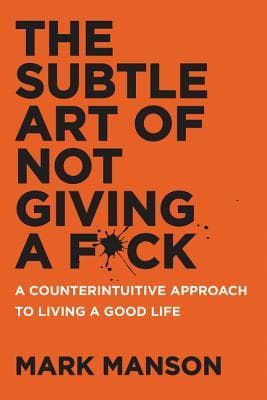
The Subtle Art of Not Giving a F*ck: A Counterintuitive Approach to Living a Good Life cover
Archivist's Choice

The Subtle Art of Not Giving a F*ck: A Counterintuitive Approach to Living a Good Life

Mark Manson (2016)

Genre

Business / Psychology / Philosophy / Self-Help

Reading Time

180 min

Key Themes

See below

Track Your Reading

Sign in to track this book

Embrace your flaws and stomach life's lemons, because true happiness isn't about relentless positivity, but about choosing what truly matters to give a f*ck about.

Core Idea

Mark Manson says that the usual search for happiness, often driven by a constant focus on good experiences and outside approval, is flawed and doesn't work. Instead, he suggests a different way: accept struggle, accept limits, and carefully choose what matters to us. The main idea is that a good life isn't about avoiding problems or always being happy, but about finding the problems we are willing to deal with and finding meaning in our struggles. When we understand we are not special, that life is hard, and that our values guide us, we can stop caring about unimportant things and put our limited energy toward things that truly matter. This leads to a more stable and meaningful life.
Reading time
180 min
Difficulty
Easy
✓ Read this if...
You're tired of conventional self-help advice, are open to blunt language, and want a practical framework for prioritizing what truly matters in your life.
✗ Skip this if...
You are easily offended by profanity, prefer a purely optimistic outlook, or are looking for a step-by-step guide to achieving specific goals.

Core idea

The central argument and framework that powers the entire book.

Mark Manson says that the usual search for happiness, often driven by a constant focus on good experiences and outside approval, is flawed and doesn't work. Instead, he suggests a different way: accept struggle, accept limits, and carefully choose what matters to us. The main idea is that a good life isn't about avoiding problems or always being happy, but about finding the problems we are willing to deal with and finding meaning in our struggles. When we understand we are not special, that life is hard, and that our values guide us, we can stop caring about unimportant things and put our limited energy toward things that truly matter. This leads to a more stable and meaningful life.

At a glance

Reading time

180 min

Difficulty

Easy

Read this if...

You're tired of conventional self-help advice, are open to blunt language, and want a practical framework for prioritizing what truly matters in your life.

Skip this if...

You are easily offended by profanity, prefer a purely optimistic outlook, or are looking for a step-by-step guide to achieving specific goals.

Key Takeaways

1

The Subtle Art of Not Giving a F*ck

Prioritize what truly matters by selectively caring less about everything else.

Quote

The secret to a good life is not to give a f*ck about more things, but rather, to give a f*ck about fewer things, only the things that are true and immediate and important.

Manson says that life naturally has problems and suffering. The goal is not to get rid of problems, but to choose which ones you want to have and which you are willing to work for. This 'subtle art' is not about not caring; it is about saving your emotional energy and attention for values that truly match who you are. By consciously deciding what you do not care about, you make mental and emotional room to invest deeply in what truly improves your life. This chosen indifference helps you free yourself, keeping you from being constan...

Supporting evidence

Manson frequently uses his own life experiences, such as his travels and various entrepreneurial ventures, to illustrate how chasing external validation or superficial goals led to unhappiness, while focusing on intrinsic values brought genuine contentment.

Apply this

Identify three areas in your life where you currently give too many 'f*cks' (e.g., social media validation, other people's opinions, minor inconveniences). Consciously decide to reduce your emotional investment in these areas. Redirect that freed-up energy towards one core value or goal you genuinely care about.


selective-indifferencevalue-prioritizationemotional-economy
2

Happiness is a Problem

True happiness comes from solving problems, not avoiding them.

Quote

Don’t hope for a life without problems. There’s no such thing. Instead, hope for a life full of good problems.

Manson questions the common cultural story that happiness is a constant state of good feelings and no problems. He says that life is a never-ending series of problems, and real happiness is not the lack of these problems, but the joy from solving them. The quality of your life depends on the quality of the problems you choose to face and how you solve them. If your problems are meaningful and match your values, solving them brings satisfaction. On the other hand, avoiding problems or having unimportant ones leads to a shallow life tha...

Supporting evidence

Manson discusses the Hedonic Treadmill, where people constantly seek new pleasures to maintain a baseline level of happiness, demonstrating that external achievements provide only temporary boosts. He contrasts this with the sustained satisfaction found in tackling significant, value-driven challenges.

Apply this

Instead of wishing away a current struggle, identify the specific problem you're facing. Ask yourself: 'Is this a problem I *want* to have? Is it aligned with my values?' If yes, reframe it as an opportunity for growth and dedicate yourself to finding a solution, embracing the process.

problem-solvinghedonic-treadmillmeaningful-struggle
3

You Are Not Special

Embrace mediocrity to find true self-worth and purpose.

Quote

The vast majority of people are mediocre at most things. Even if you’re exceptional at one thing, you’re probably mediocre at most other things. That’s just the nature of life.

Manson criticizes the modern self-esteem movement and the common belief that everyone is special and meant for great things. He says that this 'special snowflake' idea leads to feeling entitled, anxious, and unable to handle failure. By accepting that you are not special—that being average is normal and perfectly fine—you remove the huge pressure to always prove you are exceptional. This acceptance allows for real self-improvement, as it lets you focus on getting good at things you truly care about, instead of chasing an impossible id...

Supporting evidence

Manson points to the 'everyone gets a trophy' mentality and the rise of social media, which fosters constant comparison and the need for external validation, leading to widespread anxiety and a fragile sense of self-worth.

Apply this

Reflect on an area where you feel pressure to be 'the best.' Consciously release that pressure. Instead, focus on incremental improvement and the joy of the process, rather than the outcome. Embrace the idea that being 'good enough' is often more than sufficient.

mediocrity-acceptanceentitlement-critiquehumility-value
4

Choose Your Values Wisely

Values dictate your problems, so pick healthy, internally-driven ones.

Quote

Our values determine the metrics by which we measure ourselves and everyone else. Our values are therefore in our control. We choose what to give a f*ck about.

Manson points out that our values are the basis of what we 'give a f*ck' about. Bad values lead to bad problems and, as a result, a bad life. He separates good, healthy values (like honesty, creativity, openness, standing up for yourself) from bad, unhealthy values (like pleasure, money, always being right, always being positive). Healthy values are based in reality, help society, and you can control them. Unhealthy values are often superficial, depend on outside things, and lead to constant anxiety and unhappiness. By carefully looki...

Supporting evidence

Manson discusses how a value like 'always being happy' is inherently unhealthy because life is not always happy, leading to self-denial and emotional suppression. He contrasts this with values like 'integrity' or 'growth,' which provide a stable foundation regardless of external circumstances.

Apply this

List your top three current values. Then, evaluate each: Is it reality-based? Socially constructive? Controllable? If not, identify a healthier, internally-driven value to replace it. For example, instead of 'being liked by everyone,' choose 'expressing my authentic self.'

value-assessmentinternal-vs-external-valuesself-control
5

You Are Always Choosing

Even inaction is a choice, and you are always responsible for your experiences.

Quote

We are responsible for everything in our lives, no matter the external circumstances. We are responsible for how we interpret those circumstances, how we react to them, and what we do with them.

Manson stresses taking full personal responsibility. He says that while you may not control every event that happens, you are always 100% responsible for how you respond to it. This idea can be hard to accept because it takes away the ability to feel like a victim or blame outside forces. However, it is also very empowering. By accepting full responsibility for your choices, actions, and even your emotional reactions, you regain control over your life. This is not about blaming yourself for things you cannot control, but knowing that ...

Supporting evidence

Manson uses the story of his friend, Josh, who, despite facing significant adversity (a difficult upbringing, being robbed), chose to take responsibility for his own life path and eventually found success and happiness, demonstrating the power of agency.

Apply this

When facing a difficult situation, instead of asking 'Why is this happening to me?' or 'Whose fault is this?', ask 'How am I choosing to respond to this? What action can I take, even a small one, to influence the outcome or my perception?'

radical-responsibilityagencyvictim-mentality
6

Be Wrong, Embrace Uncertainty

Growth requires admitting ignorance and challenging your own beliefs.

Quote

The only way to achieve meaning and a sense of importance is to know what you’re *not* giving a f*ck about, and to only give a f*ck about what truly matters.

Manson supports the value of uncertainty and being willing to be wrong. Our brains tend to confirm what we already believe, which creates 'confirmation bias' and makes us resist new information that might challenge our views. But real growth and learning happen only when we are open to the chance that we might be wrong. Accepting uncertainty means questioning your assumptions, being open enough to admit you don't know, and always looking for new ways of thinking. This intellectual humility helps personal growth, letting you adapt, cha...

Supporting evidence

Manson discusses the Dunning-Kruger effect, where less competent individuals overestimate their abilities, and how this links to our aversion to admitting ignorance. He also highlights the importance of asking 'What if I'm wrong?' as a path to deeper understanding.

Apply this

Identify a strong opinion you hold. Actively seek out information or perspectives that challenge that opinion. Engage in a discussion with someone who disagrees, not to win, but to understand their viewpoint. Practice saying, 'I might be wrong about that.'

intellectual-humilityconfirmation-biasgrowth-mindset
7

The Pain of Progress

Suffering is inevitable and often necessary for meaningful progress.

Quote

Growth is an endlessly iterative process. When we choose to grow, we are choosing to suffer. It’s the suffering that makes the growth meaningful.

This idea repeats that real self-improvement and progress are rarely comfortable. Manson says that suffering is not just something to avoid, but a necessary part of growth. Whether it is the pain of discipline, the discomfort of facing a hard truth, or the struggle of learning a new skill, pain shows that you are pushing limits and growing your abilities. Trying to avoid all suffering leads to staying the same and a superficial life. By accepting the pain that comes with worthwhile efforts, you change it from something that stops you ...

Supporting evidence

Manson relates this to the pursuit of any skill or mastery, from learning an instrument to building a business. The initial struggles and failures are painful but are precisely what forge competence and a deeper appreciation for the eventual success.

Apply this

Identify a goal you've been avoiding due to anticipated difficulty or discomfort. Break down the initial 'pain points' and commit to enduring them for a short, defined period (e.g., 15 minutes of an unpleasant task). Recognize that this discomfort is a sign of progress.

suffering-for-growthresiliencediscomfort-tolerance
8

The Choice to Act

Motivation is a result of action, not a prerequisite for it.

Quote

Action isn’t just the effect of motivation; it’s also the cause of it.

Manson changes the usual idea about motivation. Many people think they need to feel motivated before they can act. However, Manson says the opposite is often true: taking action, even small, imperfect steps, creates momentum and, in turn, motivation. This 'Do Something' rule encourages you to move past waiting for inspiration. By simply starting, you create a loop where action leads to progress, which then makes you want to continue. This view is very freeing, as it puts the power to start change directly in your hands, no matter ...

Supporting evidence

Manson describes the 'Action-Motivation-Inspiration' cycle: Action leads to Inspiration, which leads to Motivation, which leads to more Action. This contrasts with the common, but often ineffective, 'Inspiration-Motivation-Action' model.

Apply this

If you're stuck on a task, don't wait for motivation. Pick the smallest possible first step (e.g., open the relevant document, write one sentence). Commit to just that one step. Often, the momentum from that tiny action will be enough to get you going.

action-over-motivationmomentum-buildingdo-something-principle
9

Embrace Imperfection

Don't strive for perfect; strive for 'good enough' to avoid paralysis.

Quote

Don’t try to be perfect. Just try to be good enough. Good enough is often better than perfect, because perfect never gets done.

Manson argues against the harmful pursuit of perfection. While trying for excellence is good, the strong need for perfection often leads to putting things off, anxiety, and finally, not doing anything. The fear of not being perfect can stop people from even starting, or finishing, important tasks. By accepting 'good enough,' you free yourself from this paralyzing pressure. This does not mean settling for bad work, but understanding that progress often comes from making small improvements rather than one perfect try. It is about puttin...

Supporting evidence

Manson frequently references how the pursuit of 'perfect' often leads to analysis paralysis or endless tweaking, preventing anything from being launched or completed. He implies that many successful ventures started imperfectly and improved over time.

Apply this

For a current project, define what 'good enough' looks like. Set a deadline for reaching that 'good enough' state and commit to launching or completing it at that point, rather than endlessly refining. Remind yourself that you can always iterate later.

perfectionism-trapgood-enoughiterative-progress

Critical analysis

Notable Quotes

The desire for more positive experience is itself a negative experience. And, paradoxically, the acceptance of one’s negative experience is itself a positive experience.

Discussing the paradox of happiness and acceptance.

Don’t hope for a life without problems. There’s no such thing. Instead, hope for a life full of good problems.

Emphasizing the importance of choosing meaningful struggles.

Who you are is defined by what you’re willing to struggle for.

Explaining how values shape identity through challenges.

The key to a good life is not giving a fuck about more; it’s giving a fuck about less, giving a fuck about only what is true and immediate and important.

Introducing the book's central thesis on selective caring.

We suffer for the simple reason that suffering is biologically useful. It is nature’s preferred agent for inspiring change.

Arguing that pain has evolutionary value in driving growth.

Maturity is what happens when one learns to only give a fuck about what’s truly fuckworthy.

Defining emotional maturity as prioritization of values.

The more something threatens your identity, the more you will avoid it.

Highlighting how ego defenses hinder personal growth.

Self-improvement is really about choosing better things to give a fuck about.

Reframing personal development as value selection.

The ticket to emotional health, like that to physical health, comes from eating your veggies—that is, accepting the bland and mundane truths of life.

Using a metaphor to advocate for embracing reality over fantasy.

Certainty is the enemy of growth. Nothing is for certain until it has already happened—and even then, it’s still debatable.

Challenging the need for certainty in decision-making.

The more you pursue feeling better all the time, the less satisfied you become, as pursuing something only reinforces the fact that you lack it in the first place.

Critiquing the culture of constant positivity and comfort.

We can be truly successful only at something we’re willing to fail at.

Linking achievement to vulnerability and risk-taking.

Pain is an inextricable thread in the fabric of life, and to tear it out is not only impossible, but destructive: attempting to tear it out unravels everything else with it.

Arguing for the necessity of pain in a meaningful life.

The most important moments in life are the moments when you are uncomfortable.

Stressing growth through discomfort and challenge.

Quiz

Test Your Knowledge

Ready to see how well you understood this book? Take our interactive quiz with 10 questions.

10
Questions
~5
Minutes
?
Best Score

Key Questions (FAQ)

It's a self-help book that argues against constant positivity, advocating instead for accepting life's inevitable struggles and focusing your limited energy on what truly matters to you. The core idea is to be selective about your concerns to live a more authentic and contented life.

About the author