BookBrief
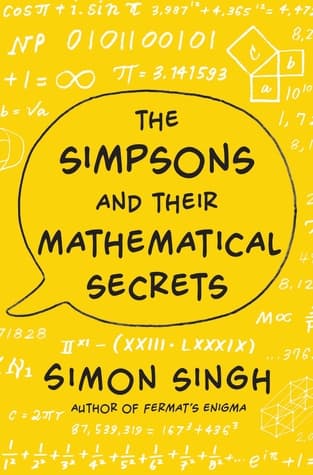
The Simpsons and Their Mathematical Secrets cover
Archivist's Choice

The Simpsons and Their Mathematical Secrets

Simon Singh (2013)

Genre

Reference / Science

Reading Time

240 min

Key Themes

See below

Track Your Reading

Sign in to track this book

Explore the hidden mathematical brilliance in The Simpsons and Futurama, from pi to P vs. NP, revealing the clever minds behind Springfield's enduring humor.

Core Idea

Simon Singh's "The Simpsons and Their Mathematical Secrets" shows the surprisingly deep mathematical concepts, jokes, and references within *The Simpsons* and *Futurama*. The book explains that many writers have strong mathematical backgrounds, intentionally putting sophisticated mathematical ideas—from famous theorems and paradoxes to complex equations and unsolved problems—into episodes. These ideas often appear in plain sight or as subtle background gags. Singh demonstrates how these shows are an unexpected and engaging way to explore advanced mathematics, changing the view of mathematics as dry and hard to understand.
Reading time
240 min
Difficulty
Medium
✓ Read this if...
You are a fan of *The Simpsons* or *Futurama* and have an interest in mathematics, or if you want to discover how complex mathematical ideas can be cleverly integrated into popular culture.
✗ Skip this if...
You have no interest in mathematics or find the concept of dissecting cartoons for academic content unappealing.

Core idea

The central argument and framework that powers the entire book.

Simon Singh's "The Simpsons and Their Mathematical Secrets" shows the surprisingly deep mathematical concepts, jokes, and references within The Simpsons and Futurama. The book explains that many writers have strong mathematical backgrounds, intentionally putting sophisticated mathematical ideas—from famous theorems and paradoxes to complex equations and unsolved problems—into episodes. These ideas often appear in plain sight or as subtle background gags. Singh demonstrates how these shows are an unexpected and engaging way to explore advanced mathematics, changing the view of mathematics as dry and hard to understand.

At a glance

Reading time

240 min

Difficulty

Medium

Read this if...

You are a fan of *The Simpsons* or *Futurama* and have an interest in mathematics, or if you want to discover how complex mathematical ideas can be cleverly integrated into popular culture.

Skip this if...

You have no interest in mathematics or find the concept of dissecting cartoons for academic content unappealing.

Key Takeaways

1

The Mathematical DNA of Springfield

The Simpsons writers are secretly (or not so secretly) mathematicians.

Quote

The Simpsons writers are not just comedic geniuses; many possess advanced degrees in mathematics, seamlessly weaving complex mathematical concepts into the fabric of Springfield.

Beneath the humor and satire, The Simpsons and Futurama are full of sophisticated mathematical references. This is not accidental; many writers have strong mathematical backgrounds, including degrees from top universities. Their love for numbers, theorems, and conjectures is not just a personal interest but a deliberate creative tool. It adds layers of intellectual depth to the shows that often go unnoticed by casual viewers. This hidden mathematical side shows the writers' brilliance and dedication, proving that high-level intellect ...

Supporting evidence

Singh highlights writers like David X. Cohen (Harvard, UC Berkeley), Al Jean (Harvard), and Jeff Westbrook (PhD in Computer Science from Princeton), detailing their academic credentials and how they apply their knowledge to episode plots and gags.

Apply this

Next time you rewatch an episode, pay closer attention to background gags, chalkboards, and throwaway lines. You might uncover a mathematical Easter egg. It encourages a more active and analytical viewing experience, demonstrating that even seemingly simple entertainment can harbor profound intellectual depths.

mathematical-easter-eggswriters-backgrounds
2

Homer's Last Theorem

An almost-counterexample to Fermat's Last Theorem appears in 'The Wizard of Evergreen Terrace'.

Quote

Homer's equation, 3987^12 + 4365^12 = 4472^12, is a brilliant mathematical near-miss, a testament to the writers' ability to craft a joke that requires a calculator to truly appreciate.

In 'The Wizard of Evergreen Terrace,' Homer Simpson tries to become an inventor. In a quick chalkboard scene, he writes an equation that looks like a counterexample to Fermat's Last Theorem (FLT). FLT states that no three positive integers a, b, and c can satisfy a^n + b^n = c^n for any integer n greater than 2. Homer's equation, 3987^12 + 4365^12 = 4472^12, seems to break this rule. But it is a 'near miss' that only works because of calculator precision limits. When calculated exactly, the left side is slightly different from the rig...

Supporting evidence

Singh details the specific episode 'The Wizard of Evergreen Terrace' and the exact equation displayed on Homer's chalkboard. He then explains the mathematical precision needed to confirm it's not a true counterexample and attributes the idea to David X. Cohen.

Apply this

This takeaway encourages skepticism and precise calculation. It teaches that apparent truths can be misleading without rigorous verification. It also highlights how mathematical concepts can be used for comedic effect, blurring the lines between education and entertainment.

fermat's-last-theoremnear-missesmathematical-humor
3

The Infinite Hotel Paradox

Infinity isn't just big; there are different sizes of infinity, explored in Futurama.

Quote

The concept of infinity, particularly the idea that some infinities are 'bigger' than others, is a mind-bending topic that Futurama bravely tackles, making abstract mathematics accessible through its narrative.

The idea of infinity is hard to grasp, but Futurama, especially in 'The Problem with Popplers,' cleverly hints at Hilbert's Infinite Hotel Paradox. This thought experiment shows that a hotel with an infinite number of rooms can always fit more guests, even if it is already full, by moving existing guests to higher-numbered rooms. This shows that 'infinity plus one' is still 'infinity.' The show also touches on different 'sizes' of infinity (countable versus uncountable), an idea Georg Cantor developed. By putting such advanced mathema...

Supporting evidence

Singh references specific Futurama episodes like 'The Problem with Popplers' and explains how the narrative subtly incorporates elements of Hilbert's Hotel. He also discusses Cantor's work on transfinite numbers as the underlying concept.

Apply this

This takeaway encourages critical thinking about abstract concepts. It demonstrates that even complex mathematical theories can be visualized and understood through creative storytelling. It also highlights the intellectual rigor embedded in shows like Futurama, inviting viewers to explore the deeper mathematical implications.

infinityhilbert's-hotelcantor's-theory
4

Prime Time Comedy

Mersenne primes, perfect numbers, and prime numbers frequently appear as gags.

Quote

The writers' fascination with prime numbers, particularly Mersenne primes, is evident in numerous background gags and plot devices, turning arcane number theory into subtle comedic gold.

Prime numbers, and special ones like Mersenne primes and perfect numbers, appear repeatedly in The Simpsons and Futurama. Whether it is a locker combination, a price tag, or a key plot point, these numbers are often inside jokes for those who understand math. For instance, a locker might be numbered with a Mersenne prime (a prime number that is one less than a power of two), or a character might casually mention a perfect number (a number equal to the sum of its proper positive divisors). This consistent use shows the writers' appreci...

Supporting evidence

Singh provides examples such as Bender's serial number in Futurama (2716057, a Mersenne prime) and various background signs or prices in The Simpsons that feature prime numbers. He explains the mathematical significance of these numbers.

Apply this

This encourages a playful engagement with numbers in everyday life. It shows that mathematics isn't just for textbooks but can be found in unexpected places. It might even inspire someone to learn more about number theory to 'get' the jokes in their favorite shows.

prime-numbersmersenne-primesperfect-numbersnumber-theory
5

P v. NP: The Million Dollar Problem

The most significant unsolved problem in computer science makes a cameo.

Quote

The P versus NP problem, a pinnacle of unsolved computer science, appears in Futurama, demonstrating the writers' willingness to tackle even the most daunting intellectual challenges in their storytelling.

The P versus NP problem is one of the seven Millennium Prize Problems, with a million-dollar reward for its solution. It asks if every problem whose solution a computer can quickly check can also be quickly solved by a computer. In a Futurama episode, a chalkboard with the P=NP equation is visible. This is a subtle reference to this deep and challenging question. This inclusion is notable because it takes a very abstract and unsolved problem from theoretical computer science and puts it smoothly into a popular animated series. It show...

Supporting evidence

Singh points to a specific scene in Futurama's 'The Prisoner of Benda' episode (also known as 'The Futurama Theorem') where a chalkboard prominently displays 'P=NP'. He explains the problem's significance and its status as an unsolved Millennium Prize Problem.

Apply this

This takeaway highlights the relevance of theoretical computer science and encourages curiosity about unsolved problems. It shows that even the most complex academic challenges can be introduced to a broad audience, potentially inspiring future mathematicians or computer scientists to tackle them.

p-vs-npmillennium-prize-problemscomputer-scienceunsolved-problems
6

The 'Futurama Theorem'

A novel mathematical theorem was invented for and proven in an episode of Futurama.

Quote

It's not every day an animated sitcom invents and proves a new mathematical theorem, but Futurama's 'The Prisoner of Benda' achieved just that, a testament to the unparalleled mathematical prowess of its writing team.

One of the most surprising mathematical achievements in animated television happened in the Futurama episode 'The Prisoner of Benda.' The plot involves characters swapping bodies, which leads to a complex permutation problem. Writer Ken Keeler, who has a PhD in applied mathematics, actually developed and proved a new theorem specifically for the episode. This 'Futurama Theorem' states that no matter how many body swaps have occurred, two previously un-swapped people can always reverse all swaps, given enough empty bodies. This is not ...

Supporting evidence

Singh dedicates a section to 'The Prisoner of Benda' episode, explaining the plot's body-swapping dilemma and the mathematical solution devised by Ken Keeler. He details the theorem itself and its proof, which was published in a mathematical journal.

Apply this

This takeaway inspires a deeper appreciation for the creative potential of mathematics. It demonstrates that mathematics is not static but a living field where new discoveries are constantly being made, even within the context of popular entertainment. It encourages viewers to recognize the brilliance behind the scenes.

futurama-theorempermutation-theorymathematical-innovation
7

Euler's Identity: Mathematical Beauty

Often called the most beautiful equation, it appears in a surprising place.

Quote

Euler's Identity, e^iπ + 1 = 0, is a beacon of mathematical elegance, and its appearance as a subtle background detail in The Simpsons elevates the show's intellectual Easter eggs to an art form.

Euler's Identity, e^iπ + 1 = 0, is often called one of the most beautiful and important equations in mathematics. It connects five fundamental constants (e, i, π, 1, and 0) with three basic arithmetic operations. Its elegance comes from its simplicity and the deep links it shows between seemingly different areas of mathematics. The Simpsons, in a quick moment, shows this equation on a blackboard, which highlights the writers' appreciation for mathematical beauty. This inclusion is a subtle tribute to the power and beauty of pure mathe...

Supporting evidence

Singh references the appearance of Euler's Identity on a blackboard in a background scene within The Simpsons, explaining the equation's components and its profound significance in mathematics.

Apply this

This takeaway encourages an appreciation for the aesthetic side of mathematics, much like art or music. It shows that beauty can be found in logical structures and abstract concepts. It also highlights how 'Easter eggs' can be more than just jokes, but profound intellectual references.

euler's-identitymathematical-beautyfundamental-constants
8

From 'Bart the Genius' to Real Math

The first episode set the stage for a legacy of mathematical humor.

Quote

Even in its nascent stages, with 'Bart the Genius,' The Simpsons established its commitment to integrating mathematics, albeit through a comedic lens, setting a precedent for intellectual depth.

The very first full-length episode of The Simpsons, 'Bart the Genius,' focuses on Bart swapping his IQ test with Martin Prince's. This leads to him being called a genius and sent to a school for gifted children. While the episode mainly focuses on Bart's antics and funny misunderstandings of intelligence, it subtly introduces mathematical concepts through the 'genius' school environment. This early inclusion showed that The Simpsons would not avoid intellectual themes, even when used for laughs. It set a standard for the show's blend ...

Supporting evidence

Singh discusses 'Bart the Genius' as the first full-length episode and how it introduces themes of intelligence and education, implicitly setting a stage for the show's later mathematical references, even if the math itself is less explicit here than in later episodes.

Apply this

This takeaway shows how foundations are laid. It teaches that even early works can hint at the intellectual depth to come. It encourages viewers to look for nascent themes and how they evolve over time within a creative work, appreciating the long-term vision of creators.

bart-the-geniusearly-simpsonseducational-humor
9

The Power of Parody and Puns

Mathematical concepts are often introduced through clever wordplay and visual gags.

Quote

The Simpsons and Futurama masterfully employ puns, visual gags, and parodies to smuggle complex mathematical ideas into their narratives, making the abstract palatable and often hilarious.

The brilliance of The Simpsons and Futurama is not just in what mathematical concepts they include, but how they include them. The shows are full of mathematical puns ('The Square Root of Evil'), visual jokes (numbers in unexpected places, like 'e' on a license plate), and parodies of famous mathematical figures or problems. This comedic approach makes complex ideas easier to approach. Viewers can encounter concepts like transcendental numbers or geometric transformations without realizing they are engaging with advanced mathematics. ...

Supporting evidence

Singh provides numerous examples of mathematical puns and visual gags, such as 'The Square Root of Evil' episode title, or signs in the background with mathematically significant numbers or symbols, demonstrating the breadth of their comedic integration.

Apply this

This takeaway encourages a playful approach to learning. It shows that even serious subjects can be approached with humor and creativity. It inspires creators to think about how to make complex information engaging and accessible through clever presentation.

mathematical-punsvisual-gagseducational-entertainment
10

Beyond the Classroom: Math in Culture

The shows demonstrate math's ubiquitous presence and cultural relevance.

Quote

By embedding profound mathematical concepts within the world's most popular animated shows, The Simpsons and Futurama brilliantly illustrate that mathematics is not confined to textbooks but is a living, breathing part of our culture and imagination.

The main idea from Singh's analysis is that mathematics is not an obscure, separate field but an important part of human culture and creativity. The Simpsons and Futurama, by consistently including advanced mathematical ideas—from number theory to topology, from calculus to computer science—show that math is everywhere. It influences storytelling, humor, and even the very structure of fictional worlds. This integration makes mathematics less mysterious, making it accessible and even cool. It proves that intellectual rigor can exist wi...

Supporting evidence

The entire book serves as evidence, showcasing dozens of examples of mathematical references across various branches of mathematics, proving their pervasive presence in the shows' content.

Apply this

This encourages a broader, more inclusive view of mathematics. It prompts individuals to look for mathematical patterns and concepts in unexpected places, fostering a deeper appreciation for the discipline's role in art, media, and everyday life. It can inspire a new generation to see math not as a chore, but as an adventure.

math-in-culturepopular-mathematicsdemystifying-math

Critical analysis

Notable Quotes

The Simpsons is the most successful cartoon series in history, but few people realize that it is also the most mathematical TV show ever broadcast.

Introduction to the book's premise, highlighting the hidden mathematical depth.

Behind the jokes, the sight gags, and the storylines, there is a dazzling array of mathematical concepts, references, and in-jokes.

Explaining the pervasive nature of mathematics throughout the show.

Many of the writers of The Simpsons are accomplished mathematicians, with degrees from Harvard and other top universities.

Revealing the academic background of the show's writing staff.

The number 1729, known as a 'taxicab number,' makes an appearance, a nod to the famous anecdote involving mathematicians G.H. Hardy and Srinivasa Ramanujan.

Discussing a specific mathematical Easter egg related to number theory.

From π to prime numbers, from calculus to geometry, The Simpsons writers have embedded a treasure trove of mathematical ideas into their scripts.

Summarizing the breadth of mathematical topics covered in the show.

The episode 'The Wizard of Evergreen Terrace' sees Homer attempt to become an inventor, and one of his equations almost disproves Fermat's Last Theorem.

Highlighting a specific plot point where complex mathematics is central to the narrative.

This book aims to reveal the mathematical brilliance of The Simpsons and Futurama, celebrating the show's unique fusion of comedy and cutting-edge science.

Stating the book's objective and including a reference to Futurama.

The writers often use mathematical concepts as a source of humor, creating jokes that only a mathematically literate audience might fully appreciate.

Explaining how mathematics is integrated into the show's comedic style.

One of the most impressive feats is how they manage to weave these complex ideas into storylines without alienating the average viewer.

Praising the writers' skill in making advanced concepts accessible.

The golden ratio, the Fibonacci sequence, and even the concept of infinity all make subtle, and sometimes not-so-subtle, appearances.

Listing more examples of mathematical concepts found in the show.

The show's mathematical depth is a testament to the intellectual curiosity and playfulness of its creators.

Reflecting on the motivations behind the mathematical inclusions.

Through 'The Simpsons,' millions of viewers have been exposed, perhaps unknowingly, to fundamental mathematical principles.

Discussing the educational impact of the show.

The writers' ability to hide sophisticated mathematical puzzles within a popular cartoon is a remarkable achievement.

Concluding thought on the unique accomplishment of the show's writers.

Quiz

Test Your Knowledge

Ready to see how well you understood this book? Take our interactive quiz with 10 questions.

10
Questions
~5
Minutes
?
Best Score

Key Questions (FAQ)

This book by Simon Singh reveals the hidden mathematical references cleverly embedded within episodes of The Simpsons and Futurama. It explores how the show's writers, many with advanced math degrees, integrated complex concepts from pi to unsolved theorems into the storylines.

About the author