BookBrief
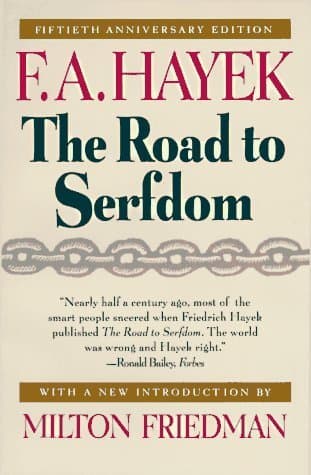
The Road to Serfdom cover
Archivist's Choice

The Road to Serfdom

Friedrich A. Hayek (1944)

Genre

Business / History / Economics / Finance / Philosophy

Reading Time

365 min

Key Themes

See below

Track Your Reading

Sign in to track this book

Hayek's 1944 book warns that government economic control, even with good intentions, leads to totalitarianism, like Nazi Germany and Fascist Italy.

Core Idea

Hayek says central economic planning, even if well-intended, leads to totalitarianism and suppresses individual liberty. He believes that modern economies are too complex for full planning without a central authority controlling production, distribution, and individual choices. This loss of economic freedom is not just a mistake; it undermines political and personal freedoms, creating a society where the state controls everything, like the totalitarian regimes it aims to avoid. Hayek states that pursuing 'social justice' or economic equality through state action means making arbitrary decisions and concentrating power. This inevitably favors ruthless individuals and suppresses disagreement. He advocates for the free market as a better way to allocate resources and protect individual liberty, noting that economic freedom is necessary for all other freedoms. The book warns against the appeal of collectivism and defends classical liberal ideas.
Reading time
365 min
Difficulty
Hard
✓ Read this if...
You are interested in the historical and philosophical arguments against central economic planning and collectivism, or if you want to understand the intellectual foundations of classical liberalism and libertarianism.
✗ Skip this if...
You are a staunch advocate for socialist economic planning or believe that extensive government intervention is the primary solution to economic inequality and societal problems, and are not open to challenging those views.

Core idea

The central argument and framework that powers the entire book.

Hayek says central economic planning, even if well-intended, leads to totalitarianism and suppresses individual liberty. He believes that modern economies are too complex for full planning without a central authority controlling production, distribution, and individual choices. This loss of economic freedom is not just a mistake; it undermines political and personal freedoms, creating a society where the state controls everything, like the totalitarian regimes it aims to avoid. Hayek states that pursuing 'social justice' or economic equality through state action means making arbitrary decisions and concentrating power. This inevitably favors ruthless individuals and suppresses disagreement. He advocates for the free market as a better way to allocate resources and protect individual liberty, noting that economic freedom is necessary for all other freedoms. The book warns against the appeal of collectivism and defends classical liberal ideas.

At a glance

Reading time

365 min

Difficulty

Hard

Read this if...

You are interested in the historical and philosophical arguments against central economic planning and collectivism, or if you want to understand the intellectual foundations of classical liberalism and libertarianism.

Skip this if...

You are a staunch advocate for socialist economic planning or believe that extensive government intervention is the primary solution to economic inequality and societal problems, and are not open to challenging those views.

Key Takeaways

1

Planning Leads to Tyranny

Economic planning, however well-intentioned, inevitably erodes individual liberty and paves the way for totalitarianism.

Quote

The tragic spectacle of a whole nation being led to believe that the only alternative to a particular system is a retrogression to the bad old days is becoming a familiar feature of our time.

Hayek's main point is a clear warning: pursuing collectivist goals, especially through central economic planning, is not a path to a better society but a dangerous move toward serfdom. He argues that once the state controls economic life, it must control individual choices for the plan to work. This requires a steady loss of personal freedoms, as planners dictate production, consumption, location, and even jobs. The initial good goals of 'social justice' or 'equality' become less important than keeping the plan going, leading to an au...

Supporting evidence

Hayek meticulously traces the intellectual lineage of socialist thought in Germany, demonstrating how seemingly benign welfare state policies and economic controls in the early 20th century laid the groundwork for the rise of Nazism, which he views as a form of national socialism. He contrasts this with the liberal traditions of England and America.

Apply this

Be highly skeptical of government initiatives that promise comprehensive solutions to societal problems through extensive economic control. Advocate for policies that prioritize individual economic freedom and market mechanisms over centralized planning.

central-planningtotalitarianismindividual-liberty
2

The Illusion of Democratic Planning

Democratic decision-making is incompatible with effective economic planning, leading to a loss of individual freedom and rule of law.

Quote

The more the state 'plans,' the more difficult does planning become for the individual.

Hayek states that democratic systems are not suitable for full economic planning. Planning needs a single, clear vision and quick, firm action, which goes against the slow, deliberate, and often conflicting nature of democratic processes. When a democracy tries to plan, it faces a problem: either planning becomes ineffective due to endless debate and compromise, or a small group of experts makes decisions, bypassing democratic accountability. This concentration of power in the hands of 'experts' or a planning board undermines democrat...

Supporting evidence

Hayek points out that the greater the scope of state activity and planning, the more general and vague the consensus of the public becomes, forcing the planners to make specific, detailed decisions that were never explicitly sanctioned by the populace. He cites the increasing frustration with parliamentary democracies in the interwar period as they grappled with economic crises, leading many to seek 'stronger' leadership.

Apply this

Support democratic institutions that focus on establishing a clear legal framework and protecting individual rights, rather than those that seek to micromanage the economy. Resist calls for 'expert' rule in economic policy that bypasses democratic accountability.

democracyrule-of-lawarbitrary-power
3

The Unintended Consequences of Good Intentions

Well-meaning social and economic interventions, without careful consideration, can lead to unforeseen and harmful outcomes.

Quote

The system of private property is the most important guarantee of freedom, not only for those who own property, but scarcely less for those who do not.

Hayek challenges the common idea that socialist planning comes from bad intentions. Instead, he argues that many well-meaning intellectuals and reformers, wanting more social justice or economic equality, do not understand the system-wide results of their ideas. They see the immediate benefits of intervention but miss the long-term loss of individual liberty and the inevitable concentration of power. The road to serfdom is paved with good intentions, as each step toward more state control, no matter how small, sets a precedent and cre...

Supporting evidence

Hayek highlights how many early socialists genuinely believed they were advancing freedom and equality. He particularly notes the intellectual climate in Britain and America where many were drawn to socialist ideas without understanding their logical implications, often viewing them as merely an extension of democratic ideals.

Apply this

Exercise critical thinking when evaluating new government programs or regulations. Always ask what the long-term, systemic consequences might be, beyond the immediate stated goals. Prioritize policies that maintain a robust sphere of individual choice and market mechanisms.

slippery-slopeunintended-consequencessocial-justice
4

The Danger of 'Social Justice'

The concept of 'social justice' as a planned outcome is inherently incompatible with individual liberty and the rule of law.

Quote

The demand for 'social justice' is one of the chief forces which has brought about the present situation.

Hayek sees the pursuit of 'social justice' as a particularly harmful part of collectivist thinking. He argues that 'social justice,' when seen as a specific distribution of wealth or outcomes decided by a central authority, requires arbitrary decisions about who deserves what. In a free market, outcomes come from impersonal forces and individual choices, not a central design. To achieve planned 'social justice,' the state must constantly intervene, overriding individual contracts, property rights, and freedom of choice. This requires ...

Supporting evidence

Hayek contrasts the concept of individual justice (fair rules applied equally) with 'social justice' (fair outcomes determined by a central authority). He argues that the latter inevitably leads to special privileges and arbitrary power, as the state must decide whose needs are greater or whose contribution is more valuable.

Apply this

Focus on ensuring equality of opportunity and fair rules for all, rather than demanding government intervention to achieve specific outcomes or redistribute wealth based on subjective notions of 'fairness.' Understand that attempts to engineer 'social justice' often lead to injustice through arbitrary power.

equality-of-opportunitydistributive-justicearbitrary-power
5

The Rise of the Worst

Centralized planning systems inherently favor the most ruthless and unscrupulous individuals for leadership roles.

Quote

The principle that the end justifies the means becomes the supreme rule for all who desire to make a collectivist system work.

This is one of Hayek's most thought-provoking arguments. He says that in a planned society, the moral character of leaders worsens. To carry out and maintain a full plan, difficult and often unpopular decisions must be made, requiring a willingness to suppress disagreement, ignore individual rights, and use force. People who care about moral principles or individual liberties will be less effective or willing to take such actions, and so will be moved aside. The system chooses those most willing to use force, deception, and propaganda...

Supporting evidence

Hayek analyzes how the mechanisms of totalitarian states (like Nazi Germany or Soviet Russia) require leaders who are adept at propaganda, willing to scapegoat minorities, and unconstrained by traditional morality. He suggests that these traits are not accidental but rather selected for by the nature of the system itself.

Apply this

Be deeply suspicious of any system that concentrates vast power in the hands of a few, even if they claim to act for the greater good. Prioritize systems that decentralize power and provide checks and balances, making it difficult for unscrupulous individuals to gain and maintain control.

power-concentrationauthoritarianismmoral-decay
6

The Market as a Discovery Process

The free market, through competition, is an essential mechanism for discovering and utilizing dispersed knowledge.

Quote

The whole complex of market relations serves as a means of communicating information.

Hayek points out the market's important role not just in allocating resources but in acting as a 'discovery process.' He argues that knowledge is spread among millions of individuals, each with unique information about their preferences, skills, and local situations. No central planner, no matter how smart, can ever have or combine this vast, constantly changing knowledge. The price system in a free market acts as an essential communication tool, conveying important information about scarcity and demand through signals. Competition en...

Supporting evidence

Hayek's broader work on the 'use of knowledge in society' is foundational here. He implicitly contrasts the dynamic, information-rich environment of a market with the static, information-poor environment of a centrally planned economy, where information is bottlenecked and distorted.

Apply this

Advocate for policies that foster free markets and competition, understanding that these are not merely economic tools but fundamental mechanisms for societal learning and progress. Resist interventions that distort price signals or stifle innovation.

knowledge-problemprice-signalsspontaneous-order
7

Individualism vs. Collectivism

True individualism, based on respect for the individual, is distinct from egoism and is the foundation of a free society.

Quote

The fundamental difference between the two systems of thought is that collectivism, in all its forms, starts from the idea of organizing society as a whole.

Hayek carefully separates true individualism from selfish self-interest or anarchy. He argues that genuine individualism is a philosophy based on respect for each person's unique dignity and self-direction, recognizing their right to pursue their own goals within general, known rules. It values individual initiative, responsibility, and voluntary cooperation. Collectivism, conversely, sees society as a single organism or a machine to be designed and directed toward a common goal. This requires putting individual aims second to the col...

Supporting evidence

Hayek contrasts the 'true individualism' of classical liberal thinkers like Adam Smith and John Locke, which emphasizes general rules and spontaneous order, with the 'false individualism' that is often confused with egoism. He shows how collectivist thinkers often misrepresent individualism to make it seem unappealing.

Apply this

Cultivate an appreciation for individual autonomy and responsibility. Be wary of rhetoric that emphasizes collective identity or purpose at the expense of individual rights and choices. Support institutions that protect the individual against the power of the group or the state.

classical-liberalismautonomyvoluntary-association
8

The Peril of Security Over Freedom

Prioritizing economic security above all else inevitably leads to the sacrifice of individual liberty.

Quote

We are promised 'freedom from want' in a new sense, but the only certain result of this would be that we should all be equally poor.

Hayek acknowledges the natural human desire for security but warns against making it the most important societal goal. He distinguishes between two types of security: a minimum income (which he suggests could work with freedom) and a guaranteed income or position (which does not). When the state tries to guarantee specific income levels or employment for everyone, it must intervene broadly in the economy, dictating production, prices, and wages. This removes individual choice and competition, turning citizens into state dependents. Th...

Supporting evidence

Hayek discusses the concept of 'freedom from want' and how it is often misinterpreted to mean freedom from the necessity of choosing or bearing risk. He argues that this broader interpretation leads directly to a demand for central control over all economic life.

Apply this

Recognize that true security often comes from individual resilience, adaptability, and the freedom to pursue opportunities, not from state guarantees. Support policies that create a safety net without stifling individual initiative or market dynamism.

welfare-stateeconomic-securitydependency
9

The End of Truth

In a planned society, objective truth is sacrificed to serve the state's ideology and planning goals.

Quote

The most effective way of making people accept the validity of the values they are to serve is to persuade them that they are really the same as those which they have always held.

Hayek argues that in a centrally planned system, truth itself serves the state's goals. To achieve a unified societal effort toward the plan, common values and beliefs must be enforced, and any differing or inconvenient truths must be suppressed. Propaganda becomes necessary, not just to promote the plan but to reinterpret history, redefine moral ideas, and control all information sources. Intellectual inquiry and the search for objective truth are thus stopped, as they threaten the ideological uniformity the planners require. This in...

Supporting evidence

Hayek details how totalitarian regimes like Nazi Germany and Soviet Russia controlled not only economic activity but also information, education, and even scientific inquiry, twisting facts to fit the party line. He highlights how the meaning of words like 'freedom' and 'justice' were inverted.

Apply this

Vigorously defend freedom of speech, independent media, and academic freedom. Be critical of any attempts by the state or powerful groups to control information, rewrite history, or enforce ideological conformity. Seek out diverse sources of information.

propagandaideological-controlcensorship
10

The International Threat of Planning

Extending economic planning to the international sphere poses even greater dangers to peace and freedom.

Quote

To imagine that the present generation can bind the future in this way is to misunderstand the whole problem.

Hayek extends his criticism to international relations, warning that global economic planning would be even more dangerous than national planning. Just as national planning needs agreement on values and suppression of dissent, international planning would demand an even broader, harder-to-reach agreement on priorities and resource allocation among different nations. This would inevitably lead to conflicts between national interests and the international planning authority's demands. Furthermore, such a system would require an internat...

Supporting evidence

Hayek wrote this during WWII, when ideas for post-war international planning were prevalent. He argues that attempts to plan a 'new international economic order' would exacerbate national rivalries and lead to greater conflict, rather than peace, due to the inherent difficulty of achieving consensus on economic goals among diverse nations.

Apply this

Be wary of proposals for extensive international economic planning or governance that would centralize power over global resources and economies. Support international cooperation based on free trade, rule of law, and respect for national sovereignty, rather than centralized control.

global-governancefree-tradenational-sovereignty

Critical analysis

Notable Quotes

The more the state 'plans' the more difficult planning becomes for the individual.

Hayek argues that centralized economic planning restricts individual freedom and decision-making.

The system of private property is the most important guarantee of freedom, not only for those who own property, but scarcely less for those who do not.

Hayek defends private property as a foundation for liberty in a free society.

The road to serfdom is paved with good intentions.

A famous warning that well-meaning collectivist policies can lead to totalitarianism.

Economic control is not merely control of a sector of human life which can be separated from the rest; it is the control of the means for all our ends.

Hayek explains how economic planning inevitably extends to controlling broader aspects of life.

The power which a multiple millionaire, who may be my neighbor and perhaps my employer, has over me is very much less than that which the smallest functionary possesses who wields the coercive power of the state.

Hayek contrasts private economic power with the coercive power of government.

The curious task of economics is to demonstrate to men how little they really know about what they imagine they can design.

Hayek critiques the hubris of central planners who believe they can manage complex economies.

Freedom to order our own conduct in the sphere where material circumstances force a choice upon us, and responsibility for the arrangement of our own life according to our own conscience, is the air in which alone moral sense grows and in which moral values are daily re-created.

Hayek links economic freedom to moral development and personal responsibility.

The most important change which extensive government control produces is a psychological change, an alteration in the character of the people.

Hayek warns that state control can erode individual initiative and independence.

We shall never prevent the abuse of power if we are not prepared to limit power in a way which occasionally may prevent its use for desirable purposes.

Hayek argues for constitutional limits on government power, even at the cost of some efficiency.

The principle that the end justifies the means is in individualist ethics regarded as the denial of all morals.

Hayek criticizes collectivist justifications for sacrificing individual rights.

It is because every individual knows so little and, in particular, because we rarely know which of us knows best that we trust the independent and competitive efforts of many to induce the emergence of what we shall want when we see it.

Hayek emphasizes the role of decentralized knowledge and competition in a free market.

The planning against which all our criticism is directed is solely the planning against competition—the planning which is to be substituted for competition.

Hayek clarifies that he opposes centralized planning that replaces market competition.

The state should confine itself to establishing rules applying to general types of situations and should allow the individuals freedom in everything which depends on the circumstances of time and place.

Hayek advocates for a limited government that sets general rules rather than specific commands.

The most important fact about this progress is that each step forward is made possible by the exploitation of past achievements.

Hayek discusses how economic and social progress builds on accumulated knowledge and traditions.

Quiz

Test Your Knowledge

Ready to see how well you understood this book? Take our interactive quiz with 10 questions.

10
Questions
~5
Minutes
?
Best Score

Key Questions (FAQ)

The Road to Serfdom is a classic work arguing that increasing government control over the economy inevitably leads to totalitarianism, using Nazi Germany and fascist Italy as examples. Hayek warns that collectivist planning, even with good intentions, destroys individual liberty and creates oppressive systems.

About the author