BookBrief
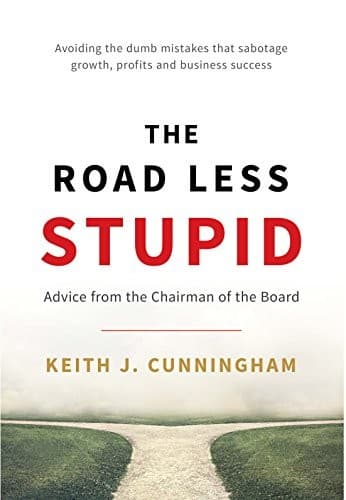
The Road Less Stupid cover
Archivist's Choice

The Road Less Stupid

Keith J. Cunningham (2018)

Genre

General

Reading Time

180 min

Key Themes

See below

Track Your Reading

Sign in to track this book

Mastering deliberate "Thinking Time" helps you make planned decisions, leading to lasting financial success and fewer costly mistakes.

Core Idea

Keith J. Cunningham's "The Road Less Stupid" states that most business failures and personal financial problems come from "stupid decisions"—errors that could have been avoided. These errors result from not thinking carefully, planning enough, or understanding oneself. Cunningham says these avoidable mistakes create a "Dumb Tax," which people can reduce by regularly spending time on critical thinking, asking good questions, and thinking like a business owner. The book highlights that business needs constant learning, future planning, and emotional control to lower risk, protect money, and achieve lasting success.
Reading time
180 min
Difficulty
Medium
✓ Read this if...
You are a business owner, entrepreneur, or manager looking to improve decision-making, reduce costly mistakes, and cultivate a more strategic approach to business and personal finance.
✗ Skip this if...
You are looking for a quick-fix business strategy or prefer a book with extensive case studies and academic research over direct, no-nonsense advice.

Core idea

The central argument and framework that powers the entire book.

Keith J. Cunningham's "The Road Less Stupid" states that most business failures and personal financial problems come from "stupid decisions"—errors that could have been avoided. These errors result from not thinking carefully, planning enough, or understanding oneself. Cunningham says these avoidable mistakes create a "Dumb Tax," which people can reduce by regularly spending time on critical thinking, asking good questions, and thinking like a business owner. The book highlights that business needs constant learning, future planning, and emotional control to lower risk, protect money, and achieve lasting success.

At a glance

Reading time

180 min

Difficulty

Medium

Read this if...

You are a business owner, entrepreneur, or manager looking to improve decision-making, reduce costly mistakes, and cultivate a more strategic approach to business and personal finance.

Skip this if...

You are looking for a quick-fix business strategy or prefer a book with extensive case studies and academic research over direct, no-nonsense advice.

Key Takeaways

1

The Dumb Tax is Real

Most financial setbacks are self-inflicted and avoidable.

Quote

The vast majority of our dumb tax is a direct result of emotional, overly optimistic and poorly thought out decisions.

Cunningham introduces the 'dumb tax'—the financial and missed opportunity costs that come from bad decisions. He believes most people would have more money if they simply reversed their three biggest financial mistakes. These mistakes rarely come from a lack of intelligence or outside factors; instead, they result from emotional, overly hopeful, or poorly thought-out choices. The main idea is that success is not about doing more smart things, but about consistently avoiding stupid ones. This changes the focus from chasing wins to care...

Supporting evidence

The author's personal 'humiliatingly large dumb tax' experience, which spurred his realization about self-inflicted errors.

Apply this

Inventory your past financial or business blunders. Instead of dwelling on regret, analyze the underlying decision-making process. Identify patterns of emotionality, over-optimism, or insufficient due diligence that led to the 'dumb tax' and commit to recognizing these triggers in the future.


dumb-taxavoidable-mistakesself-sabotage
2

Thinking Time: The Ultimate Weapon

Dedicated, structured thinking time is the antidote to impulsive, costly decisions.

Quote

The principles and structure suggested in The Road Less Stupid will enable anyone...to run their business more effectively, make more money, and dramatically increase the likelihood of keeping that money. It all hinges on Thinking Time.

The core of Cunningham's method is 'Thinking Time'—a planned period set aside just for careful analysis and decision-making, away from daily business tasks. This is not just about 'thinking more,' but about focused intellectual effort. By making this time, people can avoid emotional reactions and the pressure of immediate deadlines, allowing them to better evaluate choices, possible risks, and long-term effects. It is an investment that pays off by preventing expensive errors and making strategies clearer, changing business from a rea...

Supporting evidence

The entire book's structure around short chapters and subsequent 'Thinking Time questions' to maximize clarity and create better choices.

Apply this

Schedule a recurring 'Thinking Time' block (e.g., 2-4 hours weekly) in your calendar. Treat it as a non-negotiable meeting with yourself. During this time, tackle complex problems, evaluate strategic choices, and proactively identify potential pitfalls, rather than just reacting to urgent demands.

thinking-timestrategic-planningdecision-making-framework
3

Business as an Intellectual Sport

Success in business is primarily a function of rigorous, disciplined thought, not just hard work.

Quote

Thinking is critical to sustainable success in business; said another way, business is an intellectual sport.

Cunningham redefines business success, seeing it as an 'intellectual sport' rather than a game of effort or luck. This view highlights that the quality of one's thinking directly affects business results. Like a chess master who plans moves, a successful business owner must think deeply and analytically to handle problems, find chances, and reduce risks. This is not about being academically 'smart,' but about using disciplined mental processes for business issues. It means that consistent, good thinking is a more reliable way to achie...

Supporting evidence

The contrast between 'operators who react and sweat' and 'owners who think and plan,' highlighting the intellectual divide.

Apply this

When faced with a business challenge, resist the urge to immediately 'do something.' Instead, pause and frame the situation as an intellectual puzzle. Ask: What are the variables? What are the potential outcomes? What information am I missing? What are the second and third-order consequences of each option?

intellectual-sportstrategic-thinkingbusiness-acumen
4

Operators vs. Owners: A Mindset Divide

Operators react to the present; owners proactively plan for the future.

Quote

Operators react and sweat. Owners think and plan.

This difference is important: 'Operators' are usually busy with daily tasks, reacting to immediate problems. They focus on doing work, often without enough foresight. 'Owners,' however, take a broader view. They prioritize strategic thinking, planning, and preparing for future problems and chances. Operators are necessary for daily work, but a business truly succeeds when its leaders think like owners. This means stepping back from urgent tasks to focus on important ones, understanding that long-term success comes from active planning...

Supporting evidence

The bumper sticker summary: 'Operators react and sweat. Owners think and plan.'

Apply this

Regularly assess your activities. Are you primarily reacting to immediate demands (operator mode) or proactively planning and strategizing for the future (owner mode)? Delegate operational tasks where possible to free up time for owner-level thinking. Ask yourself: 'What would an owner do in this situation?'

owner-mindsetoperator-mindsetproactive-planningstrategic-leadership
5

Minimizing Risk: The Path to Wealth Preservation

Focusing on avoiding loss is often more impactful than chasing big gains.

Quote

The chance of success goes up when you think, plan, consistently execute the right things, and worry about the possibility of loss.

Cunningham supports a careful but effective way to build wealth: focusing on reducing risk and preventing losses. While many entrepreneurs focus on maximizing gains, Cunningham argues that consistently avoiding 'dumb taxes' and protecting money is a surer way to lasting wealth. This does not mean avoiding all risk, but carefully checking things and planning for different situations to find and reduce possible downsides before they happen. By actively 'worrying about the possibility of loss,' businesses can become stronger and ensure t...

Supporting evidence

The core message that 'the key to getting rich (and staying that way) is to avoid doing stupid things.'

Apply this

Before making any significant decision (investment, hiring, new project), conduct a 'pre-mortem.' Imagine the decision has failed spectacularly. What went wrong? What factors contributed to the failure? Use these insights to identify and address potential weaknesses in your plan *before* execution.

risk-managementwealth-preservationdownside-protectionpre-mortem
6

Emotional Decisions are Expensive

Harnessing emotions is vital for clear, rational business choices.

Quote

The vast majority of our dumb tax is a direct result of emotional, overly optimistic and poorly thought out decisions.

Emotions, though natural, often quietly ruin good business decisions. Cunningham points out that many 'dumb taxes' come from choices made when people are overly hopeful, fearful, excited, or desperate. These emotional states can cloud judgment, lead to quick actions, and override logical analysis. Thinking Time helps by letting people step away from the immediate emotional intensity of a situation and use their rational abilities. Recognizing and acknowledging one's emotional state before deciding is important to stop these feelings f...

Supporting evidence

The explicit mention of 'emotional, overly optimistic' decisions as a primary cause of the dumb tax.

Apply this

Before a major decision, perform an 'emotional check-in.' Are you feeling overly excited, stressed, or pressured? If so, postpone the decision if possible, or engage in a structured 'Thinking Time' session to force a rational, dispassionate analysis, perhaps even seeking an objective opinion.

emotional-intelligencerational-decision-makingcognitive-biasimpulse-control
7

Clarity Precedes Action

Uncertainty and ambiguity are precursors to costly mistakes.

Quote

The series of short chapters and subsequent Thinking Time questions are designed to maximize clarity and create better choices...

A repeated idea is how important clarity is before acting. Many mistakes happen not from bad intentions or lack of skill, but from not clearly understanding the situation, goals, possible results, or available choices. Cunningham's 'Thinking Time' method, with its structured questions, is made to clear up confusion and show the main issues. By spending time to understand things very clearly—what he calls 'creating better choices'—people can greatly lower the chance of making uninformed decisions. This highlights that effective action ...

Supporting evidence

The book's format itself, with questions designed to 'maximize clarity and create better choices.'

Apply this

Before committing to any significant action, articulate the problem, your goals, and your proposed solution in writing. Ask yourself: 'Is this absolutely clear? Are there any assumptions I haven't validated? What information am I missing?' If you can't explain it simply, you don't understand it clearly enough.

clarity-of-thoughtproblem-definitionstrategic-clarityinformed-decisions
8

Consistency Trumps Intensity

Small, consistent acts of good thinking yield greater results than sporadic bursts.

Quote

The chance of success goes up when you think, plan, consistently execute the right things, and worry about the possibility of loss.

Cunningham subtly emphasizes that consistency is more powerful than occasional, intense effort. It is not about having one great idea, but about consistently using the principles of Thinking Time and disciplined decision-making. Just as small, regular savings grow wealth, small, consistent acts of good thinking prevent money and opportunities from being lost. This means regularly reviewing strategies, questioning assumptions, and actively planning, instead of only thinking deeply when a crisis occurs. Avoiding many small 'dumb taxes' ...

Supporting evidence

The phrase 'consistently execute the right things' within the success formula.

Apply this

Establish a weekly or bi-weekly 'Thinking Time' habit and stick to it, even if for a shorter duration initially. Don't wait for a major problem to engage in deep thought. Make it a routine to review progress, anticipate challenges, and refine strategies, even when things are going well.

consistencyhabit-formationlong-term-thinkingdisciplined-approach
9

The Power of Questions

Asking the right questions unlocks clarity and reveals better choices.

Quote

The series of short chapters and subsequent Thinking Time questions are designed to maximize clarity and create better choices...

At the heart of Cunningham's method is the power of structured questions. The book itself is full of questions meant to encourage deeper thought and reveal hidden assumptions or overlooked details. This approach goes beyond just 'thinking' to actively examining a situation from many angles. By asking specific, targeted questions during Thinking Time, people can find hidden risks, identify new opportunities, and get a fuller understanding of a problem. This intellectual discipline prevents shallow analysis and forces a more thorough lo...

Supporting evidence

The book's pedagogical design, explicitly stating that 'Thinking Time questions' are central to maximizing clarity.

Apply this

When faced with a decision, don't just consider 'yes' or 'no.' Instead, generate a list of 5-10 critical questions to explore the problem thoroughly. For example: 'What's the worst-case scenario?', 'What's the best-case scenario?', 'What assumptions am I making?', 'Who else needs to be involved?', 'What data am I missing?', 'What are the long-term implications?'

critical-thinkinginquiry-based-learningproblem-solving-questionsanalytical-skills

Critical analysis

Notable Quotes

The quality of your thinking determines the quality of your results.

Core premise of the book, emphasizing the importance of deliberate thought.

Stupid is expensive. Thinking is cheap.

Argument that poor decisions cost more than taking time to think.

If you don't have a plan, you're planning to fail.

Stressing the necessity of strategic planning in business.

The goal is not to be right; the goal is to get it right.

Encouraging a focus on outcomes over ego in decision-making.

Your business is a reflection of your thinking.

Linking personal mindset to organizational performance.

The most dangerous person in the room is the one who doesn't know what they don't know.

Warning about overconfidence and ignorance in business.

Time is the most valuable asset you have. Spend it wisely.

Advice on prioritizing time management for better outcomes.

Profit is not an event; it's a process.

Explaining that profitability requires consistent systems.

The best way to predict the future is to create it.

Encouraging proactive action rather than passive prediction.

You can't manage what you don't measure.

Highlighting the importance of metrics in business management.

Success is not about being lucky; it's about being prepared.

Arguing that preparation trumps chance in achieving success.

The road to success is paved with mistakes well-handled.

Viewing mistakes as learning opportunities rather than failures.

Your network is your net worth.

Emphasizing the value of relationships in business success.

Clarity precedes success.

Stating that clear thinking and goals are prerequisites for achievement.

Quiz

Test Your Knowledge

Ready to see how well you understood this book? Take our interactive quiz with 10 questions.

10
Questions
~5
Minutes
?
Best Score

Key Questions (FAQ)

Thinking Time is the core practice advocated by Keith J. Cunningham, involving dedicated, structured periods to think deeply, plan, and analyze decisions before acting. It helps minimize emotional reactions and 'dumb tax' mistakes by fostering clarity and better choices.

About the author