BookBrief
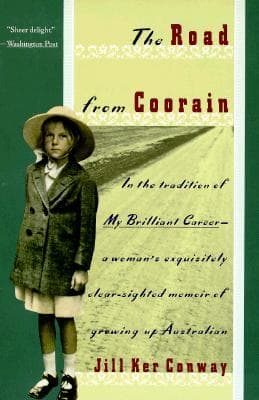
The Road from Coorain cover
Archivist's Choice

The Road from Coorain

Jill Ker Conway (1989)

Genre

Lifestyle / Biography / Memoir / History

Reading Time

12 Minutes

Key Themes

See below

Track Your Reading

Sign in to track this book

Core Idea

Jill Ker Conway's "The Road from Coorain" is a compelling memoir that chronicles her formative years growing up on a remote sheep station in the Australian outback during the 1930s and 40s. It explores themes of identity, gender roles, the impact of environment on character, and the pursuit of knowledge and self-determination against a backdrop of immense personal loss and societal expectations. Conway masterfully portrays her struggle to reconcile the rugged independence forged in the wilderness with the intellectual curiosity that eventually propelled her to an academic career in America, illustrating a powerful journey of self-discovery and resilience.
Difficulty
Medium

Core idea

The central argument and framework that powers the entire book.

Jill Ker Conway's "The Road from Coorain" is a compelling memoir that chronicles her formative years growing up on a remote sheep station in the Australian outback during the 1930s and 40s. It explores themes of identity, gender roles, the impact of environment on character, and the pursuit of knowledge and self-determination against a backdrop of immense personal loss and societal expectations. Conway masterfully portrays her struggle to reconcile the rugged independence forged in the wilderness with the intellectual curiosity that eventually propelled her to an academic career in America, illustrating a powerful journey of self-discovery and resilience.

At a glance

Difficulty

Medium

Key Takeaways

1

The Outback as a Crucible for Self-Reliance

Jill Ker Conway's formative years on Coorain instilled an unparalleled independence and resilience.

Quote

The vast unpeopled landscape, beautiful and hostile, whose uncertain weathers tormented the sheep ranchers with conflicting promises of riches and inescapable disaster.

Conway describes her childhood on Coorain, a 30,000-acre sheep station in the Australian outback. This remote place, with its extreme weather and isolation, forced her into adult responsibilities young. By eight, she was doing 'man's work,' herding sheep alone across miles. This early self-sufficiency, needed because of wartime labor shortages, created a deep independence. The outback was not just a setting; it shaped her character, teaching her to handle challenges with little outside help. This is the book's strongest insight into h...

Supporting evidence

Her experiences riding alone, managing sheep, and witnessing the constant struggle against drought and flood on Coorain.

Apply this

Embrace challenging environments or responsibilities as opportunities to cultivate self-reliance and problem-solving skills, rather than avoiding discomfort.
2

Parental Partnership as a Foundation

The symbiotic relationship between Conway's parents provided a model of strength and purpose, whose disruption had profound consequences.

Quote

Her strong, radiant mother, who had gone willingly with him into a pioneering life of loneliness and bone-breaking toil, who seemed miraculously to succeed in creating a warmly sheltering home in the harsh outback.

Conway's parents, especially their partnership on Coorain, are a strong and inspiring team. Her father's 'large vision' and her mother's 'radiant' strength created a 'warmly sheltering home' in the harsh outback. This union, built on shared purpose, love, and hard work, provided stability. Her father's sudden death shattered this, causing her mother's depression and dependency. This shows the role of a balanced, supportive partnership for the individuals and the family. The book suggests such a union's strength can be a double-edged s...

Supporting evidence

Her mother's subsequent decline into depression after her father's death, contrasting sharply with her earlier 'radiant' presence.

Apply this

Recognize the importance of cultivating balanced partnerships in life and work, and build personal resilience independent of those partnerships to withstand unforeseen losses.

3

The Dislocating Power of Transition

Moving from the outback to suburban Sydney represented a profound cultural and psychological shock.

Quote

Catapulted to what seemed another planet—the suburban Sydney of the 1950s and its crowded, noisy, cliquish school life.

Moving from the isolated, self-reliant Coorain to the busy, social Sydney of the 1950s was a huge change for young Jill. Her description of Sydney as 'another planet' shows the cultural and emotional shock she felt. She went from a world where her worth came from physical work and toughness to one based on social classes, groups, and school performance. This sudden change forced her to rethink her identity and adapt to new social rules, showing the difficulties of major environmental and social shifts. This argument focuses on persona...

Supporting evidence

Her feelings of being 'staggered' and her specific struggles with 'crowded, noisy, cliquish school life' in Sydney.

Apply this

When facing significant life transitions, anticipate and prepare for cultural and social adjustments, recognizing that identity may need to be re-negotiated.

4

Education as Liberation and Escape

University offered intellectual freedom and a path to self-discovery, but also an escape from familial burdens.

Quote

The heady excitement of the University, but with it a yet more demanding course of lessons—Jill embracing new ideas, new possibilities, while at the same time trying to be mother to her mother and resenting it, escaping into drink, pulling herself back, striking a balance.

Conway describes her university years as a time of intellectual growth and personal freedom. The 'heady excitement' of new ideas contrasted sharply with the domestic duties she felt towards her depressed mother. Education became a way to achieve self-actualization, letting her explore her intellect and form an independent identity. However, this freedom came with struggles; she dealt with resentment, escapism (including alcohol), and the ongoing challenge of balancing personal goals with family duties. This tension shows the interplay...

Supporting evidence

Her description of 'embracing new ideas, new possibilities' juxtaposed with 'trying to be mother to her mother and resenting it, escaping into drink'.

Apply this

Utilize education and intellectual pursuits not just for knowledge acquisition, but as a means of personal growth, self-discovery, and navigating life's complexities, while also acknowledging the need to address underlying personal burdens.

5

The Double-Edged Nature of Deep Commitment

Profound dedication to a place or dream can both empower and restrict an individual's life path.

Quote

Her story of Coorain and the road from Coorain startles by its passion and evocative power, by its understanding of the ways in which a total, deep-rooted commitment to place—or to a dream—can at once liberate and imprison.

This is one of the book's main themes. Conway shows how her parents' 'total, deep-rooted commitment to place' (Coorain) was both their strength and, for her mother after her father's death, her downfall. This commitment allowed them to build a purposeful life, but also trapped them within its demands. Similarly, Jill's own commitment to intellectual pursuits and her later career in America offered freedom but also required sacrifices. The book asks readers to consider the full effects of their deepest commitments, recognizing that whi...

Supporting evidence

The narrative arc of her parents' life on Coorain, and her mother's inability to thrive once that commitment was broken by her husband's death.

Apply this

Reflect on personal commitments to places, careers, or relationships. Understand their liberating aspects, but also critically assess potential imprisoning or limiting factors, and plan for diversification.

6

Childhood as Both Eden and Anguish

Conway's early years were a complex tapestry of idyllic freedom and profound suffering.

Quote

It is a story of childhood as both Eden and anguish, and of growing up as a journey toward the difficult life of the free.

Conway shows her Coorain childhood as a dual experience. The 'Eden' part is clear in her love for the vast landscape, the freedom of riding alone, and her parents' secure presence. This idyllic image is, however, always shadowed by 'anguish'—the droughts, the isolation, the constant threat of disaster, and her father's death. This duality is key to understanding her later development; the toughness built in anguish existed with a deep appreciation for beauty and freedom. The book avoids a simple view of childhood, instead showing it a...

Supporting evidence

Her descriptions of loving the 'vast unpeopled landscape' alongside the 'drought-haunted acres' and her father's sudden death.

Apply this

Recognize that formative experiences often contain both positive and negative elements; understanding this complexity can foster empathy and a more nuanced self-perception.

7

The Journey Toward the Difficult Life of the Free

True freedom is not merely the absence of constraints, but a continuous, challenging process of self-definition.

Quote

And of growing up as a journey toward the difficult life of the free.

Conway's story ends with a strong statement about freedom. Her journey is not simply about leaving Coorain or family burdens, but about actively building a life of intellectual and emotional independence. This freedom is 'difficult' because it requires constant self-awareness, the courage to make independent choices, and the ability to handle new challenges, as seen in her move to America and her career. It means freedom is not a destination but an ongoing process of choosing one's path, even when hard. This idea challenges simple vie...

Supporting evidence

Her intellectual and emotional growth at university, her move to America, and her eventual career as a historian and president of Smith College.

Apply this

View personal freedom not as an inherent state, but as an active, ongoing process requiring continuous self-reflection, courage, and adaptation.

8

The Power of Love as a Catalyst for Self-Discovery

A healthy, supportive romantic relationship provided the final impetus for Conway's full emotional and intellectual blossoming.

Quote

And beginning the joyous love affair that gave wings to her newfound self.

While much of Conway's journey is about individual toughness and intellectual pursuit, the book highlights the effect of a 'joyous love affair.' This relationship is the final piece in her self-discovery, allowing her 'newfound self' to flourish. It suggests that while independence is important, a supportive partnership can boost personal growth and provide the emotional security needed to fully use one's potential. This does not lessen her solo achievements but shows how human connection, when healthy, can be a catalyst for further d...

Supporting evidence

The phrasing 'gave wings to her newfound self' explicitly links the love affair to her complete emotional and intellectual emergence.

Apply this

Cultivate relationships that are not just emotionally fulfilling but also actively support and encourage personal growth and self-actualization.

9

Gendered Expectations and Breaking Barriers

Conway's life implicitly challenges the gender roles prevalent in her Australian upbringing and 1950s society.

Quote

At eight, still too small to mount her horse unaided, she was galloping miles, alone, across Coorain, her parents' thirty thousand windswept, drought-haunted acres in the Australian outback, doing a 'man's job' of helping herd the sheep because World War II had taken away the able-bodied men.

Though not explicitly a feminist statement, Conway's story challenges the gender expectations of her time. Her early life on Coorain involved 'man's job,' a necessity that blurred traditional roles. Later, her pursuit of higher education and an academic career, becoming the first woman president of Smith College, directly went against societal norms for women in the mid-20th century. Her story shows how individual drive, with opportunity, can go beyond prescribed gender roles. The book suggests that capability and ambition are not lim...

Supporting evidence

Her early 'man's job' on Coorain and her ultimate achievement as the first woman president of Smith College.

Apply this

Actively challenge and question societal gender expectations, pursuing opportunities based on personal capability and aspiration rather than prescribed roles.

10

The Enduring Influence of Place and Memory

The sensory and emotional landscape of Coorain remained a foundational element of Conway's identity, even continents away.

Quote

Her story of Coorain and the road from Coorain startles by its passion and evocative power, by its understanding of the ways in which a total, deep-rooted commitment to place—or to a dream—can at once liberate and imprison.

Even after decades and continents separated her from Coorain, the Australian outback remained a strong force in Conway's memory and identity. Her descriptions of the 'vast unpeopled landscape' and its 'uncertain weathers' show a deep connection to that place. This sense of belonging to a specific landscape, with its unique challenges and beauty, continued to shape her understanding of herself and the world. The book shows how early environments, especially those experienced intensely, leave a lasting mark, influencing perception, toug...

Supporting evidence

The vivid, detailed sensory descriptions of Coorain throughout the memoir, despite her later life in America.

Apply this

Reflect on the formative influence of your own childhood environments and memories, understanding how they continue to shape your perspective and identity.

Critical analysis

Notable Quotes

Quiz

Test Your Knowledge

Ready to see how well you understood this book? Take our interactive quiz with 10 questions.

10
Questions
~5
Minutes
?
Best Score

Key Questions (FAQ)

"The Road from Coorain" is a memoir by Jill Ker Conway detailing her journey from a lonely childhood in the Australian outback to becoming a renowned historian and the first female president of Smith College. It explores themes of resilience, self-discovery, and the impact of landscape on identity.

About the author