BookBrief
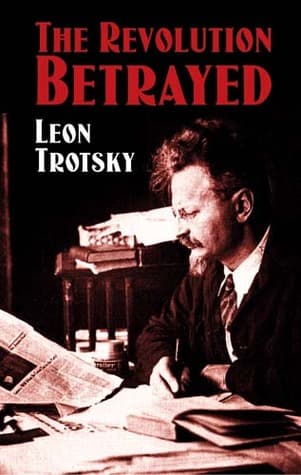
The Revolution Betrayed cover
Archivist's Choice

The Revolution Betrayed

Leon Trotsky (1967)

Genre

Politics / History / Economics / Philosophy

Reading Time

240 min

Key Themes

See below

Track Your Reading

Sign in to track this book

Trotsky explains how the Soviet Union, under Stalin, fell from a revolutionary state to a totalitarian one, showing how bureaucratic corruption and the rejection of true socialist goals betrayed the workers' state.

Core Idea

Trotsky argues that Stalin's leadership betrayed the original socialist revolution in the Soviet Union, turning a workers' state into a bureaucratic dictatorship. He claims that 'socialism in one country' abandoned international revolutionary goals, leading to a privileged bureaucracy that exploited workers and suppressed democracy. This takeover, according to Trotsky, caused internal conflicts, economic stagnation, and inequality, which would eventually collapse the Soviet state without a new political revolution to restore workers' democracy and international socialist principles.
Reading time
240 min
Difficulty
Hard
✓ Read this if...
You want a foundational critique of Stalinism from a Marxist perspective, understand the internal political struggles of the early Soviet Union, or explore theories of revolutionary degeneration and bureaucratic power.
✗ Skip this if...
You are unfamiliar with basic Marxist terminology, prefer a less polemical historical analysis, or are looking for an unbiased account of Soviet history without a strong ideological stance.

Core idea

The central argument and framework that powers the entire book.

Trotsky argues that Stalin's leadership betrayed the original socialist revolution in the Soviet Union, turning a workers' state into a bureaucratic dictatorship. He claims that 'socialism in one country' abandoned international revolutionary goals, leading to a privileged bureaucracy that exploited workers and suppressed democracy. This takeover, according to Trotsky, caused internal conflicts, economic stagnation, and inequality, which would eventually collapse the Soviet state without a new political revolution to restore workers' democracy and international socialist principles.

At a glance

Reading time

240 min

Difficulty

Hard

Read this if...

You want a foundational critique of Stalinism from a Marxist perspective, understand the internal political struggles of the early Soviet Union, or explore theories of revolutionary degeneration and bureaucratic power.

Skip this if...

You are unfamiliar with basic Marxist terminology, prefer a less polemical historical analysis, or are looking for an unbiased account of Soviet history without a strong ideological stance.

Key Takeaways

1

The Bureaucratic Usurpation

How a revolutionary workers' state degenerated into a totalitarian bureaucracy.

Quote

The bureaucracy conquered not by means of force, but by the fact that the proletariat, having achieved victory, was exhausted and began to go to sleep. This historical 'fatigue' was the main content of the Thermidorian reaction in the Soviet Union.

Trotsky argues that the Soviet Union, despite its revolutionary beginnings and nationalized economy, experienced a counter-revolution. This was not a change in class, but a shift in political power. The working class, exhausted by war, civil war, and rebuilding, slowly lost control to an increasingly powerful bureaucracy. This bureaucracy, led by Stalin, was not a new economic class but a parasitic group that took political power, securing its position by suppressing dissent and dismantling workers' democracy. The revolution's initial...

Supporting evidence

Trotsky meticulously details the erosion of Soviet democracy: the decline of the Soviets' power, the suppression of internal party factions (like the Left Opposition), and the increasing power of the secret police (GPU). He contrasts the vibrant debates of the early Bolshevik years with the monolithic conformity enforced under Stalin.

Apply this

Recognize that revolutionary gains are not self-sustaining; constant vigilance and active participation are required to prevent the erosion of democratic principles and the rise of bureaucratic control, even within ostensibly progressive movements.

thermidorbureaucratic-degenerationworkers-democracy
2

Socialism in One Country: A Betrayal

Stalin's doctrine of national socialism contradicted the internationalist spirit of the revolution.

Quote

The theory of socialism in one country, which first saw the light in 1924, was an unmistakable sign of the nationalistic degeneration of the Bolshevik party.

Trotsky strongly criticizes Stalin's idea of 'socialism in one country' as a complete abandonment of the international principles of the October Revolution. For Marx and Lenin, socialism was an international project, requiring capitalism's overthrow globally. Stalin's theory, born from national isolation and the failure of European revolutions, prioritized consolidating power within the Soviet Union, even at the cost of supporting international revolutionary movements. This shift encouraged narrow nationalism, justified the bureaucrac...

Supporting evidence

Trotsky points to the disastrous consequences of this policy, such as the betrayal of the Chinese Revolution in 1927, where the Comintern (under Stalin's direction) forced the Chinese Communist Party into a subordinate alliance with the Kuomintang, leading to its massacre.

Apply this

Evaluate political movements not just by their stated goals but by their practical internationalist commitments. Beware of nationalistic tendencies that can undermine broader solidarity and revolutionary potential.

internationalismsocialism-in-one-countrycomintern
3

The Planned Economy: A Contradiction

While productive, the planned economy was stifled by bureaucratic mismanagement and corruption.

Quote

The nationalized means of production and the planned character of the economy, in spite of all its defects, represent a colossal step forward in humanity's economic development.

Trotsky recognizes the vast production potential released by the nationalized planned economy, which enabled the Soviet Union to achieve significant industrial growth, especially in heavy industry. He sees this as proof of socialist economic principles. However, he argues that the bureaucratic regime severely hindered and distorted this potential. Instead of rational allocation based on societal needs and democratic input, the plan became a tool of bureaucratic command, full of waste, corruption, and inefficiency. The absence of worke...

Supporting evidence

Trotsky cites Soviet statistics on industrial growth alongside evidence of widespread inefficiency, the suppression of consumer goods production in favor of heavy industry, and the growing disparity between the official plan and actual economic realities.

Apply this

Understand that economic planning, while potentially powerful, requires democratic control and transparency to avoid becoming an instrument of power and inefficiency. Centralization without accountability leads to stagnation.

planned-economyeconomic-inefficiencynationalization
4

Inequality and Privilege: The New Aristocracy

The bureaucracy created vast social stratification, negating socialist ideals of equality.

Quote

The Soviet bureaucracy has become a privileged caste, which has concentrated in its hands the power and the material wealth, and which has created for itself a life of luxury and comfort.

One of Trotsky's most damaging criticisms is the rise of significant social inequality and privilege within the Soviet Union, which directly contradicted the revolution's egalitarian goals. The bureaucracy, far from serving the people selflessly, became a new aristocracy, enjoying better housing, food, clothing, and access to education and healthcare. This stratification was not based on private ownership of production means but on access to power and state resources. This growing gap between the bureaucratic elite and the general pop...

Supporting evidence

Trotsky presents statistics on wage differentials, access to goods and services, and the rise of a 'Soviet aristocracy' with special shops, resorts, and educational opportunities, contrasting this with the continued hardship faced by ordinary workers and peasants.

Apply this

Be critical of any system that claims to be egalitarian but exhibits significant disparities in wealth, power, or access based on political position rather than merit or need. True socialism requires addressing all forms of inequality.

social-inequalityprivilegecaste-system
5

The Permanent Revolution vs. Stagnation

The abandonment of permanent revolution led to internal stagnation and external isolation.

Quote

The theory of socialism in one country is a mechanical and utopian theory, which contradicts the entire course of the historical development of humanity.

Trotsky's theory of 'permanent revolution' stated that in underdeveloped countries like Russia, the democratic revolution (bourgeois tasks like land reform and industrialization) could only be completed under the working class's leadership. This would then immediately lead to socialist tasks, linking its fate to the international socialist revolution. Stalin's abandonment of this theory for 'socialism in one country' led to the Soviet Union's internal stagnation, as the bureaucracy prioritized its own stability over revolutionary driv...

Supporting evidence

Trotsky contrasts the early revolutionary optimism and internationalist outreach of the Bolsheviks with the later insular and pragmatic foreign policy of Stalin, which often prioritized alliances with capitalist powers over supporting revolutionary movements.

Apply this

Understand that genuine social transformation often requires a continuous, evolving process that cannot be confined by national borders or static doctrines. Be wary of movements that prioritize national self-interest over global solidarity.

permanent-revolutionstagnationinternational-revolution
6

The Collapse Prophesied

Trotsky foresaw the eventual downfall of the Soviet Union due to its internal contradictions.

Quote

The fall of the present bureaucratic dictatorship, if it is not replaced by a new socialist power, would lead to the restoration of capitalist relations with a catastrophic decline of culture and economy.

Perhaps the book's most striking aspect is Trotsky's foresight into the Soviet Union's future. He argued that the bureaucratic regime, while temporarily stable, contained the seeds of its own destruction. The basic conflict between nationalized production and the parasitic, anti-democratic rule of the bureaucracy could not last indefinitely. He suggested two possible outcomes: either the working class would overthrow the bureaucracy and restore workers' democracy, or the bureaucracy itself would eventually pave the way for capitalism'...

Supporting evidence

Trotsky details the inherent instability of a system where the ruling caste has no organic connection to the means of production and relies solely on political repression, making it vulnerable to internal decay and external pressures.

Apply this

Analyze political systems for their inherent contradictions and potential points of failure, rather than accepting their stated longevity. Understand that internal political dynamics are often more crucial than external threats to a regime's stability.

prophecysystem-collapserestoration-of-capitalism
7

The Role of Repression and Cult of Personality

Terror and idolization were essential tools for bureaucratic control.

Quote

The totalitarian regime, having crushed the independent initiative of the masses, replaces it with the unlimited authority of the leader.

Trotsky highlights how the Stalinist bureaucracy maintained power through systematic political repression, purges, and the suppression of any independent thought or organization. The lively internal debates of the early Bolshevik party were replaced by a single party line enforced through terror. At the same time, the cult of personality around Stalin became a key tool for legitimizing the bureaucracy's rule. By deifying the leader, the regime could demand unquestioning loyalty and hide the collective failures and abuses of the bureau...

Supporting evidence

Trotsky references the Moscow Trials (though they hadn't fully unfolded by 1936, the groundwork was laid), the suppression of the Left Opposition, and the systematic rewriting of history to elevate Stalin and erase his rivals.

Apply this

Be deeply skeptical of any political system that relies on a cult of personality or uses widespread repression to maintain power. These are hallmarks of authoritarianism, not genuine democracy or liberation.

cult-of-personalitypolitical-repressiontotalitarianism
8

The Soviet Union: A Degenerated Workers' State

A unique historical formation, neither socialist nor purely capitalist.

Quote

The Soviet Union is a contradictory social formation, halfway between capitalism and socialism, which has preserved the nationalized means of production but has lost the democratic character of the workers' state.

Trotsky's main theoretical contribution is his description of the Soviet Union as a 'degenerated workers' state.' He strongly rejected the idea that it was truly socialist (due to the lack of workers' democracy and the presence of a parasitic bureaucracy) or state capitalist (because the means of production remained nationalized, not privately owned). Instead, it was a transitional, contradictory formation where the progressive economic foundation (nationalized property) conflicted with the reactionary political structure (the totalit...

Supporting evidence

He contrasts the economic base (nationalized industry, planned economy) with the political superstructure (lack of democratic control, privileges of the bureaucracy, political repression) to argue for this unique, transitional designation.

Apply this

Avoid simplistic categorizations of complex political systems. Acknowledge that societies can exist in transitional, contradictory states, requiring nuanced analysis beyond binary classifications like 'capitalist' or 'socialist.'

degenerated-workers-statetransitional-societystate-capitalism
9

The Necessity of Political Revolution

Only a new political revolution could restore the socialist ideals.

Quote

The further development of the Soviet Union will lead to the overthrow of the bureaucracy by the working class, or to the restoration of capitalism. The former is still possible, but it requires a new political revolution.

Given the bureaucratic takeover of power, Trotsky concluded that the only way to save the gains of the October Revolution and move towards true socialism was through a new 'political revolution.' This would not be a social revolution aimed at changing the economic base (as the means of production were already nationalized), but a political one aimed at overthrowing the parasitic bureaucracy and restoring workers' democracy, democratic planning, and true equality. He believed that such a revolution was both necessary and possible, repr...

Supporting evidence

Trotsky argues that the economic base of nationalized property remained a progressive achievement worth defending, but that the political superstructure of the bureaucracy had to be surgically removed through a revolutionary act by the working class.

Apply this

Recognize that even after a social revolution, a 'political revolution' might be necessary to safeguard and advance its original goals against internal decay or authoritarian tendencies. Constant vigilance and readiness for political action are crucial.

political-revolutionanti-bureaucratic-strugglesocialist-renewal

Critical analysis

Notable Quotes

The bureaucracy, which began by creating conveniences for the administration of the party's current affairs, ended by transforming itself into an uncontrollable force.

Describing the rise of the bureaucracy within the Soviet Union.

The state, even in the period of proletarian dictatorship, remains the instrument of class oppression.

Discussing the nature of the state even under a workers' government.

The living historical process of the class struggle is replaced by the mechanical schema of the 'program.'

Criticizing the dogmatic approach of the Stalinist bureaucracy to Marxist theory.

History is not an automatic machine. It is the arena of the class struggle.

Emphasizing the role of human agency and class conflict in historical development.

The nationalization of the means of production and land, together with the monopoly of foreign trade, constitutes the basis of the Soviet social structure.

Outlining the fundamental economic achievements of the October Revolution.

Socialism has demonstrated its right to victory, not on the pages of Capital, but in an industrial arena encompassing a sixth part of the earth's surface.

Acknowledging the material achievements of the Soviet planned economy.

The October Revolution brought about a far-reaching transformation of property relations, but it did not create a new mode of production.

Distinguishing between changes in ownership and fundamental changes in the productive process.

The Soviet bureaucracy has expropriated the proletariat politically in order to guard its own conquests with its own methods.

Explaining how the bureaucracy took political power from the working class.

The complete victory of socialism in one country is unthinkable.

Reiterating the theory of permanent revolution against Stalin's 'socialism in one country'.

The Thermidor of the great French Revolution prepared the way for Napoleon. The Soviet Thermidor is preparing the way for ... who?

Drawing a parallel between the French Revolution's Thermidorian Reaction and the Stalinist period.

The material prerequisites for socialism exist, but the subjective factors are distorted and suppressed by the bureaucracy.

Arguing that the economic base for socialism was present, but political leadership was corrupt.

Inequality is still the law of life for the Soviet society.

Highlighting the persistence of social and economic inequality under Stalinism.

The revolution, betrayed by the ruling party, still lives in the consciousness of the advanced workers.

Expressing hope that revolutionary ideals still resonate despite the betrayal by the leadership.

The struggle against the bureaucracy is the struggle for the salvation of the revolution.

Framing the central task for revolutionaries in the Soviet Union.

Quiz

Test Your Knowledge

Ready to see how well you understood this book? Take our interactive quiz with 10 questions.

10
Questions
~5
Minutes
?
Best Score

Key Questions (FAQ)

'The Revolution Betrayed' argues that the Soviet Union, despite its nationalized planned economy, had degenerated from a workers' democracy into a totalitarian bureaucratic state under Stalin, thereby betraying the original goals of the October Revolution. Trotsky uses extensive data to illustrate this decline and its implications.

About the author