BookBrief
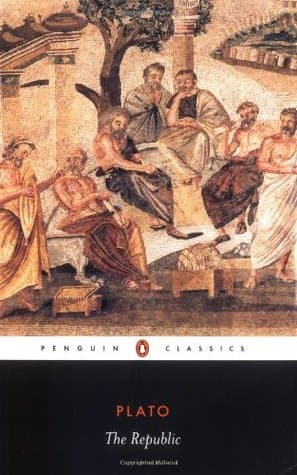
The Republic cover
Archivist's Choice

The Republic

Plato (1980)

Genre

Politics / History / Philosophy

Reading Time

1000 min

Key Themes

See below

Track Your Reading

Sign in to track this book

Plato's "The Republic" explores justice, reality, and the ideal individual through Socratic dialogues, envisioning a harmonious state led by philosopher-kings.

Core Idea

Plato's "The Republic" builds an ideal state, Kallipolis, and an ideal person, both based on justice. For Plato, justice means that each part of a system works as it should, without overstepping its bounds. This applies to laws, power, and the inner workings of a person or society. The ideal state is led by philosopher-kings, who dedicate their lives to finding truth and understanding the Forms, especially the Form of the Good. This makes them uniquely qualified to govern. The book shows how this harmony is achieved through strict education, limiting art that could corrupt, and a social structure that assigns roles based on natural ability, not birth or money. Plato argues that justice in the soul (reason guiding spirit and appetite) mirrors justice in the state. He also suggests that states decline when these internal principles are corrupted, moving from aristocracy to timocracy, oligarchy, democracy, and finally tyranny, each step becoming more unjust.
Reading time
1000 min
Difficulty
Hard
✓ Read this if...
You are interested in the foundational texts of Western political philosophy, ethics, and metaphysics, or want to understand the origins of concepts like the ideal state, the tripartite soul, and the role of knowledge in governance.
✗ Skip this if...
You are looking for a light read, are averse to extensive philosophical argumentation, or find ancient Greek societal views (e.g., on censorship or class structures) unpalatable without critical engagement.

Core idea

The central argument and framework that powers the entire book.

Plato's "The Republic" builds an ideal state, Kallipolis, and an ideal person, both based on justice. For Plato, justice means that each part of a system works as it should, without overstepping its bounds. This applies to laws, power, and the inner workings of a person or society. The ideal state is led by philosopher-kings, who dedicate their lives to finding truth and understanding the Forms, especially the Form of the Good. This makes them uniquely qualified to govern.

The book shows how this harmony is achieved through strict education, limiting art that could corrupt, and a social structure that assigns roles based on natural ability, not birth or money. Plato argues that justice in the soul (reason guiding spirit and appetite) mirrors justice in the state. He also suggests that states decline when these internal principles are corrupted, moving from aristocracy to timocracy, oligarchy, democracy, and finally tyranny, each step becoming more unjust.

At a glance

Reading time

1000 min

Difficulty

Hard

Read this if...

You are interested in the foundational texts of Western political philosophy, ethics, and metaphysics, or want to understand the origins of concepts like the ideal state, the tripartite soul, and the role of knowledge in governance.

Skip this if...

You are looking for a light read, are averse to extensive philosophical argumentation, or find ancient Greek societal views (e.g., on censorship or class structures) unpalatable without critical engagement.

Key Takeaways

1

Justice as Harmony, Not Power

True justice is a state of internal balance, not merely the advantage of the stronger.

Quote

Justice is nothing else than the interest of the stronger.

Plato, through Socrates, challenges the idea that justice is only a tool for the powerful. He argues that such a view leads to conflict and instability. Instead, justice, for both individuals and states, means order and harmony among different parts. For a person, this means reason leads, spirit supports reason, and appetite is controlled. For a state, it means each class does its job without overstepping. This internal order, not external might, brings true strength and well-being, suggesting a moral duty beyond simple practicality.

Supporting evidence

Socrates' refutation of Thrasymachus' definition of justice in Book I, demonstrating that rulers, if they are truly skilled, rule for the benefit of the ruled, not themselves, and that injustice leads to disunity and weakness.

Apply this

Evaluate your own internal 'state': are your passions leading, or is your reason guiding your actions? In group settings, prioritize clear roles and mutual respect over power struggles to foster genuine collaboration and effectiveness.

justiceethicspolitical-philosophy
2

The Philosopher King

Societies achieve true excellence only when governed by those who possess wisdom and a love for truth.

Quote

Unless philosophers rule as kings or those who are now called kings and leading men genuinely and adequately philosophize… there is no rest from evils for cities, nor, I think, for the human race.

Plato argues that the ideal state must be led by philosopher kings. These are individuals who have had extensive intellectual and moral training, understand the Forms (especially the Form of the Good), and value truth and the city's welfare over personal gain. This is not a call for academics to rule, but for leaders with true wisdom, who understand reality and justice. Their rule is not oppressive, but based on their superior knowledge and dedication to the public good, making them uniquely able to guide the state toward harmony and ...

Supporting evidence

The detailed curriculum for the education of guardians, culminating in dialectic and contemplation of the Form of the Good, as outlined in Books VI and VII.

Apply this

When selecting leaders, prioritize individuals who demonstrate a genuine commitment to truth, critical thinking, and the collective good over those who appeal solely to emotion or self-interest. Support education systems that cultivate deep philosophical inquiry, not just vocational skills.

philosopher-kinggovernanceideal-state
3

The Allegory of the Cave

Our perceptions of reality are often mere shadows, and true knowledge requires a painful ascent to enlightenment.

Quote

The prisoners would in every way believe that the truth is nothing other than the shadows of artificial things.

This well-known allegory shows the human condition: most people live in ignorance, mistaking appearances for reality, like prisoners in a cave who only see shadows. The journey out of the cave, toward the sun's light (representing the Form of the Good), is difficult. It stands for philosophical education and the effort to move past senses to true knowledge. Those who make this ascent and return to share their insights often face disbelief or hostility, showing how hard it is to lead others to truth.

Supporting evidence

The detailed narrative of the cave, the prisoners, the fire, the shadows, and the painful ascent into the sunlight in Book VII.

Apply this

Constantly question your assumptions and the sources of your information. Be open to challenging your deeply held beliefs, even if it's uncomfortable. Recognize that what appears to be common sense might just be a widely accepted 'shadow' of a deeper truth.

allegory-of-the-caveepistemologyrealitytruth
4

The Tripartite Soul

The individual soul is composed of reason, spirit, and appetite, and its health depends on their proper hierarchy.

Quote

The just man does not allow the three parts within him to interfere with each other, but he sets his own house in order and rules himself.

Plato states that the human soul has three parts: rational (reason), spirited (courage, honor), and appetitive (desires for food, drink, sex). An individual achieves justice when reason, helped by spirit, controls the appetites. When these parts are in harmony, the person is virtuous and happy. If appetite or spirit controls reason, the soul is unjust and conflicted, leading to inner trouble and a disordered life. This model gives a psychological basis for his political philosophy, mirroring the ideal state structure.

Supporting evidence

Socrates' argument in Book IV, comparing the three classes of the ideal state (rulers, auxiliaries, producers) to the three parts of the soul, and defining individual justice as the proper functioning of these parts.

Apply this

Practice self-awareness to identify which part of your soul is driving your decisions. Cultivate self-discipline to ensure your reason, not your impulses or ego, is in control. For example, before making a significant purchase, pause and consider if it's a rational need or an appetitive desire.

tripartite-soulpsychologyvirtueself-control
5

Education for the Guardians

A rigorous and holistic education is essential for cultivating virtuous leaders and maintaining societal stability.

Quote

And the purpose of gymnastic and music is not, as some suppose, the care of the body and the soul respectively, but primarily the care of the soul.

Plato describes a thorough, lifelong education program for the guardians (rulers and auxiliaries), including 'music' (arts, literature, moral training) and 'gymnastic' (physical training). This education aims to build courage, moderation, and wisdom, removing bad influences like certain poems. It moves from childhood stories to advanced math, astronomy, and finally, dialectic – the study of the Forms. The goal is not just intellectual growth, but character building, ensuring future leaders are knowledgeable and virtuous, able to know ...

Supporting evidence

The detailed discussion in Books II, III, and VII regarding the curriculum for guardians, including censorship of stories, the role of music and gymnastics, and the progression to higher studies like mathematics and dialectic.

Apply this

Advocate for educational systems that prioritize critical thinking, moral development, and a broad liberal arts foundation, rather than narrow specialization. Reflect on your own learning: are you seeking knowledge that builds character and understanding, or just information for practical gain?

educationguardianscurriculummoral-development
6

The Degeneration of States

States inevitably decline from the ideal aristocracy through a predictable sequence of increasingly corrupt forms of government.

Quote

And now we have to tell how oligarchy comes out of timocracy, and what it is like when it has come into being.

Plato presents a repeating pattern of political decline, from the ideal aristocracy (rule by the best, like philosopher kings) to timocracy (rule by honor), then to oligarchy (rule by wealth), democracy (rule by the people, often leading to disorder), and finally, tyranny (rule by a single, unchecked person). Each stage involves a change in the main value and a drop in justice and stability. This negative view of political change suggests that without constant care and building virtue, even the best societies can become corrupt and fa...

Supporting evidence

Plato's detailed analysis in Book VIII of the five types of regimes: aristocracy, timocracy, oligarchy, democracy, and tyranny, and their corresponding individual character types.

Apply this

Be aware of the warning signs of political decay in your own society: an overemphasis on wealth, a decline in public service, or the rise of unbridled populism. Support institutions that promote virtue, reason, and balanced governance over narrow self-interest or mob rule.

political-degenerationforms-of-governmenttyrannydemocracy
7

The Noble Lie

For societal cohesion, a foundational myth, even if untrue, can be necessary to foster unity and purpose.

Quote

Though it is a myth, there is no reason why it should not be told, even now, in the city.

Plato introduces the 'Noble Lie' or 'Myth of the Metals' – a story to be taught to all citizens. This myth says that people are born with different metals in their souls (gold for rulers, silver for auxiliaries, bronze/iron for producers), which determines their natural place in society. Plato admits it is made up, but argues it serves a key purpose: to create a shared identity, acceptance of one's role, and social unity, thereby preventing internal conflict and ensuring state stability. This shows a conflict between absolute truth an...

Supporting evidence

The 'Myth of the Metals' (or Phoenician tale) described in Book III, presented as a story to convince citizens that their social status is divinely ordained.

Apply this

Critically analyze national narratives or founding myths in your own society. Understand their purpose in fostering unity, but also question their historical accuracy and potential for manipulation. Recognize that 'stories' often shape collective behavior more than pure facts.

noble-liemythologysocial-cohesionpropaganda
8

Equality of Opportunity for Women

If women possess the same natural capacities as men, they should receive the same education and hold the same positions.

Quote

There is no practice in the administration of a state that belongs to a woman because she is a woman, or to a man because he is a man.

In a surprisingly modern view for his era, Plato argues that if women show the same natural abilities and intelligence as men, they should get the same education and be eligible for the same roles, including guardian or even philosopher king. He dismisses superficial physical differences as unimportant to the soul's abilities. This radical idea challenges traditional gender roles and supports merit based on individual talent, not biological sex, showing his focus on the soul's capacities over physical traits.

Supporting evidence

Socrates' discussion in Book V, where he argues against conventional views on women's roles, stating that natural capacities (for guardianship, philosophy, etc.) are distributed among both sexes, making equal education and opportunity logical.

Apply this

Advocate for policies and practices that ensure equal access to education and professional opportunities for all genders, based on merit and capability, not historical or perceived differences. Challenge gender stereotypes that limit individual potential.

gender-equalitymeritocracywomen-in-leadershipsocial-justice
9

The Immutability of Forms

True knowledge lies not in the fleeting sensory world, but in eternal, unchanging, perfect Forms.

Quote

There is a Form of the Beautiful itself, separate and apart from all beautiful things, and it is in this that all beautiful things participate.

Central to Plato's metaphysics is the theory of Forms. He says that beyond the observable, changing world of individual things (e.g., beautiful objects), there is a realm of perfect, eternal, unchanging Forms (e.g., the Form of Beauty itself). These Forms are the true reality and what genuine knowledge is about, accessible only through reason, not senses. The physical world is just an imperfect copy or 'participation' in these Forms. Understanding this difference is important for the philosopher, as it guides them toward higher truths...

Supporting evidence

The discussion of the two realms (visible and intelligible) and the Divided Line analogy in Book VI, which illustrates the different levels of reality and knowledge, from images and beliefs to understanding and pure intelligence of the Forms.

Apply this

When evaluating concepts like 'justice,' 'beauty,' or 'goodness,' strive to understand their underlying universal principles rather than getting lost in specific examples or subjective opinions. Seek the essence of things, not just their appearances.

theory-of-formsmetaphysicsepistemologyreality
10

The Necessity of Censorship for the Young

To cultivate virtuous citizens, the artistic and literary influences on the young must be carefully controlled.

Quote

The stories that children hear first, and most, should be those that are best adapted to promote virtue.

Plato argues for strict control over poetry and stories, especially for young guardians. He believes that art, particularly dramatic poetry, can imitate and manipulate emotions, potentially corrupting character by encouraging bad traits or showing gods and heroes in a poor light. He thinks that early exposure to noble and morally uplifting stories is crucial for shaping citizens' souls, strengthening virtues like courage, moderation, and piety. This view highlights Plato's deep concern with culture's power to shape and its direct effe...

Supporting evidence

The extensive discussion in Books II and III on the types of stories that should be told to children, including the rejection of tales depicting gods as deceitful or heroes as overly emotional, and the regulation of musical modes.

Apply this

Be mindful of the media and narratives you expose yourself and especially children to. Critically evaluate the moral messages and character models presented in popular culture. Consider actively seeking out art and literature that inspires virtue and critical thought.

censorshipart-and-moralityeducationcultural-influence

Critical analysis

Notable Quotes

The price good men pay for not being interested in politics is to be governed by men worse than themselves.

Socrates discussing the reluctance of the just to rule.

Until philosophers are kings, or the kings and princes of this world have the spirit and power of philosophy, and political greatness and wisdom meet in one, and those commoner natures who pursue either to the exclusion of the other are compelled to stand aside, cities will never have rest from their evils—nor the human race, as I believe—and then only will this our State have a possibility of life and behold the light of day.

Socrates introducing the concept of the 'philosopher king'.

We are like people looking at a screen where shadows are cast by objects we never see.

Socrates describing the human condition in the Allegory of the Cave.

Justice in the life and conduct of the individual is possible only if there is justice in the life and conduct of the state as a whole.

Socrates drawing a parallel between individual and societal justice.

The heaviest penalty for disobeying a superior is to have to bear the burden of his rule.

Socrates on the consequences of not actively participating in governance.

And is not the good the beautiful?

Socrates linking the concepts of good and beauty.

Democracy, which is a charming form of government, full of variety and disorder, and dispensing a sort of equality to equals and unequals alike.

Socrates critiquing democracy.

No law or ordinance is mightier than understanding.

Socrates on the supremacy of wisdom over rigid laws.

The beginning is the most important part of the work.

Socrates emphasizing the importance of education and early influences.

For good people to do evil, it takes nothing more than for good people to do nothing.

Socrates on the passive allowance of injustice, often paraphrased.

And what is the good of eyes that are not open?

Socrates questioning the utility of unexamined existence.

The soul of man is immortal and imperishable.

Socrates discussing the nature of the soul.

Ignorance, the root and stem of all evil.

Socrates identifying ignorance as the source of wrongdoing.

Courage is a kind of salvation.

Socrates defining courage in the context of preserving right opinion.

Quiz

Test Your Knowledge

Ready to see how well you understood this book? Take our interactive quiz with 10 questions.

10
Questions
~5
Minutes
?
Best Score

Key Questions (FAQ)

'The Republic' by Plato is primarily an exploration of justice, both in the individual and in the state. Through a series of dialogues, Socrates and his interlocutors discuss the ideal society and the characteristics of a just person, touching upon politics, ethics, and metaphysics.

About the author

Plato

Biography coming soon.