BookBrief
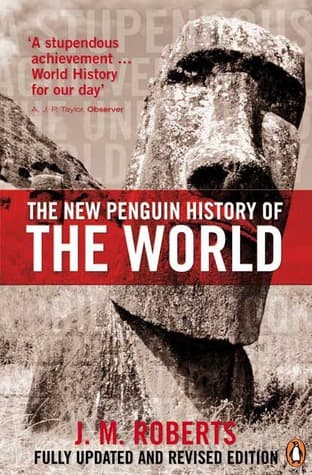
The New Penguin History of the World cover
Archivist's Choice

The New Penguin History of the World

J.M. Roberts

Genre

Lifestyle / Reference / History

Reading Time

12 Minutes

Key Themes

See below

Track Your Reading

Sign in to track this book

From the African savannah to the post-9/11 world, this sweeping chronicle traces the diversity of human civilization, power shifts, and the triumphs and struggles of people across continents.

Core Idea

J.M. Roberts' "The New Penguin History of the World" offers a comprehensive and accessible narrative of global history from the Big Bang to the late 20th century. It emphasizes interconnectedness and the long-term patterns of human development, moving beyond Eurocentric perspectives to integrate the experiences and contributions of diverse civilizations across continents. The book argues that understanding the broad sweep of human experience, including cultural, social, political, and economic developments, is crucial for comprehending the present and anticipating future global challenges and opportunities.
Difficulty
Medium

Core idea

The central argument and framework that powers the entire book.

J.M. Roberts' "The New Penguin History of the World" offers a comprehensive and accessible narrative of global history from the Big Bang to the late 20th century. It emphasizes interconnectedness and the long-term patterns of human development, moving beyond Eurocentric perspectives to integrate the experiences and contributions of diverse civilizations across continents. The book argues that understanding the broad sweep of human experience, including cultural, social, political, and economic developments, is crucial for comprehending the present and anticipating future global challenges and opportunities.

At a glance

Difficulty

Medium

Key Takeaways

1

Deep Time, Human Scale

Understanding human history requires appreciating both the vastness of geological time and the comparatively brief, yet impactful, span of human civilization.

Quote

The story of humanity, however long it seems to us, is but a fleeting moment in the immense geological timescale of the Earth.

Roberts puts human history into the context of the planet's much older story, starting not with written records but with the origins of life and Earth's formation. This view helps us understand the evolutionary forces that shaped early humans and the environmental limits that affected their migrations and developments. He notes that while human civilization has existed for only a few thousand years, the biological and geological processes supporting us span billions of years. This basic understanding keeps us from being too focused on...

Supporting evidence

The book's initial chapters detailing Earth's formation, the emergence of life, and early hominid evolution, preceding discussions of agricultural revolutions.

Apply this

When studying specific historical events, always consider the longer-term ecological and evolutionary contexts. Recognize that present-day challenges often have roots in deep historical patterns.


2

The Agricultural Revolution's Dual Legacy

While agriculture enabled civilization, it also introduced new forms of social hierarchy, disease, and environmental impact.

Quote

The domestication of plants and animals was arguably the most profound transformation in human history, fundamentally reshaping human societies, their relationship with the environment, and their very biology.

Roberts focuses on the Neolithic Revolution, calling it a major turning point, more important than any political change. He details how the move from nomadic hunter-gatherer lives to settled farming communities led to more people, the growth of villages and cities, and specialized labor. However, he also covers its downsides: more risk of famine from single crops, the rise of diseases spread by denser populations and close contact with animals, and the start of strict social classes as extra food allowed for non-farming elites. This b...

Supporting evidence

Discussion of early agricultural societies, the emergence of class structures, and the impact of diseases like smallpox and measles in early civilizations.

Apply this

When evaluating technological or societal advancements, look beyond immediate benefits to anticipate long-term ecological, social, and health implications.

3

The Contingency of Empire

Empires, though seemingly dominant, often arose from specific geographical, technological, and ideological contingencies, and their decline was equally complex.

Quote

The rise and fall of empires, though often presented as inevitable, were frequently the outcome of a confluence of specific circumstances, both internal and external, rather than predetermined destinies.

Roberts does not present empires as single, unstoppable forces. Instead, he shows how their creation often depended on specific new ideas (like iron weapons, central administration, or sea travel), good geographical locations, or strong leaders. He looks at the Roman Empire, for example, through its legal system and infrastructure, not just its military power. Importantly, he also explores their weaknesses: expanding too much, internal disagreements, economic stress, and outside pressures. His study of how various empires fell—from Ha...

Supporting evidence

Detailed accounts of the rise of empires like Persia, Rome, and various Chinese dynasties, alongside their periods of internal strife and eventual fragmentation.

Apply this

When analyzing current geopolitical power structures, consider the specific conditions that enabled their rise and the potential vulnerabilities that could lead to their transformation or decline.

4

The Interconnectedness of Civilizations

Despite perceived isolation, major civilizations throughout history were profoundly shaped by exchanges of goods, ideas, technologies, and pathogens.

Quote

No civilization, however grand or self-sufficient it might appear, ever truly developed in isolation; the threads of exchange and influence connected distant peoples in ways often underestimated.

Roberts's strongest point is his constant focus on the global network of connections that existed before modern globalization. He carefully traces the Silk Road, Indian Ocean trade routes, and trans-Saharan paths, showing how goods like spices and silk, technologies like paper and gunpowder, and religions like Buddhism and Islam spread across continents. He also highlights the less positive exchanges, such as the spread of diseases like the Black Death, which had terrible, but ultimately transformative, effects on societies. This inte...

Supporting evidence

Discussions of the Silk Road's impact on Rome and China, the spread of Buddhism from India, the influence of Islamic scholarship on medieval Europe, and the devastating impact of the Black Death across Eurasia.

Apply this

Recognize that global events and trends are rarely isolated. Seek to understand the ripple effects and cross-cultural influences that shape historical outcomes.

5

The Enduring Power of Ideas and Belief Systems

Religions, philosophies, and ideologies have been as potent as armies and economics in shaping human societies and historical trajectories.

Quote

Beyond the clash of empires and the flow of trade, the invisible currents of belief and thought often provided the very bedrock upon which societies were built and their destinies forged.

Roberts consistently shows how abstract forces—ideas, spiritual beliefs, and philosophical systems—have greatly shaped history. He explores the basic role of monotheistic religions (Judaism, Christianity, Islam) in forming moral codes, political legitimacy, and cultural identity across large areas. He also looks at the impact of Eastern philosophies like Confucianism and Buddhism on social order and individual behavior. Furthermore, he traces the rise of Enlightenment ideas and later, nationalism and communism, showing how these non-r...

Supporting evidence

Analysis of the spread of Christianity in the Roman Empire, the unifying force of Islam, the impact of the Reformation, and the ideological underpinnings of the French Revolution.

Apply this

When analyzing contemporary conflicts or societal structures, investigate the underlying belief systems and ideologies that motivate individuals and groups.

6

The Uneven March of Progress

History is not a linear progression; periods of innovation and advancement are often followed by stagnation, decline, or even regression in different regions.

Quote

The story of humanity is not one of ceaseless, upward ascent, but rather a complex tapestry of advances and retreats, of brilliant epochs and periods of apparent stasis or even regression.

Roberts challenges the simple idea that historical progress is a continuous, unbroken line. He points out how different regions had peak periods at different times—for example, the Golden Age of Islam during Europe's 'Dark Ages,' or the thriving of Chinese civilization while other parts of the world were less developed. He also details times when advanced societies suffered setbacks due to invasion, environmental disaster, or internal collapse, losing knowledge or abilities. The collapse of the Bronze Age civilizations, for instance, ...

Supporting evidence

Comparison of the 'Dark Ages' in Europe with contemporary advancements in the Islamic world or China, and the societal collapse after the Bronze Age.

Apply this

Resist deterministic views of history. Understand that societal development is often cyclical and vulnerable to disruption, and that 'progress' is not universally defined or experienced.

7

The Shaping Power of Geography

Geographical features—rivers, mountains, oceans, and climate—have played a fundamental, often underestimated, role in shaping human settlement, conflict, and development.

Quote

The very contours of the land, the flow of its waters, and the patterns of its climate have, from the beginning, exerted an inescapable influence on where and how humanity chose to live, trade, and fight.

Roberts consistently includes geographical analysis in his historical narrative, showing its great impact. He explains how river valleys (Nile, Tigris-Euphrates, Indus, Yellow River) helped early civilizations grow because of fertile land and irrigation potential. He highlights how mountain ranges acted as natural barriers, helping create distinct cultures or slowing expansion, while navigable seas helped trade and imperial reach. Climate zones determined farming possibilities and disease spread. This geographical influence, though no...

Supporting evidence

Discussion of the importance of the Nile for ancient Egypt, the role of the Mediterranean for Roman power, and how the Himalayas isolated South Asia from East Asia.

Apply this

When analyzing historical or contemporary events, always consider the geographical context, including topography, climate, and access to resources, as a primary shaping factor.

8

The Revolutions of Modernity

The scientific, industrial, and democratic revolutions fundamentally transformed human society, creating unprecedented wealth, power, and new global challenges.

Quote

The period from the Renaissance onward, marked by accelerating scientific inquiry, technological innovation, and new political ideologies, unleashed forces that would reshape the entire globe with astonishing speed and intensity.

Roberts dedicates large sections to the 'modern' era, beginning with the Renaissance and Age of Exploration, through the Scientific Revolution, Enlightenment, Industrial Revolution, and the rise of democratic thought. He argues these were not separate events but connected forces that together created our world. The Scientific Revolution fostered a new way of understanding the world, leading to technological advances. The Industrial Revolution, fueled by new energy sources, created huge wealth but also vast social inequalities and envi...

Supporting evidence

Detailed analysis of the impact of the steam engine, the French Revolution's ideological spread, the rise of factory systems, and the colonial expansion driven by industrial power.

Apply this

Understand that many contemporary global issues (climate change, economic inequality, geopolitical power struggles) are direct legacies of these transformative modern revolutions.

9

History as a Narrative of Ordinary Lives

Beyond kings and conquerors, the daily lives, struggles, and innovations of ordinary people form the essential fabric of human history.

Quote

While the grand narratives of kings and battles often fill the history books, it is the cumulative experience of countless ordinary lives – their innovations, their endurance, their daily struggles – that truly constitutes the human story.

While Roberts covers political leaders and major events, he consistently reminds the reader that history is also the story of ordinary people. He includes discussions of population, social structures, farming methods, and daily life in his broader narrative. He touches on the lives of peasants, artisans, women, and slaves, emphasizing how their labor, beliefs, and resilience supported the great civilizations. For example, he describes the hard work involved in building large structures or the daily routines of a medieval village. This...

Supporting evidence

Discussions of changes in family structures, the impact of disease on populations, agricultural techniques, and the daily routines of various social classes across different eras.

Apply this

When studying history, actively seek out sources and perspectives that shed light on the lives of non-elite individuals and groups, recognizing their crucial role in societal development.

10

The Unfinished Symphony of History

History is an ongoing process, with the present moment merely the latest chapter in a continuously unfolding narrative, rife with unresolved challenges and future possibilities.

Quote

The past is not a closed book, but an open text, constantly being reinterpreted and extended by the present, shaping a future yet unwritten.

Roberts ends his vast history not with a final conclusion, but with an acknowledgment that the narrative is always moving. He brings the story up to the early 21st century, highlighting the complex global situation shaped by centuries of interaction, conflict, and technological advancement. He suggests that the forces unleashed by modernity—globalization, technological acceleration, environmental pressures, and ideological clashes—are not final destinations but ongoing processes. The book reminds us that understanding the past is not ...

Supporting evidence

The final chapters discussing the post-Cold War world, the rise of new global powers, and the enduring challenges of terrorism and global inequality.

Apply this

View current events not in isolation, but as continuations or reactions to historical trends. Use historical knowledge to inform critical thinking about contemporary issues and future scenarios.

Critical analysis

Notable Quotes

Quiz

Test Your Knowledge

Ready to see how well you understood this book? Take our interactive quiz with 10 questions.

10
Questions
~5
Minutes
?
Best Score

Key Questions (FAQ)

This book is an accessible narrative of world history, covering the period from human origins on the African savannah up to the early 2000s. It traces the development of civilizations, examining periods of change, shifts in power, and conflicts that have shaped human experience.

About the author