BookBrief
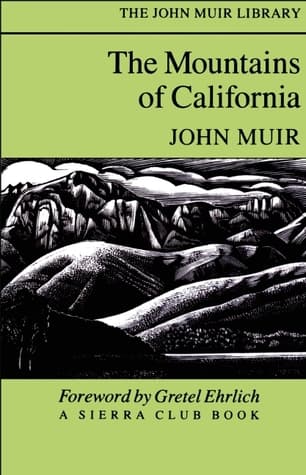
The Mountains of California cover
Archivist's Choice

The Mountains of California

John Muir (1893)

Genre

Lifestyle / History / Science

Reading Time

600 min

Key Themes

See below

Track Your Reading

Sign in to track this book

John Muir's ecstatic writing shows the Sierra Nevada's beauty, from Yosemite to ancient sequoia groves, revealing the heart of California's 'Range of Light'.

Core Idea

John Muir's "The Mountains of California" explores the Sierra Nevada, focusing on its geology, ecology, and the deep impact it had on him. Muir describes the glaciation that shaped its valleys and peaks, the resilience of sequoias, and how seasons and water sustain its ecosystems. He argues for the intrinsic value of wilderness, emphasizing the connection of all natural elements and advocating for its preservation for its own grandeur and the peace it offers.
Reading time
600 min
Difficulty
Medium
✓ Read this if...
You are a nature enthusiast, appreciate detailed observational writing, or are interested in the historical perspective of American environmentalism and the beauty of the Sierra Nevada.
✗ Skip this if...
You prefer fast-paced narratives, dry scientific reports, or are not interested in detailed descriptions of landscapes and natural processes.

Core idea

The central argument and framework that powers the entire book.

John Muir's "The Mountains of California" explores the Sierra Nevada, focusing on its geology, ecology, and the deep impact it had on him. Muir describes the glaciation that shaped its valleys and peaks, the resilience of sequoias, and how seasons and water sustain its ecosystems. He argues for the intrinsic value of wilderness, emphasizing the connection of all natural elements and advocating for its preservation for its own grandeur and the peace it offers.

At a glance

Reading time

600 min

Difficulty

Medium

Read this if...

You are a nature enthusiast, appreciate detailed observational writing, or are interested in the historical perspective of American environmentalism and the beauty of the Sierra Nevada.

Skip this if...

You prefer fast-paced narratives, dry scientific reports, or are not interested in detailed descriptions of landscapes and natural processes.

Key Takeaways

1

The Range of Light's Divine Beauty

Muir's profound reverence for the Sierra Nevada as a sacred, radiant landscape.

Quote

The Range of Light, the most divinely beautiful of all the mountain chains I have ever seen.

Muir describes a spiritual experience, not just mountains. His term 'Range of Light' captures the Sierra Nevada's unique appeal, from its granite peaks, clear air, and how sunlight interacts with its ecosystems. This is not just an appreciation of scenery, but a belief that these mountains have an inherent beauty that sets them apart. He sees a divine hand in their formation and ongoing processes, creating a sense of awe that runs through his writing. This spiritual link is central to understanding Muir's support for wilderness preser...

Supporting evidence

Muir consistently refers to the Sierra Nevada as 'divinely beautiful,' 'holy ground,' and uses metaphors of light and purity throughout his descriptions of Yosemite Valley, Mount Whitney, and the sequoia groves.

Apply this

Cultivate a deeper appreciation for local natural landscapes by seeking out moments of profound beauty and reflecting on the natural forces that shaped them. Approach nature not just as a place for recreation, but as a source of spiritual rejuvenation and wonder.

sierra-nevadawilderness-spiritualitydivine-beauty
2

Glacial Sculptors of Yosemite

The immense, transformative power of ancient glaciers in shaping the iconic Sierra landscape.

Quote

The Yosemite Valley is a grand cathedral of nature, carved by the slow, irresistible power of ice.

Muir was an early supporter of the glacial theory for Yosemite's formation, a view initially met with doubt. He observed the landscape carefully, finding signs of glacial activity: U-shaped valleys, polished granite domes, moraines, and erratics. His geological eye allowed him to reconstruct the ancient process of ice sheets grinding and flowing, shaping features like El Capitan, Half Dome, and the valley floor. This understanding changes the landscape from static scenery into a dynamic example of geological time and natural forces, s...

Supporting evidence

Muir's detailed descriptions of glacial polish, striations on granite, moraines in Yosemite Valley and the high Sierra, and his vivid imaginings of ice rivers flowing through the canyons.

Apply this

When visiting mountainous regions, look for geological clues like U-shaped valleys, smooth rock surfaces, or piles of loose rock that indicate past glacial activity. Research the geological history of a place to enhance understanding of its current form.

glacial-geologyyosemite-valleygeological-history
3

The Enduring Life of Sequoias

A tribute to the ancient, majestic giant sequoias as living monuments of time.

Quote

These are the kings of the forest, and the most venerable of all living things.

Muir's encounters with giant sequoias are filled with reverence. He sees them as ancient beings, silent witnesses to millennia of change. He marvels at their size, age, and resilience against fire and storms. His descriptions often give them personality, highlighting their majesty and the unique ecosystem they support. He regrets the destruction of these 'kings of the forest' by logging, stressing their irreplaceable value and advocating for their protection. Their scale and age make one reconsider humanity's place in the natural worl...

Supporting evidence

Muir's detailed accounts of visiting the Mariposa Grove and other sequoia groves, describing their size, age, bark, and the surrounding flora, alongside his impassioned pleas for their preservation from logging.

Apply this

Support conservation efforts for ancient forests and endangered species. When observing old-growth trees, pause to consider their age and the history they've witnessed, fostering a deeper sense of connection to the past.

giant-sequoiaold-growth-foresttree-conservation
4

The Rhythm of Mountain Seasons

How changing seasons dictate life, beauty, and survival in the high Sierra.

Quote

Every season has its own song, and in the mountains, these songs are grandest of all.

Muir shows that the mountains are not static, but change with the seasons. He depicts the harsh beauty of winter, with deep snows and frozen waterfalls, contrasting it with the bloom of spring, the sunny days of summer, and the colors of autumn. Each season brings its own challenges and sights, affecting animal migration, plant growth, and water flow. This cyclical view highlights the connection of all elements within the mountain ecosystem, showing how life adapts and thrives within these powerful rhythms. Understanding this rhythm d...

Supporting evidence

Muir's chapters dedicated to specific seasons, like 'The Snow-Storm' or 'The Glacier Meadows,' and his observations on seasonal changes in flora, fauna, and water flow throughout the book.

Apply this

Pay closer attention to seasonal changes in your own environment, noting how they affect local flora and fauna. Engage in outdoor activities that align with the current season to experience its unique character.

seasonal-ecologymountain-ecosystemnatural-cycles
5

Water: The Lifeblood of the Range

The vital role of water in all its forms—rivers, lakes, and snow—in shaping the Sierra.

Quote

The snow is the parent of the rivers, and the rivers are the lifeblood of the Sierra.

For Muir, water is the life force of the Sierra Nevada. He traces water's journey from snow and ice on the highest peaks, through rivers, waterfalls, and alpine lakes, down to the valleys. He describes the power of floods, the beauty of frozen cascades, and the life-giving properties of streams. Water is not just a geological agent, but a living entity, constantly moving, shaping the landscape, nourishing plants, and providing habitat for animals. His observation of the water cycle highlights its importance to the entire ecosystem, sh...

Supporting evidence

Muir's extensive descriptions of Yosemite Falls, Nevada Falls, the Merced River, countless alpine lakes, and his detailed accounts of snowmelt and its impact on the landscape.

Apply this

Reflect on the source and journey of the water you consume daily. Support initiatives that protect watersheds and ensure clean water access, recognizing its fundamental importance to all life.

water-cyclehydrologyriver-ecology
6

The Interconnected Web of Life

Muir's holistic view of nature, where every element is intimately linked.

Quote

When we try to pick out anything by itself, we find it hitched to everything else in the universe.

Though this quote is from another work, it captures Muir's perspective in 'The Mountains of California.' He rarely describes one element alone. Instead, he combines observations of geology, botany, zoology, and meteorology, showing how rocks affect soil, how soil dictates plant life, how plants support animals, and how weather affects all. He sees the mountain ecosystem as a complex system where every part plays a role. This view is a strong argument for preserving wilderness intact, as removing one 'hitch' can unravel the entire 'uni...

Supporting evidence

Muir's detailed descriptions of specific plant communities in relation to elevation and soil, the behavior of birds and mammals in their specific habitats, and the interplay between weather and landscape features.

Apply this

Consider the broader ecological impacts of your actions, even seemingly small ones. Cultivate a systemic perspective when approaching environmental issues, recognizing the interdependence of all living things.

ecological-interconnectednessecosystem-healthholistic-ecology
7

The Peril and Grandeur of Storms

Muir's adventurous embrace of mountain storms as magnificent displays of nature's power.

Quote

I was glad to be alive to see it, and for once to be in a grand storm, with the freedom of a bird.

Muir actively sought out and enjoyed mountain storms. He describes blizzards, thunderstorms, and windstorms with glee, seeing them as spectacular natural events. He recounts climbing trees in gales to feel the wind's force or watching avalanches with awe. These experiences show his deep immersion in nature and his belief that even its destructive forces are part of its beauty and power. His willingness to face nature at its wildest shows a deep trust and respect for its untamed aspects, offering a lesson in embracing, rather than fear...

Supporting evidence

His famous account of climbing a Douglas fir during a windstorm to experience its full force, and his descriptions of snowstorms and lightning storms in the high Sierra.

Apply this

Instead of always seeking comfort, occasionally step outside your comfort zone to experience nature in its more intense forms (safely, of course). Seek to understand, rather than fear, natural phenomena.

wilderness-adventurenatural-phenomenastorm-chasing
8

Beyond the Sierra: Cascades Encounters

Muir's comparative observations of Mount Shasta and Mount St. Helens.

Quote

Mount Shasta, a grand, solitary cone, a type of volcanic architecture in grandest style.

While focused on the Sierra, Muir's inclusion of Mount Shasta and Mount St. Helens offers insights into different mountain ranges and geological processes. He highlights the distinct volcanic nature of these Cascades peaks, comparing their conical forms and lava flows with the granitic, glacially carved Sierra. His descriptions of their unique flora, fauna, and climbing challenges show his universal curiosity and observation across diverse mountain environments. These chapters broaden his appreciation for mountains, showing how differ...

Supporting evidence

Muir's specific descriptions of the volcanic geology, specific plant life (like the 'Shasta fir'), and climbing experiences on Mount Shasta and Mount St. Helens.

Apply this

When exploring new natural areas, consciously look for geological and ecological differences from places you already know. Use comparative analysis to deepen your understanding of diverse landscapes.

volcanic-geologymount-shastamount-st-helenscomparative-geography
9

The Call to Wilderness Preservation

Muir's implicit and explicit advocacy for protecting wild places for their inherent value.

Quote

In every walk with nature one receives far more than he seeks.

Though 'The Mountains of California' came before the full intensity of his preservation efforts, the book is a key text for his advocacy. Muir's descriptions of the Sierra's beauty, its ancient sequoias, and its ecosystems are a strong argument for their protection. He does not just describe; he inspires reverence, arguing that these wild places have intrinsic value beyond resources. His writing creates an emotional connection to nature, implicitly urging readers to cherish and defend these irreplaceable landscapes from human use. Thi...

Supporting evidence

His lamentations over the logging of sequoias, his detailed descriptions designed to evoke awe and wonder, and his consistent emphasis on the 'divine' nature of the wilderness.

Apply this

Educate yourself about local and national conservation issues. Support organizations dedicated to wilderness preservation. Spend time in nature to foster a personal connection that motivates protective action.

wilderness-preservationconservation-ethicenvironmental-advocacy
10

The Joy of Solitary Exploration

Muir's personal journey of deep immersion and discovery through solo wilderness treks.

Quote

I was alone, and in the presence of these glorious works, I felt myself to be nothing, and yet a part of everything.

Muir's narrative is personal, often recounting his solitary travels through the Sierra. These solo trips gave him an intimacy with nature, free from human distractions. In this solitude, he could observe, reflect, and connect with the wilderness spiritually. His joy is not in conquering peaks, but in understanding their details, feeling the wind, tasting the water, and becoming part of the landscape. This personal engagement highlights the value of independent exploration for fostering a deep connection and understanding of the natura...

Supporting evidence

Numerous passages describing his solo hikes, camping alone in the high country, his observations of wildlife while unobserved, and his internal reflections on these experiences.

Apply this

Plan a solo day hike or camping trip to a natural area, even a local park. Practice mindful observation, leaving your phone behind, and allowing yourself to simply 'be' in nature without distraction.

solo-hikingwilderness-immersionmindful-exploration

Critical analysis

Notable Quotes

The clearest way into the Universe is through a forest wilderness.

Muir's overarching philosophy on nature's revelatory power.

When we try to pick out anything by itself, we find it hitched to everything else in the universe.

Reflecting on the interconnectedness of all natural elements.

Going to the mountains is going home.

Expressing his deep personal connection and sense of belonging in the mountains.

Thousands of tired, nerve-shaken, over-civilized people are beginning to find out that going to the mountains is going home; that wilderness is a necessity; and that mountain parks and reservations are useful not only as fountains of timber and irrigating rivers, but as fountains of life.

Arguing for the vital importance of wilderness for human well-being and conservation.

No amount of word-painting can give any adequate idea of the exquisite finish and marvelous beauty of the glacial sculpture.

Describing the intricate and profound geological formations shaped by glaciers.

One day's exposure to mountains is better than a carload of books.

Highlighting the superior experiential learning gained from direct interaction with nature.

The world is big and I want to have a good look at it before it gets dark.

A reflection on his insatiable desire to explore and experience the natural world.

The sun shines not on us but in us. The rivers flow not past, but through us, thrilling, tingling, vibrating every cell and fiber of our being.

A poetic expression of the immersive and deeply personal experience of nature.

Every natural object is a conductor of divinity, and we can only be in its presence with a certain awe.

Muir's view of nature as a direct manifestation of divine presence.

Climb the mountains and get their good tidings. Nature's peace will flow into you as sunshine flows into trees. The winds will blow their freshness into you, and the storms their energy, while cares will drop off like autumn leaves.

A vivid description of the restorative and healing power of nature.

To the lover of wilderness, Alaska is one of the most wonderful countries in the world.

Expressing his admiration for the untouched wilderness of Alaska.

Few places in this world are more worthy of a pilgrimage than Yosemite.

A testament to the unparalleled beauty and significance of Yosemite Valley.

The snow is not a mere white mantle of protection, but a living, breathing, all-embracing creature.

Describing the dynamic and vital role of snow in the mountain ecosystem.

In every walk with nature one receives far more than he seeks.

Emphasizing the unexpected and profound gifts received from time spent in nature.

Quiz

Test Your Knowledge

Ready to see how well you understood this book? Take our interactive quiz with 10 questions.

10
Questions
~5
Minutes
?
Best Score

Key Questions (FAQ)

'The Mountains of California' is a collection of essays by John Muir, detailing his extensive travels and deep observations within the Sierra Nevada mountains, including Yosemite Valley, Kings Canyon, and sequoia groves. It blends personal reflection with scientific observations of the region's flora, geology, and changing seasons, painting a vivid portrait of the wilderness Muir cherished.

About the author