BookBrief
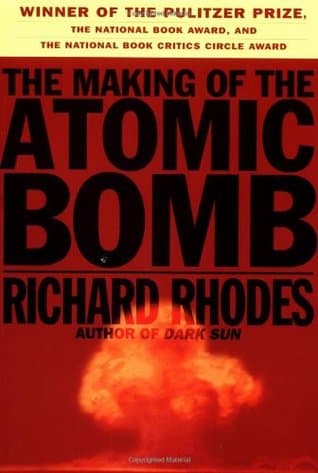
The Making of the Atomic Bomb cover
Archivist's Choice

The Making of the Atomic Bomb

Richard Rhodes (1986)

Genre

Politics / History / Science

Reading Time

1200 min

Key Themes

See below

Track Your Reading

Sign in to track this book

This book traces the twenty-five year journey from abstract atomic theory to the reality of the Manhattan Project and the atomic bomb, which changed human history.

Core Idea

Richard Rhodes' "The Making of the Atomic Bomb" carefully details the scientific, political, and moral path to the atomic bomb. It argues that the bomb was not just a new technology, but the result of centuries of scientific work, driven by curiosity, global fears, and a huge effort during wartime. The book shows the unexpected route to the bomb, explaining how individual ideas and scientific progress, first pursued for knowledge, came together under the pressure of World War II to create a weapon of unmatched destructive power. This event permanently changed human history and introduced a new era of global fear and control.
Reading time
1200 min
Difficulty
Hard
✓ Read this if...
You want a comprehensive, deeply researched history of the atomic bomb, covering its scientific origins, political motivations, and the ethical dilemmas faced by its creators.
✗ Skip this if...
You are looking for a quick overview or prefer a less dense historical narrative; this book is exhaustive and lengthy.

Core idea

The central argument and framework that powers the entire book.

Richard Rhodes' "The Making of the Atomic Bomb" carefully details the scientific, political, and moral path to the atomic bomb. It argues that the bomb was not just a new technology, but the result of centuries of scientific work, driven by curiosity, global fears, and a huge effort during wartime. The book shows the unexpected route to the bomb, explaining how individual ideas and scientific progress, first pursued for knowledge, came together under the pressure of World War II to create a weapon of unmatched destructive power. This event permanently changed human history and introduced a new era of global fear and control.

At a glance

Reading time

1200 min

Difficulty

Hard

Read this if...

You want a comprehensive, deeply researched history of the atomic bomb, covering its scientific origins, political motivations, and the ethical dilemmas faced by its creators.

Skip this if...

You are looking for a quick overview or prefer a less dense historical narrative; this book is exhaustive and lengthy.

Key Takeaways

1

The Unforeseen Path to Armageddon

Nuclear fission, a scientific marvel, quickly morphed into a weapon of unprecedented destruction.

Quote

The bomb was not invented; it was discovered, a truth waiting to be unveiled by human intellect.

Rhodes carefully shows how Otto Hahn and Fritz Strassmann's discovery of nuclear fission in late 1938, initially a purely scientific pursuit, quickly became tied to global worries. Once its energy potential was understood, it presented a clear, terrifying path to a super-weapon. This change was not a simple invention but a series of scientific discoveries and strategic choices, driven by the fear that Nazi Germany would develop such a weapon first. The scientific community, at first driven by pure inquiry, found itself dealing with th...

Supporting evidence

The initial experiments by Hahn and Strassmann, Lise Meitner's and Otto Frisch's interpretation of fission, and the subsequent theoretical work by scientists like Leo Szilard on chain reactions.

Apply this

Recognize that scientific progress, however benign its origin, can have unforeseen and profound societal impacts, necessitating constant ethical consideration and foresight.


nuclear-fissionmanhattan-project-originsscientific-responsibility
2

The Race Against Fascism

Fear of a Nazi atomic bomb fueled the frantic, secretive American effort.

Quote

The overriding fear was not that America would build the bomb, but that Germany would build it first.

The reason for the Manhattan Project was not just scientific curiosity but a deep, existential fear that Nazi Germany would develop a nuclear weapon and use it to conquer the world. Rhodes clearly shows the atmosphere of fear and urgency among scientists and politicians in the early 1940s. Scientists like Leo Szilard, understanding the implications of fission, pushed for American action, famously convincing Albert Einstein to sign a letter to President Roosevelt. This fear, though ultimately wrong about German progress, was the main r...

Supporting evidence

The Einstein-Szilard letter to President Roosevelt, intelligence reports (or lack thereof) on German atomic research, and the personal testimonies of scientists expressing their fears about a Nazi bomb.

Apply this

Understand how perceived threats, real or imagined, can drive monumental, resource-intensive projects, and critically evaluate the intelligence that informs such decisions.

world-war-ii-impacteinstein-szilard-letternazi-atomic-program
3

The Ivory Tower to the Battlefield

Scientists, once detached academics, were thrust into the moral and logistical complexities of war.

Quote

They were not soldiers, but their work would decide the fate of nations and the lives of millions.

Rhodes expertly details how brilliant, often unusual, physicists, chemists, and engineers changed from working in quiet university labs to the high-stakes, secret world of wartime engineering and moral problems. People like J. Robert Oppenheimer, a theoretical physicist, became the director of Los Alamos, managing thousands of people and huge technical challenges. This change forced scientists to face the practicalities of large-scale industrial production, security, and the deep ethical questions about their creation. They struggled ...

Supporting evidence

Oppenheimer's shift from theoretical physics to managing Los Alamos, the internal debates among scientists about the bomb's use, and the personal struggles of figures like Leo Szilard and Niels Bohr regarding arms control.

Apply this

Consider the ethical responsibilities inherent in scientific and technological innovation, especially when it has the potential for widespread societal impact, and advocate for scientists to be part of the ethical discourse.

j-robert-oppenheimerlos-alamos-laboratoryscientists-moral-dilemma
4

The Engineering Marvel of Destruction

Building the bomb required unprecedented scale, ingenuity, and industrial mobilization.

Quote

The Manhattan Project was not just science; it was an industrial undertaking of staggering proportions, a testament to American ingenuity and organizational might.

Beyond theoretical physics, Rhodes explains that the Manhattan Project was an unmatched achievement of engineering and industrial effort. The challenge was not just understanding how an atomic bomb could work, but how to actually build it—how to enrich uranium, produce plutonium, design the complex implosion mechanisms, and build the huge facilities needed. Places like Oak Ridge and Hanford appeared almost overnight, employing hundreds of thousands of people in highly specialized, often dangerous, tasks. The book details the huge ...

Supporting evidence

Descriptions of the uranium enrichment plants at Oak Ridge (calutrons, gaseous diffusion), the plutonium production reactors at Hanford, and the design challenges of the 'Fat Man' implosion device.

Apply this

Appreciate the often-underestimated role of engineering, logistics, and industrial capacity in translating scientific theory into tangible, large-scale reality, and consider the resource allocation implications of such projects.

manhattan-project-logisticsuranium-enrichmentplutonium-productionindustrial-mobilization
5

The Trinity Test: A New Dawn of Fear

The first atomic detonation ushered in the nuclear age with terrifying beauty and profound implications.

Quote

We knew the world would not be the same. A few people laughed, a few people cried. Most people were silent. I remembered the line from the Hindu scripture, the Bhagavad-Gita; Vishnu is trying to persuade the Prince that he should do his duty and, to impress him, takes on his multi-armed form and says, 'Now I am become Death, the destroyer of worlds.' I suppose we all thought that, one way or another.

Rhodes' account of the Trinity test is a masterful historical narrative, capturing both the wonder and horror of the world's first atomic detonation. The description of the blinding flash, the intense heat, and the towering mushroom cloud shows the sheer destructive power released. More importantly, it highlights the immediate and deep understanding among the scientists present that they had crossed an irreversible line. Oppenheimer's famous quote captures the mix of scientific success and terrifying moral reckoning. The Trinity test ...

Supporting evidence

Detailed descriptions of the Trinity test, including the reactions of Oppenheimer, Groves, and other scientists present, and the subsequent analysis of its destructive yield.

Apply this

Reflect on pivotal historical moments that irrevocably change human understanding and capabilities, and consider the long-term consequences of technological breakthroughs.

trinity-testj-robert-oppenheimer-quotenuclear-age-beginning
6

The Decision to Drop: A Complex Calculation

The use of the bomb on Japan was a product of wartime logic, not a simple act of malice.

Quote

The decision to use the bomb was not made in a vacuum, but within the brutal context of total war, with the specter of a bloody invasion looming.

Rhodes discusses the difficult decision-making process that led to the atomic bombings of Hiroshima and Nagasaki. He presents a balanced view, explaining that the decision came from the wartime mindset of total war, the desire to end the conflict quickly, and the predicted terrible casualties of a conventional invasion of mainland Japan (Operation Downfall). While acknowledging the huge human cost, Rhodes argues that the decision was less about malice and more about ending a long, brutal war that had already killed tens of millions of...

Supporting evidence

Discussions of casualty projections for an invasion of Japan, the Potsdam Declaration, President Truman's perspective, and the lack of a clear surrender signal from Japan before the bombings.

Apply this

Analyze historical decisions within their specific contexts, understanding the pressures and limited information available to decision-makers, rather than imposing contemporary moral frameworks retrospectively.

hiroshima-nagasakipresident-truman-decisionend-of-world-war-iioperation-downfall
7

The Legacy of Fear and Control

The atomic bomb permanently reshaped international relations and the imperative for arms control.

Quote

With the bomb, humanity had acquired the means of its own destruction, and the imperative to control it became the defining challenge of the new age.

The book concludes by exploring the deep and lasting impact of the atomic bomb on global politics and human awareness. The immediate aftermath saw a rush for control and a new understanding that nuclear weapons required a new way of international relations. The Cold War, with its nuclear standoff, defined the second half of the 20th century. Rhodes highlights the urgent calls from many of the scientists involved, like Niels Bohr and Leo Szilard, for international cooperation and arms control, recognizing the existential threat they ha...

Supporting evidence

The Baruch Plan, early discussions about international control of atomic energy, the subsequent arms race, and the formation of organizations dedicated to nuclear disarmament.

Apply this

Engage with the ongoing challenges of nuclear proliferation and arms control, understanding their historical roots, and support diplomatic efforts to mitigate nuclear threats.

cold-war-originsnuclear-proliferationarms-controlinternational-relations
8

The Human Cost and Moral Reckoning

Beyond the science and politics, the story is one of immense human suffering and ethical introspection.

Quote

Behind every equation and every political decision lay the unimaginable suffering of millions, a burden that would haunt many of the creators of the bomb.

While full of scientific and political detail, Rhodes does not avoid the terrible human cost of the atomic bomb. He describes the immediate horrors of Hiroshima and Nagasaki, the long-term suffering of the hibakusha (survivors), and the moral distress of many scientists who helped create it. The book implicitly and explicitly asks readers to consider the ethical implications of scientific progress, especially when it leads to such destructive power. It is a powerful reminder that history involves not just grand narratives but individu...

Supporting evidence

Descriptions of the devastation in Hiroshima and Nagasaki, the testimonies of survivors (though less directly emphasized in this book, it's the underlying context), and the later public statements and reflections of scientists like Oppenheimer and Szilard.

Apply this

Cultivate empathy and a deep understanding of the human consequences of conflict and technological innovation, advocating for peace and responsible scientific development.

hiroshima-survivorsethical-implications-sciencewar-human-cost
9

The Power of Individual Vision

A few visionary scientists foresaw the atomic age and drove its creation.

Quote

It was the prescience of a few, often eccentric, individuals that first glimpsed the power within the atom and pushed for its realization.

Rhodes highlights the important role played by a few exceptionally brilliant and forward-thinking individuals in the journey to the atomic bomb. Figures like Leo Szilard, who thought of the nuclear chain reaction and tirelessly pushed for its development and later for its control, and Enrico Fermi, whose experimental genius led to the first self-sustaining chain reaction, were crucial. These were not just parts of a machine but independent thinkers who, driven by scientific curiosity and later by global fear, shaped history. Their int...

Supporting evidence

Leo Szilard's patent for the chain reaction and his efforts to warn Roosevelt, Enrico Fermi's Chicago Pile-1 experiment, and Niels Bohr's insights into fission and later, arms control.

Apply this

Recognize and foster the power of individual initiative and critical thinking, understanding that single insights can catalyze monumental change, and support visionary leadership in science and policy.

leo-szilardenrico-ferminiels-bohrscientific-visionaries

Critical analysis

Notable Quotes

The bomb was not a thing, but a process, and the process was a human one.

Rhodes' overarching theme about the human endeavor behind the bomb's creation.

The physicists have known sin; and this is a knowledge which they cannot lose.

A reflection on the moral implications for the scientists involved, particularly after Hiroshima and Nagasaki.

It is a profound and moving experience to watch the world, as it were, give birth to itself.

Describing the early cosmic ray and particle physics experiments, hinting at the fundamental nature of the discoveries.

Secrecy was a way of life, and it deformed everyone.

Referring to the intense secrecy surrounding the Manhattan Project and its psychological toll.

The history of the atomic bomb is not merely a history of science, but a history of human beings grappling with power.

Emphasizing the human and political dimensions of the bomb's development, beyond just scientific discovery.

In a world of nations, the bomb was a currency, and the United States had a monopoly.

Discussing the immediate post-war geopolitical landscape and the strategic advantage held by the US.

They had built the bomb to end one war, but in doing so, they had begun another.

Reflecting on the transition from World War II to the Cold War, triggered by the bomb's existence.

The scale of the enterprise was staggering, a nation-state mobilized to build a single weapon.

Highlighting the unprecedented mobilization of resources and manpower for the Manhattan Project.

The bomb was not merely a weapon; it was a revolution in human affairs.

Arguing that the atomic bomb fundamentally altered international relations and human perception of war.

Curiosity, the greatest of human virtues, had led them to the brink of self-destruction.

A poignant observation on the double-edged sword of scientific inquiry and its potential for both progress and catastrophe.

The mushroom cloud, an iconic image of the 20th century, became a symbol of both power and peril.

Discussing the visual and symbolic impact of the atomic bomb's detonation.

The greatest secrecy of the Manhattan Project was not the bomb itself, but the fact that it was possible.

Suggesting that the true revelation was the feasibility of such a destructive device, rather than just its design.

The physics was beautiful, but its application was terrifying.

A common sentiment among the scientists, appreciating the elegance of the science while recoiling from its destructive potential.

They had opened Pandora's Box, and the world would never be the same.

A classic metaphor for the irreversible consequences of developing and deploying the atomic bomb.

Quiz

Test Your Knowledge

Ready to see how well you understood this book? Take our interactive quiz with 10 questions.

10
Questions
~5
Minutes
?
Best Score

Key Questions (FAQ)

The book meticulously details the complete history of how the atomic bomb was developed, tracing its origins from early 20th-century atomic discoveries through to the dropping of the first bombs on Japan, encompassing the scientific, political, and human elements of this monumental undertaking.

About the author