BookBrief
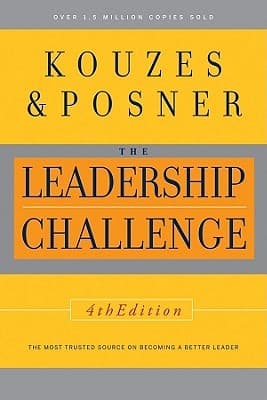
The Leadership Challenge cover
Archivist's Choice

The Leadership Challenge

James M. Kouzes (1987)

Genre

Business / Reference / Leadership / Self-Help

Reading Time

350 min

Key Themes

See below

Track Your Reading

Sign in to track this book

This updated guide helps you improve your leadership skills to get better results, with new research, case studies, and stories from real leaders.

Core Idea

Leadership is a set of practices anyone can learn, no matter their position or title. Research and thousands of case studies show that extraordinary leaders use five main practices: Model the Way, Inspire a Shared Vision, Challenge the Process, Enable Others to Act, and Encourage the Heart. These practices are not just ideas; they are actions that help people work together to achieve great things in organizations. The book states that trust is the basis of leadership, built on honesty, skill, inspiration, and looking ahead. It emphasizes that leadership is a relationship where trust and respect are most important. The authors give practical advice and examples for each of the five practices, showing how ordinary people can get great results by always learning and applying these leadership behaviors. The main message is that leadership involves observable, measurable, and teachable skills that anyone willing to try can develop and improve.
Reading time
350 min
Difficulty
Medium
✓ Read this if...
You are a current or aspiring leader looking for a practical, evidence-based framework to improve your leadership skills and inspire your team. You want actionable strategies rather than abstract theories.
✗ Skip this if...
You are looking for a purely philosophical or academic treatise on leadership theory, or if you prefer a highly anecdotal approach without a structured model.

Core idea

The central argument and framework that powers the entire book.

Leadership is a set of practices anyone can learn, no matter their position or title. Research and thousands of case studies show that extraordinary leaders use five main practices: Model the Way, Inspire a Shared Vision, Challenge the Process, Enable Others to Act, and Encourage the Heart. These practices are not just ideas; they are actions that help people work together to achieve great things in organizations.

The book states that trust is the basis of leadership, built on honesty, skill, inspiration, and looking ahead. It emphasizes that leadership is a relationship where trust and respect are most important. The authors give practical advice and examples for each of the five practices, showing how ordinary people can get great results by always learning and applying these leadership behaviors. The main message is that leadership involves observable, measurable, and teachable skills that anyone willing to try can develop and improve.

At a glance

Reading time

350 min

Difficulty

Medium

Read this if...

You are a current or aspiring leader looking for a practical, evidence-based framework to improve your leadership skills and inspire your team. You want actionable strategies rather than abstract theories.

Skip this if...

You are looking for a purely philosophical or academic treatise on leadership theory, or if you prefer a highly anecdotal approach without a structured model.

Key Takeaways

1

Model the Way

Leaders embody the values and set the example for others to follow.

Quote

You can't ask others to do something you aren't willing to do yourself.

Good leadership starts with knowing your own values and understanding the organization's shared values. Leaders must first express their own beliefs and then confirm shared values by working with others to agree on common ideas. This means not just stating values, but living them. When leaders' actions match their stated values, they build trust, which is essential for inspiring others. If actions do not match words, trust is lost and leadership suffers. Modeling the way requires constant self-reflection and making sure words and acti...

Supporting evidence

The authors frequently cite research showing that constituents consistently rank honesty and integrity as the most important characteristics in a leader. They present numerous case studies where leaders' actions, not just their words, were pivotal in shaping organizational culture and performance. For instance, a CEO who personally volunteers for a company-sponsored charity event sends a powerful message about the value of community involvement.

Apply this

Identify your top 3-5 personal values and articulate how they align with your team's or organization's values. Regularly reflect on whether your daily actions are consistent with these values. When faced with a decision, ask yourself, 'Does this action reflect the values I want to model?'


values-claritycredibilityintegrityauthenticity
2

Inspire a Shared Vision

Leaders envision an exciting future and enlist others in a common aspiration.

Quote

People commit to a vision when they can see how it connects to their own aspirations.

Good leaders can look to the future, seeing possibilities others might not yet. This vision is not just a plan; it is a clear picture of what could be, full of passion and purpose. Inspiring a shared vision means more than just telling people about the leader's dream. It means understanding what followers hope for and showing them how their own goals can fit into the bigger vision. It is about creating a clear picture of the future that connects emotionally and intellectually, making abstract ideas real and exciting. This shared owner...

Supporting evidence

Kouzes and Posner reference numerous examples of leaders, from corporate CEOs to community organizers, who successfully rallied people around a future state. They highlight how effective leaders use evocative language, metaphors, and storytelling to make their vision come alive, such as Martin Luther King Jr.'s 'I Have a Dream' speech, which masterfully connected individual hopes to a collective future.

Apply this

Develop a clear, compelling vision for your team or project. Practice telling stories and using vivid language to describe this future state. Actively listen to your team members' aspirations and find ways to connect them to the shared vision.

vision-castingfuture-orientationshared-purposemotivation
3

Challenge the Process

Leaders seek opportunities to innovate, grow, and improve by questioning the status quo.

Quote

Leaders are pioneers. They are willing to step out into the unknown.

Leadership means change. Challenging the process means not being happy with how things are, but actively looking for ways to innovate, try new things, and improve. This involves carefully watching both inside and outside environments to find areas where current processes are not working or are old. It also requires a willingness to take risks and experiment, even if there might be problems. Leaders who challenge the process create a culture where learning from mistakes is valued, and where creativity and new ideas are encouraged. They...

Supporting evidence

The book details how successful leaders encourage experimentation and risk-taking. They often cite examples of companies that embraced innovation despite initial failures, such as 3M's allowance for 'bootlegging' projects or the development of Post-it Notes, which originated from a 'failed' adhesive. They emphasize the importance of viewing failures as learning opportunities rather than punitive events.

Apply this

Identify one process in your work that could be improved. Brainstorm three alternative approaches and propose an experiment to test one. Encourage your team to share 'lessons learned' from both successes and failures, fostering a safe environment for constructive criticism and innovation.

innovationrisk-takingexperimentationcontinuous-improvement
4

Enable Others to Act

Leaders foster collaboration and empower individuals to contribute their best.

Quote

Leadership is not a solo act; it's a team effort.

Real leadership is about sharing power, not keeping it. Enabling others to act means creating an environment of trust and teamwork, where people feel safe to share ideas, take initiative, and use their unique talents. This means listening actively, giving credit when it is due, and building strong relationships within the team. Leaders empower others by sharing information, providing resources, and developing their skills. They understand that group effort and shared responsibility lead to better results than individual heroics. By em...

Supporting evidence

The authors frequently highlight studies demonstrating that high-performing teams are characterized by high levels of psychological safety and shared leadership. They present stories of leaders who successfully delegated significant authority and responsibility, leading to increased employee engagement and innovative solutions. For example, a manager who empowered a junior team member to lead a critical client presentation, providing guidance but not micromanaging, resulted in both client satisfaction and the individual's growth.

Apply this

Delegate a significant task or project to a team member, providing clear expectations and necessary resources, but allowing them autonomy in execution. Actively seek input from all team members in meetings, ensuring diverse voices are heard and valued. Provide constructive feedback and mentorship to help others grow their capabilities.

empowermentcollaborationteamworkpsychological-safety
5

Encourage the Heart

Leaders recognize contributions and celebrate values-driven accomplishments.

Quote

Genuine appreciation is a powerful motivator.

Keeping people motivated and committed, especially during hard times, requires leaders to genuinely appreciate and celebrate what others do. Encouraging the heart is not about empty praise; it is about recognizing individual and team efforts in a meaningful way, connecting achievements back to shared values, and building a sense of community. This includes personal recognition, public celebrations of success, and creating activities that strengthen group identity and purpose. Leaders who do this well understand that positive feedback ...

Supporting evidence

The book features numerous anecdotes illustrating the power of sincere recognition, from handwritten thank-you notes to public awards ceremonies. They cite research showing that teams with higher rates of positive feedback and recognition tend to have lower turnover and higher productivity. For instance, a leader who celebrated a small team's 'failed' experiment for the valuable lessons learned, rather than just the outcome, reinforced a culture of learning and courage.

Apply this

Make it a habit to offer specific, sincere praise to at least one team member daily. Create a team ritual to celebrate small wins or milestones. When recognizing someone, clearly articulate how their effort contributes to the shared vision or embodies a key value.

recognitioncelebrationmotivationgratitudemorale
6

Leadership is a Learnable Skill

Leadership is not an innate trait but a set of practices that can be developed and mastered.

Quote

The belief that leadership is reserved for a select few is a myth.

One of the most helpful messages of 'The Leadership Challenge' is that leadership is not just for a few special people. Instead, it is a set of observable behaviors and practices anyone can learn. The Five Practices of Exemplary Leadership give a framework that anyone, at any level, can study, practice, and improve. This view makes leadership accessible, changing the focus from personality traits to actions. It means that with effort, self-awareness, and a willingness to learn from experience, anyone can improve their leadership skill...

Supporting evidence

Kouzes and Posner's extensive research, spanning decades and involving hundreds of thousands of leaders and constituents, consistently demonstrates that the Five Practices are common across diverse industries, cultures, and organizational levels. They present data showing that individuals who intentionally practice these behaviors are consistently rated as more effective leaders. Their 'Leadership Practices Inventory' (LPI) is a direct tool for assessing and developing these specific behaviors.

Apply this

Identify one of the Five Practices where you feel weakest and commit to practicing specific behaviors related to it for the next month. Seek feedback from peers or mentors on your progress. Read leadership biographies not just for inspiration, but to analyze how those leaders applied the Five Practices.

leadership-developmentgrowth-mindsetskill-acquisitionself-improvement
7

Credibility is the Foundation

Leaders must earn and maintain trust through honesty, competence, and inspiration.

Quote

If people don't believe in you, they won't believe in your message.

At the heart of good leadership is trust, built on three main parts: honesty, skill, and the ability to inspire. Honesty means being truthful, open, and matching actions with words (Model the Way). Skill refers to the leader's knowledge, abilities, and capacity to get things done. Inspiration speaks to the leader's passion, enthusiasm, and ability to describe a compelling vision for the future (Inspire a Shared Vision). Without a strong foundation of trust, a leader's attempts to influence, motivate, or guide others will face doubt an...

Supporting evidence

The authors' research consistently shows that 'honest,' 'competent,' and 'inspiring' are the top three characteristics people look for in a leader, often ranking significantly higher than other traits like intelligence or charisma. They provide numerous examples where leaders lost influence due to a breach of trust or perceived incompetence, even if they had compelling visions.

Apply this

Before making a decision or communicating a change, consider how it might impact your perceived honesty, competence, and ability to inspire. Always follow through on commitments. When you make a mistake, acknowledge it promptly and take responsibility, demonstrating honesty and a commitment to learning.

trusthonestycompetenceintegrityinfluence
8

Leadership is a Relationship

Effective leadership is built on mutual respect and genuine connections between leaders and constituents.

Quote

It's not about the leader; it's about the relationship between leaders and constituents.

Leadership is a relationship between those who want to lead and those who choose to follow. This relationship goes both ways and needs mutual respect, shared understanding, and a willingness to influence and be influenced. It is not just a one-way street of telling people what to do, but a dynamic interaction built on trust. Leaders must actively work with their followers, listen to their concerns, understand their goals, and include them in decisions. The quality of this relationship directly affects how willing people are to commit ...

Supporting evidence

The book emphasizes that the 'Follower's Bill of Rights' is as important as the 'Leader's Bill of Responsibilities.' They highlight studies showing that employees who feel respected and valued by their leaders are significantly more engaged and productive. For instance, a leader who regularly holds 'skip-level' meetings to hear directly from frontline employees, or who personally mentors emerging talent, builds stronger, more impactful relationships.

Apply this

Schedule regular one-on-one check-ins with your team members that go beyond task updates to discuss their development and aspirations. Practice active listening, seeking to understand their perspectives before offering your own. Look for opportunities to collaborate on projects, fostering a sense of shared ownership and mutual respect.

relationshipsmutual-respectengagementinfluence
9

Small Wins Drive Momentum

Breaking down large goals into achievable steps builds confidence and progress.

Quote

Significant accomplishments are the accumulation of many small wins.

When facing a big vision or a difficult process, it can feel overwhelming for individuals and teams. Good leaders understand the value of 'small wins' – achievable, concrete steps that build momentum and show real progress. By breaking down large goals into smaller, manageable parts, leaders create chances for frequent success, which in turn boosts morale, builds confidence, and strengthens commitment. These small victories, when recognized and celebrated, provide the psychological fuel needed to handle bigger challenges. This approac...

Supporting evidence

The authors cite research on the 'progress principle,' which demonstrates that of all the things that can boost emotions, motivation, and perceptions during a workday, the single most important is making progress in meaningful work. They illustrate this with examples like a software development team releasing frequent, small updates rather than waiting for one large, risky launch, or a sales team celebrating weekly targets rather than just annual quotas.

Apply this

For any large project, identify the first three 'small wins' that can be achieved within a week or two. Publicly acknowledge and celebrate these small victories. When a team member feels stuck, help them identify the very next, smallest actionable step they can take.

progress-principlegoal-settingmotivationmomentumresilience
10

Leadership is an Inside-Out Process

Self-awareness and personal development are prerequisites for leading others effectively.

Quote

You can't lead others until you know who you are and what you stand for.

Before leading others, you must lead yourself. This 'inside-out' approach highlights the important role of self-awareness, personal values, and continuous self-improvement. Knowing your own strengths, weaknesses, motivations, and biases is essential for modeling the way and building trust. Leaders must regularly think about themselves, ask for feedback, and commit to lifelong learning. Without a clear sense of self and purpose, a leader's actions can seem inconsistent or fake, hurting their ability to inspire and empower. This basic s...

Supporting evidence

The initial practice, 'Model the Way,' explicitly starts with 'Clarify values,' which is an internal process of self-discovery. The authors' research consistently shows that leaders who are perceived as authentic and self-aware are more trusted and effective. They often reference the importance of 'finding your voice' through personal reflection and understanding your core beliefs before you can effectively communicate them to others.

Apply this

Dedicate time each week for self-reflection on your leadership actions and decisions. Seek 360-degree feedback to gain insights into how others perceive your leadership. Identify one area for personal growth and create a plan to develop it, whether through reading, mentoring, or specific practice.

self-awarenesspersonal-developmentauthenticityintrospectionemotional-intelligence

Critical analysis

Notable Quotes

Leadership is not about personality; it's about behavior—an observable set of skills and abilities.

Introduction, emphasizing the learnable nature of leadership.

The best leaders are the best learners.

Discussing the importance of continuous improvement and adaptability.

You can't believe in the organization until the organization believes in you.

Highlighting the reciprocal trust between leaders and their teams.

Challenge is the crucible for greatness.

Encouraging leaders to embrace difficult situations as opportunities.

Credibility is the foundation of leadership.

Stressing the importance of being trustworthy and reliable.

Leaders inspire a shared vision.

One of the five practices of exemplary leadership, focusing on future goals.

Model the way by setting the example.

Another of the five practices, emphasizing leading by actions.

Enable others to act by fostering collaboration.

A practice that involves empowering team members.

Encourage the heart by recognizing contributions.

The fifth practice, focusing on motivation and appreciation.

Leadership is a relationship between those who aspire to lead and those who choose to follow.

Defining leadership as a dynamic, mutual process.

The more you care, the stronger you can be.

Linking emotional investment to leadership strength.

Celebrate the values and victories by creating a spirit of community.

Advising on building team cohesion through shared successes.

Leaders don't wait for inspiration; they act to inspire others.

Encouraging proactive behavior in leadership roles.

Feedback is the breakfast of champions.

Promoting the use of feedback for continuous improvement.

Quiz

Test Your Knowledge

Ready to see how well you understood this book? Take our interactive quiz with 10 questions.

10
Questions
~5
Minutes
?
Best Score

Key Questions (FAQ)

The Leadership Challenge is a comprehensive guide to effective leadership, presenting five fundamental practices that leaders use to achieve extraordinary results. It combines research, case studies, and real-world stories to help individuals develop their leadership skills.

About the author