BookBrief
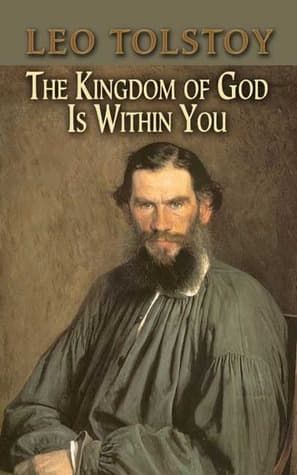
The Kingdom of God Is Within You cover
Archivist's Choice

The Kingdom of God Is Within You

Leo Tolstoy (1894)

Genre

Politics / Spirituality / Philosophy

Reading Time

9 hours 30 min

Key Themes

See below

Track Your Reading

Sign in to track this book

Tolstoy's book presents a Christianity without dogma, urging readers to find morality and nonviolent resistance within themselves. This message inspired Gandhi and challenged empires.

Core Idea

Tolstoy writes that Christ's true teachings, especially the command of non-resistance to evil by force, have been corrupted by church and state. These institutions support each other through violence and dogma. He says the 'Kingdom of God' is not an external, future event but a present reality inside people. It is accessible through understanding and applying Christ's ethical principles, especially the law of love. Tolstoy believes this inner change and commitment to non-resistance is the only way to real freedom, justice, and an end to all violence, including war and oppression. This makes external governments and institutions unnecessary.
Reading time
9 hours 30 min
Difficulty
Medium
✓ Read this if...
You are interested in a radical reinterpretation of Christian ethics, pacifism, anarcho-pacifism, or a critique of state and church power from a spiritual perspective.
✗ Skip this if...
You are looking for a traditional theological defense of Christianity, a historical analysis of early Christian communities, or if you are not open to challenging conventional views on religion, government, and violence.

Core idea

The central argument and framework that powers the entire book.

Tolstoy writes that Christ's true teachings, especially the command of non-resistance to evil by force, have been corrupted by church and state. These institutions support each other through violence and dogma. He says the 'Kingdom of God' is not an external, future event but a present reality inside people. It is accessible through understanding and applying Christ's ethical principles, especially the law of love. Tolstoy believes this inner change and commitment to non-resistance is the only way to real freedom, justice, and an end to all violence, including war and oppression. This makes external governments and institutions unnecessary.

At a glance

Reading time

9 hours 30 min

Difficulty

Medium

Read this if...

You are interested in a radical reinterpretation of Christian ethics, pacifism, anarcho-pacifism, or a critique of state and church power from a spiritual perspective.

Skip this if...

You are looking for a traditional theological defense of Christianity, a historical analysis of early Christian communities, or if you are not open to challenging conventional views on religion, government, and violence.

Key Takeaways

1

The Inner Kingdom

True Christianity resides in individual conscience, not external authority.

Quote

The Kingdom of God is within you, and not in the observances and teachings of men.

Tolstoy reinterprets Christian doctrine. He argues that the true 'Kingdom of God' is not a future heavenly place or an earthly institution like the Church or State, but an inner spiritual state for every person. This inner kingdom means following Christ's moral teachings, especially non-resistance, which Tolstoy sees as the Gospel's core. He says that external rituals, dogmas, and the authority of religious or government bodies are corruptions that hide this simple, internal truth. For Tolstoy, real faith is a direct, personal connect...

Supporting evidence

Tolstoy meticulously dissects passages from the Gospels, particularly Luke 17:21, to demonstrate that Jesus's message was consistently about an internal transformation and a direct, personal understanding of divine law, not adherence to external rites or the authority of the Sanhedrin or Roman Empire.

Apply this

Cultivate a personal moral compass based on universal principles of love and non-violence, rather than blindly following societal norms, religious dogma, or state laws. Regularly reflect on your actions and align them with your deepest ethical convictions, even if it means dissenting from popular opinion or institutional directives.


inner-lightconsciencespiritual-autonomy
2

Non-Resistance as Core Doctrine

Violence, even in self-defense or by the state, is an absolute violation of Christ's teachings.

Quote

The command of non-resistance to evil by force is the very key to understanding the whole teaching of Christ.

Tolstoy supports non-resistance (non-violence) not as passive surrender, but as an active, revolutionary idea. He argues that Christ's command to 'turn the other cheek' and 'resist not evil' is not a suggestion but the absolute, basic rule of true Christianity. Any violence, whether personal revenge, state-approved war, or capital punishment, goes directly against this divine law. Tolstoy says that violence only causes more violence, creating endless suffering. He believes true change comes from refusing to participate in this cycle, ...

Supporting evidence

Tolstoy extensively analyzes the Sermon on the Mount (Matthew 5:38-48), particularly the injunctions against an eye for an eye and loving one's enemies, presenting them as literal, practical commands rather than metaphorical ideals. He contrasts this with the Old Testament law and contemporary justifications for violence.

Apply this

Commit to resolving conflicts through dialogue, empathy, and peaceful means. Actively refuse to participate in or support systems that rely on violence, even if it means facing social or legal repercussions. Advocate for non-violent solutions in all spheres of life, from personal interactions to international relations.

pacifismahimsacivil-disobedience
3

The State as an Instrument of Violence

Governmental power is inherently incompatible with Christian love and non-resistance.

Quote

The State is nothing else than the organization of violence.

Tolstoy sees the State as the main source of organized violence, fundamentally at odds with Christ's teachings. He argues that all governments, no matter their stated goals, use force, coercion, and the threat of violence (police, army, courts, prisons) to keep power and enforce laws. This reliance on violence makes the State anti-Christian. Therefore, a true Christian cannot logically participate in or support the State's functions, such as military service, judicial roles, or even paying taxes that fund these violent institutions. T...

Supporting evidence

Tolstoy critiques the legal systems, military conscription, and taxation policies of his time (and all states), showing how they compel individuals to participate in or fund violence, directly contradicting the Gospel's message of love and non-resistance. He cites historical examples of early Christians refusing military service.

Apply this

Critically evaluate your relationship with state authority. Consider whether your actions and support inadvertently contribute to systems of violence. Explore avenues for conscientious objection and non-cooperation with state mandates that conflict with your core ethical principles, even if it's just through thoughtful dissent and advocacy.

anarchismstate-violenceconscientious-objection
4

Hypocrisy of Church and State

Traditional institutions corrupt Christ's message to maintain power.

Quote

Churches, States, and all human institutions exist only to deceive men and to make them blind to the truth.

Tolstoy criticizes both the established Church and the State, calling them hypocritical. He argues that these institutions, while claiming to uphold Christian values, actively undermine them to keep their own power and control. The Church, by working with the State and supporting violence, war, and social hierarchies, has betrayed Christ's original message of universal love and equality. Likewise, the State uses the appearance of law and order to continue injustice and violence. Tolstoy sees this as a deliberate hiding of the simple, ...

Supporting evidence

Tolstoy details how the Russian Orthodox Church, for instance, blesses soldiers going to war, supports the Tsar's autocratic rule, and teaches doctrines that justify social inequality, all while claiming to be followers of Christ. He contrasts this with the explicit teachings of Jesus regarding loving enemies and serving the poor.

Apply this

Approach all institutional claims to moral authority with a critical eye. Seek out the original, unadulterated sources of spiritual or ethical teachings and compare them against the practices of contemporary institutions. Do not allow tradition or authority to override your own moral reasoning and conscience.

institutional-critiquereligious-hypocrisypower-corruption
5

The Law of Love Transcends All Other Laws

Divine law, rooted in love, is superior to human-made laws.

Quote

The one great law of God is the law of love.

For Tolstoy, the 'law of love' is not just an ethical suggestion but a universal, divine command that is more important than all human-made laws, whether civil or religious. This law means one must treat all beings with compassion, empathy, and non-violence. When human laws (from the State or Church) go against this basic law of love, they lose all legitimacy and must be morally disobeyed. Tolstoy argues that true morality comes from aligning one's actions with this inner, divine law, rather than following external rules that often se...

Supporting evidence

Tolstoy frequently refers to the Golden Rule ('Do unto others as you would have them do unto you') and Christ's command to love one's neighbor as oneself and one's enemies, presenting these as the supreme, all-encompassing laws that invalidate any conflicting human legislation.

Apply this

Prioritize the ethical implications of your actions based on the principle of love and non-harm, even when it conflicts with legal requirements or social expectations. Be prepared to stand by your conscience, understanding that true justice aligns with universal compassion, not just statutory compliance.

natural-lawdivine-lawgolden-rule
6

Rejection of Dogma and Mysticism

Christianity is a practical philosophy, not an obscure religion.

Quote

The teaching of Christ is not a mysticism, but a new method of life.

Tolstoy removes Christianity's mystical, dogmatic, and supernatural parts. He presents it instead as a practical and rational way of living. He dismisses concepts like the Trinity, original sin, redemption through sacrifice, and bodily resurrection as later theological corruptions that hide the simple, ethical core of Christ's teachings. For Tolstoy, Jesus was a great moral teacher whose message offered a clear, practical way to individual and societal change, based on love, humility, and non-violence. This simpler view makes Christia...

Supporting evidence

Tolstoy systematically deconstructs core Christian dogmas, arguing that they are either later additions or misinterpretations that distract from the plain ethical meaning of the Gospels. He emphasizes Jesus's parables and direct ethical commands over abstract theological debates.

Apply this

Focus on the actionable ethical principles within any spiritual or philosophical tradition, rather than getting entangled in abstract dogmas or supernatural claims. Seek practical wisdom that can directly improve your conduct and relationships, rather than purely intellectual or ritualistic adherence.

rational-christianityethical-philosophydemystification
7

True Freedom Through Obedience to Inner Law

Liberation comes from following conscience, not external dictates.

Quote

True freedom consists in doing what is right, and not in doing what one likes.

Tolstoy argues that true freedom is not found in unrestrained liberty or submission to external authorities, but in willingly following the inner, divine law of love and reason. When a person chooses to obey their conscience, even if it means defying state laws or social norms, they feel a deep spiritual release. This freedom is not about being free from responsibility, but free to act responsibly according to one's highest moral understanding. He says that people are enslaved not by physical chains, but by their willingness to pa...

Supporting evidence

Tolstoy highlights the moral courage of early Christian martyrs and later dissenters who chose to suffer persecution rather than violate their conscience by obeying unjust laws or participating in violence. He contrasts their inner freedom with the spiritual slavery of those who conform out of fear or self-interest.

Apply this

Identify areas where you might be compromising your values due to external pressure or fear. Practice small acts of ethical courage, gradually building your capacity to act in accordance with your conscience, even when it's inconvenient or challenging. Understand that genuine freedom often requires internal discipline and moral fortitude.

moral-autonomyspiritual-freedomconscience-driven
8

The Power of Individual Transformation

Societal change begins with individual moral awakening, not collective revolution.

Quote

The change in men's consciousness must precede the change in the external forms of life.

Unlike many revolutionaries of his time, Tolstoy did not believe that societal change could happen by violently overthrowing governments or imposing new systems from above. Instead, he supported the idea that true, lasting change must start with individuals. When enough people understand Christ's teachings—especially non-resistance and the law of love—and start to live by them, the world's violent and unjust systems will naturally disappear because no one cooperates with them. This 'moral revolution' is a gradual, internal process. It...

Supporting evidence

Tolstoy points to historical instances where individuals or small groups, through their moral steadfastness and refusal to participate in evil, eventually brought about significant social shifts, albeit slowly. He implies that the Roman Empire's eventual Christianization was due to individual conversions, not military conquest.

Apply this

Focus on personal moral development and living out your values consistently, understanding that your individual actions, however small, contribute to a larger societal shift. Inspire others through your example rather than attempting to force change through coercive means. Recognize the long-term impact of consistent ethical living.

moral-revolutionindividual-responsibilityspiritual-evolution
9

Fair Treatment for the Poor and Working Class

Exploitation of labor is an un-Christian act, demanding radical empathy.

Quote

The rich are continually doing to the poor what they would not have done to themselves.

Tolstoy’s work has a strong emotional and moral appeal because it emphasizes treating the poor and working class fairly. He strongly condemns economic exploitation and social inequality, seeing them as direct violations of the Christian law of love. He argues that the wealthy and powerful, by living off others' labor and keeping systems that create poverty, are acting in an un-Christian way. For Tolstoy, true faith requires active compassion, helping the disadvantaged, and rejecting materialism and seeking wealth at others' expense. T...

Supporting evidence

Tolstoy observes the stark contrast between the lives of the Russian peasantry and the aristocracy, highlighting the systemic injustices that allow the wealthy to prosper through the exploitation of labor. He ties this directly to Christ's teachings about serving the least among us and the dangers of wealth.

Apply this

Actively challenge economic injustices and advocate for policies that promote equity and fair labor practices. Critically examine your own consumption habits and how they might contribute to exploitative systems. Seek opportunities to support and uplift the poor and marginalized, not just through charity, but through systemic change.

social-justiceeconomic-equalitycompassion
10

The Universal Appeal of Christ's Ethics

Jesus's moral philosophy transcends religious boundaries.

Quote

Christ's teaching is not a religion, but a life-guide for all humanity.

Tolstoy's interpretation of Christianity extends its appeal beyond traditional religious followers. By removing dogma and focusing on the practical, ethical core of Jesus's teachings, he presents Christ as a 'remarkable teacher' whose philosophy of love, non-resistance, and service applies to everyone. This secular view lets people of any faith, or no faith, engage with and benefit from the moral wisdom in the Gospels. It changes Christianity from an exclusive, mystical religion into a universal ethical framework for human conduct. It...

Supporting evidence

Tolstoy cites the resonance of Christ's ethical principles with those found in other great spiritual traditions, suggesting a universal truth underlying diverse religious expressions. He focuses on the practical applicability of Christ's commands rather than their theological origins.

Apply this

Seek out and embrace universal ethical principles that promote human flourishing, regardless of their origin. Engage with the moral teachings of various traditions, including Christianity, as sources of wisdom for living a good life, rather than as exclusive claims to truth. Promote interfaith dialogue and understanding based on shared ethical ground.

universal-ethicssecular-christianitymoral-philosophy

Critical analysis

Notable Quotes

The Kingdom of God is within you.

Tolstoy's central thesis, drawing from Luke 17:21, emphasizing internal spiritual transformation over external religious or political systems.

The only significance of life consists in helping to establish the kingdom of God; and this can be done only by means of the acknowledgment and profession of the truth by each one of us.

Tolstoy argues that individual commitment to truth and nonviolence is essential for realizing God's kingdom on earth.

All violence consists in some people forcing others, under threat of suffering or death, to do what they do not want to do.

A definition of violence that underpins Tolstoy's critique of state power and coercion.

The abolition of the state will come only when people cease to participate in violence and no longer need it.

Tolstoy's anarchist conclusion that the state relies on popular complicity and can be dismantled through non-cooperation.

Christianity in its true sense puts an end to the state. It was so understood from its very beginning, and for that Christ was crucified.

Tolstoy contends that genuine Christianity is inherently anti-state, contrasting it with institutionalized religion.

The law of love is the supreme law of human life, and as such it cannot be subordinated to any other law.

Tolstoy asserts that Christ's commandment to love supersedes all human laws, including those of the state.

Governments, in order to retain their power, have always tried to suppress true Christianity.

Tolstoy argues that states persecute authentic Christian teachings because they threaten state authority.

The recognition of the law of love, and the attempt to put it into practice, will inevitably lead to the abolition of all violence.

Tolstoy's optimistic view that embracing nonviolence will naturally dismantle oppressive structures.

The whole organization of our life, and the whole structure of our society, is based on violence.

A critique of how modern institutions, from governments to economies, depend on coercion.

The only thing necessary for the triumph of evil is for good men to do nothing.

Often misattributed to others, this line appears in Tolstoy's work, urging active resistance to injustice through nonviolent means.

True life is possible only in the kingdom of God, that is, in that state of man in which he does not commit violence.

Tolstoy defines authentic existence as one free from coercion, aligning with spiritual ideals.

The church, by allying itself with the state, has betrayed the teachings of Christ.

A sharp criticism of institutional Christianity for compromising with political power.

Non-resistance to evil by violence means not that you should not resist evil, but that you should not resist it with violence.

Clarifying that Tolstoyan nonviolence involves active, peaceful opposition to injustice.

The entire history of mankind is nothing but a gradual realization of the truth that violence is not necessary.

Tolstoy's historical perspective on human progress toward nonviolent principles.

Quiz

Test Your Knowledge

Ready to see how well you understood this book? Take our interactive quiz with 10 questions.

10
Questions
~5
Minutes
?
Best Score

Key Questions (FAQ)

The book is Leo Tolstoy's philosophical work advocating for Christian anarchism and nonviolent resistance based on Jesus's teachings, particularly the principle of 'turning the other cheek.' It argues against all forms of violence, including state-sanctioned violence, and emphasizes looking inward for moral guidance.

About the author

Leo Tolstoy

Count Lev Nikolayevich Tolstoy, usually referred to in English as Leo Tolstoy, was a Russian writer who is regarded as one of the greatest authors of all time. He received nominations for the Nobel Prize in Literature every year from 1902 to 1906 and for the Nobel Peace Prize in 1901, 1902, and 1909; the fact that he never won is a major controversy.