“They were the women who did the curing of the meat, and to see them when they were at work was a thing to remember all your life.”
— Describing the horrible conditions of the meatpacking plants, specifically the women working with diseased meat.

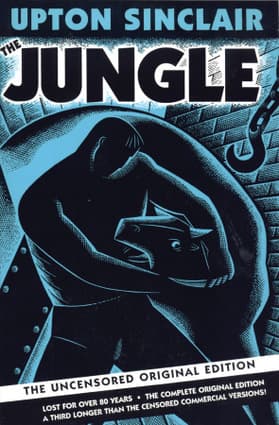
Upton Sinclair (2005)
Genre
Politics / Historical Fiction
Reading Time
10-12 hours
Key Themes
See below
Sign in to track this book
In Chicago's turn-of-the-century meatpacking plants, Jurgis Rudkus and his family are destroyed by capitalism, showing the brutal cost of the American dream.
The novel begins with Jurgis Rudkus and Ona Lukoszaite's wedding celebration in Packingtown, Chicago. It is elaborate but financially ruinous. Their large Lithuanian family and friends gather, consuming much food and drink, but custom means guests are not obligated to pay. This leaves the young couple with significant debt. Jurgis, a strong and hopeful immigrant, believes hard work in America will overcome all problems. He and his family, including Ona, her stepmother Teta Elzbieta, her father Dede Antanas, and her cousins Marija Berczynskas, Stanislovas, and others, came to America for a better life, drawn by the promise of opportunity. This initial joy is soon overshadowed by crushing financial burdens and the grim prospects of their new lives in the stockyards.
After the wedding, the family looks for work. Jurgis gets a job as a 'shoveler of guts' at Durham's, a physically demanding and dangerous position. Ona and Marija find work in canning factories. Dede Antanas, despite his age and frailty, also seeks employment, eventually finding a low-paying job sweeping floors, which he hides to maintain his dignity. They are tricked into buying a dilapidated house on an installment plan, a common scam that leaves them constantly in debt for hidden fees and interest. The house symbolizes their false hope; they soon discover it is falling apart and the payments are much higher than advertised, trapping them in a cycle of poverty and exploitation from landlords and employers.
Life in the stockyards is a constant struggle. Jurgis sees the horrific conditions of the meatpacking plants, including rats, spoiled meat, and dangerous machinery. His initial hope fades as he works long hours for low wages, always fearing injury or unemployment. Ona, working in humid, unsanitary canning rooms, frequently falls ill. Stanislovas, a young boy, is forced to work despite his fear of the cold and machinery, often enduring cruel punishments. The family's health worsens, and they face constant financial insecurity, made worse by dishonest foremen, corrupt politicians, and the ever-present threat of strikes. They must take out loans at high rates, further trapping them in debt.
The family's troubles grow. Dede Antanas, weakened by his hard work and poor living conditions, dies from illness, leaving the family heartbroken and without his small income. Ona gives birth to a son, Antanas, which adds to their financial strain and her physical weakness. Marija, initially a strong woman, is injured at work and loses her job, forcing her into prostitution to help support the family. Jurgis, already struggling with responsibility, becomes more despondent and starts to drink heavily. The constant hardships wear away at their spirits, leaving them with little hope.
Jurgis discovers that his foreman, Phil Connor, forced Ona into prostitution by threatening to fire the entire family. Enraged, Jurgis savagely attacks Connor, leading to his arrest and imprisonment. In jail, he worries about his family suffering without him. After his release, he struggles to find work because of his criminal record and pervasive blacklisting. The corrupt system constantly thwarts his attempts to provide for his family. This period is a major turning point for Jurgis, as his belief in the American dream is shattered, replaced by bitterness and a growing sense of injustice.
After Jurgis's release, he finds his family in even worse condition. Ona, weakened by childbirth, malnutrition, and trauma, dies during a premature second labor, along with the baby. Jurgis is devastated, his last shred of hope gone. Soon after, his young son, Antanas, also dies from eating poisoned sausage, a tragic irony given Jurgis's work. These losses break Jurgis completely, driving him to abandon his remaining family and wander the city in a drunken stupor, feeling utterly alone. He becomes a hobo, drifting from job to job, escaping the unbearable pain of his past.
Jurgis spends time as a tramp, experiencing harsh winters and society's indifference. He briefly finds work in a steel mill but is injured, returning him to the streets. He falls in with criminals, learning robbery and blackmail. He works for saloon keepers and political bosses, becoming a part of the corrupt machine that preys on the vulnerable. This period makes him hardened and cynical, his moral compass twisted by the constant struggle for survival. He gains a superficial understanding of the city's power structures, but it only fuels his rage and despair rather than offering redemption.
Jurgis eventually meets his former brother-in-law, Jonas, who tells him that his remaining family members—Teta Elzbieta, Marija, and the younger children—are still alive but living in extreme poverty. Marija is now a full-time prostitute, and the children are starving. Jurgis is torn between a renewed sense of responsibility and his desire to escape the endless suffering. He even considers leaving them again, but his conscience forces him to stay and try to help. This reunion highlights the inescapable nature of their plight and the devastating impact of the system on their lives.
One cold night, seeking warmth, Jurgis goes into a socialist meeting. He initially dismisses the speaker, but as he listens, the orator's explanation of systemic injustice and worker exploitation deeply resonates with his own experiences. The speaker explains that individual suffering is not a personal failing but a result of an unfair capitalist system. This revelation is a major turning point for Jurgis. He begins to see his past struggles and his family's tragedies not as random misfortunes, but as direct results of economic and political structures designed to oppress the poor. He feels a glimmer of hope for the first time in years, a sense of belonging to a larger cause.
Inspired by the socialist message, Jurgis dedicates himself to the movement. He attends more meetings, reads socialist literature, and begins to understand collective action and economic reform. He finds camaraderie and purpose among fellow socialists, people who share his vision of a more equitable society. He becomes an active participant, distributing pamphlets and organizing workers. Although his family's immediate circumstances remain dire, Jurgis now has newfound hope and a framework for understanding and fighting the injustices he and his family endured. He sees socialism as the only path to true liberation and a better future for the working class.
Jurgis becomes actively involved in socialist political campaigns, especially during elections. He sees the supporters' enthusiasm and the strong opposition from established political parties and corporate interests. He learns about political corruption and efforts to suppress the socialist vote. Despite setbacks and slow change, Jurgis believes the socialist movement will eventually succeed. He finds strength and motivation in his comrades' solidarity and the shared vision of a society free from exploitation. The novel ends with cautious optimism, as Jurgis, though still facing hardships, has found a cause that gives his life meaning.
The Protagonist
From optimistic immigrant to broken man, and finally to a politicized activist finding purpose in socialism.
The Supporting
From a hopeful bride to a broken, exploited woman, ultimately dying from the system's abuses.
The Supporting
Endures constant suffering and loss, yet remains a steadfast, if weary, pillar of the family.
The Supporting
From a strong, independent worker to a desperate prostitute, symbolizing the crushing power of the system.
The Supporting
His brief appearance and quick demise serve as an early warning of the family's grim fate.
The Supporting
Forced into premature labor, his life is cut short by the brutal conditions, symbolizing child exploitation.
The Antagonist
Remains consistently villainous, representing the unpunished corruption of the powerful.
The Supporting
Provides a crucial bridge for Jurgis from personal despair to political enlightenment.
The novel thoroughly dismantles the myth of the American Dream for immigrants. Jurgis and his family arrive in America believing that hard work will bring prosperity and happiness. Instead, they face relentless exploitation, poverty, and systemic corruption. Their initial hope is systematically crushed by dangerous working conditions, dishonest landlords, predatory lenders, and society's indifference. The 'land of opportunity' becomes a land of suffering, showing that for many, the dream is an illusion used to lure and exploit the vulnerable, as seen in the family's disastrous house purchase and Jurgis's inability to provide despite his efforts.
“"They had been told that in America, one could make a fortune by working hard; and now they found that they had to work harder than they had ever worked in their lives, merely to keep alive."”
Sinclair clearly shows the brutal exploitation of the working class in early 20th-century industrial America, especially in the meatpacking industry. Workers are treated as disposable parts of a machine, subjected to long hours, dangerous conditions, and low wages. The novel details the physical toll on Jurgis and Ona, Stanislovas's child labor, and Marija's forced prostitution, all direct results of a capitalist system that prioritizes profit over human welfare. The constant threat of injury, unemployment, and blacklisting keeps workers subjugated, illustrating how their lives and bodies are consumed by industry's demands.
“"The men in the pickle rooms, for instance, would have their hands eaten by the acid, to the bone; and they would have to wear leather gauntlets on their arms, their hands were so sore that they could not wash them."”
The novel depicts a society full of corruption at every level, from individual foremen to powerful politicians and industrialists. Jurgis and his family are victims of a system where justice is bought, and the poor have no recourse. Examples include the fraudulent house sale, political bribery, collusion between employers and law enforcement, and manipulation of labor strikes. Phil Connor's unpunished exploitation of Ona, and Jurgis's subsequent wrongful imprisonment, highlight the deep injustice where the powerful act with impunity while the vulnerable are criminalized for seeking justice. This theme shows that the family's suffering is systemic, extending beyond individual misfortunes to a widespread societal illness.
“"There were the 'grafters' and the 'pushers' and the 'spotters' and the 'gang leaders,' and a dozen other varieties of the human shark, all preying upon the helpless workers."”
After enduring endless personal tragedies and seeing capitalism's systemic failures, Jurgis finds salvation and purpose in the socialist movement. His journey from despair to political awakening illustrates Sinclair's argument that individual suffering is not a personal failing but a symptom of a flawed economic system. Socialism is presented as the only alternative, offering collective action, economic equality, and social justice. The socialist meetings give Jurgis an intellectual framework to understand his experiences and a community that offers hope and solidarity, suggesting that systemic problems require systemic, not individual, solutions.
“"He had been like a man who had fallen into a pit, and been trying to climb out by himself; and now he saw that there was a ladder, and men holding it, and reaching down their hands to him."”
The characters in 'The Jungle' lose their innocence and dignity as their environment systematically dehumanizes them. Ona, initially a pure and gentle bride, is forced into prostitution and dies a broken woman. Marija, a strong woman, also turns to prostitution. Even Jurgis, initially a man of integrity, descends into violence and petty crime before finding a new moral compass in socialism. The harsh conditions and moral compromises forced upon them strip away their self-respect and humanity, showing how extreme poverty and exploitation can corrupt even the most virtuous people.
“"They were good men, and they had come to America to be free; and they had been trapped and caged, and their lives ground out of them, in the mills of the packers."”
The stockyards and Chicago as a predatory, lawless 'jungle.'
The 'jungle' serves as a pervasive metaphor for the cutthroat, brutal environment of Chicago's meatpacking district and, by extension, capitalist society. It evokes a sense of lawlessness, survival of the fittest, and a place where human beings are reduced to animals, fighting for scraps. This imagery is reinforced by the descriptions of the literal filth, disease, and violence within the packing plants, where workers are 'devoured' by the system, much like the animals processed in the factories. It highlights the dehumanizing effect of industrial capitalism, where compassion and morality are sacrificed for profit.
A series of interconnected tragedies illustrating the systemic nature of suffering.
The novel's plot unfolds as a series of distinct, yet interconnected, episodes of misfortune for the Rudkus family. Each chapter often brings a new tragedy – a death, an injury, a financial scam, an act of corruption. This episodic structure serves to demonstrate the relentless and pervasive nature of the system's oppression. It's not one single bad event, but a continuous barrage of hardships that collectively break the characters, emphasizing that their suffering is not accidental but a systematic consequence of their environment and economic status. This accumulation of misery drives Jurgis towards radicalization.
Detailed, exposé-style descriptions of the meatpacking industry's horrors.
Sinclair employs a muckraking style, providing vivid and often gruesome details about the unsanitary conditions, adulterated food products, and inhumane practices within the meatpacking industry. These descriptions, such as the rats, poisoned meat, and workers losing fingers, serve a dual purpose: to shock the reader into awareness of the public health crisis and to illustrate the utter disregard for both consumer and worker safety. This device was instrumental in sparking public outrage and leading to real-world legislative changes like the Pure Food and Drug Act and the Meat Inspection Act of 1906.
Long speeches and discussions used to explain socialist ideology.
Towards the end of the novel, Sinclair integrates lengthy dialogues and speeches from socialist characters, particularly the orator Jurgis hears. This device functions as a direct didactic tool, explaining socialist theory, critiquing capitalism, and offering a clear ideological solution to the problems presented throughout the narrative. While some critics argue it detracts from the narrative flow, it is crucial for Sinclair's purpose of converting readers to the socialist cause, providing the intellectual framework for Jurgis's transformation and the novel's ultimate message.
“They were the women who did the curing of the meat, and to see them when they were at work was a thing to remember all your life.”
— Describing the horrible conditions of the meatpacking plants, specifically the women working with diseased meat.
“It was the custom, when saloons were crowded, for the men to drink at the bar, and the women at the tables, but here the women stood at the bar with the men.”
— Illustrating the desperation and lack of social niceties among the working poor in Packingtown.
“They were good, honest, ignorant people, and they were glad to have a friend.”
— Describing the naivety and vulnerability of the immigrant workers, particularly Jurgis and his family, upon arriving in America.
“He would not have wanted to do it, if he had known what it meant.”
— Referring to Jurgis's initial enthusiasm for work, before he understood the brutal reality of the capitalist system.
“They were all the time talking about 'the system,' and how it was 'up to them' to change it.”
— Reflecting the growing awareness and socialist sentiments among the downtrodden workers.
“There was no place in it for a man who had not a cent of money and no friends.”
— Jurgis's realization of his utter powerlessness and isolation in a capitalist society after losing everything.
“They did not like to hear about things that were not nice.”
— Critiquing the public's ignorance or willful disregard for the unpleasant truths of industrial production.
“And the people of Chicago were eating it, and they were eating it raw.”
— A stark commentary on the unsanitary and dangerous conditions of the meatpacking industry and its impact on consumers.
“He had been like a man in a dream, and now he had awakened.”
— Jurgis's awakening to the harsh realities of his exploitation and the injustices of the capitalist system.
“It was a world where you had to fight for every breath of air, and for every mouthful of food.”
— Describing the relentless struggle for survival faced by the working class in Packingtown.
“They were the victims of a system, and not of their own vices.”
— A core argument of the novel, attributing the suffering of the poor to systemic issues rather than individual failings.
“And still the great stream of newcomers flowed in, men and women, with their children, and their hopes, and their ignorance.”
— Highlighting the continuous cycle of immigration and the vulnerability of new arrivals to exploitation.
“They were not fighting for themselves alone, but for all the world.”
— Expressing the universal aspirations of the socialist movement to uplift all of humanity.
“And so Jurgis remained, a type of the helpless, inarticulate workingman, suffering in silence, and with a dumb, animal patience.”
— Describing Jurgis's initial state of passive suffering before his political awakening.
“And when Jurgis could not understand, he would simply repeat the words, 'It is the system.'”
— Emphasizing the pervasive and often invisible nature of the oppressive capitalist system.
Ready to see how well you understood this book? Take our interactive quiz with 10 questions.

Biography coming soon.

Brett Casper
5.0

Dirk Uffelmann
4.7

Winston S. Churchill
4.5

Chimamanda Ngozi Adichie
4.5

Will Durant
4.4

Thomas Sowell
4.4
W.E.B. Du Bois
4.3

Alan Moore
4.3