“We went on and on, till the head of the column was a tiny speck in the distance, yet that tiny speck was the van of a hosts of toilers.”
— Describing a massive socialist march in Oakland.

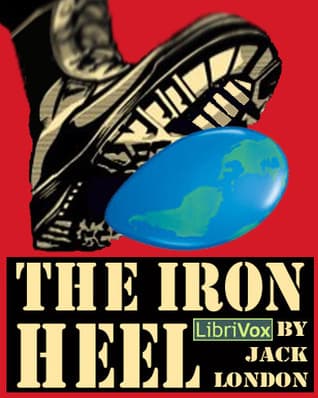
Jack London (1907)
Genre
Politics / Science Fiction
Reading Time
9-10 hours
Key Themes
See below
Sign in to track this book
Jack London's 'The Iron Heel' is a chilling forecast of corporate tyranny in 20th-century America, where an oligarchy crushes the nation, and a socialist movement rises to defy it.
The book starts with an introduction by Anthony Meredith, writing in 2607 AD. He presents the 'Everhard Manuscript' as a historical document from the 'Oligarchy Period' (1912-2300 AD). Meredith explains that Avis Everhard, wife of socialist revolutionary Ernest Everhard, wrote the manuscript, detailing the rise of the Oligarchy, also known as the Iron Heel. He warns that Avis's account, while valuable, is biased due to her direct involvement and strong belief in socialism. This framing device immediately sets up the dystopian future and the tragic fate of the revolutionary movement Avis records.
Avis Cunningham, daughter of a physics professor, attends a dinner party at industrialist Mr. Wickson's home. Among the guests is Ernest Everhard, a working-class socialist and a strong intellectual. Ernest, invited as a curiosity, immediately challenges the capitalists' views, especially Mr. Wickson's, by exposing the systemic injustices and exploitation in their economic system. Avis, initially surprised by his blunt honesty and radical ideas, finds herself intellectually stimulated and morally troubled by his arguments, which align with her own growing sense of social injustice. This meeting begins her deep intellectual and emotional change.
After their first meeting, Avis spends more time with Ernest, attending his socialist lectures and debates. She sees the poverty and suffering of the working class in Oakland firsthand, often going with Ernest to the slums. Through these experiences and Ernest's clear explanations of capitalist exploitation, Avis's worldview breaks apart. She realizes the hypocrisy and injustice of her comfortable, middle-class life, built on others' suffering. Her intellectual curiosity turns into a passionate commitment to socialism, and she falls in love with Ernest, drawn to his integrity, intelligence, and dedication to justice.
Bishop Morehouse, a respected clergyman and friend of Avis's family, is deeply moved by Ernest's arguments. He begins to preach against the social injustices done by wealthy industrialists. His sermons, which support Christian socialism, are met with hostility from powerful financial interests. When he refuses to retract his views, the Oligarchy arranges his public discrediting. He is declared insane and forced into a private asylum, a clear example of the Oligarchy's ruthless suppression of dissent and control over public institutions, even spiritual ones. This event further solidifies Avis's understanding of the Oligarchy's power.
As the economic crisis worsens, the capitalist class, through trusts and monopolies, steadily increases its power. Small businesses are bought out or go bankrupt, and independent farmers lose their land. Labor unions, initially protecting workers, are infiltrated, corrupted, or violently suppressed by the emerging Oligarchy. This group uses private armies and government forces to break strikes and stop unrest. The middle class slowly disappears, forced into either the working class or service to the powerful trusts. This period marks the clear formation of the Iron Heel – a ruthless, organized oligarchy controlling all parts of society, making resistance harder.
Ernest Everhard, a prominent voice of socialist defiance, becomes a main target for the Iron Heel. He is falsely accused of inciting violence and sedition. During his public trial, Ernest skillfully exposes the judicial system's corruption and hypocrisy, showing how the courts are simply tools of the Oligarchy. Despite his strong defense, he is convicted and sentenced to a long prison term. This event shows the Oligarchy's complete control over the legal system, using it to silence its most dangerous opponents. This further inspires Avis and other revolutionaries, even as it signals a grim future.
Amid growing economic hardship and widespread social unrest, a massive general strike erupts in Chicago, quickly becoming a full-scale uprising known as the Chicago Commune. Hundreds of thousands of workers rise up against the Iron Heel, taking control of parts of the city. However, the Oligarchy, with its superior organization and military strength, responds with overwhelming force. Their mercenary armies, with advanced weapons, brutally crush the rebellion, causing an unprecedented slaughter. The streets run red with blood, and the revolutionaries are destroyed, showing the Iron Heel's unwavering resolve to keep power at all costs. Avis sees the horror firsthand.
After the Chicago Commune's defeat and Ernest's escape from prison, Avis and Ernest become fugitives, living underground. They join the 'Brotherhood of Man,' a secret revolutionary organization working to overthrow the Iron Heel. They move from safe house to safe house, constantly avoiding the Oligarchy's network of spies and agents. Avis, now fully committed, works tirelessly with Ernest, organizing resistance, writing propaganda, and keeping morale high among the struggling revolutionaries, all while facing constant danger and the threat of discovery and death.
The Iron Heel strengthens its rule by carefully reorganizing society into strict castes. At the top are the 'Oligarchs,' living lives of great luxury and power. Below them are the 'Servitors,' a professional class of managers, engineers, and intellectuals who serve the Oligarchy. Most of the population is in the 'Labor Castes,' living in squalor and doing menial tasks, effectively enslaved. A small, despised 'Proletariat' remains outside the system, surviving on scraps. The Oligarchy also builds magnificent 'Wonder Cities' for its elite, built by the enslaved Labor Castes, further solidifying social divisions and showing their absolute control over resources and human lives.
The Everhard Manuscript ends abruptly mid-sentence, detailing preparations for another uprising against the Iron Heel. The final entry describes Avis and Ernest's continued work in the underground movement, their unwavering hope despite huge odds, and the constant threat of capture. The sudden end leaves Avis's and Ernest's ultimate fate unclear, implying their likely capture or death during one of the many failed insurrections against the powerful Oligarchy. This unresolved ending emphasizes the tragic nature of their struggle and the Iron Heel's immense power, leaving the reader with a sense of the vast, bloody history that followed.
Anthony Meredith returns in an epilogue to give historical context to the manuscript. He explains that the Iron Heel ruled brutally for three centuries, a time of countless failed revolutions and great suffering. Meredith details the various uprisings and the eventual, successful 'Revolt of the Brothers of the Common Weal' which finally overthrew the Oligarchy. He praises Avis Everhard and Ernest Everhard as key figures in the long struggle for human freedom, acknowledging their sacrifices and the inspiration they provided. His commentary offers a hopeful, though distant, view of the eventual triumph of the socialist ideal, contrasting with the immediate tragedy of Avis's account.
The Protagonist
Avis transforms from an innocent academic into a committed revolutionary, sacrificing her privileged life for the socialist cause, becoming a chronicler and an active participant in the struggle.
The Protagonist
Ernest remains steadfast in his socialist convictions, evolving from a public debater to an underground revolutionary leader, consistently challenging and inspiring others despite increasing oppression.
The Narrator/Frame Device
As a future historian, Meredith's 'arc' is external to the main narrative, providing a retrospective and hopeful framework for the past's struggle.
The Antagonist/Supporting
Wickson remains a static representation of capitalist power, serving as an early antagonist and a symbol of the system Ernest fights against.
The Supporting
Morehouse transforms from a respected clergyman into a social critic, only to be silenced and institutionalized by the Oligarchy, demonstrating their ruthlessness.
The Supporting
Professor Cunningham's arc shows a respected academic gradually losing his standing and security as the Oligarchy crushes independent thought and professional autonomy.
The Mentioned/Supporting
Jackson's 'arc' is a tragic illustration of exploitation, serving as a catalyst for Avis's awakening rather than a developing character.
The Antagonist
The Iron Heel's 'arc' is its rise to absolute power, its brutal consolidation of control, and its long, oppressive reign, which is eventually overthrown centuries after the manuscript's end.
The novel warns against unchecked wealth and power in a capitalist elite. London shows how capitalism, without regulation and strong social checks, leads to worker exploitation, suppression of dissent, and a totalitarian oligarchy. The systematic dismantling of labor unions, the persecution of figures like Bishop Morehouse and Ernest Everhard, and the creation of 'Labor Castes' all show the terrifying end point of a system driven only by profit and power, as seen in the brutal suppression of the Chicago Commune.
“''The Iron Heel' was the name burnt into the living flesh of the people by the Oligarchy. It was the symbol of its rule, the stamp of its tyranny, the insignia of its might.'”
Conversely, the novel presents socialism as the only alternative to the oppressive capitalist system. Ernest Everhard's arguments consistently highlight capitalism's injustices and advocate for a society based on equality, cooperation, and collective ownership. The revolutionary movement, despite failures and sacrifices, is portrayed as the only force capable of challenging the Iron Heel and leading humanity to a more just future. The 'Brotherhood of Man's' ultimate triumph in Meredith's epilogue reinforces this, suggesting that despite immediate defeat, the socialist ideal will eventually win.
“'You are a breeder of swine,' Ernest said, 'and you are a poor breeder, for you breed not for the good of the swine but for your own profit.'”
The Iron Heel keeps power through brute force and sophisticated propaganda and control over all information. The Oligarchy manipulates public opinion, discredits opponents (like Bishop Morehouse), and controls media to shape perceptions and suppress truth. Avis's manuscript is a counter-narrative, a desperate attempt to record truth in a world where victors rewrite history. The constant threat of exposure and the need for secrecy in the underground movement highlight the Oligarchy's pervasive surveillance and censorship.
“'The Iron Heel was careful to prevent the dissemination of knowledge that might prove dangerous to its rule.'”
Violence is a central theme, shown as a tool of oppression by the Iron Heel and a necessary, though tragic, means of resistance for revolutionaries. The Oligarchy uses overwhelming force to crush strikes, suppress dissent, and brutally end insurrections like the Chicago Commune, showing its willingness to commit mass atrocities to keep power. Revolutionaries, in turn, realize peaceful protest is useless against such an enemy and must resort to armed struggle, even knowing the immense cost. The novel does not glorify violence but presents it as an unavoidable reality of the struggle for freedom.
“'The Iron Heel was without conscience. It knew no morality but its own strength.'”
The novel's core conflict is the class struggle between the capitalist elite (the Oligarchy) and the working class (the proletariat). London details how society becomes stratified under the Iron Heel, with rigid 'Labor Castes,' 'Servitors,' and privileged 'Oligarchs.' The middle class is eliminated, forced into lower strata. This extreme social stratification highlights the dehumanizing effects of a system that prioritizes wealth and power over human dignity and equality, leading to widespread poverty and suffering for most people.
“'There were two classes in society, the producers and the parasites, and the parasites, by virtue of their being parasites, were able to live in luxury and idleness off the toil of the producers.'”
A story within a story, with a future historian presenting a historical manuscript.
The novel uses a frame narrative, where Anthony Meredith, a historian from 2607 AD, discovers and annotates Avis Everhard's manuscript from the early 20th century. This device allows London to present a dystopian future as a historical past, giving the events a sense of gravitas and inevitability. The footnotes provided by Meredith offer crucial historical context, foreshadowing, and an eventual sense of hope, revealing that the Iron Heel was eventually overthrown, thus mitigating the immediate tragedy of Avis's account and validating the long-term struggle.
Characters engage in lengthy, explicit discussions to explain socialist and capitalist ideologies.
Much of the novel's exposition of political and economic theory occurs through extensive dialogues and debates, particularly involving Ernest Everhard. These are not merely conversational but serve a didactic purpose, allowing London to directly present the arguments for socialism and against capitalism. Ernest often acts as a mouthpiece for London's own socialist views, systematically dismantling the capitalist arguments of characters like Mr. Wickson. This device ensures that the ideological underpinnings of the conflict are clearly understood by the reader.
Early events and character statements predict the grim future of the Iron Heel.
Throughout the narrative, there are numerous instances of characters, especially Ernest, making predictions about the future that subsequently come true. Ernest explicitly warns of the rise of the Oligarchy, the suppression of labor, and the brutal violence that will be used to maintain power. This prophetic quality not only builds tension but also serves to validate Ernest's (and London's) analysis of capitalist tendencies, making the dystopian future seem less like fiction and more like an inevitable outcome of the societal forces at play.
The central text is presented as a historical document from the past.
Avis Everhard's manuscript functions as a fictional primary source document, lending authenticity and immediacy to the narrative. By presenting the story as a firsthand account written by a participant, London immerses the reader directly into the emotional and physical struggles of the revolutionaries. The manuscript's abrupt ending further emphasizes the dangerous and uncertain nature of their fight, making Avis's personal testimony a poignant and invaluable record of a brutal historical period.
“We went on and on, till the head of the column was a tiny speck in the distance, yet that tiny speck was the van of a hosts of toilers.”
— Describing a massive socialist march in Oakland.
“The great unwashed, as you are so fond of calling them, are beginning to think, and to move, and to make their numbers felt.”
— Ernest Everhard addressing a group of wealthy industrialists.
“You have sold your country, and you have sold your souls, and you are rotten with the corruption of money.”
— Ernest Everhard's scathing indictment of the capitalist class.
“The Iron Heel will grind you down, and in the end it will grind itself to pieces.”
— A prophetic statement about the eventual downfall of the oligarchy.
“All your sweet little ideals of justice and mercy are so many pretty toys to play with while the world is starving.”
— Ernest Everhard dismissing the moral platitudes of the ruling class.
“Theirs was the might of the ten thousand times ten thousand, and the future was theirs.”
— Reflecting on the overwhelming numbers and potential power of the working class.
“History shows that the great social changes have come about through the pressure of the class below.”
— Ernest Everhard explaining the historical forces behind societal transformation.
“It was a time of terror, and of the red wrath of the people.”
— Describing the violent suppression of workers' uprisings.
“They were the masters of the world, and they wielded the power of life and death.”
— Describing the absolute authority of the Oligarchy.
“The hunger of the world was the hunger of the beast, and it devoured everything.”
— Reflecting on the pervasive poverty and desperation under the Iron Heel.
“There was no compromise possible. It was either they or we.”
— Highlighting the irreconcilable conflict between the proletariat and the Oligarchy.
“And through all this, the cause of the people, the cause of the revolution, grew and strengthened.”
— Despite the oppression, the revolutionary spirit persists and gains momentum.
“The Iron Heel was strong, but stronger still was the human spirit of freedom.”
— A statement of enduring hope against overwhelming tyranny.
Ready to see how well you understood this book? Take our interactive quiz with 10 questions.

John Griffith Chaney, better known as Jack London, was an American novelist, journalist and activist. A pioneer of commercial fiction and American magazines, he was one of the first American authors to become an international celebrity and earn a large fortune from writing. He was also an innovator in the genre that would later become known as science fiction.

Brett Casper
5.0
Dirk Uffelmann
4.7

Winston S. Churchill
4.5

Chimamanda Ngozi Adichie
4.5
Will Durant
4.4
Thomas Sowell
4.4
W.E.B. Du Bois
4.3
Alan Moore
4.3