BookBrief
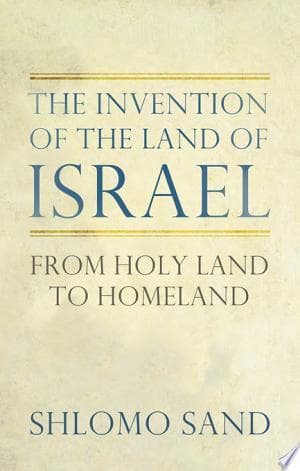
The Invention of the Land of Israel cover
Archivist's Choice

The Invention of the Land of Israel

Shlomo Sand (2012)

Genre

Politics / History

Reading Time

8-12 hours (estimated based on typical academic history book length, though 'None pages' was given)

Key Themes

See below

Track Your Reading

Sign in to track this book

Shlomo Sand shows how 19th-century Evangelical Protestants and Jewish Zionists created the 'Land of Israel,' arguing that this invention, meant to secure the Jewish state, now threatens its survival.

Core Idea

Shlomo Sand's "The Invention of the Land of Israel" questions the Zionist idea of a continuous, ancient link between the Jewish people and the land now known as Israel. Sand says 'the Land of Israel' as an exclusive, ancestral Jewish homeland is a modern idea, a product of 19th and 20th-century nationalism, not an unbroken historical fact. He challenges the idea of constant Jewish exile and a chosen people waiting to return, showing how these stories were made and used to support Zionist land claims and the creation of Israel. Sand explains how Christian-Evangelical views shaped the idea of a fixed, ethno-national 'Land of Israel,' and how Zionist thinkers later adopted and changed it. He examines the historical methods used to prove these claims, exposing their political aims and the dangers of basing national identities on invented homelands and exclusive historical rights. The book argues for moving past ethnocentric nationalism and recognizing the region's complex history.
Reading time
8-12 hours (estimated based on typical academic history book length, though 'None pages' was given)
Difficulty
Hard
✓ Read this if...
You are interested in critical historical analysis of national myths, particularly those surrounding the origins of Israel, and want to understand how modern national identities are constructed and justified through selective historical narratives. Essential for those seeking a post-Zionist or revisionist perspective on Israeli history.
✗ Skip this if...
You are looking for a book that affirms traditional Zionist narratives, prefer a less academic or highly critical approach to the history of Israel, or are uncomfortable with arguments that challenge deeply held national identity myths.

Core idea

The central argument and framework that powers the entire book.

Shlomo Sand's "The Invention of the Land of Israel" questions the Zionist idea of a continuous, ancient link between the Jewish people and the land now known as Israel. Sand says 'the Land of Israel' as an exclusive, ancestral Jewish homeland is a modern idea, a product of 19th and 20th-century nationalism, not an unbroken historical fact. He challenges the idea of constant Jewish exile and a chosen people waiting to return, showing how these stories were made and used to support Zionist land claims and the creation of Israel. Sand explains how Christian-Evangelical views shaped the idea of a fixed, ethno-national 'Land of Israel,' and how Zionist thinkers later adopted and changed it. He examines the historical methods used to prove these claims, exposing their political aims and the dangers of basing national identities on invented homelands and exclusive historical rights. The book argues for moving past ethnocentric nationalism and recognizing the region's complex history.

At a glance

Reading time

8-12 hours (estimated based on typical academic history book length, though 'None pages' was given)

Difficulty

Hard

Read this if...

You are interested in critical historical analysis of national myths, particularly those surrounding the origins of Israel, and want to understand how modern national identities are constructed and justified through selective historical narratives. Essential for those seeking a post-Zionist or revisionist perspective on Israeli history.

Skip this if...

You are looking for a book that affirms traditional Zionist narratives, prefer a less academic or highly critical approach to the history of Israel, or are uncomfortable with arguments that challenge deeply held national identity myths.

Key Takeaways

1

The Land as a Modern Construct

The 'Land of Israel' is a geopolitical invention of the 19th century, not an ancient, immutable entity.

Quote

The 'Land of Israel' as a specific, bounded national territory is a relatively recent invention, shaped by 19th-century religious and political movements.

Sand argues that 'Eretz Israel' (the Land of Israel) as a clear, exclusive national homeland is a modern idea, mainly from 19th-century Evangelical Protestantism and Jewish Zionism. Before this, the 'Holy Land' was a more general, religious area, not a national territory with set borders. This modern creation served important political goals, helping European colonial plans in the Middle East and giving a founding story for Zionism. Understanding this change is key to seeing the current Israeli-Palestinian conflict as a fight over a r...

Supporting evidence

Sand traces the term's evolving usage, noting how Evangelical Protestants, driven by millenarian beliefs, meticulously mapped and defined 'Palestine' as a prelude to a Jewish return, thereby laying groundwork for Zionist claims. He highlights how the term was rarely used as a national designation by Jews themselves before the rise of Zionism.

Apply this

Challenge narratives that portray national territories as timeless and organic. Investigate the historical, political, and religious forces that shaped contemporary geopolitical boundaries and national identities in any given region, rather than accepting them as self-evident.


geopolitical-invention19th-century-nationalismzionist-narrative
2

Myth of Perpetual Exile and Return

The narrative of an exiled Jewish people returning to an empty homeland is largely a modern, politically motivated myth.

Quote

The idea of a continuous, unbroken 'exile' of the Jewish people from the Land of Israel, followed by a 'return' to an awaiting, empty land, is a powerful but historically problematic myth.

Sand examines the Zionist story of Jewish people exiled from their homeland for two thousand years, only to 'return' in modern times. He argues this story simplifies and distorts complex history. Many Jews stayed in the region throughout history, and local populations converted to Judaism. Also, not all diaspora Jews constantly wished for a physical return to the 'Holy Land' until Zionism began. This story supports exclusive land claims and dismisses the presence and historical claims of other groups, especially Palestinians, by prese...

Supporting evidence

Sand cites historical evidence of Jewish communities thriving in Palestine after the Roman period and the significant conversions of local populations to Judaism, particularly during the Hellenistic and Roman eras. He also points to the diverse motivations and varying degrees of attachment to a physical return among Jewish communities worldwide prior to the 19th century.

Apply this

When evaluating historical claims, question narratives of unbroken lineage or singular origin. Look for evidence of internal diversity, conversion, and continuous presence of various groups, rather than accepting monolithic accounts of 'people' or 'nation' over millennia.

exile-mythzionist-historiographyhistorical-revisionism
3

The Christian-Evangelical Precursor

19th-century Christian Evangelicals played a crucial, often overlooked, role in conceptualizing the 'Land of Israel' as a Jewish homeland.

Quote

Before Zionism, it was often Christian Evangelicals who most fervently promoted the idea of a Jewish return to the 'Holy Land' as a precursor to their own eschatological visions.

Sand highlights the important, often overlooked, role of 19th-century Christian Evangelical movements in shaping the modern idea of the 'Land of Israel' as a future Jewish state. Driven by end-times beliefs and biblical prophecy, these groups pushed for the 'restoration' of Jews to Palestine, seeing it as a necessary step for the Second Coming of Christ. They mapped the region, funded early Jewish settlements, and urged European powers to support a Jewish presence. This Christian activism before Zionism gave a key conceptual framework...

Supporting evidence

Sand details the activities of figures like Lord Shaftesbury, a prominent British Evangelical, who advocated for Jewish settlement in Palestine in the mid-19th century, famously stating 'a country without a nation for a nation without a country.' He also points to the mapping expeditions and lobbying efforts by various Christian missionary societies.

Apply this

Recognize the multifaceted origins of political movements and national narratives. Explore how religious beliefs and external actors can influence the formation of national identities and territorial claims, even when seemingly driven by internal forces.

christian-zionismmillenarianismcolonial-influence
4

The 'Historical Right' as a Modern Justification

The concept of 'historical right' to the land is a modern legal and political construct, not an inherent, timeless truth.

Quote

The 'historical right' to the Land of Israel, often presented as an ancient and self-evident truth, is in fact a modern legal and political justification coined to legitimize territorial claims.

Sand analyzes the idea of 'historical right' to the Land of Israel, arguing it is not an eternal, divine truth but a relatively recent legal and political invention. This concept became popular in the late 19th and early 20th centuries as Zionism tried to explain its claims using international law and diplomacy. By framing ancient religious texts and historical presence as a 'right' to modern national territory, Zionism could compete with other national movements. However, Sand argues this 'right' is problematic because it selectively...

Supporting evidence

Sand analyzes how Zionist ideologues and early Israeli state documents invoked 'historical right' as a primary justification for the establishment of Israel, often drawing selectively from biblical narratives and archaeological findings while downplaying or ignoring other historical facts.

Apply this

Critically examine claims of 'historical right' in any conflict. Question the selectivity of historical narratives and the application of modern legal concepts to ancient contexts. Consider whose rights are asserted and whose are erased by such claims.

historical-rightlegal-justificationanachronismland-claims
5

Zionism's Selective Archaeology and History

Zionist archaeology and historiography often selectively interpret evidence to support a predetermined national narrative.

Quote

Zionist historiography, like many national histories, has been prone to a selective reading of the past, emphasizing certain narratives while marginalizing or ignoring others to construct a coherent national identity.

Sand criticizes how Zionist history has often served to build national identity, rather than being purely objective academic work. He claims there has been a tendency to favor findings that support a continuous Jewish presence and an ancient, unified Jewish nation, while downplaying or reinterpreting evidence that contradicts this, such as the continuous presence of other groups or the diverse origins of Jewish communities. This selective approach has been key to solidifying the 'historical right' to the land and creating a powerful, ...

Supporting evidence

Sand discusses how archaeological sites are often interpreted through a Zionist lens, focusing on 'Jewish' layers while neglecting or downplaying non-Jewish periods. He also points to the initial reluctance to acknowledge the diverse ethnic origins of Mizrahi Jews, preferring a singular, 'pure' Ashkenazi narrative.

Apply this

Be critical of national histories and archaeological interpretations, especially when they present a perfectly coherent and uninterrupted narrative. Look for alternative interpretations, marginalized voices, and evidence that complicates the dominant story. Understand how power dynamics influence historical discourse.

zionist-archaeologynational-historiographyselective-memoryhistorical-bias
6

The Dangers of Invented Homelands

Basing national identity on an 'invented' and exclusive homeland narrative can lead to ongoing conflict and internal contradictions.

Quote

The very invention of the Land of Israel as an exclusive national territory, while foundational to the state's existence, paradoxically threatens its long-term stability and democratic ideals.

Sand's main point is that the creation of the 'Land of Israel' as an exclusive Jewish homeland, while allowing the state to form, now seriously threatens its future. By basing national identity on a selective historical story that often excludes or marginalizes other inhabitants, Israel creates internal problems. This 'invented' homeland requires constantly asserting a unique, exclusive claim, which clashes with the rights and stories of the Palestinian people. This basic tension fuels ongoing conflict, hinders peace, and challenges I...

Supporting evidence

Sand points to the ongoing Israeli-Palestinian conflict, the legal status of Arab citizens within Israel, and the persistent debates over 'who is a Jew' and 'who belongs to the land' as manifestations of these foundational contradictions stemming from the exclusive national narrative.

Apply this

Examine how national myths, particularly those emphasizing exclusivity and ancient claims, contribute to contemporary conflicts and internal social divisions. Advocate for inclusive historical narratives that acknowledge the multiplicity of presences and claims to a shared territory.

national-mythologyisraeli-palestinian-conflictexclusive-nationalismstate-identity
7

The Land's Names and Meanings

The various names for the region—Palestine, Holy Land, Eretz Israel—reflect shifting political and religious claims.

Quote

The very names by which the land has been known—Palestine, Holy Land, Eretz Israel—are not neutral labels but loaded terms reflecting different historical periods and competing claims of ownership and identity.

Sand stresses that the names used for the region are not random but deeply political and historically specific. 'Palestine,' for example, has a long history, predating the modern nation-state, and was the common administrative name under Ottoman and British rule. 'Holy Land' shows a universal religious importance for many faiths. 'Eretz Israel,' especially in its modern Zionist use, means an exclusive Jewish national territory. By tracing how these names have changed and been argued over, Sand shows how language itself is a fight for ...

Supporting evidence

Sand analyzes the historical usage of 'Palestine' by various empires and peoples, contrasting it with the more recent and specific application of 'Eretz Israel' by Zionist movements to define a political entity.

Apply this

Pay close attention to the terminology used in geopolitical discourse. Investigate the historical origins and political implications of place names and national designations, as they often reveal underlying power dynamics and contested claims. Avoid using terms uncritically.

place-nameslinguistic-politicscontested-historyottoman-palestine
8

Challenging the 'Chosen People' Narrative

The concept of a 'chosen people' is a theological construct that has been politicized to justify territorial claims.

Quote

The theological concept of a 'chosen people,' when translated into a modern political doctrine, can become a dangerous tool for justifying exclusive national rights and territorial acquisition.

Sand suggests that the idea of the 'chosen people' has been turned from a theological concept into a political reason for land claims and national exclusivity. While 'chosenness' is deeply religious for Judaism, its use in modern political Zionism, especially for the 'Land of Israel,' changes its meaning a lot. It goes from a spiritual agreement to a claim of inherent, divine right to a specific piece of land, overriding the rights of other inhabitants. This politicization, Sand suggests, creates a huge barrier to shared power and pea...

Supporting evidence

Sand's previous work, 'The Invention of the Jewish People,' lays the groundwork for this critique by arguing against a singular, unbroken biological lineage. Here, he extends that argument to how 'chosenness' has been used to solidify claims to the land, citing how this concept underpins much of the Zionist discourse on 'historical right.'

Apply this

Be wary of political movements that derive their legitimacy from religious claims of divine mandate or 'chosenness.' Analyze how theological concepts are secularized and politicized to justify actions, particularly when those actions impact the rights and sovereignty of other groups.

chosen-peopletheological-politicsreligious-nationalismdivine-mandate
9

The Colonial Context of Zionist Settlement

Early Zionist settlement, regardless of intent, operated within and benefited from European colonial frameworks.

Quote

Despite its unique characteristics, early Zionist settlement cannot be entirely divorced from the broader context of European colonial expansion into the Middle East.

Sand suggests that early Zionist settlement, though driven by a desire for self-determination and safety from persecution, mostly worked within and benefited from European colonialism. European powers, especially Britain, saw the Zionist project as fitting their strategic interests in the Middle East, often viewing Jewish settlers as a 'civilizing' force or a useful buffer. This colonial context provided political support, money, and a legal framework (like the Balfour Declaration and the Mandate system) that helped Jewish immigration...

Supporting evidence

Sand refers to the Balfour Declaration and the British Mandate for Palestine as key examples of how European colonial powers actively supported and facilitated Zionist aims, viewing them through a colonial lens of 'development' and strategic interest.

Apply this

Analyze historical events, especially nation-building projects, within their broader global and imperial contexts. Consider how seemingly independent movements can be intertwined with and benefit from existing power structures, such as colonialism, even if their motivations are distinct.

colonialismbritish-mandatebalfour-declarationsettler-colonialism
10

Beyond Exclusive Nationalisms

A path to peace requires moving beyond exclusive, ethno-nationalist claims to the land.

Quote

The current impasse in the region stems from the inability to transcend exclusive nationalisms and embrace a more inclusive vision of shared space and identity.

While Sand's book is mainly a historical analysis, its main message is a call for a future that moves beyond the exclusive, ethno-nationalist claims that have caused conflict. By showing that the 'Land of Israel' is an 'invention' and that the historical stories supporting its exclusivity are problematic, he implies that lasting peace cannot be built on such foundations. A way forward, he suggests, would involve acknowledging the complex history of the land and all its inhabitants, moving from a single, exclusive claim to a more inclu...

Supporting evidence

The entire work serves as evidence, demonstrating how the 'invention' of an exclusive homeland has led to the current, seemingly intractable conflict. The book's critical analysis of foundational myths points towards the necessity of dismantling them to build a different future.

Apply this

In any conflict rooted in competing historical claims, advocate for historical inquiry that is inclusive and critical of exclusive narratives. Promote dialogue that seeks shared understanding of complex pasts rather than perpetuating competing, unchallengeable 'truths.' Consider how national identities can evolve to be more inclusive.

inclusive-nationalismpost-nationalismshared-sovereigntypeace-building

Critical analysis

Notable Quotes

The belief that Jews constitute a 'people' or a 'nation' in the biological or genealogical sense is a modern invention.

Central thesis challenging the traditional understanding of Jewish identity.

Israel, as a 'Jewish state', is founded on a mythological rather than a historical narrative.

Critique of the foundational myths of the State of Israel.

The idea of a continuous exile and return to a 'homeland' is more a product of religious dogma and political necessity than historical fact.

Challenging the narrative of Jewish exile and return.

Most of the Jews living in the world today are not descendants of the ancient Israelites, but rather converts from various peoples throughout history.

Controversial claim about the genetic origins of modern Jews.

The 'Land of Israel' as a defined, exclusive territory for a single people is a relatively recent political construct.

Examining the historical evolution of the concept of the 'Land of Israel'.

Zionism did not discover the Jewish people; it invented it.

Directly linking Zionism to the creation of a modern Jewish national identity.

The 'expulsion' of Jews from Palestine by the Romans is largely a myth, as many remained and converted to other religions.

Debunking the historical narrative of the Roman expulsion.

The Palestinians are, in many cases, the direct descendants of the ancient inhabitants of the land, including those who converted to Islam.

Proposing a genealogical link between Palestinians and ancient inhabitants.

History is not a simple recounting of facts, but an active construction, often serving political agendas.

Broader epistemological statement about the nature of historical writing.

The idea of a 'pure' lineage for any people is typically a nationalist fantasy.

General critique of nationalist claims of ethnic purity.

Academic history has often been complicit in propagating national myths rather than critically examining them.

Criticism of the role of academia in national narratives.

If the Jews are not a race, then the very foundations of Zionism as a national movement based on shared ancestry are undermined.

Highlighting the implications of his research for Zionist ideology.

The concept of 'Jewish blood' is a dangerous and unscientific notion, echoing earlier racist ideologies.

Strong condemnation of essentialist views of Jewish identity.

The 'Land of Israel' was never an empty land awaiting the return of its 'rightful' owners.

Challenging the 'land without a people' narrative.

Quiz

Test Your Knowledge

Ready to see how well you understood this book? Take our interactive quiz with 10 questions.

10
Questions
~5
Minutes
?
Best Score

Key Questions (FAQ)

Shlomo Sand argues that the modern geopolitical concept of the 'Land of Israel' is a relatively recent invention, primarily by 19th-century Evangelical Protestants and Jewish Zionists, rather than an ancient, continuous historical entity. He contends this invention facilitated colonization and now threatens the Jewish state.

About the author