BookBrief
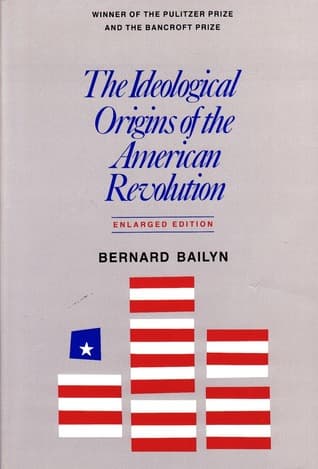
The Ideological Origins of the American Revolution cover
Archivist's Choice

The Ideological Origins of the American Revolution

Bernard Bailyn (1967)

Genre

Politics / History / Philosophy

Reading Time

10-15 hours (for a thorough read)

Key Themes

See below

Track Your Reading

Sign in to track this book

Bernard Bailyn shows how the American Revolution's radical ideals sparked a continuous struggle for the nation's identity, shaping the Constitution and affecting modern issues.

Core Idea

Bernard Bailyn's "The Ideological Origins of the American Revolution" argues that the American Revolution was an intellectual movement, driven by a deep, radical Whig ideology rather than economic or social problems alone. This ideology, from English Commonwealthmen and Dissenters, created a widespread fear of government corruption and a conspiracy against liberty. This led colonists to see British imperial policies, from the Stamp Act to the Intolerable Acts, as deliberate attempts to control them. The book shows how this way of thinking, spread through many pamphlets, changed ideas about representation, sovereignty, and rights, pushing colonists toward independence and a new, republican government.
Reading time
10-15 hours (for a thorough read)
Difficulty
Hard
✓ Read this if...
You want to understand the intellectual foundations and the pervasive mindset that drove the American Revolution, moving beyond simplistic economic explanations to grasp the power of ideas in shaping historical events.
✗ Skip this if...
You are looking for a narrative history of battles and key figures, or prefer a less academic, more accessible introduction to the American Revolution. This book is dense and focused on intellectual history.

Core idea

The central argument and framework that powers the entire book.

Bernard Bailyn's "The Ideological Origins of the American Revolution" argues that the American Revolution was an intellectual movement, driven by a deep, radical Whig ideology rather than economic or social problems alone. This ideology, from English Commonwealthmen and Dissenters, created a widespread fear of government corruption and a conspiracy against liberty. This led colonists to see British imperial policies, from the Stamp Act to the Intolerable Acts, as deliberate attempts to control them. The book shows how this way of thinking, spread through many pamphlets, changed ideas about representation, sovereignty, and rights, pushing colonists toward independence and a new, republican government.

At a glance

Reading time

10-15 hours (for a thorough read)

Difficulty

Hard

Read this if...

You want to understand the intellectual foundations and the pervasive mindset that drove the American Revolution, moving beyond simplistic economic explanations to grasp the power of ideas in shaping historical events.

Skip this if...

You are looking for a narrative history of battles and key figures, or prefer a less academic, more accessible introduction to the American Revolution. This book is dense and focused on intellectual history.

Key Takeaways

1

The Power of Radical Whiggism

British opposition thought became the intellectual bedrock of American revolutionary ideology.

Quote

The ultimate origins of the American Revolution are to be found in the peculiar strain of British political thought known as 'radical Whiggism' or the 'country' ideology.

Bailyn shows that American revolutionaries were not mainly driven by economic problems or a sudden wish for independence. Instead, they were deeply involved in and interpreted radical Whig thought. This intellectual tradition, mostly ignored in Britain, offered a ready framework for understanding political corruption, the dangers of standing armies, and the need to watch out for growing power. It led to a conspiratorial view of history, where ambitious rulers constantly threatened liberty. This intellectual heritage shaped how they sa...

Supporting evidence

Bailyn meticulously analyzes pamphlets, sermons, and newspapers from the colonial period, showing how American writers consistently drew upon the language and ideas of figures like John Trenchard and Thomas Gordon (Cato's Letters), Algernon Sidney, and John Locke, emphasizing their radical interpretations.

Apply this

When analyzing contemporary political movements, look beyond immediate causes to identify the underlying intellectual traditions and historical narratives that inform their worldview. Understand how these frameworks can transform perceptions of seemingly neutral events into evidence of systemic threats.


radical-whiggismcountry-ideologyconspiracy-theorypolitical-pamphleteering
2

Conspiracy as Interpretive Lens

Revolutionaries saw British actions not as missteps, but as parts of a deliberate plot to enslave them.

Quote

The colonists saw in the acts of the British government not a sequence of isolated, arbitrary impositions, but a deliberate, comprehensive design for the enslavement of America.

One of Bailyn's strongest arguments is that American revolutionaries saw British policies through a 'conspiracy theory' lens. From the Stamp Act to the Intolerable Acts, each new measure was not viewed alone but as more proof of a planned, malicious plot by a corrupt British government and Parliament. This perception was deeply rooted in their radical Whig understanding of power, which held that liberty was always fragile and constantly threatened by ambitious men seeking to expand their control. This conspiratorial worldview gave a s...

Supporting evidence

Bailyn cites numerous colonial pamphlets and letters that explicitly articulate fears of a 'ministerial plot' or 'design to enslave' the colonies, often linking specific policies (e.g., taxation, quartering of troops, Admiralty courts) as interconnected parts of this larger scheme.

Apply this

Recognize that the perception of conspiracy, even if not objectively 'true,' can be a potent mobilizer in political movements. Understand how a series of seemingly disparate events can be woven into a coherent, alarming narrative by those operating within a particular ideological framework. Challenge yourself to differentiate between genuine coordinated efforts and coincidental convergences of events.

conspiracy-theoryministerial-plottyrannyrevolutionary-narrative
3

The Transformation of Sovereignty

The Revolution fundamentally redefined the concept of governmental authority, shifting it from Parliament to the people.

Quote

The ultimate power to govern must reside not in any branch of government, but in the people themselves.

The American Revolution, caused by the perceived threat of parliamentary overreach, required a new look at sovereignty. Initially, colonists struggled with 'divided sovereignty,' arguing for legislative freedom while staying loyal to the Crown. However, as the conflict grew, they moved toward the revolutionary idea that true sovereignty rests not in Parliament, nor even in the King, but in 'the people' themselves. This change was profound, setting the stage for popular sovereignty, constitutional conventions, and the idea that governm...

Supporting evidence

Bailyn traces this evolution through documents like Thomas Jefferson's 'Summary View of the Rights of British America' and the declarations of various colonial assemblies, culminating in the Declaration of Independence's assertion of popular sovereignty and the right of the people to alter or abolish government.

Apply this

When examining debates about governmental power, identify where different factions locate ultimate sovereignty. Understand that the concept of 'the people' as the ultimate sovereign is a revolutionary idea with profound implications for constitutional design and political legitimacy.

popular-sovereigntyparliamentary-supremacyconsent-of-the-governedconstitutionalism
4

The Ideological Nature of the Constitution

The struggle over the Constitution was a direct continuation of revolutionary ideological debates.

Quote

The debate over the ratification of the Constitution was not a break from the Revolution but a fulfillment and further articulation of its deepest ideological commitments.

In his postscript, 'Fulfillment,' Bailyn argues that the intense debates over the U.S. Constitution's ratification were not a break from revolutionary principles but their logical, though disputed, next step. The Federalists and Anti-Federalists, while seemingly opposed, both worked within the same radical Whig framework. They shared a deep suspicion of power and a commitment to liberty. Their disagreements came from different interpretations of how best to protect those principles in a large republic. The Constitution itself came fro...

Supporting evidence

Bailyn highlights how both Federalists (e.g., Madison in Federalist No. 10) and Anti-Federalists (e.g., Brutus) framed their arguments in terms of preserving liberty, preventing tyranny, and guarding against corruption, using language directly traceable to the revolutionary pamphlets.

Apply this

Understand that foundational documents are often products of ongoing ideological struggles, not just pragmatic compromises. When analyzing historical documents, look for the continuities of ideas and concerns, even amidst apparent shifts or new solutions. Recognize that 'fulfillment' can mean a complex, contested realization of ideals.

constitutional-ratificationfederalistsanti-federalistsrepublicanism
5

The Fear of Corruption

A pervasive anxiety about corruption drove revolutionary and constitutional thought.

Quote

The colonists saw themselves as defending against corruption, against the debasement of the body politic, and against a systematic assault on their civic virtue.

A main idea throughout revolutionary thought was a strong fear of corruption. Drawing from classical republicanism and radical Whiggism, Americans believed that unchecked power inevitably led to corruption, which would then destroy liberty and civic virtue. They saw the British imperial system as full of corruption — placemen, pensions, standing armies, and manipulative ministers — all meant to undermine the public good for private gain. This fear motivated their demands for more accountability, transparency, and an alert citizenry. I...

Supporting evidence

Bailyn details how colonial writers frequently invoked historical examples of fallen republics (Rome, Carthage) and warned against the 'luxury' and 'effeminacy' that accompanied corruption, using these arguments to condemn British policies and rally support for resistance.

Apply this

Recognize that 'corruption' is not merely illegal acts, but can also refer to a broader decay of public virtue and institutional integrity in political discourse. Consider how fears of corruption continue to shape debates about governmental power, campaign finance, and institutional design today. How do we define and combat 'corruption' in a way that aligns with modern values?

corruptioncivic-virtuerepublicanismchecks-and-balances
6

The Pamphlet as a Revolutionary Engine

The sheer volume and accessibility of pamphlets transformed political discourse.

Quote

The pamphlet was the primary medium for the transmission of ideas, a swift, flexible, and responsive form that allowed for an unprecedented level of public political discourse.

Bailyn stresses the important role of the pamphlet in spreading revolutionary ideas and shaping public opinion. Unlike more formal writings or long books, pamphlets were relatively cheap, quick to print, and easy to distribute, making them available to many readers across the colonies. They created a lively, often argumentative, intellectual exchange, allowing arguments to be made, challenged, and refined quickly. This 'pamphlet war' was not just a reflection of revolutionary thought; it was a driving force, creating a shared intellec...

Supporting evidence

Bailyn's entire study is built upon an exhaustive analysis of thousands of revolutionary-era pamphlets, demonstrating their thematic consistency and wide circulation, and highlighting specific examples like Thomas Paine's 'Common Sense' as pivotal for its impact and reach.

Apply this

Consider how new media technologies (e.g., social media, blogs, podcasts) similarly democratize and accelerate political discourse today. Analyze how the format and accessibility of a medium influence the content and spread of ideas. Think about the 'pamphlet wars' of our era and their impact on public opinion.

pamphlet-warpublic-spherepolitical-discourseprint-culture
7

The Radicalization of 'Rights'

The concept of 'rights' evolved from traditional English liberties to universal human rights.

Quote

What began as an assertion of specific, traditional English liberties became, in the heat of revolution, a claim for universal, natural rights.

Initially, American colonists claimed their rights as Englishmen, referring to historical precedent, common law, and the British constitution. They demanded the same freedoms enjoyed by those in the mother country. However, as their complaints grew and reconciliation seemed impossible, the ideological framework changed. The debate moved from specific historical rights to broader, more abstract concepts of natural rights belonging to all humanity, independent of any government or king. This radicalization, ending with the Declaration o...

Supporting evidence

Bailyn traces this evolution from early petitions citing Magna Carta and the English Bill of Rights to later documents like the Virginia Declaration of Rights and the Declaration of Independence, which articulated rights as 'self-evident' and 'unalienable' (life, liberty, pursuit of happiness).

Apply this

When examining debates about rights, identify whether the claims are based on historical precedent, legal statutes, or universal philosophical principles. Understand that the language of 'rights' can be dynamic and transformative, evolving to meet new political realities and moral imperatives. How do societies reconcile traditional rights with aspirational universal rights?

natural-rightsenglish-libertiesuniversal-rightsdeclaration-of-independence
8

The Duality of Ideology and Interests

Ideology was not a mere rationalization but a genuine, driving force alongside practical interests.

Quote

The ideas and beliefs that the colonists brought to the Revolution were not a 'propaganda screen' for economic interests, but were genuinely believed and profoundly influential.

Bailyn directly challenges economic interpretations of the Revolution. He argues that ideology was not just a cover for economic problems or class interests. While practical concerns certainly existed, the colonists truly believed in the ideas they supported — liberty, virtue, natural rights, and the dangers of power. These ideas provided the framework through which they understood their material conditions and turned specific complaints into a clear revolutionary movement. The intellectual tradition was deeply accepted, shaping their...

Supporting evidence

Bailyn's entire methodological approach, focusing on the content and evolution of revolutionary pamphlets, serves as evidence. He shows that the arguments were complex, consistent, and deeply rooted in a shared intellectual tradition, not just simplistic appeals to self-interest.

Apply this

When analyzing historical or contemporary events, resist the urge to reduce complex motivations solely to economic or material interests. Consider how deeply held beliefs, ideologies, and worldviews can genuinely shape perceptions, drive actions, and provide meaning to struggles, even when intertwined with practical concerns. How do we distinguish between genuine belief and cynical manipulation?

economic-determinismideological-originshistorical-motivationpropaganda-vs-belief
9

The Unfinished Revolution

The ideals of the Revolution presented challenges that the founders themselves struggled to fully resolve.

Quote

The very principles of the Revolution, once released, posed dilemmas and contradictions that would continue to challenge American society for generations.

Bailyn shows that revolutionary ideals, while powerful, were also challenging and often contradictory, leaving an 'unfinished' legacy. The claim of universal liberty and equality sharply contrasted with the reality of slavery and the subjugation of Native Americans. The fear of centralized power made creating a stable national government full of tension. The commitment to popular sovereignty raised questions about who truly made up 'the people.' These unresolved tensions, built into the founding, ensured that the Revolution's 'meaning...

Supporting evidence

Bailyn points to the immediate post-revolutionary debates over slavery and the rights of various groups as examples of the inherent contradictions within the revolutionary ideology, even as the founders struggled to reconcile them in the Constitution.

Apply this

Understand that founding principles, while inspirational, often contain inherent contradictions or leave significant questions unanswered. Recognize that historical 'victories' often create new challenges and that the interpretation and application of ideals are ongoing processes, not static achievements. How do we grapple with the 'unfinished' aspects of our own foundational narratives?

unfinished-revolutionfounding-contradictionslegacy-of-slaveryconstitutional-dilemmas

Critical analysis

Notable Quotes

The ultimate goal of the American Revolution was not simply independence from British rule but the establishment of a new political order founded on the principles of liberty, equality, and popular sovereignty.

Bailyn's overarching thesis on the revolution's deeper ideological roots.

The colonists were not, in their own eyes, rebelling against the best traditions of the English past, but were rather defending them against the corruptions of the present.

Explaining the colonists' perception of their actions as a defense of traditional rights.

The fear of conspiracy, of a deliberate plot against liberty, was not a paranoid delusion but a rational interpretation of observable events through the lens of a particular intellectual tradition.

Discussing the pervasive fear of a ministerial conspiracy among colonists.

The pamphlets are the direct and authentic voice of the Revolution.

Highlighting the importance of pamphlets as primary sources for understanding revolutionary thought.

It was this belief in the unique character of the American experience, in its special destiny to preserve and advance the cause of liberty, that gave the Revolution its extraordinary moral force.

On American exceptionalism and its role in motivating the revolution.

The colonists, in effect, were not merely asserting their rights as Englishmen but were creating a new conception of rights altogether.

Analyzing how colonial arguments evolved beyond traditional English rights.

The radical Whig tradition, with its emphasis on liberty, virtue, and the dangers of power, provided the essential intellectual framework for the American Revolution.

Identifying the key intellectual current influencing revolutionary thought.

The language of liberty, once released, proved to be a force that could not be contained.

Describing the powerful and expansive nature of revolutionary rhetoric.

The colonists' understanding of history was not simply a recounting of past events but a dynamic and selective process designed to illuminate their present predicament.

Examining how colonists used historical narratives to justify their resistance.

For the colonists, power was by its very nature aggressive and expansive, constantly threatening to encroach upon liberty.

Explaining the colonists' deep suspicion of centralized power.

The transformation of the colonists' arguments from pleas for redress of grievances to demands for fundamental change was a gradual but decisive process.

Tracing the evolution of colonial resistance from protest to revolution.

The writings of the Enlightenment provided the vocabulary, but the immediate experience of colonial politics provided the context and the urgency.

Balancing the influence of European Enlightenment with local colonial experiences.

The pamphlets reveal a world where ideas were not merely abstract concepts but weapons in a fierce political struggle.

Emphasizing the practical and polemical nature of revolutionary discourse.

The commitment to popular sovereignty, though initially vague, became the bedrock upon which the new American governments would be built.

On the foundational role of popular sovereignty in post-revolutionary governance.

Quiz

Test Your Knowledge

Ready to see how well you understood this book? Take our interactive quiz with 10 questions.

10
Questions
~5
Minutes
?
Best Score

Key Questions (FAQ)

Bailyn argues that the American Revolution was primarily driven by a distinct set of political ideas and beliefs, deeply rooted in radical Whig opposition thought from England. These ideas, emphasizing liberty, conspiracy fears, and the corrupting nature of power, shaped the colonists' understanding of British actions and fueled their eventual rebellion.

About the author

Bernard Bailyn

Bernard Bailyn was a prominent American historian and intellectual historian, renowned for his work on the American Revolution. His Pulitzer Prize-winning book, "The Ideological Origins of the American Revolution," is a seminal work that redefined the understanding of the Revolution's intellectual underpinnings. He was a professor at Harvard University and received numerous accolades for his contributions to historical scholarship.