BookBrief
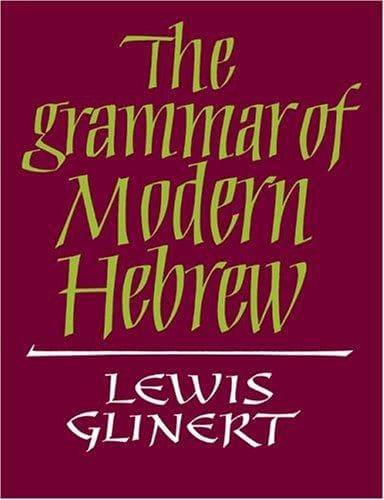
The Grammar of Modern Hebrew cover
Archivist's Choice

The Grammar of Modern Hebrew

Lewis Glinert

Genre

General

Reading Time

10-15 hours (for a thorough read, not including exercises)

Key Themes

See below

Track Your Reading

Sign in to track this book

Glinert meticulously deciphers the vibrant, often complex, machinery of modern Hebrew, revealing the intricate dance of its ancient roots and contemporary evolution.

Core Idea

Lewis Glinert's "The Grammar of Modern Hebrew" presents a comprehensive and accessible exploration of the Hebrew language as it is spoken and written today. The book emphasizes that Modern Hebrew is not a static academic subject but a dynamic, living language with deep historical roots that continue to influence its contemporary structure. It meticulously dissects the core grammatical systems, such as the intricate binyanim (verb conjugation patterns), the nuanced construct state for expressing noun-noun relationships, and the usage of pronouns and pronominal suffixes, all while considering the practicalities of word order. Glinert's central argument is that understanding these foundational elements, viewed through the lens of Hebrew's historical development and its current usage, is essential for truly mastering the language.
Reading time
10-15 hours (for a thorough read, not including exercises)
Difficulty
Hard
✓ Read this if...
You are a serious student of Modern Hebrew, a linguist interested in Semitic languages, or a learner looking for a detailed, academically sound yet practical guide to Hebrew grammar. This book is ideal for those who want to understand not just 'what' but 'why' certain grammatical structures exist in Hebrew.
✗ Skip this if...
You are a complete beginner looking for a simple phrasebook or a very light introduction to conversational Hebrew. This book assumes some foundational knowledge or a willingness to delve deep into linguistic structures. It is not designed for casual learners or those seeking only a tourist's grasp of the language.

Core idea

The central argument and framework that powers the entire book.

Lewis Glinert's "The Grammar of Modern Hebrew" presents a comprehensive and accessible exploration of the Hebrew language as it is spoken and written today. The book emphasizes that Modern Hebrew is not a static academic subject but a dynamic, living language with deep historical roots that continue to influence its contemporary structure. It meticulously dissects the core grammatical systems, such as the intricate binyanim (verb conjugation patterns), the nuanced construct state for expressing noun-noun relationships, and the usage of pronouns and pronominal suffixes, all while considering the practicalities of word order. Glinert's central argument is that understanding these foundational elements, viewed through the lens of Hebrew's historical development and its current usage, is essential for truly mastering the language.

At a glance

Reading time

10-15 hours (for a thorough read, not including exercises)

Difficulty

Hard

Read this if...

You are a serious student of Modern Hebrew, a linguist interested in Semitic languages, or a learner looking for a detailed, academically sound yet practical guide to Hebrew grammar. This book is ideal for those who want to understand not just 'what' but 'why' certain grammatical structures exist in Hebrew.

Skip this if...

You are a complete beginner looking for a simple phrasebook or a very light introduction to conversational Hebrew. This book assumes some foundational knowledge or a willingness to delve deep into linguistic structures. It is not designed for casual learners or those seeking only a tourist's grasp of the language.

Key Takeaways

1

A Living Language: Historical Layers

Modern Hebrew is a unique blend of ancient roots and contemporary innovation.

Quote

Modern Hebrew is not merely a revival but a dynamic continuum, drawing deeply from its biblical and Mishnaic past while rapidly adapting to the demands of contemporary life.

Modern Hebrew, while a revitalized language, is not a tabula rasa. Its grammar is profoundly influenced by historical layers, primarily Biblical Hebrew (Tanakh) and Mishnaic Hebrew (Rabbinic literature). This manifests in its morphology, syntax, and lexicon. For instance, the Binyanim (verb conjugations) are ancient, but their usage and semantic nuances have evolved. The language constantly negotiates between preserving historical forms and developing new ones, reflecting an ongoing tension between tradition and modernity. Understandi...

Supporting evidence

Glinert extensively details the etymological roots of lexical items and grammatical constructions, tracing their evolution from Biblical and Mishnaic sources to modern usage, such as the persistence of certain dual forms or construct state patterns.

Apply this

When learning new vocabulary or grammatical structures, try to identify their historical roots. This can aid memorization and provide deeper insight into their meaning and usage, rather than simply memorizing them in isolation.


biblical-hebrewmishnaic-hebrewlanguage-revivalhistorical-linguistics
2

The Binyanim System: Core of Verb Conjugation

Mastering the seven Binyanim is fundamental to understanding Hebrew verbs.

Quote

The Binyanim constitute the central organizing principle of the Hebrew verbal system, each imparting a distinct semantic and grammatical nuance.

The Binyanim (building blocks) are seven verb patterns that categorize almost all Hebrew verbs. Each Binyan (singular) indicates not just conjugation but also a specific semantic relationship, such as active, passive, reflexive, causative, or intensive. For example, the root ש.ב.ר (sh.b.r) means 'to break.' In Pa'al (active simple), it's שָׁבַר (shavar - he broke); in Pi'el (intensive/causative), it's שִׁבֵּר (shibber - he smashed/broke into pieces); in Hif'il (causative), it's הִשְׁבִּיר (hishbir - he caused to break); and in Nif'al ...

Supporting evidence

Glinert dedicates significant chapters to the detailed morphology and semantics of each Binyan, providing extensive examples of root variations and their corresponding meanings across the patterns.

Apply this

Instead of learning individual verbs, focus on learning common three-letter roots and how they behave across different Binyanim. Practice identifying the Binyan of new verbs to infer their meaning and grammatical function.

binyanimverb-conjugationmorphologyroot-system
3

Construct State: Noun-Noun Relationships

The Smikhut (construct state) is a unique way to express possession and modification.

Quote

The construct state, or smikhut, is a cornerstone of Hebrew nominal syntax, forming tightly bound semantic units that often defy direct translation.

The construct state (סמיכות - smikhut) is a grammatical construction where two or more nouns are linked to express a possessive or modifying relationship, similar to 'the house of the king' or 'a coffee cup' in English. The first noun (or nouns) undergoes a phonetic change (shortening of vowels, stress shift) and becomes 'bound' to the second noun, which remains in its absolute form. For example, בַּיִת (bayit - house) + מֶלֶךְ (melekh - king) becomes בֵּית מֶלֶךְ (beit melekh - king's house). This creates a single semantic unit. Adje...

Supporting evidence

Glinert provides numerous tables illustrating the vowel and stress changes in nouns when they enter the construct state, along with syntactic rules for adjective placement and agreement.

Apply this

Pay close attention to vowel changes when encountering noun phrases. Practice forming construct states with common nouns to internalize the patterns, as they are highly frequent in both spoken and written Hebrew.

smikhutconstruct-statenominal-syntaxnoun-phrases
4

Pronouns and Pronominal Suffixes

Possession and direct/indirect objects are often expressed via suffixes.

Quote

Pronominal suffixes are highly productive and integral to Hebrew grammar, encapsulating information about possession, direct objects, and even prepositions within single lexical units.

Unlike English, where pronouns are standalone words, Hebrew frequently attaches pronominal suffixes directly to nouns, verbs, and prepositions. These suffixes indicate possession (on nouns, e.g., סוּסִי - susi - my horse), direct objects (on verbs, e.g., רָאִיתִי אוֹתוֹ - ra'iti oto - I saw him), and objects of prepositions (e.g., אֵלַי - elai - to me). This system is highly economical and creates compact expressions. The forms of these suffixes vary depending on the gender, number, and person of the pronoun, and the word they attach ...

Supporting evidence

Glinert dedicates sections to the paradigms of pronominal suffixes for nouns, verbs, and prepositions, explaining the phonetic changes and semantic roles of each.

Apply this

When learning new nouns or prepositions, make an effort to learn their forms with common pronominal suffixes. This will help you recognize them quickly in natural speech and text, and express complex ideas concisely.

pronominal-suffixespossessiondirect-objectprepositional-phrases
5

Word Order: SVO and Beyond

While generally SVO, Hebrew exhibits flexibility influenced by historical and pragmatic factors.

Quote

While Modern Hebrew largely adheres to an SVO typology, the legacy of Biblical Hebrew and pragmatic considerations allow for significant deviations, particularly in literary or emphatic contexts.

Modern Hebrew is primarily an SVO (Subject-Verb-Object) language, similar to English. For example: הַיֶּלֶד אָכַל תַּפּוּחַ (Hayeled akhal tapuach - The boy ate an apple). However, it retains influences from Biblical Hebrew, which often used VSO (Verb-Subject-Object). This historical legacy, combined with pragmatic factors like emphasis or topic fronting, allows for more flexible word order than in strictly SVO languages. For instance, putting the object first can emphasize it. This flexibility adds richness and nuance to expression, ...

Supporting evidence

Glinert analyzes various sentence structures, contrasting typical SVO constructions with instances of VSO or OVS, and explaining the rhetorical or stylistic motivations behind such variations.

Apply this

Start by mastering the basic SVO structure. As you advance, pay attention to deviations in texts and try to discern the emphasis or stylistic choice behind them, rather than assuming it's 'incorrect' grammar.

word-orderSVOVSOsyntaxpragmatics
6

The Role of Prepositions: More Than Location

Hebrew prepositions are highly versatile, conveying complex grammatical relationships.

Quote

Hebrew prepositions are not merely spatial markers but powerful grammatical tools, governing case, expressing temporal relations, and even serving as crucial components of verbal idioms.

Hebrew prepositions are crucial and often carry more grammatical weight than their English counterparts. Beyond indicating location (e.g., עַל - al - on, בְּ - be - in), they are integral to expressing direct and indirect objects (e.g., אֶת - et for definite direct objects, לְ - le for indirect objects), temporal relationships (e.g., לִפְנֵי - lifnei - before), and are often part of fixed verbal expressions or idioms. Many verbs 'govern' specific prepositions, meaning a particular preposition must follow that verb to convey a certain ...

Supporting evidence

Glinert provides extensive lists of common prepositions, their various meanings, and their interaction with specific verbs and nouns, highlighting differences from English equivalents.

Apply this

When learning new verbs, always try to learn the prepositions they commonly take. Don't assume direct translation from English; many Hebrew verbs require specific prepositions to complete their meaning.

prepositionsverbal-idiomsgrammatical-relationscase-marking
7

Adjectives and Adverbs: Agreement is Key

Adjectives always agree with their nouns in gender, number, and definiteness.

Quote

Adjectival agreement in Hebrew is strict and pervasive, serving as a vital mechanism for maintaining clarity and cohesion within the nominal phrase.

In Hebrew, adjectives are not static; they must agree with the noun they modify in three aspects: gender (masculine/feminine), number (singular/plural), and definiteness (definite/indefinite). For example, יֶלֶד טוֹב (yeled tov - good boy) becomes יַלְדָּה טוֹבָה (yalda tova - good girl), יְלָדִים טוֹבִים (yeladim tovim - good boys), and הַיֶּלֶד הַטּוֹב (hayeled hatov - the good boy). This consistent agreement is a hallmark of Semitic languages. Adverbs, on the other hand, do not change form and typically modify verbs, adjectives, or...

Supporting evidence

Glinert dedicates a chapter to adjectival agreement, providing comprehensive tables and examples illustrating the various forms adjectives take to match their nouns.

Apply this

When forming noun-adjective phrases, always consciously check for gender, number, and definiteness agreement. This practice will help internalize the patterns and reduce common grammatical errors.

adjectival-agreementgendernumberdefinitenessadverbs
8

The Definite Article: הַ (Ha-)

The definite article performs multiple roles beyond simple 'the'.

Quote

The definite article 'ha-' is a grammatical workhorse, not only marking definiteness but also participating in demonstrative constructions and even marking certain relative clauses.

The Hebrew definite article הַ- (ha-) is prefixed directly to the noun, and sometimes causes gemination (doubling) of the following consonant. Its primary function is to mark definiteness, similar to 'the' in English (e.g., סֵפֶר - sefer - a book; הַסֵּפֶר - hasefer - the book). However, its role extends further. It is also used with demonstrative adjectives (e.g., הַבַּיִת הַזֶּה - habayit hazeh - this house, literally 'the house the this') and can mark certain types of relative clauses, especially those without an explicit relative ...

Supporting evidence

Glinert explains the phonetic rules for 'ha-' (e.g., changes before guttural letters) and provides examples of its use in simple definite phrases, demonstrative phrases, and relative clauses.

Apply this

Always remember to attach 'ha-' directly to the noun and consider its potential phonetic impact. When seeing 'ha-' in a sentence, consider if it's marking simple definiteness, part of a demonstrative, or signaling a relative clause.

definite-articleha-definitenessdemonstrativesrelative-clauses
9

Tense and Aspect: Nuances of Time

Hebrew verbs primarily express aspect, with tense often inferred from context.

Quote

While Modern Hebrew possesses clear markers for past, present, and future, the underlying system is deeply rooted in aspect, emphasizing the completion or ongoing nature of an action.

Unlike English, which has a rich system of tenses (past, present, future, perfect, progressive), Hebrew's verbal system is often described as aspectual. The 'past' tense (עָבָר - avar) primarily indicates a completed action, while the 'future' tense (עָתִיד - atid) indicates an incomplete or prospective action. The 'present' tense (הוֹוֶה - hoveh) is actually a participle and describes ongoing actions or states. While Modern Hebrew has developed clearer temporal markers, the aspectual foundation remains. This means that context, adver...

Supporting evidence

Glinert delves into the morphology of the past, present, and future forms, explaining their historical development and their primary aspectual functions, differentiating them from purely temporal English tenses.

Apply this

When conjugating verbs, focus not just on 'when' the action happens, but also on whether it's completed, ongoing, or prospective. Use temporal adverbs (e.g., אֶתְמוֹל - etmol - yesterday, מָחָר - machar - tomorrow) to clarify tense where ambiguity might arise.

tenseaspectverbal-systemparticiplestemporal-adverbs

Critical analysis

Notable Quotes

Modern Hebrew is a fascinating case study in language revival, displaying both continuity with its ancient roots and radical innovation.

Introduction to the structure and history of Modern Hebrew.

The verbal system of Hebrew, particularly the binyanim, is central to its grammar and often a point of challenge for learners.

Discussion of Hebrew verb conjugations and patterns (binyanim).

While rooted in Biblical Hebrew, Modern Hebrew has undergone significant phonological and morphological shifts, influenced by various diaspora languages.

Analysis of the evolution from Biblical to Modern Hebrew.

The definite article in Hebrew behaves somewhat differently from its English counterpart, often appearing with proper nouns or possessive constructions.

Explanation of the definite article 'ha-' and its usage.

Noun gender, masculine and feminine, is pervasive in Hebrew and affects agreement in adjectives, verbs, and pronouns.

Detailed examination of grammatical gender in Hebrew nouns.

The construct state (smikhut) is a unique and elegant feature of Hebrew grammar, forming close semantic units between nouns.

Elaboration on the construct state and its syntactic/semantic functions.

Prepositions in Hebrew are often bound morphemes, attaching directly to nouns or pronouns, which can be initially confusing for non-native speakers.

Discussion of Hebrew prepositions and their clitic nature.

The revival of Hebrew was not merely a linguistic act but a profound cultural and national project.

Broader historical and cultural context of Modern Hebrew's revival.

The syntax of Modern Hebrew, while largely Semitic, shows influences from Indo-European languages, particularly in sentence structure and subordination.

Comparison of Hebrew syntax with other language families.

Vocalization (niqqud) plays a crucial role in disambiguating homographs and is essential for understanding the nuances of written Hebrew.

Explanation of the role and importance of niqqud (vowel points).

The imperative mood in Hebrew is closely linked to the future tense and often expresses commands or requests.

Analysis of the imperative mood and its relation to other tenses.

Rules for adjective placement and agreement.

Detailed explanation of the triliteral root system.

Quiz

Test Your Knowledge

Ready to see how well you understood this book? Take our interactive quiz with 10 questions.

10
Questions
~5
Minutes
?
Best Score

Key Questions (FAQ)

This book offers a comprehensive and detailed analysis of the grammatical structures of modern spoken and written Hebrew. It delves into syntax, morphology, and semantics, providing a thorough understanding of how the language functions in contemporary usage.

About the author