BookBrief
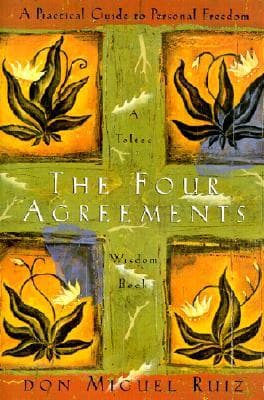
The Four Agreements: A Practical Guide to Personal Freedom cover
Archivist's Choice

The Four Agreements: A Practical Guide to Personal Freedom

Miguel Ruiz (1997)

Genre

Business / Psychology / Spirituality / Philosophy / Self-Help

Reading Time

12 Minutes

Key Themes

See below

Track Your Reading

Sign in to track this book

Ancient Toltec wisdom offers a four-part code—honoring your word, detaching from others' actions, avoiding assumptions, and always doing your best—to dismantle self-limiting beliefs and unlock true freedom, happiness, and love.

Core Idea

Miguel Ruiz's "The Four Agreements" posits that much of human suffering stems from self-limiting beliefs and agreements we make with ourselves and others, often unconsciously, that are based on fear rather than truth. Drawing from ancient Toltec wisdom, the book proposes four simple yet powerful agreements—Be Impeccable with Your Word, Don't Take Anything Personally, Don't Make Assumptions, and Always Do Your Best—as a code of conduct that can transform one's life by eliminating psychological drama, fear, and suffering, leading to personal freedom and happiness. By consciously adopting these agreements, individuals can break free from domesticated patterns of thinking and perceiving, creating a new dream for their personal reality.
Difficulty
Easy

Core idea

The central argument and framework that powers the entire book.

Miguel Ruiz's "The Four Agreements" posits that much of human suffering stems from self-limiting beliefs and agreements we make with ourselves and others, often unconsciously, that are based on fear rather than truth. Drawing from ancient Toltec wisdom, the book proposes four simple yet powerful agreements—Be Impeccable with Your Word, Don't Take Anything Personally, Don't Make Assumptions, and Always Do Your Best—as a code of conduct that can transform one's life by eliminating psychological drama, fear, and suffering, leading to personal freedom and happiness. By consciously adopting these agreements, individuals can break free from domesticated patterns of thinking and perceiving, creating a new dream for their personal reality.

At a glance

Difficulty

Easy

Key Takeaways

1

The Domestication of Humanity

How societal 'agreements' shape our self-perception and limit our freedom.

Quote

We are born with the capacity to learn how to dream, and the humans who are here before us teach us how to dream the way society dreams.

Ruiz explains 'domestication' as the process where external agreements from parents, teachers, religion, and society shape our beliefs about ourselves and the world. This creates a 'Book of Law' in our minds, defining right and wrong, and an 'Inner Judge' that constantly checks if we follow these rules. The 'Victim' within us then suffers when we fail. This framework helps us understand where self-limiting beliefs and constant self-criticism come from. This core idea is the basis for the four agreements, which offer a new way to see o...

Supporting evidence

The entire first chapter, 'The Domestication and the Dream of the Planet,' details this process, comparing human conditioning to the domestication of pets, where reward and punishment shape behavior and belief systems.

Apply this

Recognize the 'Book of Law' and 'Inner Judge' in your own mind. Question the origin of your deeply held beliefs and fears, asking if they truly serve your authentic self or are remnants of societal conditioning.

2

Be Impeccable With Your Word

Words are powerful tools of creation or destruction, impacting ourselves and others.

Quote

The word is not just a sound or a symbol. The word is a force; it is the power you have to express and communicate, to think, and thereby to create the events in your life.

This is likely the book's strongest idea and the most important agreement. Ruiz states that our words have great power; they act like magic. They can build or destroy, heal or hurt, both others and ourselves. To be 'impeccable' means using words with honesty, speaking truthfully and helpfully, and avoiding gossip or self-criticism. He compares negative words to black magic, giving the example of a mother telling her daughter she's ugly, which can shape the child's self-image for life. Positive words, affirmations, and honest communica...

Supporting evidence

The story of Hitler's use of words to manipulate an entire nation serves as a stark example of the destructive power of the word. Conversely, the power of a loving word to heal is also highlighted.

Apply this

Before speaking, ask yourself if your words are truthful, kind, and necessary. Practice self-talk that is supportive and empowering. Actively avoid gossip and negative commentary about others.

3

Don't Take Anything Personally

Others' actions are reflections of their own 'dream,' not a direct attack on you.

Quote

Whatever happens around you, don't take it personally. Nothing other people do is because of you. It is because of themselves.

This agreement helps us avoid emotional reactions. Ruiz says that when others criticize, insult, or praise us, their words and actions come from their own 'Book of Law,' their own beliefs, fears, and internal world. It has nothing to do with us directly. Taking things personally means we think we are the center of everyone else's world, but people act from their own experiences. This agreement is especially hard in close relationships, but mastering it brings great peace. It stops us from internalizing negativity and getting into unne...

Supporting evidence

Ruiz uses the example of someone calling you 'stupid.' If you don't take it personally, you understand that their comment reflects their own anger or frustration, not an objective truth about you.

Apply this

When someone offers criticism or negativity, pause and remind yourself that their words are a reflection of their internal state. Practice observing without reacting, letting others' opinions pass through you like wind.

4

Don't Make Assumptions

Unverified assumptions create misunderstandings and unnecessary suffering.

Quote

The problem with making assumptions is that we believe they are the truth. We could swear they are real.

Making assumptions causes much drama and conflict in relationships. We often create whole stories in our minds based on little information, then react as if those stories are real. Ruiz points out that we often assume others know what we want or need, which leads to disappointment when they don't deliver. Instead of assuming, the solution is simple but hard: ask questions. Clarify. Communicate. This agreement shows our habit of filling in gaps with our own interpretations, often negative, instead of seeking accurate information. It ca...

Supporting evidence

Ruiz gives the common example of a man assuming his wife knows what he wants, and when she doesn't, he gets upset, even though he never clearly communicated his desires.

Apply this

When uncertain, ask open-ended questions to clarify. In relationships, articulate your needs and expectations clearly. Challenge your own internal narratives and seek facts before reacting.

5

Always Do Your Best

Your 'best' fluctuates, but consistent effort leads to self-acceptance and growth.

Quote

Under any circumstance, always do your best, no more and no less. But keep in mind that your best is not going to be the same from one moment to the next.

This agreement balances the others, providing a path to self-acceptance and steady improvement. Ruiz clarifies that 'your best' is not a fixed standard. It changes daily, depending on your energy, mood, health, and situation. The key is to consistently put in your maximum effort for that moment. When you do your best, there is no room for self-judgment, guilt, or regret, because you know you gave all you had. This agreement is about the intention and effort, not the result. It encourages resilience and self-compassion, understanding t...

Supporting evidence

The example of a runner whose 'best' on a sick day is still their best, even if it's slower than their healthy best, illustrates the fluctuating nature of this agreement.

Apply this

Focus on the effort you put into tasks and relationships rather than solely on the results. Forgive yourself when your 'best' falls short of an ideal, recognizing the circumstances. Strive for consistent effort, not perfection.

6

The Power of Forgiveness

Forgiving ourselves and others is essential to breaking old agreements and healing.

Quote

The greatest act of courage is to be able to love yourself, and the greatest act of love is to forgive yourself.

While not one of the four agreements, forgiveness is a main idea throughout the book, especially for escaping 'domestication' and breaking old, limiting agreements. Ruiz states that true freedom comes from forgiving ourselves for not being 'perfect' according to the 'Book of Law' taught by others. This self-forgiveness disarms the Inner Judge and frees us from self-punishment. Forgiving others who have wronged us is just as important, as it releases us from resentment and anger, letting us reclaim our personal power. This idea has maj...

Supporting evidence

Ruiz discusses the 'healing' that occurs when we forgive, allowing the 'poison' of past hurts to be released, particularly in the context of the story of the man who learned to forgive his parents.

Apply this

Consciously practice self-forgiveness for past mistakes or perceived failings. Identify individuals you hold resentment towards and actively work on releasing that anger through intentional forgiveness, even if it's just an internal act.

7

The Parasite of Fear

Fear is the root of suffering, driving negative agreements and actions.

Quote

The whole problem is that we suffer from a disease called fear. Fear is the cause of all the wars, the violence, the prejudice, and the injustices in the world.

Ruiz identifies fear as the 'disease' that causes human suffering and drives our self-limiting agreements. Fear of not being good enough, fear of rejection, fear of punishment — these fears lead us to build defenses and hurt others before they can hurt us. This idea connects directly to 'Don't Take Anything Personally' and 'Don't Make Assumptions,' as our fears often project onto others, creating perceived threats where none exist. While a powerful concept, some might find this idea too simple for human psychology, as other emotions l...

Supporting evidence

Ruiz frequently links the 'Book of Law' and the 'Inner Judge' to fear, stating that the fear of punishment drives our adherence to these agreements and our self-criticism.

Apply this

Become aware of the fears that drive your decisions and reactions. When you feel triggered, ask yourself, 'What am I afraid of right now?' Work to address those fears directly rather than allowing them to dictate your behavior.

8

Breaking the Spell of the Collective Dream

Personal freedom lies in consciously choosing to rewrite our internal 'Book of Law'.

Quote

The greatest fear in the world is the fear of not being good enough. This is the great fear of the human being.

The goal of using the Four Agreements is to break free from the 'collective dream' — the shared illusion of reality and the limiting beliefs it imposes. Ruiz says we are all living in a 'dream' that is mostly not our own. By consciously adopting these new agreements, we start to dismantle the old, fear-based agreements that trap us. This process is not about fighting the old dream but creating a new personal dream based on love, joy, and truth. This takes great courage, as it often means going against societal norms, but it promises a...

Supporting evidence

The concluding chapters of the book explicitly discuss 'The New Dream' and the concept of 'resurrection' from the old dream, emphasizing the transformative power of adopting these agreements.

Apply this

Actively challenge and replace old, negative self-beliefs with new, empowering agreements. Consciously choose to observe the world through a lens of love and truth rather than fear and judgment. Engage in practices that support your personal evolution.

9

The Path to Heaven on Earth

Living the agreements transforms everyday life into an experience of joy and love.

Quote

When you are impeccable with your word, when you don't take anything personally, when you don't make assumptions, and when you always do your best, your life will be full of love, happiness, and freedom.

Ruiz proposes that consistently living the Four Agreements leads to a state he calls 'Heaven on Earth.' This is not a mystical paradise, but an achievable state of inner peace, joy, and unconditional love experienced daily. By shedding self-limiting beliefs and fear-driven behaviors, individuals can improve their relationships, careers, and overall well-being. This vision makes applying the agreements highly motivating. While the promise of 'Heaven on Earth' may sound grand, it shows the impact these principles can have on one's exper...

Supporting evidence

The final chapter, 'The New Dream: Heaven on Earth,' vividly describes the experience of living free from fear and judgment, emphasizing spontaneous joy and unconditional love as the natural outcome.

Apply this

Envision what your 'Heaven on Earth' looks like. Use this vision to motivate your daily practice of the Four Agreements, understanding that each agreement is a step towards this desired state of being.

10

The Power of Intentionality

Conscious choice and consistent practice are key to transforming our lives.

Quote

The way to freedom is to break the old agreements that come from fear, and to adopt new agreements that come from love.

The book does not just present wisdom; it offers a direct, active path. Ruiz states that transformation is not passive; it requires intention and consistent effort to 'break' old agreements and 'adopt' new ones. The Four Agreements are not suggestions but a 'code of conduct' that requires active involvement. This highlights the self-help genre's core idea: personal responsibility for one's inner state. The challenge lies in how deeply ingrained our conditioning is, making the practice of these agreements a lifelong journey rather than...

Supporting evidence

Ruiz repeatedly stresses the need to 'practice' the agreements, acknowledging that breaking lifelong habits and beliefs takes effort and repetition, likening it to learning a new language.

Apply this

Commit to consciously practicing one agreement at a time, or all four daily. Journal your experiences and challenges. Recognize that setbacks are part of the process and recommit to the practice each day.

Critical analysis

Notable Quotes

Quiz

Test Your Knowledge

Ready to see how well you understood this book? Take our interactive quiz with 10 questions.

10
Questions
~5
Minutes
?
Best Score

Key Questions (FAQ)

The Four Agreements are a powerful code of conduct based on ancient Toltec wisdom. They are: Be Impeccable With Your Word, Don't Take Anything Personally, Don't Make Assumptions, and Always Do Your Best.

About the author