“The memory of the goat was always there, a stench of blood and fear.”
— Reflecting on Trujillo's brutal reign and the lingering trauma.

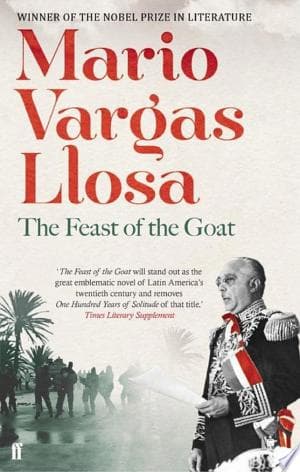
Mario Vargas Llosa (2012)
Genre
Politics / Historical Fiction
Reading Time
15-20 hours
Key Themes
See below
Sign in to track this book
A New York lawyer returns to the Dominican Republic to confront the ghosts of Trujillo's brutal dictatorship, unearthing her family's entanglement in the regime's violent end and the enduring trauma it inflicted.
In 1996, Urania Cabral, a lawyer in New York, returns to Santo Domingo after 35 years. She visits her ailing, catatonic father, Agustín Cabral, a former official in the Trujillo regime, now in a wheelchair and unable to speak. Her return surprises her aunt and cousins, who do not know why she left as a teenager. Urania's thoughts show a deep trauma and hatred for her father, tied to the oppressive memory of the Trujillo dictatorship. Her visit makes her relive the regime's final days and the personal tragedy that shaped her life.
The story moves to May 30, 1961, focusing on the conspirators preparing to assassinate Rafael Leónidas Trujillo, 'El Benefactor' or 'The Goat.' Men like Antonio de la Maza, Antonio Imbert Barrera, and Salvador Estrella Sadhalá gather weapons and practice their roles. They are motivated by patriotism, personal revenge, and a desire to free the Dominican Republic from Trujillo's brutal rule, which has lasted over 30 years. The plan is to ambush Trujillo's car on the coastal highway, hoping his death will start a popular uprising and lead to democracy, though they know the great risks.
On the same day, Rafael Trujillo is shown in his final hours, displaying his absolute power, paranoia, and his almost god-like view of himself. He attends a cabinet meeting, where he humiliates his ministers, including Agustín Cabral, who has lost favor. Trujillo is concerned with the country's economic problems, growing international pressure from the OAS and the United States, and the perceived disloyalty of some in his inner circle. He drives alone towards his country estate, Hacienda Fundación, thinking about his legacy and the future of his regime, unaware of the ambush waiting for him.
As Trujillo's Chevrolet speeds along the Malecón, the conspirators act. They stop his car, and after a tense standoff, they shoot and kill the dictator. The scene is chaotic and violent, with Trujillo fighting back. The conspirators, excited but scared, flee, believing they have freed their country. However, their next actions are disorganized, and the expected popular uprising does not happen right away. This initial success is quickly overshadowed by the realization that the regime's power structure is still strong, leading to a brutal response.
News of Trujillo's death reaches his inner circle, causing disbelief and panic. His cruel son, Ramfis Trujillo, returns from Paris and immediately takes charge. Ramfis, with Johnny Abbes García, head of the military intelligence service (SIM), starts a systematic and brutal search for the assassins. Many conspirators are captured, tortured, and executed. The regime's response is swift and merciless, meant to create terror and keep power, showing that even without Trujillo, the oppression machine remains strong. The Dominican Republic enters a period of intense fear and uncertainty.
The story follows the captured conspirators' terrible fates. They endure torture from Ramfis and his men, often with Ramfis present and participating. Their families are also targeted. One by one, the men who killed Trujillo are executed, their bodies often desecrated. Antonio Imbert Barrera is the only one who escapes capture and survives the initial purge, hiding for months before the regime's eventual fall. Their sacrifice, while not immediately starting a revolution, sets the stage for future change.
The story reveals why Agustín Cabral lost favor. Once a trusted advisor, 'Agent 00,' Trujillo increasingly saw him as a problem because of his perceived declining loyalty and his daughter Urania's outspokenness. To regain favor and save his life, Agustín makes an unthinkable sacrifice: he offers his 14-year-old daughter, Urania, to Trujillo for the dictator's sexual gratification on the night of the assassination. This horrific event, which Urania remembers clearly, is the source of her lifelong trauma, her hatred for her father, and her leaving the country.
Back in 1996, Urania confronts her silent, incapacitated father. Driven by years of anger and a need for closure, she finally tells her shocked aunt and cousins what happened to her on the night of May 30, 1961. She recounts how her father, desperate to please Trujillo and save himself, delivered her to the dictator's bed. This revelation shatters the family's illusions about Agustín, exposing his cowardice and the terrible price his daughter paid under the regime. Urania's confession is a painful act of freedom and a condemnation of the moral compromises made under tyranny.
Despite Ramfis's brutal response, Trujillo's assassination ultimately causes the regime's collapse. International pressure grows, and the United States, which had supported Trujillo for decades, begins to withdraw its backing. The remaining Trujillo family members, including Ramfis, eventually flee the country, taking large amounts of wealth. The country slowly begins the difficult process of moving away from dictatorship, though the effects of violence, fear, and corruption last for decades. The assassination, though messy, marks the clear end of an era.
After sharing her painful truth, Urania feels a fragile sense of release, though her past emotional scars remain. Her family must deal with the shocking revelations about Agustín and their country's history. Urania acknowledges that while she cannot forgive her father, she has started to heal by speaking out. She prepares to return to New York, leaving the physical reminder of her trauma in the Dominican Republic. The book ends with the understanding that while the dictator is gone, the psychological and societal wounds from 'The Goat' will continue to affect generations.
The Protagonist
Urania moves from suppressing her trauma to confronting it directly, ultimately achieving a painful but necessary catharsis by revealing the truth to her family.
The Antagonist
Trujillo's arc culminates in his assassination, marking the violent end of his tyrannical reign.
The Supporting
Agustín's arc is one of decline, from a powerful but morally compromised official to a disgraced, broken man, a victim of his own choices and the regime he served.
The Supporting
Imbert Barrera survives the assassination and its brutal aftermath, becoming a historical survivor and a testament to the conspirators' courage.
The Supporting
De la Maza successfully assassinates Trujillo but is subsequently captured, tortured, and killed, becoming a martyr for the cause of freedom.
The Supporting
Ramfis briefly consolidates power through extreme brutality after his father's death, but ultimately flees the country as the regime crumbles.
The Supporting
Abbes García's arc demonstrates the unbridled power and cruelty of the regime's repressive apparatus, which he wields until the family's eventual downfall.
The Supporting
Turko's arc is one of youthful idealism leading to martyrdom, as he is brutally killed for his involvement in the assassination.
The Mentioned
Manolo's influence grows as a symbol of resistance, though his eventual death highlights the continued oppression even after Trujillo's demise.
The novel shows how absolute power corrupts not only the dictator, Trujillo, but also those who serve him and society. Trujillo's self-importance, paranoia, and sexual immorality are direct results of his unchecked authority. His ministers, like Agustín Cabral, become flatterers, willing to do terrible things to keep their positions. The entire nation lives in fear, where moral integrity is lost, and personal dignity is sacrificed for survival, as seen when Urania is given to Trujillo. This theme is central to understanding the Dominican Republic under Trujillo.
“He was the boss, the owner of the country, the master of lives and deaths, and he had been for thirty-one years, so long that no one could remember a time without him.”
Urania Cabral's story explores trauma and how historical events affect individual memory. Her leaving the country and her inability to speak about her past for decades show the deep psychological scars from her assault and the oppressive dictatorship. Her return to Santo Domingo forces her to face these memories, a painful process of reliving the past to find some peace. The novel shows how personal trauma connects with collective historical trauma, and how suppressed memories can ruin a life.
“The past doesn't die. It lives in us, it is us, and it will kill us if we don't kill it first.”
The conspirators' story shows the human spirit's ability to resist and sacrifice when faced with tyranny. Despite Trujillo's overwhelming power and the near certainty of torture and death, men like Imbert Barrera and Antonio de la Maza risk everything to free their country. Their actions, though initially leading to a brutal response, ultimately cause the regime's downfall. The theme explores the moral courage needed to defy an oppressive force and the high cost paid by those who dream of freedom.
“They were going to kill him, they were going to kill the Goat, and they would be killed, too, but the country would be free.”
The novel connects the characters' personal lives with major political history. Urania's personal trauma is a direct result of the political schemes and moral decay of the Trujillo regime. Her father's betrayal is not just a personal failing but a reflection of the compromises and cruelties demanded by the dictatorship. Conversely, Trujillo's assassination has deep personal consequences for the conspirators and their families. The book argues that in a totalitarian state, personal life is always political, and no individual life is untouched by the ruling power.
“There was no private life in the time of Trujillo, only life for Trujillo, by Trujillo, and through Trujillo.”
The patriarchy of the Trujillo regime is highlighted by the sexual violence against women. Urania's rape by Trujillo, arranged by her own father, is a horrific example of this theme. It shows how women's bodies become tools of power and submission in a male-dominated, tyrannical system. The casual objectification of women, Trujillo's mistresses, and women's general vulnerability under the regime show a society where female independence is severely suppressed. This theme helps understand Urania's trauma and the broader societal oppression.
“That night, she stopped being a girl and became a thing, a piece of meat offered to the Beast.”
Alternating narratives provide a comprehensive view of the dictatorship's end.
The novel employs a tripartite narrative structure, alternating between three main perspectives and two distinct timelines. Urania Cabral's first-person narrative in 1996 provides a reflective, trauma-informed view of the regime's legacy. The third-person omniscient perspective follows the conspirators on May 30, 1961, detailing the assassination plot. A third-person perspective also delves into Trujillo's final day, offering insight into his thoughts and actions. This shifting perspective allows Llosa to present a multifaceted and holistic understanding of the dictatorship, its fall, and its enduring consequences, building suspense and revealing the full horror of the past gradually.
Urania's inner thoughts reveal her deep psychological trauma.
Urania Cabral's sections are heavily reliant on internal monologue and stream of consciousness. Her narrative is often a torrent of unspoken thoughts, memories, and emotions, revealing her deep-seated anger, pain, and the complex process of confronting her past. This device allows the reader direct access to her psychological state, emphasizing the profound impact of her trauma and the difficulty of articulating unspeakable horrors. It also provides a stark contrast to the more objective, historical accounts of the other narratives, grounding the political events in a deeply personal, psychological reality.
Seamless integration of historical facts and fictionalized events.
Vargas Llosa masterfully weaves meticulously researched historical facts, real figures, and documented events of the Trujillo regime into the fictional narrative. The names of the conspirators, the details of the assassination, and the general atmosphere of fear and repression are historically accurate. This blending of fact and fiction lends authenticity and weight to the story, making the atrocities and the characters' struggles feel incredibly real. It allows the novel to function not just as a work of fiction, but also as a powerful historical document, illuminating a dark chapter in Dominican history.
Trujillo's nickname symbolizes his predatory nature and the country's subjugation.
The nickname 'The Goat' (El Chivo) for Trujillo is a powerful and multifaceted symbol. It evokes the image of a virile, lustful, and predatory animal, reflecting Trujillo's well-known sexual appetites and his abuse of power. It also carries connotations of a sacrificial animal, hinting at his eventual demise. Furthermore, 'goat' can imply stubbornness and a crude, untamed nature. This epithet encapsulates his tyrannical rule, his personal depravity, and the way he treated the Dominican Republic as his personal dominion, to be exploited and consumed at will.
Hints of impending doom and characters' unawareness create tension.
The novel effectively uses foreshadowing and dramatic irony, particularly in Trujillo's narrative segments. The reader knows from the outset that Trujillo will be assassinated, creating a constant tension as he goes about his final day, oblivious to his impending death. His internal reflections on his legacy and his belief in his invincibility are undercut by the reader's knowledge of his fate. Similarly, the conspirators' hopes for an immediate uprising are dramatically ironic, as the reader knows the brutal crackdown that follows. This technique heightens the tragedy and the sense of inevitability surrounding the events.
“The memory of the goat was always there, a stench of blood and fear.”
— Reflecting on Trujillo's brutal reign and the lingering trauma.
“He had been the most powerful man in the country, and now he was a piece of meat.”
— Describing the immediate aftermath of Trujillo's assassination.
“Dictatorships are like trees: they grow from a single seed, but their roots spread everywhere.”
— A general reflection on the insidious nature and reach of authoritarian regimes.
“That's how it is with monsters, Urania, they never think they're monsters.”
— Urania's internal monologue about Trujillo's self-perception.
“Fear, she thought, was the real currency of power.”
— Urania pondering the mechanisms of Trujillo's long-standing control.
“Every dictator creates his own hell, and then he makes everyone else live in it.”
— A commentary on the widespread suffering inflicted by Trujillo.
“The past is never dead. It's not even past.”
— Urania's realization about the enduring impact of her past experiences under Trujillo.
“To be a man in this country, you had to be a coward, a traitor, or a corpse.”
— A character's cynical view of survival under the Trujillo regime.
“The truth was a luxury few could afford in the Dominican Republic.”
— Highlighting the pervasive censorship and misinformation during the dictatorship.
“The Generalissimo was not a man, he was an institution, a national catastrophe.”
— A character's assessment of Trujillo's role and impact on the nation.
“Sometimes, the only way to be free is to kill the past.”
— Urania's internal struggle with her traumatic history.
“He governed with an iron fist, but also with a velvet glove, when it suited him.”
— Describing Trujillo's dual approach of brutal force and manipulative charm.
“The silence was sometimes more terrifying than the screams.”
— Reflecting on the atmosphere of fear and suppressed dissent.
“Revenge, like power, was a dish best served cold, and often, without a trace.”
— A character contemplating the clandestine nature of their actions against the regime.
Ready to see how well you understood this book? Take our interactive quiz with 10 questions.
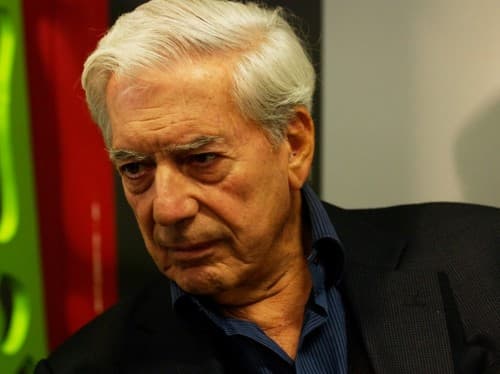
Jorge Mario Pedro Vargas Llosa, 1st Marquess of Vargas Llosa, more commonly known as Mario Vargas Llosa, is a Peruvian novelist, journalist, essayist and former politician, who also holds citizenship of Spain and the Dominican Republic. Vargas Llosa is one of Latin America's most significant novelists and essayists, and one of the leading writers of his generation. Some critics consider him to have had a larger international impact and worldwide audience than any other writer of the Latin American Boom. In 2010 he won the Nobel Prize in Literature, "for his cartography of structures of power and his trenchant images of the individual's resistance, revolt, and defeat." He also won the 1967 Rómulo Gallegos Prize, the 1986 Prince of Asturias Award, the 1994 Miguel de Cervantes Prize, the 1995 Jerusalem Prize, the 2012 Carlos Fuentes International Prize, and the 2018 Pablo Neruda Order of Artistic and Cultural Merit. In 2021, he was elected to the Académie française.

Brett Casper
5.0
Dirk Uffelmann
4.7

Winston S. Churchill
4.5

Chimamanda Ngozi Adichie
4.5
Will Durant
4.4
Thomas Sowell
4.4
W.E.B. Du Bois
4.3
Alan Moore
4.3