BookBrief
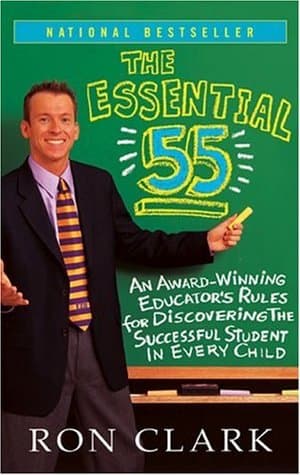
The Essential 55 cover
Archivist's Choice

The Essential 55

Ron Clark (2003)

Genre

Reference / Relationships

Reading Time

180 min

Key Themes

See below

Track Your Reading

Sign in to track this book

Ron Clark's "The Essential 55" gives parents and teachers practical ways to teach children respect, responsibility, and life skills, showing how a dedicated teacher's advice can change lives.

Core Idea

Ron Clark's "The Essential 55" states that setting clear, consistent, and firm behavioral expectations and etiquette rules is key to creating an effective and respectful learning environment. The book argues that by teaching students specific social manners, encouraging mutual respect, and holding them to high standards—both academically and behaviorally—teachers can help students reach their full potential. This framework emphasizes that character development, personal responsibility, and social competence matter as much as academic achievement. These qualities are best taught through structured discipline, positive encouragement, and a firm belief in every child's ability to succeed. The main idea is that when students understand and follow a clear code of conduct, they gain the self-discipline, respect for others, and social skills needed for success in school and beyond. Clark shows that these basic elements create a positive cycle: order leads to focus, respect leads to cooperation, and high expectations lead to effort. This ultimately results in better education and well-rounded individuals.
Reading time
180 min
Difficulty
Easy
✓ Read this if...
You are an educator, parent, or anyone working with children who believes in the power of high expectations, clear rules, and structured environments to foster respect, responsibility, and academic success.
✗ Skip this if...
You prefer a more unstructured, child-led, or permissive approach to education and behavior management, or you are looking for deep academic theory rather than practical, prescriptive methods.

Core idea

The central argument and framework that powers the entire book.

Ron Clark's "The Essential 55" states that setting clear, consistent, and firm behavioral expectations and etiquette rules is key to creating an effective and respectful learning environment. The book argues that by teaching students specific social manners, encouraging mutual respect, and holding them to high standards—both academically and behaviorally—teachers can help students reach their full potential. This framework emphasizes that character development, personal responsibility, and social competence matter as much as academic achievement. These qualities are best taught through structured discipline, positive encouragement, and a firm belief in every child's ability to succeed.

The main idea is that when students understand and follow a clear code of conduct, they gain the self-discipline, respect for others, and social skills needed for success in school and beyond. Clark shows that these basic elements create a positive cycle: order leads to focus, respect leads to cooperation, and high expectations lead to effort. This ultimately results in better education and well-rounded individuals.

At a glance

Reading time

180 min

Difficulty

Easy

Read this if...

You are an educator, parent, or anyone working with children who believes in the power of high expectations, clear rules, and structured environments to foster respect, responsibility, and academic success.

Skip this if...

You prefer a more unstructured, child-led, or permissive approach to education and behavior management, or you are looking for deep academic theory rather than practical, prescriptive methods.

Key Takeaways

1

The Power of High Expectations

Setting clear, non-negotiable standards elevates student behavior and academic performance.

Quote

When you expect the best from your students, they will often rise to meet those expectations, even if they didn't believe they could at first.

Ron Clark believes children can achieve more than many adults think. By setting high standards for behavior, respect, and academic effort, Clark creates a setting where students often surpass these expectations. This isn't about strict control, but about teaching personal responsibility and showing that excellence comes from consistent effort and following basic rules. He demonstrates that when expectations are high and the path to meet them is clear, students will try to reach them, often surprising themselves and their teachers.

Supporting evidence

Clark's own experience in Harlem schools, where despite initial skepticism, his students transformed from disengaged to high-achieving, demonstrating impeccable manners and academic prowess.

Apply this

Parents and teachers should articulate clear, high expectations for children in all areas – academic, social, and personal responsibility. Consistently reinforce these standards without wavering, providing support and clear consequences when necessary.


high-expectationsstudent-empowerment
2

Respect is the Foundation

Cultivating mutual respect between students, teachers, and the learning environment is paramount.

Quote

Treat everyone with respect, regardless of who they are or what their position is. It costs you nothing and means everything.

Central to 'The Essential 55' is a strong focus on respect. This means not just students respecting teachers, but also students respecting each other, themselves, their learning materials, and the classroom space. Clark clearly outlines rules that enforce this, from how to speak to adults to how to treat personal items and shared resources. By making respect essential, he prevents common classroom problems and creates a peaceful learning atmosphere. This basic respect goes beyond the classroom, preparing students for positive interact...

Supporting evidence

Rule #1: 'Respond to any adult with 'Yes, sir' or 'Yes, ma'am,' or 'No, sir' or 'No, ma'am.'' This simple rule immediately establishes a baseline of respect for authority figures.

Apply this

Implement specific, clear rules that directly address respectful behavior towards people and property. Model respectful interactions yourself and consistently correct disrespectful behavior, explaining the 'why' behind the rule.

mutual-respectclassroom-culture
3

The Etiquette Advantage

Teaching proper social etiquette equips children with invaluable tools for success in life.

Quote

Good manners are not just about being polite; they are about showing consideration for others and opening doors to opportunities.

Clark spends much time teaching social graces and etiquette, skills often overlooked today. From how to answer a phone to dining manners and good conversation skills, these 'soft skills' are presented as vital life skills. He argues that children with strong social etiquette are more likely to make good impressions, handle social situations confidently, and open more doors for themselves, both personally and professionally. This focus on polish and presentation is a key part of Clark's method, preparing students for interactions far b...

Supporting evidence

Rules like 'Do not chew gum in class,' 'Always look people in the eye when speaking to them,' and detailed instructions on how to set a table or properly introduce oneself.

Apply this

Actively teach and practice social etiquette skills, such as table manners, conversational skills, and polite greetings. Create opportunities for children to apply these skills in real-world scenarios.

social-skillsetiquettelife-skills
4

Consequences as Learning Opportunities

Consistent and logical consequences are crucial for teaching responsibility and accountability.

Quote

When you break a rule, there must be a consequence. It's not about punishment, but about learning from your actions and making better choices next time.

Clark's rule system works because it includes a clear, consistent, and logical system of consequences. He avoids random punishments, choosing instead consequences that directly relate to the misstep and offer a chance to learn. This helps students understand the direct link between their actions and the results, building a strong sense of accountability. The predictable and fair consequence system builds trust and helps students learn the rules, rather than just fearing punishment. This approach teaches self-discipline and the importa...

Supporting evidence

If a student breaks a rule, a specific, pre-determined consequence (e.g., losing privilege, extra chores) is applied without exception. He emphasizes that the consequence is delivered calmly and consistently.

Apply this

Establish clear, pre-defined consequences for rule-breaking that are logical and directly related to the action. Apply them consistently and calmly, focusing on the learning aspect rather than solely on punishment.

accountabilitydisciplinelogical-consequences
5

The Power of Enthusiasm

Bringing genuine passion and energy to teaching inspires and engages students.

Quote

Your energy is contagious. If you're excited about what you're teaching, your students will be excited to learn.

Beyond the rules, Clark's success comes from his great energy and love for teaching. He doesn't just teach the curriculum; he performs it, making learning an exciting and memorable experience. This contagious energy is important for engaging students, especially those who may be uninterested or come from difficult backgrounds. His lively approach shows that learning can be fun and active, turning the classroom into a place where students truly want to be. This passion motivates students, showing that a teacher's attitude greatly affec...

Supporting evidence

Clark's use of songs, dances, and creative teaching methods to make lessons engaging, such as rapping multiplication tables or turning historical events into dramatic performances.

Apply this

Inject genuine enthusiasm and creativity into teaching and parenting. Find ways to make learning fun and engaging, using different modalities and personal passion to inspire children.

teacher-passionstudent-engagementcreative-teaching
6

No Excuses, Just Effort

Fostering a mindset where effort and perseverance overcome perceived limitations.

Quote

I don't accept excuses. I accept effort. If you try your best, even if you fall short, that's what matters.

Clark strongly believes in the 'no excuses' idea, not as punishment, but as a way to empower students to take charge of their learning and behavior. He challenges students to always do their best, no matter their starting point or perceived difficulties. This mindset shifts the focus from natural ability or outside circumstances to the power of persistence and hard work. By consistently pushing students to try, to redo, and to improve, he teaches a growth mindset where challenges are seen as chances to grow, rather than impossible obs...

Supporting evidence

Clark's insistence that students re-do assignments until they meet the standard, rather than accepting substandard work as 'good enough.' His relentless encouragement for students to push past frustration.

Apply this

Encourage children to always give their best effort and persist through challenges. Emphasize the value of process and improvement over immediate perfection, and avoid accepting excuses for lack of effort.

growth-mindsetperseverancework-ethic
7

Community and Belonging

Building a strong classroom community where everyone feels valued and supported.

Quote

When students feel like they belong, and that their classroom is a family, they will look out for each other and strive to make it a better place.

Despite the strict rules, Clark's classroom has a strong sense of community and family. He actively creates a setting where students support each other, celebrate successes, and offer encouragement during difficulties. This is not just about individual achievement; it's about group growth. By building strong bonds and a shared purpose, he creates a safe space where students feel comfortable taking risks, making mistakes, and learning from each other. This sense of belonging is a strong motivator, ensuring students care not only about ...

Supporting evidence

Clark's implementation of 'family meetings,' where students discuss issues, celebrate achievements, and offer constructive feedback to one another, building collective responsibility.

Apply this

Create opportunities for children to collaborate, support each other, and contribute to a shared group identity. Emphasize teamwork and mutual respect, celebrating collective achievements.

classroom-communitybelongingteamwork
8

Beyond Academics: Character Development

Education must extend beyond subject matter to encompass moral character and civic responsibility.

Quote

We are not just teaching subjects; we are shaping human beings. Character is as important as calculus.

While academic rigor is important, 'The Essential 55' makes clear that Clark's view of education is complete, valuing character development alongside intellectual growth. The rules themselves are designed to teach virtues like honesty, integrity, kindness, and personal responsibility. He aims to produce not just smart students, but good people ready to be productive, respectful citizens. This focus on moral education offers a strong alternative to purely test-driven education models, advocating for a return to basic values that build ...

Supporting evidence

Many rules directly address character, such as 'Be honest,' 'Be kind,' and 'Do not interrupt.' These are integrated into daily routines, not just taught as abstract concepts.

Apply this

Integrate character education into daily interactions by explicitly teaching and reinforcing virtues like honesty, empathy, and responsibility. Provide opportunities for children to demonstrate these traits.

character-educationmoral-developmentcivic-responsibility
9

The Power of Consistency

Unwavering consistency in applying rules and expectations is the cornerstone of effective discipline.

Quote

Consistency is not just important; it is everything. If you are not consistent, the rules mean nothing.

The large number and specific nature of Clark's 55 rules might seem too much, but their effectiveness comes from their absolute and constant application. Every rule is enforced, every time, by every adult in the classroom. This consistency removes confusion, builds trust, and ensures students understand how their environment works. It teaches them that boundaries are firm and reliable, creating a sense of security and clarity. Inconsistency, Clark argues, quickly undermines authority and makes any rule system useless. This principle i...

Supporting evidence

Clark describes how he and his teaching assistants meticulously ensure that every rule infraction, no matter how small, is addressed immediately and consistently, leaving no room for doubt.

Apply this

Be absolutely consistent in applying rules and consequences. Avoid making exceptions or wavering, as this undermines the effectiveness of any established boundaries. All caregivers should be on the same page.

consistencydiscipline-effectivenessrule-enforcement
10

Parents as Partners

Engaging parents as active partners is vital for reinforcing values and ensuring student success.

Quote

The greatest impact on a child's success comes from the partnership between home and school.

Clark understands that the classroom is not separate; student success is greatly affected by the home environment. He actively tries to involve parents, not just to inform them, but to make them partners in reinforcing the values and expectations taught at school. By sharing his rules and philosophy, he encourages a unified approach, ensuring children receive consistent messages about respect, responsibility, and effort from all important adults in their lives. This collaboration creates a strong support system, maximizing the positiv...

Supporting evidence

Clark's practice of sending home his list of 55 rules and actively communicating with parents to ensure they understand and support his methods, fostering a consistent message between school and home.

Apply this

Actively communicate with parents or guardians, sharing your expectations and strategies. Seek their partnership in reinforcing positive behaviors and values at home to create a cohesive support system for the child.

parent-engagementhome-school-partnershipshared-responsibility

Critical analysis

Notable Quotes

Never get so comfortable with success that you stop seeking new ways to improve.

Emphasizing continuous improvement and avoiding complacency.

When you have respect for yourself, you will have respect for others.

Highlighting the foundational role of self-respect in interpersonal relationships.

The greatest gift you can give another is the purity of your attention.

Stresssing the importance of truly listening and being present for others.

Always look people in the eye when speaking to them.

A fundamental rule for showing respect and confidence in communication.

When someone gives you a gift, always send a handwritten thank-you note.

A rule promoting gratitude and proper etiquette.

If you are asked a question in conversation, you should ask one in return.

Encouraging reciprocal engagement and genuine interest in dialogue.

Don't be afraid to fail, be afraid not to try.

Motivating readers to overcome fear and embrace effort.

The way you dress speaks volumes about who you are and how you perceive yourself.

Discussing the importance of appearance and presentation.

When you are a guest in someone's home, always offer to help.

A rule demonstrating politeness, helpfulness, and good manners.

Your reputation is built on your actions, not just your words.

Emphasizing the importance of consistency between words and deeds.

Never interrupt an adult while they are speaking.

A key rule for showing respect and proper conversational etiquette.

Always share the credit for a job well done.

Promoting humility and teamwork in achievements.

A true leader inspires others to become more than they thought they could be.

Defining the essence of effective leadership.

The best way to make a friend is to be a friend.

A simple yet profound principle for building genuine relationships.

Quiz

Test Your Knowledge

Ready to see how well you understood this book? Take our interactive quiz with 10 questions.

10
Questions
~5
Minutes
?
Best Score

Key Questions (FAQ)

The Essential 55 outlines a set of fundamental rules and guidelines for teaching children, focusing on respect, responsibility, and effective classroom management. It provides practical advice for both parents and educators on fostering positive behaviors and academic success.

About the author