BookBrief
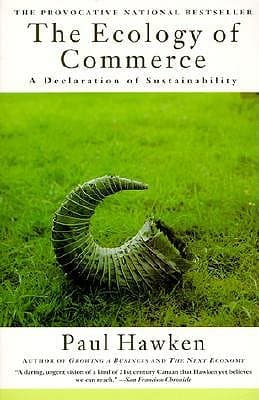
The Ecology of Commerce cover
Archivist's Choice

The Ecology of Commerce

Paul Hawken (1993)

Genre

Business / Politics / Economics / Science

Reading Time

6-8 hours

Key Themes

See below

Track Your Reading

Sign in to track this book

Paul Hawken's "The Ecology of Commerce" presents a new way for businesses to move from harmful practices to ones that restore the planet, showing that economic health and ecological well-being depend on each other.

Core Idea

Paul Hawken argues that common industrial and commercial practices harm the planet's ecological systems, rather than just being inefficient. He says the current economic system, which uses up resources and pollutes, cannot last. He believes small improvements are not enough. Instead, Hawken suggests a complete change: commerce should become a restorative force. He advocates for businesses to use ecological design, eliminate waste, offer services instead of just products, and include environmental costs in their budgets. He imagines an economy that works like natural systems, rebuilding the environment instead of damaging it. He calls for a new understanding of wealth, success, and the purpose of business to achieve true sustainability and human well-being.
Reading time
6-8 hours
Difficulty
Medium
✓ Read this if...
You believe that current business models are unsustainable and are looking for a comprehensive, systemic critique of industrialism and a vision for a restorative economy. This is for you if you're a business leader, policymaker, student, or engaged citizen seeking a foundational text on ecological economics and corporate responsibility.
✗ Skip this if...
You are looking for a purely practical 'how-to' guide for greening a specific business without engaging with the broader philosophical and economic overhaul. If you prefer incremental changes within the existing capitalist framework, this book's radical proposals might feel overwhelming or impractical.

Core idea

The central argument and framework that powers the entire book.

Paul Hawken argues that common industrial and commercial practices harm the planet's ecological systems, rather than just being inefficient. He says the current economic system, which uses up resources and pollutes, cannot last. He believes small improvements are not enough. Instead, Hawken suggests a complete change: commerce should become a restorative force. He advocates for businesses to use ecological design, eliminate waste, offer services instead of just products, and include environmental costs in their budgets. He imagines an economy that works like natural systems, rebuilding the environment instead of damaging it. He calls for a new understanding of wealth, success, and the purpose of business to achieve true sustainability and human well-being.

At a glance

Reading time

6-8 hours

Difficulty

Medium

Read this if...

You believe that current business models are unsustainable and are looking for a comprehensive, systemic critique of industrialism and a vision for a restorative economy. This is for you if you're a business leader, policymaker, student, or engaged citizen seeking a foundational text on ecological economics and corporate responsibility.

Skip this if...

You are looking for a purely practical 'how-to' guide for greening a specific business without engaging with the broader philosophical and economic overhaul. If you prefer incremental changes within the existing capitalist framework, this book's radical proposals might feel overwhelming or impractical.

Key Takeaways

1

Industrialism's Fatal Flaw

Modern commerce is inherently destructive to the environment, not just inefficient.

Quote

The design of the industrial system itself is flawed, not just its efficiency. It is a system that creates waste and pollution as an inevitable outcome.

Hawken says the current industrial model, which extracts, produces, consumes, and disposes of resources, cannot last. It assumes endless resources and waste disposal, ignoring ecological limits and the true costs of pollution. This requires a complete system redesign, not just minor improvements. The current system hides environmental and social costs, making harmful practices seem profitable while the planet and future generations suffer. This flaw means we must rethink how businesses operate and how economies are built.

Supporting evidence

Hawken points to the massive accumulation of waste, greenhouse gases, and toxic chemicals since the Industrial Revolution, directly linking these to the design principles of the economic system rather than just individual bad actors.

Apply this

Businesses must move beyond 'less bad' to 'net positive.' This means adopting circular economy principles, designing products for disassembly and reuse, and internalizing environmental costs rather than externalizing them.

linear-economyexternalitiessystemic-designecological-limits
2

Beyond 'Less Bad' to 'Restorative'

Sustainability isn't about minimizing harm, but actively healing and regenerating natural systems.

Quote

To be less bad is not to be good. To be less toxic is not to be healthy. To be less wasteful is not to be thrifty. To be less harmful is not to be restorative.

Hawken criticizes the common corporate idea of 'sustainability,' which often means only reducing harm. He says this 'less bad' approach is not enough. True ecological commerce must move beyond reducing harm to actively restoring and regenerating. This means designing systems and products that do no harm and also improve ecosystem health. It is a shift from damage control to ecological healing, recognizing that nature provides essential services that need to be replenished. The goal is to create businesses that give back more than they...

Supporting evidence

Hawken contrasts companies that merely reduce their carbon footprint with those like Interface (though not explicitly named in this book, the philosophy is there) that aim for 'Mission Zero' and eventually 'Climate Take Back,' demonstrating a shift towards restorative goals.

Apply this

Companies should set ambitious goals to not just reduce waste but eliminate it, to not just minimize pollution but to create products that enhance ecological health, and to invest in regenerating natural capital.

restorative-economynet-positiveregenerative-designecological-restoration
3

The Economic Invisibility of Nature

Current economic models fail to value natural capital, leading to its destruction.

Quote

The greatest failing of our economic system is that it does not accurately value natural capital. It treats nature as an infinite resource and a free waste dump.

A key problem Hawken identifies is that the economic system ignores the value of natural resources and ecosystem services. Clean air, fresh water, fertile soil, biodiversity, and a stable climate are treated as 'externalities' – free goods that do not appear on balance sheets until they are damaged and need expensive fixes. This creates a system where exploiting nature is profitable, but preserving it is not, leading to the steady loss of what makes long-term prosperity possible. Including these environmental costs in accounting is es...

Supporting evidence

Hawken cites the destruction of rainforests for short-term timber profits without accounting for the loss of biodiversity, climate regulation, or indigenous livelihoods. He also mentions the depletion of fisheries due to a lack of pricing for the resource itself, only the cost of extraction.

Apply this

Advocate for policies that internalize environmental costs, such as carbon taxes, ecological tariffs, and payment for ecosystem services. Businesses should develop internal accounting systems that track natural capital depletion and replenishment.

natural-capitalecosystem-servicestrue-cost-accountingenvironmental-externalities
4

The Power of Ecological Design

Mimicking nature's closed-loop systems is key to sustainable production.

Quote

Nature operates in closed loops, where every output is an input for something else. Our industrial systems must learn to do the same.

Hawken stresses the importance of ecological design, taking ideas from natural systems that regenerate and produce no waste. In nature, everything is used; one process's output becomes another's input. Industrial processes, however, are usually linear and create much waste. Ecological design aims to copy nature's cycles, creating products and systems where materials can be reused or safely returned to the environment. This means designing products for easy disassembly, using safe materials, and integrating industrial processes into la...

Supporting evidence

Hawken implicitly references biomimicry and industrial ecology concepts, even if not using those specific terms. He highlights the contrast between a forest ecosystem's nutrient cycling and a typical factory's waste stream.

Apply this

Businesses should invest in R&D for product redesign, material innovation (e.g., biodegradable plastics, non-toxic dyes), and reverse logistics to facilitate product take-back and recycling. Embrace circular economy principles in all stages of production.

ecological-designbiomimicrycircular-economycradle-to-cradleindustrial-ecology
5

Redefining Wealth and Prosperity

True prosperity includes ecological health and social equity, not just financial growth.

Quote

We are currently liquidating our natural capital to create financial capital, a process that is ultimately impoverishing us all. True wealth is not just money, but healthy communities and a living planet.

Hawken questions the usual definition of wealth, often linked to Gross National Product (GNP) and money. He argues this narrow view ignores the loss of natural resources and social well-being, leading to 'impoverished growth.' True prosperity, he says, must include ecological health, social fairness, and a good quality of life for everyone. This requires moving from an economy focused only on increasing output to one that prioritizes human and ecological thriving. Policies and business models should aim for lasting well-being rather t...

Supporting evidence

He implicitly critiques the limitations of GDP as a measure of progress, highlighting how it includes 'defensive expenditures' (e.g., cleaning up pollution) as positive contributions while ignoring the intrinsic value of intact ecosystems.

Apply this

Support alternative economic indicators that go beyond GDP, such as the Genuine Progress Indicator (GPI) or Gross National Happiness. Businesses should measure their success not just by profit but by their social and environmental impact, adopting frameworks like B Corp certification.

genuine-progress-indicatorsocial-equityquality-of-lifesustainable-development
6

The Role of Business: Agents of Change

Businesses, not just governments, have the power and responsibility to drive ecological transformation.

Quote

Business is the only mechanism on the planet today powerful enough to reverse environmental degradation.

Hawken places much responsibility on businesses, saying they are in a unique position to lead the needed ecological transformation. While government rules are important, the private sector's size, innovation, and economic power make it the strongest force for change. Businesses can choose to be part of the problem or part of the solution. By adopting ecological principles, developing sustainable products, and supporting helpful policies, businesses can change markets, influence consumers, and reshape the economy toward sustainability....

Supporting evidence

Hawken highlights examples of pioneering companies (without naming specific ones from 1993, the spirit points to future leaders like Patagonia or Interface) that were already beginning to experiment with environmentally sound practices, demonstrating that such initiatives are possible and can be profitable.

Apply this

Entrepreneurs should build ecological principles into their business models from inception. Existing businesses should integrate sustainability into their core strategy, invest in green technologies, and engage in corporate social responsibility initiatives that go beyond mere philanthropy.

corporate-responsibilitybusiness-innovationmarket-transformationgreen-entrepreneurship
7

Policy for a Regenerative Economy

Governments must create a framework that rewards ecological behavior and penalizes destruction.

Quote

The government's role is to create a level playing field where ecological businesses can thrive and destructive ones are marginalized.

While emphasizing business's role, Hawken also acknowledges the need for supportive government policies. He argues that current rules often unintentionally support harmful practices and fail to properly price environmental damage. Governments should adjust fiscal policies (taxes, subsidies) to reflect ecological realities, taxing 'bads' (pollution, resource depletion) instead of 'goods' (labor, income). They must also set clear, science-based environmental standards, ensure accountability, and encourage innovation in sustainable techn...

Supporting evidence

Hawken discusses the historical role of government subsidies in fossil fuels and other extractive industries, demonstrating how policy can inadvertently favor unsustainable practices. He advocates for a shift towards ecological tax reform, where taxes are levied on resource depletion and pollution rather than on income and value-added.

Apply this

Advocate for policy changes such as carbon pricing, green taxes, elimination of environmentally harmful subsidies, and robust environmental protection laws. Support politicians who prioritize ecological economics.

ecological-tax-reformenvironmental-policysubsidiescarbon-pricinggreen-economy
8

The Moral Imperative

Beyond economics, ecological restoration is a moral duty for humanity.

Quote

The ecological crisis is not merely an economic problem; it is a moral and spiritual crisis, a reflection of our estrangement from nature.

Hawken raises the discussion beyond just economic or scientific terms, seeing the ecological crisis as a moral and spiritual challenge. He suggests that humanity's current path shows a deep separation from nature and a failure to see our connection to all life. Solving the crisis needs more than just technology; it requires a basic change in values, ethics, and worldview – recognizing our duty to protect the planet. This moral duty calls for empathy, fairness for future generations, and a renewed respect for nature, moving away from j...

Supporting evidence

Hawken touches on indigenous wisdom and traditional ecological knowledge, contrasting their inherent respect for nature with the Western industrial mindset that often views nature as something to be conquered or exploited.

Apply this

Cultivate personal connection to nature through outdoor activities, mindfulness, and education. Advocate for environmental ethics in education and public discourse. Support organizations working on environmental justice and indigenous rights.

environmental-ethicsintergenerational-justicestewardshipecocentric-worldview
9

The Power of Small, Decentralized Actions

Systemic change emerges from countless individual and local initiatives.

Quote

The solutions to our environmental problems will not come from a single grand plan, but from millions of small, decentralized acts of ingenuity and commitment.

While advocating for large-scale systemic change, Hawken also champions the power of local efforts and individual choices. He recognizes that top-down solutions alone are not enough and that real change often starts from many distributed efforts. From community gardens and local renewable energy projects to conscious consumer choices and ethical business practices, these 'small acts' create a strong force for change. This spread-out intelligence and action build resilience, innovation, and a sense of purpose, showing that everyone has...

Supporting evidence

Hawken highlights the burgeoning number of non-profits, community groups, and ethical businesses that were emerging even in the early 90s, demonstrating a growing collective will for change beyond traditional corporate and governmental structures.

Apply this

Support local, sustainable businesses. Participate in community environmental initiatives. Make conscious consumer choices (e.g., buying organic, reducing waste). Educate yourself and others about sustainable practices.

grassroots-movementslocal-economyconscious-consumerismdistributed-innovationcommunity-resilience
10

Hope Through Action

Despite the scale of the crisis, purposeful action fuels optimism and creates solutions.

Quote

There is no environmental crisis; there is a crisis of imagination and will. We have the knowledge and the means to create a restorative economy; what we lack is the collective will to do it.

Hawken's message, though clear about the problem, is ultimately hopeful. He argues that despair is something we cannot afford, and the size of environmental challenges should not stop us. Instead, it should motivate us to act. The solutions, he says, mostly exist; what is missing is the collective will, imagination, and courage to use them. By actively working for ecological restoration and sustainable commerce, individuals and businesses can lessen despair and actively create a better future. This active involvement changes the envir...

Supporting evidence

Hawken's entire book is an argument for hope, presenting a comprehensive, actionable plan rather than just a dire warning. He points to the human capacity for innovation and problem-solving when faced with existential threats.

Apply this

Don't succumb to eco-anxiety; instead, channel concerns into tangible actions. Join or support environmental organizations, engage in political advocacy, start a green business, or simply make more sustainable choices in your daily life. Believe in the power of collective action.

environmental-optimismcollective-willagencyeco-actionfuture-generations

Critical analysis

Notable Quotes

Business and industry are the primary causes of environmental degradation but are also the only institutions large enough, powerful enough, and wealthy enough to reverse the trend.

Introducing the central paradox and thesis of the book.

The environmental crisis is a crisis of mind, not of nature.

Emphasizing that human perception and consciousness are at the root of ecological problems.

The greatest threat to life on earth is the belief that someone else will save it.

Calling for individual and collective action, rejecting complacency.

Every act of consumption has an ecological consequence.

Highlighting the direct link between consumer behavior and environmental impact.

Industrialism, as it is presently practiced, is not sustainable.

A direct critique of current industrial models and their long-term viability.

Nature does not have a waste problem. Humans do.

Contrasting natural cycles with human linear 'take-make-waste' systems.

The ultimate goal of business is not to make money, but to make a profit so that the business can make more things better.

Redefining the purpose of business beyond mere financial gain to include value creation and improvement.

If we are to have a sustainable economy, we must design systems that mimic nature.

Advocating for biomimicry and ecological design principles in economic systems.

The economy is a wholly owned subsidiary of the environment.

Stressing the fundamental dependence of economic activity on ecological health.

We need an economy that is restorative, not just sustainable.

Pushing beyond simply 'sustaining' damage to actively repairing and regenerating ecological systems.

No one has ever become poor by giving.

Reflecting on the abundance mindset and the potential for sharing and generosity in a new economic paradigm.

The current economic system is based on a false premise: that resources are infinite and waste disappears.

Critiquing the fundamental flawed assumptions of conventional economics.

The path to sustainability is a path of invention, innovation, and entrepreneurship.

Highlighting the role of creativity and business acumen in solving environmental challenges.

The health of our planet and the health of our economy are two sides of the same coin.

Underlining the intrinsic link between ecological and economic well-being.

Quiz

Test Your Knowledge

Ready to see how well you understood this book? Take our interactive quiz with 10 questions.

10
Questions
~5
Minutes
?
Best Score

Key Questions (FAQ)

'The Ecology of Commerce' argues that current business practices are fundamentally destructive to the environment and human well-being. It proposes a radical transformation of commerce to become regenerative and restorative, integrating ecological principles into every aspect of design, production, and consumption.

About the author