BookBrief
The Dispossessed cover
Archivist's Choice

The Dispossessed

Ursula K. Le Guin (1974)

Genre

Politics / Fantasy / Science Fiction / Philosophy

Reading Time

360 min

Key Themes

See below

Track Your Reading

Sign in to track this book

On a barren anarchist moon, a brilliant physicist grapples with the sacrifices of freedom and the allure of a hierarchical, resource-rich homeworld he's forbidden to embrace.

Synopsis

Shevek, a physicist from the anarchist moon Anarres, travels to Urras, the neighboring capitalist planet, to share his 'Sequency Principle,' a theory of simultaneity that could connect the two worlds. On Anarres, Shevek grows up in a society based on Odonian principles of shared resources and collective good, but he also experiences the subtle pressures of conformity and isolation. His desire to connect Anarres with the wider universe makes him challenge old rules and get passage to Urras, a world with great wealth, inequality, and intellectual freedom. On Urras, Shevek is praised for his science but also becomes involved in political schemes, seeing the sharp differences between privilege and poverty. He struggles with Urras's moral compromises and his isolation from his Anarresti family and community. He realizes that true freedom is not about physical walls but mental barriers. His experiences lead to an act of protest and a dangerous escape to the Terran Embassy, where he finally shares his theory with all worlds. Shevek returns to Anarres, not as a hero, but as someone who starts change. He has made a connection between two different societies and brought a new understanding of freedom and responsibility to his own people, even as his shared theory's future is uncertain.
Reading time
360 min
Difficulty
Medium
Pacing
Moderate
Mood
Philosophical, Thought-provoking, Reflective, Utopian/Dystopian
✓ Read this if...
You enjoy thought-provoking science fiction that delves deep into political philosophy, anarchism, capitalism, and the nature of freedom and society. Ideal for readers who appreciate complex world-building and moral dilemmas.
✗ Skip this if...
You prefer fast-paced action or clear-cut heroes and villains. The book is rich in philosophical discussion and can be slow in its development of plot.

Plot Summary

Shevek's Departure from Anarres

The novel opens with Shevek, a physicist, getting ready to leave Anarres for Urras. His decision is new, as Anarres, a moon settled by Odonian anarchists centuries ago, stays separate from its home planet, Urras. Shevek wants to 'break the wall' of isolation, believing that scientific progress, especially his General Temporal Theory, needs cooperation and idea exchange with Urrasti scientists. His fellow Anarresti are divided; many see his departure as a betrayal of Odonian ideas and a dangerous surrender to a hierarchical society. His partner, Takver, and close friend, Bedap, support him, though they worry about the results for Anarres and their relationship. The trip itself is a symbol, the first time an Anarresti has willingly visited Urras since the original settlement.

Life on Anarres: Shevek's Childhood and Early Education

Through flashbacks, Shevek's early life on Anarres is shown. He grows up in a communal dorm, learning Odonian ideas of togetherness, mutual help, and the rejection of private property. Education is practical and self-guided, focusing on helping society. Shevek shows an early talent for math and physics. He forms close bonds with his childhood friends, especially Bedap, and experiences the challenges of Anarresti life, including times of scarcity and the constant need for group effort to keep their simple society going. No money system and a focus on work for the common good are key to his early years, shaping his understanding of society and individual duty.

Arrival on Urras and Initial Impressions

Shevek arrives on Urras, in the wealthy country of A-Io, and immediately sees a world very different from Anarres. He stays in luxurious rooms at the Ioti University, a sharp contrast to the plain living conditions he knows. The abundance of food, resources, and personal items confuses him. He sees the huge wealth gap, with both the rich elite and the poor working class. The idea of private property, which is foreign to him, appears in every part of Urrasti life, from personal items to land and labor ownership. He struggles to make sense of Urrasti scientific advances with their social unfairness, feeling uneasy despite the hospitality.

Anarresti Adolescence and the Call for Change

During his teenage years on Anarres, Shevek, with Bedap and other friends, notices a growing conservatism in Odonian society. While anarchist ideas are kept, a slow bureaucracy and subtle social pressure to conform have started to stop new ideas and individual expression. They question the strict following of tradition and the unspoken 'walls' of custom that are forming. Shevek's scientific questions, especially his interest in theoretical physics, are sometimes met with doubt, as practical, immediately useful work is often given priority. This time marks the start of his desire to 'break the wall' not just between planets, but within Anarresti thinking itself.

Scientific Collaboration and Disillusionment on Urras

Shevek begins working with Urrasti physicists, mainly with the well-known Sabul. At first, he is excited by access to advanced equipment and the chance to share his General Temporal Theory. However, he soon finds that Sabul and the Ioti scientific community are more interested in using his work for their own fame and possibly for military uses than in truly working together to gain knowledge. His theories are published under Sabul's name, or with Sabul getting too much credit. Shevek feels more and more alone, treated more as a curiosity or a tool than an equal. He sees the constant competition and intellectual property fights that go against his Anarresti values, leading to deep disappointment.

Love and Family on Anarres

Flashbacks describe Shevek's relationship with Takver, a biologist. Their relationship has intellectual companionship and a shared commitment to Odonian ideals. They choose to 'bond' and have children, Tirin and Sadik, a decision made without formal ceremony but with deep personal meaning in Anarresti society. Their life together is one of mutual support and shared duty, handling the challenges of communal living and the demands of their work. Takver's practical nature and strong morals help ground Shevek, and their family shows the close, personal connections that grow within Anarres's larger communal structure, showing the emotional richness possible even in a simple society.

Urras's Political Turmoil and Shevek's Activism

As Shevek becomes more disappointed with the Ioti scientific community, he starts to connect with Urrasti dissenters and thinkers who criticize the A-Io government and its social inequalities. He sees a violent protest by the working class, which affects him deeply and strengthens his Odonian beliefs. Driven by his principles, Shevek decides to speak publicly, criticizing the Urrasti system and supporting the values of togetherness and freedom he knows from Anarres. His speeches connect with some, but also cause hostility from the authorities. He becomes a symbol of hope for the oppressed but also a target for the powerful, further solidifying his decision to 'break the wall' in a political sense, not just a scientific one.

The Wall Broken: Shevek's Escape and the Terran Embassy

After his public activism and growing political danger, Shevek must flee the Ioti university. He finds safety at the embassy of Terra, humanity's ancestral home, which stays neutral on Urras. There, he reveals his complete General Temporal Theory, which he had purposely kept from the Urrasti, fearing its misuse. He explains his true reason for coming to Urras: to share his work with all humanity, not just one group, and to challenge Anarres's isolation. He hopes to encourage true communication and cooperation between worlds, believing that the 'wall' must be broken for everyone's benefit. His actions at the Terran Embassy are a turning point, making his work available to a wider, neutral audience.

Return to Anarres and Uncertain Future

After successfully sending his theory and getting a promise of wider sharing, Shevek returns to Anarres. He is joined by Kye, a Terran who wants to visit Anarres, another new act of opening. His return is met with mixed reactions; some Anarresti see him as a hero for ending the isolation, while others remain suspicious or critical of his contact with Urras. He reunites with Takver and his children, a touching moment after their long separation. Shevek's journey has changed him and, by extension, Anarres. The future of Odonian society, now exposed to the wider universe and challenged by its own internal 'walls,' is uncertain, but Shevek has started an unavoidable process of change.


Principal Figures

Shevek

The Protagonist

Shevek evolves from an idealistic scientist seeking intellectual exchange to a political activist who understands the interconnectedness of scientific and social freedom, ultimately becoming a catalyst for change on both worlds.

Takver

The Supporting

Takver remains a steadfast anchor for Shevek and their family, adapting to his absence and return while upholding the core values of Anarresti society.

Bedap

The Supporting

Bedap remains a consistent advocate for Odonian principles, pushing for internal societal evolution and offering critical support to Shevek's broader mission.

Sabul

The Antagonist/Supporting

Sabul serves as a foil to Shevek, demonstrating the pitfalls of a scientific culture driven by ego and profit, and ultimately becomes a source of Shevek's disillusionment.

Oiie

The Supporting

Oiie remains a supportive, if somewhat detached, observer and intellectual guide for Shevek on Urras, helping him to understand the alien culture.

Paedir

The Supporting

Paedir remains a cautious figure, representing the societal checks and balances within Anarres.

Kye

The Supporting

Kye serves as a symbol of the newly opened dialogue between Anarres and the wider universe, accompanying Shevek on his return.

Veo

The Mentioned

Veo's role is primarily to illustrate Anarresti communal child-rearing practices.

Themes & Insights

Anarchism vs. Capitalism

This theme explores the basic differences between an anarchist society (Anarres) and a capitalist, hierarchical society (Urras). Le Guin carefully contrasts their economic systems, social structures, values, and individual freedoms. On Anarres, no private property or government encourages togetherness but also brings struggles with scarcity and possible stagnation. Urras, with its wealth and technology, suffers from great inequality, exploitation, and a constant threat of war. The novel asks readers to consider the strengths and weaknesses of each system, showing that neither is perfect.

You cannot buy the revolution. You cannot make it. You can only be it. It is there, or it is not. It is up to you.

Shevek

Freedom and Walls

The idea of 'walls' is a common metaphor in the novel, representing both physical barriers (the space between planets, the prison walls on Urras) and metaphorical ones (social customs, ideological rules, intellectual property, gender roles). Shevek's journey is an attempt to 'break the wall' of isolation between Anarres and Urras, but he also faces internal 'walls' within Anarresti society—the subtle pressures of conformity and bureaucracy. The novel questions what true freedom means and how societies, regardless of their beliefs, can accidentally create limits that restrict individual and group potential.

The wall is not a wall. It is an idea.

Shevek

Identity and Self-Discovery

Shevek's journey is a deep one of self-discovery. By leaving Anarres, he gains a new view of his home world, seeing both its strengths and its limits. On Urras, he must confront his Anarresti identity in a very different culture, leading to a deeper understanding of his values and principles. The novel explores how one's identity is shaped by society and how challenging those societal norms can lead to personal growth and a new look at what it means to be an individual within a group.

He had to go to Urras, to break the wall, to bring the worlds together, to bring the human race together.

Narrator about Shevek

The Nature of Time and Progress

Shevek's scientific work, the General Temporal Theory, is central to this theme. It explores the philosophical ideas of time as a non-linear, relative concept, challenging usual perceptions. This scientific question reflects the novel's larger exploration of societal progress. Is progress linear? Can a society truly advance without outside influence? The contrast between Anarres's steady, often unchanging progress and Urras's fast, exploitative, yet creative advancement makes one think about what true societal 'progress' is and whether it can be achieved with both freedom and responsibility.

The only thing that makes life possible is permanent, intolerable uncertainty: not knowing what comes next.

Shevek

Science and Ethics

The novel looks at the ethical duties of scientists and how scientific knowledge can both free and destroy. Shevek's experience on Urras shows the dangers of science being used for profit, fame, or military power, as Sabul tries to use his theory. On Anarres, science is meant for the common good, but it can be held back by a lack of resources or too much focus on immediate practical use. Le Guin asks how scientific inquiry can grow while staying ethical, supporting the free exchange of ideas over private control.

To make a thing is to make a wall, to be a possessor. It is to hold.

Bedap

Plot Devices & Literary Techniques

Alternating Chapters/Dual Timeline

The narrative alternates between Shevek's present on Urras and his past on Anarres.

The novel employs an alternating chapter structure, with odd-numbered chapters detailing Shevek's current experiences on Urras and even-numbered chapters flashing back to his life on Anarres. This non-linear narrative allows Le Guin to draw direct comparisons and contrasts between the two societies, highlighting their similarities and differences in real-time for the reader. It builds suspense regarding Shevek's motivations and the events that led to his unprecedented journey, while also enriching the character development and world-building of both planets simultaneously. This structure effectively demonstrates how Shevek's past shapes his present actions and perceptions.

The Wall (Metaphor)

A central metaphor representing physical, social, and ideological barriers.

The 'wall' is a dominant and multifaceted metaphor in 'The Dispossessed.' It literally refers to the physical barrier of space between Anarres and Urras, but extends to the ideological 'wall' of isolation maintained by Anarres, the economic 'wall' of private property on Urras, the social 'walls' of class and gender, and even the internal 'walls' of dogma and conformity within Odonian society. Shevek's mission is to 'break the wall,' symbolizing his desire for open communication, shared knowledge, and the dismantling of oppressive structures, both external and internal. It underscores the novel's central theme of freedom and its limitations.

Anarresti Language and Names

Reflects the communal, non-possessive nature of Anarresti society.

Le Guin crafts the Anarresti language to reflect their anarchist principles. Names are typically derived from a random word generator, often with a prefix indicating gender, and are unique to each individual rather than being inherited. This detail subtly reinforces the Anarresti rejection of lineage, hierarchy, and private ownership—even of names. The language also lacks possessive pronouns in the same way Standard Terran does, further emphasizing their communal ethos. This linguistic detail is a powerful, understated world-building element that immerses the reader in the Odonian worldview and highlights its fundamental differences from Urrasti culture.

The General Temporal Theory

Shevek's scientific discovery, a fictional theory of time, central to the plot and themes.

Shevek's General Temporal Theory is a fictional scientific discovery that serves as both a key plot device and a profound thematic element. It is the catalyst for his journey to Urras and the object of Urrasti exploitation. Philosophically, the theory—which posits time as a relative and non-linear phenomenon—mirrors the novel's exploration of societal progress and the cyclical nature of revolution and stagnation. Its potential applications, both for scientific advancement and for military weaponry, raise ethical questions about the responsibility of knowledge and the free dissemination of scientific findings, tying into the themes of science, ethics, and freedom.

Critical analysis

Notable Quotes

Quiz

Test Your Knowledge

Ready to see how well you understood this book? Take our interactive quiz with 10 questions.

10
Questions
~5
Minutes
?
Best Score

Key Questions (FAQ)

The novel follows physicist Shevek, who travels from the anarchist moon Anarres to the capitalist planet Urras to complete his revolutionary theory of time. It explores his struggles with societal constraints, political ideologies, and personal integrity as he navigates the contrasting worlds, ultimately seeking to bridge their divide through his work.

About the author

Ursula K. Le Guin

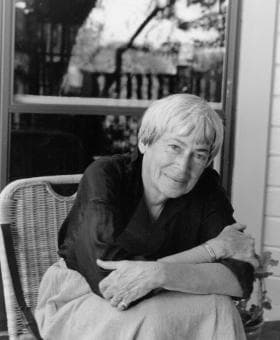
Ursula Kroeber Le Guin was an American author best known for her works of speculative fiction, including science fiction works set in her Hainish universe, and the Earthsea fantasy series. She was first published in 1959, and her literary career spanned nearly sixty years, producing more than twenty novels and over a hundred short stories, in addition to poetry, literary criticism, translations, and children's books. Frequently described as an author of science fiction, Le Guin has also been called a "major voice in American Letters". Le Guin said she would prefer to be known as an "American novelist".