BookBrief
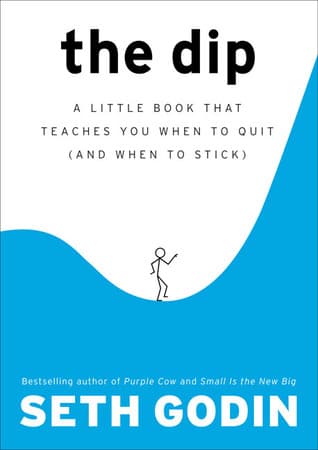
The Dip: A Little Book That Teaches You When to Quit (and When to Stick) cover
Archivist's Choice

The Dip: A Little Book That Teaches You When to Quit (and When to Stick)

Seth Godin (2007)

Genre

Business / Productivity / Leadership / Philosophy / Self-Help

Reading Time

45 min

Key Themes

See below

Track Your Reading

Sign in to track this book

Success is not about never giving up, but knowing when to quit the wrong things so you can focus on conquering the right challenges and achieve excellence.

Core Idea

Seth Godin says success in any effort is not about simply pushing through, but about carefully handling 'The Dip'—the long, hard period between initial excitement and true skill. His main point is that successful people often quit wrong things early so they can put all their effort into being the best at the right things. He thinks the market rewards the best, not just the good, and that the Dip filters out those without enough commitment. The book suggests evaluating if an effort's Dip leads to a worthwhile reward or a 'Cul-de-Sac' (a dead end). It teaches readers when to quit and when to stick with the effort needed to become a market leader.
Reading time
45 min
Difficulty
Easy
✓ Read this if...
You are struggling to decide whether to continue with a project, career path, or personal goal, or if you feel overwhelmed by too many commitments and need to strategically prune them.
✗ Skip this if...
You are looking for a detailed, step-by-step guide on how to achieve specific business or personal goals, or if you prefer books with extensive research and complex theoretical frameworks.

Core idea

The central argument and framework that powers the entire book.

Seth Godin says success in any effort is not about simply pushing through, but about carefully handling 'The Dip'—the long, hard period between initial excitement and true skill. His main point is that successful people often quit wrong things early so they can put all their effort into being the best at the right things. He thinks the market rewards the best, not just the good, and that the Dip filters out those without enough commitment. The book suggests evaluating if an effort's Dip leads to a worthwhile reward or a 'Cul-de-Sac' (a dead end). It teaches readers when to quit and when to stick with the effort needed to become a market leader.

At a glance

Reading time

45 min

Difficulty

Easy

Read this if...

You are struggling to decide whether to continue with a project, career path, or personal goal, or if you feel overwhelmed by too many commitments and need to strategically prune them.

Skip this if...

You are looking for a detailed, step-by-step guide on how to achieve specific business or personal goals, or if you prefer books with extensive research and complex theoretical frameworks.

Key Takeaways

1

Embrace the Dip

The path to exceptionalism is paved with temporary setbacks that most people abandon.

Quote

The Dip is the long slog between starting and mastery. A Dip is a temporary drop in performance or enthusiasm that is quickly followed by a return to a higher level of performance.

Godin says that true success—being 'the best in the world' at something—is not about avoiding problems. It means actively looking for and overcoming 'The Dip.' This is not a random problem; it is the natural period of struggle, frustration, and fewer returns that happens after the first excitement of a new project fades. Most people quit when they face this hard phase. But the Dip is what makes something rare and valuable. If it were easy, everyone would do it, and mastery would not be special. By understanding and accepting the Dip, ...

Supporting evidence

Godin uses examples like becoming a concert pianist, a successful entrepreneur, or an Olympic athlete. The initial learning is quick and fun, but the mastery requires years of grinding practice, repetitive failures, and moments of wanting to quit.

Apply this

When embarking on a new project or skill, anticipate the Dip. Don't be surprised or discouraged when the initial enthusiasm wanes and progress slows. Instead, view it as a necessary filter that separates the committed from the casual. Prepare for the grind.

masteryperseverancegrit
2

Quit the Right Things

Successful people are not just good at sticking; they are great at strategically quitting dead ends.

Quote

Winners quit all the time. They just quit the right stuff at the right time.

Unlike common belief, quitting is not always a sign of weakness. Godin states that successful people are good at quitting, but they quit smartly. They quickly find and leave pursuits that are 'Cul-de-Sacs'—dead ends with no chance for a big breakthrough, no matter how much effort. This frees up valuable resources (time, energy, money) to put into opportunities that have a real Dip. The key is to tell the difference between a temporary Dip, which leads to skill, and a permanent Cul-de-Sac, which leads to staying stuck. Quitting the w...

Supporting evidence

Godin implies that entrepreneurs often start multiple ventures, quickly shutting down those that show no traction to focus on the one that does. He also references professional poker players who know when to fold a bad hand, preserving their chips for better opportunities.

Apply this

Before committing deeply, establish clear, objective criteria for success or failure. If a project consistently fails to meet these benchmarks despite genuine effort, be prepared to cut your losses early. Don't let sunk costs dictate your future actions.

strategic-quittingopportunity-costdecision-making
3

The Cul-de-Sac Trap

Beware of paths that offer no upward trajectory, regardless of effort.

Quote

The Cul-de-Sac is a situation where you work and work and work and nothing much changes.

The Cul-de-Sac is the opposite of the Dip. The Dip is a temporary struggle that leads to eventual skill and reward. The Cul-de-Sac is a dead end where effort does not lead to important improvement or breakthrough. It is a trap because it often feels safer or easier than facing the Dip, but it ultimately leads to average results and stagnation. Many people get stuck here because they are afraid to quit or cannot see that their current path has no real benefit. Finding and avoiding Cul-de-Sacs is important for using your limited resourc...

Supporting evidence

Godin uses examples like being stuck in a dead-end job with no promotion prospects, or pursuing a hobby that you're simply not good at and have no passion to improve, even after years of trying.

Apply this

Regularly evaluate your commitments. Ask yourself: 'Is more effort here likely to lead to a significant breakthrough, or just more of the same?' If the answer is the latter, it's time to consider a strategic exit.

dead-endstagnationresource-allocation
4

The Importance of Being the Best

Being 'good enough' is a recipe for irrelevance; true rewards go to the top.

Quote

Scarcity makes things valuable. The best in the world is scarce.

Godin points out that in most fields, rewards are not spread evenly; they are heavily weighted towards the top. Being 'pretty good' or 'above average' often brings only average returns. The real advantage, the big profits, the wide recognition—these go to those who are 'the best in the world' at what they do. This is not about being objectively superior globally, but about being the best within your chosen area or market. The Dip exists because reaching this level of excellence is hard, making it a natural filter. Those who push thr...

Supporting evidence

He cites examples like professional sports, where the top 1% earn disproportionately more than the next 10%, or the market for consultants, where the most sought-after experts command far higher fees.

Apply this

When considering a new venture, ask yourself if there's a path to becoming 'the best in the world' (within your defined scope). If not, or if you're unwilling to commit to that level of effort, consider if it's truly worth pursuing at all.

excellencemarket-valueniche-mastery
5

Don't Be a Dabbler

Half-hearted commitment leads to mediocre results and wasted effort.

Quote

Dabbling is the worst of all possible worlds. It's the equivalent of quitting without the benefits.

Dabbling is doing many things without fully committing to any of them, usually quitting just before or during the early stages of the Dip. This approach guarantees average results. Dabblers spread their efforts too thin, never gaining enough momentum or skill in any single area to get important results. They feel the first excitement of starting something new, but also the frustration of never becoming skilled. Godin says that dabbling is worse than quitting strategically because it uses up time and energy without offering the chance ...

Supporting evidence

Someone who starts learning guitar, then painting, then coding, but never gets past the beginner stage in any of them. They might enjoy the superficial engagement but never experience the deep satisfaction of mastery.

Apply this

Before starting something new, decide if you're willing to commit to pushing through the inevitable Dip. If not, don't start it. Focus your energy on one or two pursuits where you *are* willing to go deep.

superficialityfocuscommitment
6

Quitting as a Strategic Advantage

Knowing when to quit frees resources for more promising endeavors.

Quote

Strategic quitting is the secret of successful organizations and people.

Quitting, when done with a plan, is not failure; it is a strong tool for making things better. By choosing to leave projects, relationships, or commitments that are using resources without offering a path to being 'the best,' you create space. This freed-up time, energy, and money can then be used for opportunities that genuinely excite you and have the chance for big returns. The fear of quitting often comes from the sunk cost fallacy or social pressure. Godin frees us from this, seeing quitting as a proactive, smart choice that spee...

Supporting evidence

Businesses regularly discontinue unprofitable product lines or divisions to focus on core competencies. Individuals might leave a toxic job to pursue a more fulfilling career, even if it means a temporary pay cut.

Apply this

Periodically audit your commitments. For each, ask: 'If I hadn't already started this, would I start it today, knowing what I know now?' If the answer is no, seriously consider quitting. Define your 'quit point' before you start.

resource-optimizationsunk-cost-fallacyproactive-decision
7

The Power of Decision

Indecision is more detrimental than making a 'wrong' choice and then adjusting.

Quote

Never quit in the middle. Decide before you start what your quit point is going to be.

Godin stresses the important role of making clear decisions. The worst situation is not quitting or sticking; it is being stuck in not knowing what to do, just moving through a Dip or Cul-de-Sac without a clear plan. He suggests deciding your 'quit point' before you even start a new project. This early commitment lets you make logical, objective choices when emotions are high during the certain struggles. It removes the uncertainty that often leads to dabbling or long suffering in a dead end. Deciding beforehand, whether to commit f...

Supporting evidence

An entrepreneur deciding before launching a product that if it doesn't hit a certain revenue target within six months, they will pivot or shut it down. This prevents endless, fruitless investment.

Apply this

For any new project, job, or relationship, establish clear, measurable criteria for success and failure. Define the specific conditions under which you will either commit fully or strategically quit. Write these down.

pre-commitmentclaritygoal-setting
8

The Dip as a Filter

The difficulty of the Dip is precisely what creates opportunity for those who persist.

Quote

The Dip is the secret to your success. The bigger the Dip, the bigger the reward for getting through it.

Godin says that the Dip is not a bad side effect; it is a basic part of how value is made and given out. If every valuable skill or effort were easy to master, there would be no competitive advantage, no scarcity, and thus no significant reward. The Dip acts as a natural filter, getting rid of those who are not committed, impatient, and average. Understanding this view changes the Dip from a problem into an opportunity—a challenge meant to raise you above the competition, if you choose to face it.

Supporting evidence

Learning a difficult foreign language: most people quit when they hit the intermediate plateau. Those who push through become fluent, opening up new career and personal opportunities. The difficulty deters the masses.

Apply this

When you encounter the Dip, remind yourself that this struggle is a sign you're on the right track to something valuable. Reframe difficulty not as a barrier, but as a competitive advantage that few others will overcome.

competitive-advantagevalue-creationendurance
9

Three Reasons to Quit

Quit if you're running out of time, money, or passion, or if you're in a Cul-de-Sac.

Quote

There are three things that lead to quitting: you run out of time, you run out of money, or you get scared.

Godin redefines 'getting scared' as losing interest or seeing a lack of potential. He lists three main, good reasons to quit: 1) You truly run out of time (e.g., a deadline passes, life changes). 2) You run out of money or necessary resources to keep going. 3) You realize you are in a Cul-de-Sac—meaning the effort is not leading to progress, you have lost interest, or the returns are simply not worth the investment. These are not signs of weakness but practical evaluations that let you use resources well. Quitting for these reasons is...

Supporting evidence

A startup running out of seed funding before achieving product-market fit. A student realizing their chosen major isn't leading to a viable career path they desire. An athlete losing the love for their sport and facing burnout.

Apply this

Before committing to a long-term goal, assess your available time, financial resources, and intrinsic passion. If any of these are critically low or unsustainable, it's a strong indicator that the endeavor might be a Cul-de-Sac or an unsustainable Dip.

resource-constraintsburnoutpragmatism
10

Don't Quit in the Middle

Make your quitting decisions consciously, not out of temporary frustration.

Quote

Never quit in the middle. Decide before you start what your quit point is going to be.

This point strengthens the previous one about decision-making. Godin warns against quitting on impulse, in the middle of frustration or temporary discouragement that is common in the Dip. Such 'middle quitting' often leads to regret, as you might have been close to a breakthrough. Instead, all quitting decisions should be made thoughtfully, either before you start (by setting a quit point) or after careful re-evaluation based on clear rules (recognizing a Cul-de-Sac). The goal is to avoid emotional, reactive quitting that harms lo...

Supporting evidence

Many aspiring writers abandon their novel halfway through, often when they hit a narrative block (the Dip), only to regret it later. A more strategic approach would be to set a word count or time limit beforehand.

Apply this

When facing intense difficulty, pause and revisit your pre-defined quit points. If you haven't hit those criteria, remind yourself why you committed. If you haven't set them, take a moment to define them before making any rash decisions.

impulse-controlemotional-intelligencelong-term-thinking

Critical analysis

Notable Quotes

Winners quit all the time. They just quit the right stuff at the right time.

Introduction, challenging the conventional wisdom that quitting is always negative.

The Dip is the long slog between starting and mastery.

Defining the central concept of the book, describing the challenging phase of any pursuit.

If you can't be the best in the world, your life will be a lot easier if you quit.

Advising strategic quitting when achieving dominance in a field is unlikely.

The opposite of quitting is rededication. The opposite of quitting is an invigorated new strategy designed to break the problem.

Emphasizing that sticking requires proactive change, not just persistence.

Quitting is not a moral failing. It's often a smart strategy.

Reframing quitting as a rational decision rather than a character flaw.

The Dip is the secret to your success. The people who set out to make it through the Dip—the people who invest the time and the energy and the effort to power through the Dip—those are the ones who become the best in the world.

Highlighting the Dip as an opportunity for those who persevere strategically.

Extraordinary benefits accrue to the tiny minority of people who are able to push just a tiny bit longer than most.

Describing the rewards of enduring the Dip when it leads to market leadership.

Quit the wrong stuff. Stick with the right stuff. Have the guts to do one or the other.

Summarizing the book's core advice on making decisive choices.

The Cul-de-Sac is a situation where you work and you work and you work and nothing much changes. It doesn't get a lot better, it doesn't get a lot worse. It just is.

Defining another key concept, a dead-end situation where quitting is advisable.

Never quit something with great long-term potential just because you can't deal with the stress of the moment.

Warning against quitting prematurely during temporary challenges in a worthwhile Dip.

The best in the world have all survived a Dip. The ones who didn't survive the Dip? We don't know about them.

Illustrating how the Dip filters out those who don't achieve mastery.

If you're not able to get through the Dip in an exceptional way, you must quit.

Advocating for quitting when you cannot differentiate yourself during the challenging phase.

Quitting when you hit the Dip is a bad idea. If the journey you started is worth doing, then quitting when you hit the Dip is a terrible waste.

Encouraging perseverance in valuable pursuits despite difficulties.

The reason we're here is to quit. To quit the stuff that doesn't matter so we can focus on the stuff that does.

Philosophical take on quitting as a tool for prioritization and meaning.

Quiz

Test Your Knowledge

Ready to see how well you understood this book? Take our interactive quiz with 10 questions.

10
Questions
~5
Minutes
?
Best Score

Key Questions (FAQ)

The Dip is a temporary setback or challenging phase that occurs after the initial excitement of a new project, job, or endeavor. According to Godin, pushing through the Dip leads to significant rewards like profits, glory, and long-term security, making it worth the effort.

About the author