BookBrief
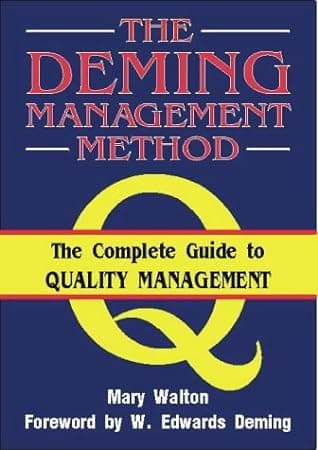
The Deming Management Method cover
Archivist's Choice

The Deming Management Method

Mary Walton (1986)

Genre

Business / Reference / Leadership / Economics

Reading Time

5-7 hours

Key Themes

See below

Track Your Reading

Sign in to track this book

Master Deming's principles to boost profits and productivity, transforming your business from its core.

Core Idea

Mary Walton's "The Deming Management Method" explains Dr. W. Edwards Deming's approach to quality and productivity. Most organizational problems, Deming argued, come from the system, not individual workers. The book outlines Deming's 14 Points for Management and the System of Profound Knowledge. It promotes a systemic change focusing on statistical thinking, ongoing improvement, and removing fear and arbitrary goals. By understanding processes, building long-term relationships, and supporting employees through training, companies can gain a lasting competitive edge and better quality.
Reading time
5-7 hours
Difficulty
Medium
✓ Read this if...
You are a manager, executive, or business leader looking for a foundational understanding of quality improvement, process management, and how to create a culture of continuous improvement, moving beyond short-term fixes to systemic solutions.
✗ Skip this if...
You are only interested in quick-fix management hacks or a purely theoretical academic treatise without practical application examples. This book requires a willingness to fundamentally rethink traditional management paradigms.

Core idea

The central argument and framework that powers the entire book.

Mary Walton's "The Deming Management Method" explains Dr. W. Edwards Deming's approach to quality and productivity. Most organizational problems, Deming argued, come from the system, not individual workers. The book outlines Deming's 14 Points for Management and the System of Profound Knowledge. It promotes a systemic change focusing on statistical thinking, ongoing improvement, and removing fear and arbitrary goals. By understanding processes, building long-term relationships, and supporting employees through training, companies can gain a lasting competitive edge and better quality.

At a glance

Reading time

5-7 hours

Difficulty

Medium

Read this if...

You are a manager, executive, or business leader looking for a foundational understanding of quality improvement, process management, and how to create a culture of continuous improvement, moving beyond short-term fixes to systemic solutions.

Skip this if...

You are only interested in quick-fix management hacks or a purely theoretical academic treatise without practical application examples. This book requires a willingness to fundamentally rethink traditional management paradigms.

Key Takeaways

1

Adopt Profound Knowledge

A system of interrelated knowledge for organizational transformation.

Quote

A manager of people needs to understand variation, some theory of knowledge, some psychology, and an appreciation for a system. This is what Deming called a System of Profound Knowledge.

Deming's 'System of Profound Knowledge' is a practical framework for understanding and improving any organization. It combines four parts: appreciation for a system, knowledge about variation, theory of knowledge, and psychology. Managers must understand how these parts work together for a complete view of their operations. Without this deep understanding, changes often only fix symptoms, not root causes, leading to recurring problems and wasted effort. This system emphasizes that all parts of an organization depend on each other, and...

Supporting evidence

Deming's lectures to Japanese industrialists in the 1950s, which laid the foundation for Japan's post-war industrial quality revolution. He presented these concepts as essential for long-term survival and prosperity, contrasting them with short-term, reactive management styles.

Apply this

Leaders should actively study and internalize the four components, using them as a lens through which to analyze all business decisions. For example, before implementing a new policy, consider its impact on the entire system, potential variations in outcomes, how it aligns with existing knowledge, and the psychological effects on employees.

system-of-profound-knowledgesystems-thinkingvariation
2

Eliminate Numerical Quotas

Quotas prioritize quantity over quality and foster fear, undermining intrinsic motivation.

Quote

The numerical quota is a destroyer of quality and productivity. It creates fear, it drives out good work, and it leads to cheating and shortcuts.

Deming strongly opposed numerical quotas for production or sales targets, saying they are counterproductive. Quotas make employees focus on hitting a number, often at the cost of quality, innovation, or teamwork. They create a system of fear, where workers are afraid to miss targets, leading to shortcuts, false data, and lower morale. Instead of motivating, quotas discourage by taking away pride in work and internal drive. They also ignore the natural variation in any process, punishing workers for things outside their control. Focusi...

Supporting evidence

Deming's observations in American factories where quotas led to high scrap rates and poor product quality, contrasting with Japanese companies that adopted process-oriented management, achieving superior results without relying on individual quotas.

Apply this

Replace individual quotas with a focus on improving the overall process. Encourage teams to identify and eliminate bottlenecks, reduce waste, and improve quality. Measure process health and customer satisfaction rather than individual output numbers.

quotasfear-in-the-workplaceintrinsic-motivationquality-over-quantity
3

Understand Variation

Distinguish between common and special causes of variation to manage processes effectively.

Quote

The greatest waste in America is people not understanding variation. Everything varies. It is how you manage the variation that counts.

Variation is natural in every process, but not all variation is the same. Deming separated common causes (random, normal changes within a stable process) from special causes (specific, outside factors disrupting the process). Managers often react to common cause variation as if it were special, leading to over-adjusting and 'tampering' with the system, which only increases variation and instability. On the other hand, they might ignore special causes, letting big problems continue. Understanding this difference, often through statisti...

Supporting evidence

The use of control charts (e.g., Shewhart charts) in manufacturing, which visually separate common and special cause variation, allowing managers to identify when a process is 'in control' or when an intervention is genuinely needed.

Apply this

Implement statistical process control (SPC) charts to monitor key metrics. Train employees and managers to interpret these charts to differentiate between common and special causes. Only intervene when a special cause is identified; otherwise, focus on improving the overall system, not individual data points.

statistical-process-controlcommon-cause-variationspecial-cause-variationtampering
4

Drive Out Fear

Create an environment where employees feel safe to ask questions and report problems without reprisal.

Quote

No one can do his best work unless he feels secure. Fear is paralyzing. It kills communication and innovation.

Fear is a damaging force in the workplace. It stops employees from speaking up about problems, suggesting improvements, or taking calculated risks, all of which are vital for ongoing improvement. When employees fear punishment for mistakes or for delivering bad news, important information is hidden, leading to unsolved problems and missed chances. Deming promoted a culture where employees feel safe, where mistakes are seen as learning opportunities, and where open communication is encouraged. Removing fear allows for honest feedback, ...

Supporting evidence

Deming's observations that many American companies suffered from a culture of fear, where employees would hide defects or problems rather than report them, leading to systemic failures and customer dissatisfaction.

Apply this

Leaders should actively solicit feedback, especially regarding problems, and respond constructively, without assigning blame. Implement anonymous reporting mechanisms where appropriate. Publicly acknowledge and reward employees who bring issues to light, framing them as opportunities for collective learning and improvement.

psychological-safetyopen-communicationtrust-in-leadershipblame-culture
5

Institute Training and Retraining

Invest in continuous education for all employees to adapt to new methods and technologies.

Quote

Training is not a one-time event; it is a continuous process. Every job requires specific knowledge and skill, and these must be maintained and improved.

In a fast-changing world, static job descriptions and one-time training are not enough. Deming stressed the importance of ongoing training for everyone, from factory workers to top management. This is not just about teaching new skills; it is about creating a learning organization where employees can adapt to new technologies, understand new processes, and help with ongoing improvement. Proper training reduces errors, increases efficiency, and boosts morale by showing employees they are valued. It also ensures a shared understanding o...

Supporting evidence

Japanese companies, after adopting Deming's methods, heavily invested in employee training across all levels, leading to significant improvements in product quality and manufacturing efficiency that surpassed Western competitors.

Apply this

Develop comprehensive training programs for every role, including cross-training. Regularly update training content to reflect new technologies and best practices. Create a budget and allocate time specifically for ongoing employee development, including non-job-specific skills like problem-solving and statistical thinking.

continuous-learningskill-developmentemployee-empowermentorganizational-learning
6

End Dependence on Mass Inspection

Build quality into the process from the start, rather than inspecting it in at the end.

Quote

Inspection is too late. It is a confession that you have failed to make the product right the first time. Quality comes not from inspection, but from improvement of the process.

Mass inspection at the end of the production line is an inefficient and expensive way to ensure quality. It only separates good products from bad, adds no value, and often misses defects. Deming argued that true quality comes from designing a strong process that consistently produces quality output from the start. This requires understanding the process, finding possible failure points, and setting up controls and feedback loops to prevent defects rather than just finding them. Ending dependence on mass inspection shifts the focus fro...

Supporting evidence

Companies that moved from 100% final inspection to process control methods saw dramatic reductions in defects and warranty claims, as exemplified by many Japanese manufacturers in the latter half of the 20th century.

Apply this

Implement in-process quality checks and statistical process control (SPC) at various stages of production. Empower workers to stop the line if a defect is detected and identify the root cause immediately. Focus on improving supplier quality to ensure raw materials meet specifications.

quality-by-designdefect-preventionin-process-controlroot-cause-analysis
7

Break Down Barriers

Foster collaboration between departments to optimize the entire system, not just individual silos.

Quote

People in different departments work for the same company, yet they often act as if they are competing with each other. This creates friction and sub-optimization.

Organizational silos, where departments work alone and optimize for their own goals, harm the overall system. Deming recognized that departments often have conflicting goals or do not understand each other's challenges, leading to inefficiencies, rework, and a broken customer experience. Breaking down these barriers means encouraging cross-functional teamwork, promoting communication, and ensuring that all departments understand their role in the larger organization. This creates a more unified, agile, and effective organization where...

Supporting evidence

Examples of companies where sales, production, and R&D teams operated in isolation, leading to products that were difficult to manufacture, hard to sell, or failed to meet customer needs, in contrast to integrated product development teams.

Apply this

Establish cross-functional teams for projects and problem-solving. Implement regular inter-departmental meetings to share information and align goals. Design performance metrics that encourage collaboration and system-wide optimization rather than individual departmental metrics.

cross-functional-teamssilo-mentalitysystems-optimizationcollaboration
8

Adopt the New Philosophy

Embrace a commitment to continuous improvement and long-term thinking over short-term profits.

Quote

American management must wake up to the new age. We can no longer live with commonly accepted levels of mistakes, defects, poor materials, and poor workmanship.

Deming's methods are a major shift from traditional Western management practices focused on short-term profits, blame, and individual performance. 'Adopting the New Philosophy' means making a clear and firm commitment to ongoing improvement, quality, and customer satisfaction as the main drivers of long-term success. It requires leaders to drop old beliefs and embrace a systemic view, understanding that quality is not an extra cost but a way to lower costs and increase market share. This philosophy demands patience, persistence, and a...

Supporting evidence

The stark contrast between the decline of many American industries in the 1970s and 80s, which clung to traditional management, versus the rise of Japanese industries that adopted Deming's principles, leading to superior quality and global market dominance.

Apply this

Top management must publicly commit to Deming's principles and lead by example. This involves re-evaluating mission statements, strategic goals, and performance metrics to align with long-term quality and process improvement, moving away from short-sighted financial targets.

continuous-improvementlean-managementlong-term-thinkingparadigm-shift
9

Constancy of Purpose

Commit to a long-term vision for improving products and services, resisting short-term pressures.

Quote

Management's job is to look ahead, to predict, to plan for the future. Without constancy of purpose, there is no constancy of action, and no sustained improvement.

One of Deming's most important points, 'Constancy of Purpose,' asks management to have a firm, long-term commitment to improving products and services. This means resisting pressure for immediate profits, quarterly dividends, or reactive decisions. Instead, leadership must focus on innovation, research, education, and ongoing improvement of the system. Without a stable, long-term vision, organizations drift, resources are misused, and efforts become scattered. Constancy of purpose provides direction, allows for strategic investment, a...

Supporting evidence

Companies that consistently invested in R&D and employee training, even during economic downturns, often emerged stronger and more innovative, contrasting with those that cut such investments for short-term financial relief.

Apply this

Develop a clear, long-term strategic plan (5-10 years) for product and service improvement. Communicate this vision consistently to all employees. Prioritize investments that support this long-term purpose, even if they don't yield immediate financial returns. Resist the temptation to chase fads or react to every market fluctuation.

strategic-planninglong-term-visioninnovationsustainable-growth
10

Empower the Workforce

Shift responsibility for quality and improvement from management to the workers who do the job.

Quote

The knowledge to improve the process resides primarily with the people who do the work. Management's job is to listen to them and remove the barriers.

Deming believed that the people closest to the work—frontline employees—have valuable insights into how processes can be improved. Traditional management often disempowers these workers, treating them as cogs in a machine rather than sources of intelligence. Empowering the workforce means giving them the tools, training, and authority to find problems, suggest solutions, and take ownership of quality. It involves listening to their feedback, acting on their suggestions, and removing systemic barriers that stop them from doing their be...

Supporting evidence

Case studies from companies where quality circles and employee suggestion programs, when genuinely supported by management, led to significant cost savings, quality improvements, and increased worker satisfaction.

Apply this

Implement mechanisms for employees to provide regular feedback and suggestions for process improvement. Provide training on problem-solving tools (e.g., PDCA, statistical methods). Empower teams to make decisions within their areas of expertise and provide resources to test and implement their ideas.

employee-empowermentworker-participationquality-circlespdca-cycle

Critical analysis

Notable Quotes

Quality is not a slogan. It is a way of life.

Emphasizing the pervasive nature of quality in an organization.

A bad system will beat a good person every time.

Highlighting the importance of systemic improvements over individual effort.

The aim of leadership should be to improve the performance of man and machine, to improve quality, to increase output, and simultaneously to bring pride of workmanship to people.

Defining the multi-faceted role and goals of effective leadership.

Management's job is to know what to do, not how to do it. The how-to is the job of the workers.

Differentiating between strategic direction (management) and operational execution (workers).

The most important things cannot be measured.

Cautioning against an over-reliance on quantifiable metrics, especially for intangible aspects like morale or innovation.

Eliminate slogans, exhortations, and targets for the work force asking for zero defects and new levels of productivity.

Arguing that such motivational tactics are counterproductive without addressing underlying system issues.

Inspection is too late. The quality, good or bad, is already in the product.

Advocating for building quality into the process rather than relying on end-of-line inspection.

The greatest waste in America is people not being able to use their abilities.

Lamenting the underutilization of human potential in traditional management systems.

The customer is the most important part of the production line.

Emphasizing the central role of the customer in driving quality and production.

Cease dependence on mass inspection to achieve quality. Eliminate the need for inspection on a mass basis by building quality into the product in the first place.

A foundational principle for achieving true quality by preventing defects.

An organization is a system. It must be managed as a system.

Underlining the interconnectedness of all parts of an organization and the need for a holistic management approach.

Fear invites people to hide problems, not to solve them.

Discussing the detrimental effects of a fear-based management culture on problem-solving and improvement.

The job of management is to work on the system, not in the system.

Distinguishing between daily operational tasks and the strategic work of improving the overall system.

It is not enough to do your best; you must know what to do, and then do your best.

Highlighting that effort alone is insufficient without proper knowledge and direction.

Quiz

Test Your Knowledge

Ready to see how well you understood this book? Take our interactive quiz with 10 questions.

10
Questions
~5
Minutes
?
Best Score

Key Questions (FAQ)

The Deming Management Method is a philosophy and set of principles for improving quality and productivity within an organization, developed by Dr. W. Edwards Deming. It emphasizes continuous improvement, understanding variation, systems thinking, and profound knowledge.

About the author