BookBrief
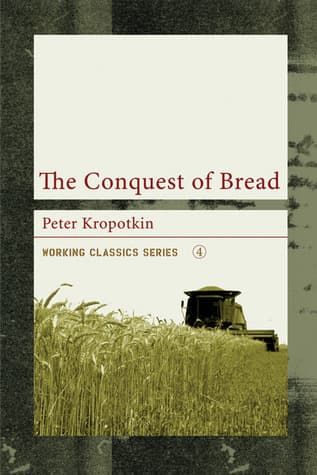
The Conquest of Bread cover
Archivist's Choice

The Conquest of Bread

Pyotr Kropotkin

Genre

Politics / History / Economics / Philosophy

Reading Time

224 min

Key Themes

See below

Track Your Reading

Sign in to track this book

Kropotkin's 'The Conquest of Bread' examines historical injustices and outlines an anarchist society where collective needs are met through revolutionary redistribution and cooperative effort.

Core Idea

Kropotkin argues that a free and prosperous society comes only from the immediate, complete takeover of all private property and the end of wage labor. He believes that current social structures, including capitalism and the state, create scarcity and inequality, even though humanity can produce enough for everyone. The book describes a decentralized, voluntarily associated society where resources are managed communally, and work is organized based on individual ability and collective need, ensuring 'luxury for all.' The main point is that revolution must be a constructive act of organizing and distributing resources to meet everyone's needs, not just a destructive overthrow of old systems. This establishes a society built on mutual aid and cooperation.
Reading time
224 min
Difficulty
Medium
✓ Read this if...
You are interested in foundational anarchist communist theory, envisioning a society without states or capitalism, and exploring practical arguments for immediate post-revolutionary social organization based on abundance and mutual aid.
✗ Skip this if...
You are looking for a step-by-step guide to political activism, or prefer reformist approaches to social change over revolutionary expropriation and the immediate abolition of wage labor and private property.

Core idea

The central argument and framework that powers the entire book.

Kropotkin argues that a free and prosperous society comes only from the immediate, complete takeover of all private property and the end of wage labor. He believes that current social structures, including capitalism and the state, create scarcity and inequality, even though humanity can produce enough for everyone. The book describes a decentralized, voluntarily associated society where resources are managed communally, and work is organized based on individual ability and collective need, ensuring 'luxury for all.' The main point is that revolution must be a constructive act of organizing and distributing resources to meet everyone's needs, not just a destructive overthrow of old systems. This establishes a society built on mutual aid and cooperation.

At a glance

Reading time

224 min

Difficulty

Medium

Read this if...

You are interested in foundational anarchist communist theory, envisioning a society without states or capitalism, and exploring practical arguments for immediate post-revolutionary social organization based on abundance and mutual aid.

Skip this if...

You are looking for a step-by-step guide to political activism, or prefer reformist approaches to social change over revolutionary expropriation and the immediate abolition of wage labor and private property.

Key Takeaways

1

Abolish Wage Slavery

The current system of wages and private property inherently creates poverty and inequality.

Quote

All have a right to well-being: well-being for all! The Revolution must assert this right, on pain of foundering in the same shoals as all preceding revolutions.

Kropotkin argues that the wage system, even when it seems fair, exploits workers. It separates them from the products of their labor and concentrates wealth, causing poverty and economic insecurity. He believes that 'private property' for basic resources like land, housing, and food is an artificial idea that keeps inequality going. Instead, Kropotkin supports communal ownership and management of all resources, so everyone's basic needs are met without the force of wage labor. The revolution's main goal is not just to change rulers, b...

Supporting evidence

Kropotkin frequently points to the vast disparity between the productive capacity of industrial societies and the poverty experienced by the working class, illustrating how the wage system fails to distribute wealth equitably.

Apply this

Challenge the notion that wage labor is the only or most just way to organize society. Advocate for policies that promote collective ownership, mutual aid, and decommodification of essential services.

wage-slaveryprivate-propertyeconomic-exploitation
2

Immediate Expropriation for All

The revolution must immediately seize and redistribute all essential resources to meet universal needs.

Quote

When the great Revolution has broken out, there will be but one way of securing its triumph, and that will be to proclaim and to realize, immediately, collectivism in all property, and communism in all consumption.

Unlike gradualist or state-socialist approaches, Kropotkin says a true social revolution must start with the immediate and complete taking of all accumulated wealth—factories, land, housing, food, and tools. This is not just about nationalization, but about making these resources directly available to the people who need them. He argues that waiting for a new government to make laws or for small changes will cause the revolution to fail, as people will become disappointed if their immediate needs for food and shelter are not met. The ...

Supporting evidence

Kropotkin draws on historical lessons from the French Revolution and the Paris Commune, noting how their failures were often linked to a lack of immediate, tangible improvements in the lives of the working class, leading to counter-revolutionary sentiment.

Apply this

In any transformative social movement, prioritize immediate, tangible benefits for the most vulnerable. Focus on direct action and mutual aid initiatives that address basic needs outside of existing state or market structures.

expropriationdirect-actioncommunal-ownership
3

Decentralized, Voluntary Association

Society should be organized through free agreements and federations of autonomous communes, not a central state.

Quote

Free agreement is the only way to arrive at an organization which would be really useful to all, and which would make the forces of each individual much more productive.

Kropotkin strongly rejects the idea of a centralized state, even a 'revolutionary' one, for achieving communism. He sees the state as an oppressive institution that centralizes power and suppresses individual freedom and local action. Instead, he proposes a society built on voluntary associations and federations of self-governing communes. These communes would organize themselves to manage local resources, production, and distribution, forming larger federations for wider coordination when needed. This decentralized, bottom-up approac...

Supporting evidence

Kropotkin points to the intricate, self-organizing systems found in nature and the historical examples of free cities and guilds as proof of humanity's capacity for voluntary cooperation without state coercion.

Apply this

Support local, community-led initiatives and mutual aid networks. Resist top-down solutions and advocate for increased autonomy and self-governance at the local level. Focus on building horizontal networks rather than vertical hierarchies.

anarcho-communismdecentralizationmutual-aidfederation
4

Abolish the Division of Labor

Specialization is degrading; integrate manual and intellectual labor for human flourishing.

Quote

Man is not a machine, and when he works for an hour or two at the production of a thing, he requires variety, he requires to vary his occupations.

Kropotkin criticizes the strict division of labor, especially separating manual and intellectual work, as something that degrades people in industrial society. He believes it reduces individuals to small parts of a machine, stops creativity, and prevents a full understanding of production. A communist society, he imagines, would encourage people to do both physical and mental work, allowing for a more varied and satisfying life. This integration would make work more enjoyable and also lead to more innovation and problem-solving, as th...

Supporting evidence

Kropotkin cites the repetitive, mind-numbing nature of factory work under capitalism as an example of how the division of labor degrades the worker, contrasting it with the more varied and skilled work of artisans in earlier periods.

Apply this

Seek opportunities to learn and apply diverse skills, blurring the lines between 'intellectual' and 'manual' tasks in your own life. Advocate for educational and workplace models that promote holistic development and cross-functional collaboration.

division-of-laborholistic-developmentalienation-of-labor
5

Abundance Through Intelligent Organization

Current productive capacity is sufficient to meet everyone's needs if rationally organized.

Quote

We are rich, far richer than we think; rich in the products of the past and rich in the means of production of the present.

Kropotkin rejects the Malthusian idea that scarcity is unavoidable. He argues that modern industrial and agricultural methods, combined with scientific knowledge, have created a huge capacity for abundance. The problem, he says, is not a lack of resources or production ability, but the irrational and wasteful organization of the capitalist system. He details how much labor is spent on non-essential industries, luxury goods, and maintaining the state and commerce, while basic needs go unmet. By directing this labor and resources toward...

Supporting evidence

Kropotkin extensively details agricultural advances, like intensive market gardening techniques in Parisian suburbs, showing how small plots of land can yield immense amounts of food, far exceeding common assumptions.

Apply this

Challenge narratives of scarcity, especially regarding essential resources. Advocate for policies and community projects that prioritize efficient, sustainable production and distribution of necessities over profit motives or luxury consumption.

scarcity-mythproductive-capacitysocially-useful-labor
6

From Each According to Ability, To Each According to Need

A communist society distributes resources based on need, not labor contributed or merit.

Quote

We assert that the only reasonable way of organizing society is to provide for the needs of all, and that the only measure of our wants is the needs themselves.

This central idea of Kropotkin's anarcho-communism sets it apart from earlier socialist movements that still suggested payment based on hours worked or labor certificates. Kropotkin argues that such systems would bring back inequality and the very exploitation the revolution aimed to end. Instead, a truly free society would recognize that everyone has a right to their basic needs being met, regardless of their individual ability to work. He also believes that 'needs' are not fixed but change, including not just physical support but al...

Supporting evidence

Kropotkin highlights how even in capitalist societies, essential services like roads, public parks, and libraries are often provided 'to each according to need,' demonstrating the feasibility and desirability of this principle on a larger scale.

Apply this

Support universal basic services and decommodification efforts. Reject meritocratic arguments that link access to necessities with individual achievement. Advocate for systems that prioritize human well-being over individual contribution metrics.

needs-based-distributioncommunist-principlemeritocracy-critique
7

The Role of Agriculture in Revolution

Urban populations must reconnect with and revolutionize food production for self-sufficiency.

Quote

The great city, it will be said, is doomed to perish if it does not take in hand agriculture.

Kropotkin spends much time on food, seeing it as the most immediate and important need during a revolution. He criticizes how large cities depend on distant farming regions, making them vulnerable to blockades and shortages. He advocates for a major change in agriculture, encouraging urban populations to farm, using scientific methods, intensive cultivation, and communal organization to grow food locally. This ensures food security and also blurs the lines between city and country, manual and intellectual work, helping communes become...

Supporting evidence

Kropotkin details historical examples of successful intensive gardening, like the 'maraîchers' (market gardeners) of Paris, who could feed vast populations from relatively small, fertile plots using innovative techniques.

Apply this

Support urban farming initiatives, community gardens, and local food movements. Learn about and practice permaculture or other sustainable, intensive agricultural methods. Advocate for policies that re-localize food systems and reduce reliance on global supply chains.

urban-agriculturefood-securityself-sufficiencyintensive-cultivation
8

Beyond the 'Right to Work' – The Right to Live

The revolution must guarantee sustenance, not just the opportunity to labor.

Quote

The right to well-being means the possibility of living like human beings, and of bringing up children to be members of a society better than ours, whilst the 'right to work' only means the right to be always a wage-slave, a drudge, ruled over and exploited by the bourgeoisie of the future.

Kropotkin distinguishes between the 'right to work'—a slogan often used by earlier socialist movements—and the more basic 'right to live' or 'right to well-being.' He argues that the 'right to work' still means one's existence depends on being employed, thus continuing wage slavery and the fear of unemployment. A true communist society, however, would guarantee everyone's sustenance and well-being as a baseline, no matter their ability or willingness to do specific work. This basic shift frees individuals from economic pressure, allow...

Supporting evidence

He contrasts the 'right to work' with the more expansive demands for 'bread' and 'housing' that spontaneously arise during revolutionary upheavals, demonstrating the populace's inherent desire for direct provision of needs.

Apply this

Advocate for universal basic income (UBI) and universal basic services (UBS) as stepping stones towards decommodification. Prioritize policies that decouple livelihood from employment, fostering true economic freedom and security.

right-to-liveright-to-well-beingdecommodificationuniversal-basic-income
9

Luxury for All, Not Just Necessities

A communist society aims to provide not just basic needs, but also comfort, leisure, and intellectual enrichment for everyone.

Quote

Bread, it is true, is the first object of existence, and bread must be secured. But bread alone is not enough; men must have shelter, clothing, leisure, and art.

Kropotkin's vision goes beyond just survival. He believes a truly free society should aim to provide 'luxury for all.' By this, he does not mean excessive extravagance, but a life rich in comfort, beauty, leisure, and intellectual pursuits. He thinks that with logical organization of production and the elimination of wasteful labor, society can easily produce enough to meet basic needs and also give everyone plenty of time for personal development, art, science, and recreation. This broad vision contrasts with ascetic forms of communi...

Supporting evidence

He meticulously calculates the amount of labor currently wasted on producing luxury goods for the wealthy or on maintaining unnecessary bureaucratic structures, arguing that this labor could be redirected to improve the quality of life for everyone.

Apply this

Advocate for policies that prioritize public access to arts, culture, education, and green spaces. Challenge the notion that 'luxuries' are only for the elite. Support initiatives that expand leisure time and opportunities for creative expression for all members of society.

luxury-for-allhuman-flourishingleisure-timecultural-access
10

Revolution as Construction, Not Destruction

While revolutionary upheaval is necessary, the focus must quickly shift to building new social structures.

Quote

The Revolution must be constructive, not merely destructive. It must build up, not merely pull down.

While Kropotkin acknowledges that revolutionary seizure and the dismantling of old institutions are necessary, he stresses that the revolution's success depends on its constructive phase. The initial acts of taking over must quickly be followed by organizing new systems of production, distribution, and social life. This means people immediately taking responsibility for feeding themselves, housing themselves, and organizing their communities through free association. A revolution that only destroys without building workable alternativ...

Supporting evidence

Kropotkin implicitly critiques revolutionary movements that get bogged down in internal power struggles or fail to address the immediate needs of the populace, leading to a loss of revolutionary momentum and public support.

Apply this

In any social change effort, always pair critiques of existing systems with concrete proposals and actions for building alternatives. Focus on developing practical skills and community infrastructure that can function independently of existing power structures.

constructive-revolutionsocial-reconstructionpost-revolutionary-organization

Critical analysis

Notable Quotes

All things are for all men, since all men have need of them, are the fruit of the labor of all, and there is no human possibility of determining the share of each in the production of the world's wealth.

Arguing against private appropriation of resources and production.

No society can flourish, no nation can grow, if an immense majority of the population are condemned to a life of misery and want.

Highlighting the detrimental effects of poverty on societal progress.

The first duty of the revolution will be to assure existence for all.

Outlining the primary goal of a social revolution.

Production, with the aid of the machinery which man has already invented, can be so increased as to give abundance to all.

Expressing optimism about the potential for technology to solve scarcity.

The earth is rich; it can nourish its inhabitants, if only they apply to it their intelligence and their labor.

Emphasizing the potential for agriculture to provide for everyone.

What we preach is the free development of each for the free development of all.

Summarizing the anarchist-communist ideal of individual and collective liberty.

The worker, who produces all the wealth, receives only a part of the products, and the part which falls to him is the least substantial.

Critiquing the exploitation of labor under capitalism.

Do not seek to establish the Commune by decree, but by the revolutionary spirit of the masses.

Advocating for organic, bottom-up revolutionary action rather than top-down mandates.

Before the Revolution, there were kings by the grace of God. After the Revolution, there will be kings by the grace of money.

Warning against merely replacing one form of hierarchy with another.

When we say 'bread for all,' we mean also 'shelter for all,' 'clothing for all,' 'leisure for all,' 'education for all.'

Expanding on the concept of fulfilling basic needs beyond just food.

The individual is not merely a producer, but also a consumer.

Stressing the importance of considering consumption alongside production in economic systems.

From each according to his ability, to each according to his needs.

A foundational principle of communist distribution, though often attributed to Marx.

The State is merely an instrument for the oppression of the masses by the privileged few.

A core anarchist critique of governmental power and its role in society.

The revolution must be economic before it can be political.

Arguing that fundamental changes in economic structure are prerequisites for true political change.

Quiz

Test Your Knowledge

Ready to see how well you understood this book? Take our interactive quiz with 10 questions.

10
Questions
~5
Minutes
?
Best Score

Key Questions (FAQ)

'The Conquest of Bread' by Pyotr Kropotkin is a foundational text in anarchist communism. It explores human needs and outlines a rational and equitable system for their satisfaction, presenting a vision for a society organized around mutual aid and voluntary cooperation without state or capitalist structures.

About the author