“On the last day of summer, a Yook named VanItch, was guarding the border, with a beefed-up slingswitch.”
— Introduction of the main character, VanItch, and the setting.

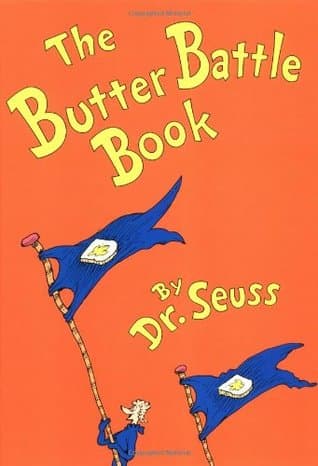
Dr. Seuss (1984)
Genre
Politics / Fantasy / Children's
Reading Time
15 min
Key Themes
See below
Sign in to track this book
In a world divided by toast-buttering preferences, the Yooks and Zooks escalate from slingshots to world-ending weaponry, comically illustrating the absurd and perilous nature of an arms race.
The story begins with a Yook grandfather recounting to his grandson the long-standing, seemingly nonsensical feud between the Yooks and their neighbors, the Zooks. The conflict is a fundamental disagreement over how to eat bread: Yooks butter their bread with the butter-side up, while Zooks butter theirs with the butter-side down. This seemingly trivial difference has escalated over generations into a deep-seated hatred and a constant state of readiness for war. The grandfather, a veteran of this conflict, proudly explains the history of their rivalry and the unwavering belief that the Yook way is the only correct way, instilling this prejudice in his young descendant.
The grandfather describes the initial, relatively simple weapons used in the 'Butter Battle.' It started with slingshots, but soon the Zooks developed their own counter-slingshots, leading to a rapid arms race. The Yooks created the 'Triple-Sling Jigger' to outdo the Zooks' 'Jigger-Rock Slinger.' This pattern of escalating weapon development continues, with each side responding to the other's advancements with something more powerful and absurd. The grandfather proudly recounts his role in these developments, describing the Yooks' ingenuity in creating increasingly elaborate devices to defend their butter-up way of life and attack the butter-down Zooks. This constant competition fuels the ongoing tension along the border.
The grandfather remembers his days as a border patrol guard, standing watch along the wall that separates the Yook and Zook territories. He recounts a specific incident where he encountered a Zook named VanItch, who was holding a 'Kick-a-Poo Kid.' This device, a small but potent weapon, was capable of delivering a powerful blow, causing the Yook grandfather considerable anxiety. The tension on the border was clear, with both sides constantly on edge, fearing an attack from the other. This encounter shows the ever-present threat of violence and the psychological toll of living in a state of perpetual conflict, even over something as trivial as bread buttering.
Following the threat posed by the Zooks' 'Kick-a-Poo Kid,' the Yooks' Chief Yookeroo orders the development of a new, more formidable weapon. The result is the 'Eight-Nozzled, Elephant-Toted Boom-Blitz,' a large, complex machine designed to counteract any Zook offensive. The grandfather proudly participates in its deployment, demonstrating the Yooks' commitment to maintaining military superiority. This development further illustrates the accelerating arms race, where each new weapon from one side immediately prompts the other to create something even more destructive, pushing both nations closer to total war, all for the sake of a buttering preference.
The Zooks respond to the 'Boom-Blitz' with their own terrifying invention, the 'Utterly Sputter.' Not to be outdone, the Yooks swiftly counter with the 'Back-and-Forth Frink,' a weapon designed to nullify the Sputter's capabilities. Each new weapon is more complex, more powerful, and more absurd than the last, showing the futility and escalating danger of the arms race. The cycle of invention and counter-invention becomes a self-perpetuating mechanism, driven by fear, pride, and an unwavering belief in their own righteousness, further cementing the deep-seated animosity between the Yooks and the Zooks.
The arms race culminates with the Yooks' creation of the 'Bitsy Big-Boy Boomeroo,' a tiny but immensely powerful bomb, described as capable of destroying every Zook, every Yook, and everything else in the world. The grandfather is entrusted with this ultimate weapon and is positioned on the wall separating the two nations, ready to deploy it. This development marks the pinnacle of the conflict, as both sides now possess the means for mutual annihilation. The tension is at its highest, with the fate of the world hanging precariously in the balance, all because of a trivial difference in buttering bread.
As the Yook grandfather stands on the wall, holding the 'Bitsy Big-Boy Boomeroo,' he is suddenly confronted by his old Zook adversary, VanItch. To the grandfather's horror, VanItch is also holding an identical, equally destructive 'Bitsy Big-Boy Boomeroo' of his own, developed by the Zooks. The two old enemies stand face to face, each with their finger on the button of a world-ending device. The air is thick with suspense, as the possibility of total annihilation becomes real. This direct confrontation symbolizes the ultimate deadlock of the arms race, where both sides have achieved the capacity for mutual destruction.
With the Yook grandfather and the Zook VanItch locked in a perilous standoff, each poised to unleash their 'Bitsy Big-Boy Boomeroo,' the young grandson, who has been listening intently to the entire tale, finally breaks the silence. He looks up at his grandfather and asks, 'Grandpa! Be careful! Oh, gee! Who's going to drop it? Will YOU or will HE?' The question highlights the immense, immediate danger and the terrifying uncertainty of the situation. The responsibility for starting a global catastrophe rests squarely on the shoulders of these two individuals, driven by generations of petty hatred.
The grandfather, now faced with the gravest decision of his life, hesitates. He lowers his head, looking down at the ground, unable to give his grandson a definitive answer. The story concludes with the two old men still standing on the wall, their fingers hovering over the buttons of their 'Bitsy Big-Boy Boomeroos,' and the grandson looking up, anxiously awaiting a response. The ending is ambiguous, leaving the reader to ponder the terrifying implications of the arms race and the potential for a catastrophic outcome. It is a stark warning about the dangers of unchecked conflict and the absurdity of war.
The Protagonist
He begins as a proud and confident war veteran, but by the end, he is depicted as hesitant and uncertain, grappling with the immense responsibility of triggering global annihilation.
The Supporting
He starts as an eager listener, absorbing his grandfather's tales, but ends as a fearful observer, questioning the ultimate consequences of the conflict.
The Antagonist
He remains a consistent, unwavering enemy, reflecting the unchanging nature of the conflict until the moment of ultimate standoff.
The Supporting
His role is consistent throughout, always pushing for greater military power.
The Mentioned
Not applicable, as he is only mentioned or implied.
The central theme is the illogical and ridiculous nature of conflict, especially when based on trivial differences. The entire war between the Yooks and Zooks stems from how they butter their bread (butter-side up vs. butter-side down). This trivial cause shows how easily humans can find reasons to fight, escalating to the point of mutual destruction. The increasingly bizarre weapons, like the 'Triple-Sling Jigger' and 'Eight-Nozzled, Elephant-Toted Boom-Blitz,' further emphasize the senselessness of dedicating vast resources and lives to such a petty dispute.
“It's a troublesome world. All the people who don't agree with our ways are called Zooks. And they have a terrible habit of buttering their bread with the butter-side down!”
The book shows the escalating and perilous nature of an arms race. Each new weapon developed by one side is immediately countered by an even more powerful or complex weapon from the other, creating a dangerous cycle of competition. This relentless pursuit of military superiority, from slingshots to the 'Bitsy Big-Boy Boomeroo' (a metaphor for nuclear weapons), ultimately leads both sides to the brink of total annihilation. The story is a cautionary tale about how such a race inevitably results in a stalemate where everyone loses.
“My Grandpa took me clear up to the Wall. 'I'll show you,' he said, 'you'll see a small bit of wall and a small bit of Zook. And a small bit of me, and a small bit of you! And a big bit of danger, my boy, on the wall!'”
The Yooks' unwavering belief that their way of buttering bread is the 'right' way, and the Zooks' way is 'wrong,' exemplifies blind nationalism and prejudice. The grandfather instills this ingrained hatred in his grandson, perpetuating the cycle of animosity. Both sides are convinced of their own righteousness and demonize the other, preventing any possibility of understanding or compromise. This theme shows how easily national pride and cultural differences can be manipulated to create hatred and justify conflict, even when the underlying reasons are baseless.
“On every Zook, you can plainly see, a Zookish kind of a Zookish 'Z'. Which shows that the Zooks are all Zook-side down, and are not to be trusted in any old town!”
The story is framed as a grandfather passing down the history of the Butter Battle to his grandson, illustrating how conflicts and prejudices are inherited and perpetuated across generations. The grandfather's pride in his past military actions and his unwavering belief in the Yook cause ensure that the animosity continues. The grandson's final question, 'Who's going to drop it? Will YOU or will HE?', shows the terrifying legacy of such conflicts, where future generations are left to face the consequences of their ancestors' unresolved disputes. It questions the responsibility of older generations in shaping the future.
“'Grandpa! Be careful! Oh, gee! Who's going to drop it? Will YOU or will HE?'”
The entire narrative acts as a symbolic representation of the Cold War and nuclear arms race.
The Butter Battle Book is a clear allegory for the Cold War and the nuclear arms race between the United States and the Soviet Union. The Yooks and Zooks represent the opposing superpowers, their trivial disagreement over buttering bread symbolizes the ideological differences (e.g., capitalism vs. communism), and the escalating weaponry, culminating in the 'Bitsy Big-Boy Boomeroo,' is a direct metaphor for the development and threat of nuclear weapons. The unresolved ending mirrors the constant tension and fear of mutually assured destruction (MAD) during that era.
The arbitrary distinction represents the trivial causes of real-world conflicts.
The core conflict over whether to butter bread 'butter-side up' or 'butter-side down' is highly symbolic. It represents the often arbitrary and trivial reasons that nations and peoples find to go to war. By making the central cause of the conflict so utterly nonsensical, Dr. Seuss highlights the absurdity and irrationality of real-world ideological, cultural, or political differences that lead to violence and destruction. It strips away any pretense of a 'just cause' for war.
A recurring motif demonstrating the relentless and dangerous nature of an arms race.
The parade of increasingly complex, absurd, and destructive weapons (from slingshots to the 'Bitsy Big-Boy Boomeroo') is a key plot device. Each new invention from one side immediately prompts a counter-invention from the other, creating a clear visual and narrative representation of an arms race. This device not only showcases the futility of such a competition but also emphasizes the rapidly increasing danger, as each weapon brings the two sides closer to total annihilation. It's a comedic yet chilling illustration of technological escalation in warfare.
A deliberate narrative choice to emphasize the ongoing threat and uncertainty of conflict.
The story concludes without a definitive resolution, leaving the Yook grandfather and Zook VanItch in a standoff, each with their finger on the button of a world-ending device. This unresolved ending is a powerful plot device that forces the reader to confront the terrifying implications of the arms race and the ever-present threat of global catastrophe. It avoids a simplistic 'happy ending' to reflect the real-world anxieties surrounding nuclear proliferation and the precarious balance of power, leaving a lasting impression of uncertainty and danger.
“On the last day of summer, a Yook named VanItch, was guarding the border, with a beefed-up slingswitch.”
— Introduction of the main character, VanItch, and the setting.
“It's a troublesome world. All the people who are in it are troubled with troubles, at least once a minute.”
— A general observation on the state of the world.
“I'll butter my bread on the top instead!”
— The Yooks' reasoning for buttering their bread on top.
“You can't trust a Zook who butters his bread on the under!”
— VanItch's prejudiced view of the Zooks.
“My grandpa took a look, and he said, 'It's high time that you knew that you're a patriotic Yook!'”
— Grandpa instilling patriotism in the narrator.
“The Butter-Up-Speader-of-Upper-Side-Butter, was the first of our weapons, my grandpa would mutter.”
— Grandpa describing the initial, simple weapon.
“And my grandpa said, 'That's what this war is about! It's about who butters their bread in or out!'”
— Grandpa simplifying the core reason for the conflict.
“My grandpa took his weapon and he started to shout, 'We'll butter our bread on the top! Not the out!'”
— Grandpa's defiant declaration of Yook tradition.
“I was learning the trade, of the Butter Battle Game. How to play it and win it, and not be a shame.”
— The narrator's indoctrination into the conflict.
“Then my grandpa said, 'This is the end of the show!' He said, 'This is the end! There's no place else to go!'”
— Grandpa's realization of the ultimate weapon and its implications.
“With a bang and a flash, it would blow them all up! Every Zook and every Yook, and every cup!”
— Describing the destructive power of the 'Bitsy Big-Boy Boomeroo'.
“I'll drop it, I will! And I'll blow 'em to bits! I'll blow all those Zooks right out of their wits!”
— The narrator's intent to use the ultimate weapon.
“Then he looked right at me, with a strange, worried stare. He said, 'Are you sure that you want to do that there?'”
— The Zook general's hesitant question before potential mutual destruction.
“Grandpa, be careful! Oh, gee! What will happen? Will you drop it? Or not? Who's going to snap in?”
— The narrator's urgent question to Grandpa at the precipice of war.
Ready to see how well you understood this book? Take our interactive quiz with 10 questions.
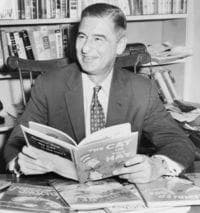
Dr. Seuss, born Theodor Seuss Geisel, was a beloved American children's author and illustrator. He is renowned for his imaginative tales and whimsical rhymes, including iconic works like 'The Cat in the Hat,' 'Green Eggs and Ham,' and 'Oh, the Places You'll Go!'. His unique style and memorable characters have made him a staple in children's literature for generations.

Brett Casper
5.0
Dirk Uffelmann
4.7
Winston S. Churchill
4.5
Chimamanda Ngozi Adichie
4.5
Will Durant
4.4
Thomas Sowell
4.4
W.E.B. Du Bois
4.3
Alan Moore
4.3