BookBrief
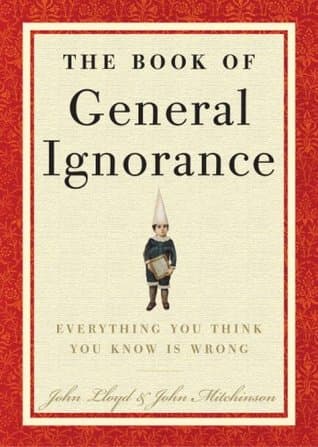
The Book of General Ignorance cover
Archivist's Choice

The Book of General Ignorance

John Lloyd (2007)

Genre

Reference / History / Science

Reading Time

12 Minutes

Key Themes

See below

Track Your Reading

Sign in to track this book

This witty book humorously corrects common wrong ideas in history, science, and nature, showing how much we collectively don't know.

Core Idea

"The Book of General Ignorance" challenges common misconceptions and widely accepted 'facts' across a myriad of subjects, from history and science to everyday life. The central argument is that much of what we think we know is, in fact, incorrect or significantly distorted. It advocates for a more critical and curious approach to information, highlighting how often popular knowledge is based on outdated information, misinterpretations, or urban legends, rather than verifiable truth. The book aims to correct these prevalent errors, demonstrating the often surprising and counter-intuitive realities behind familiar topics.
Difficulty
Easy

Core idea

The central argument and framework that powers the entire book.

"The Book of General Ignorance" challenges common misconceptions and widely accepted 'facts' across a myriad of subjects, from history and science to everyday life. The central argument is that much of what we think we know is, in fact, incorrect or significantly distorted. It advocates for a more critical and curious approach to information, highlighting how often popular knowledge is based on outdated information, misinterpretations, or urban legends, rather than verifiable truth. The book aims to correct these prevalent errors, demonstrating the often surprising and counter-intuitive realities behind familiar topics.

At a glance

Difficulty

Easy

Key Takeaways

1

The Ubiquity of General Ignorance

Common knowledge is often anything but, revealing widespread misconceptions across diverse fields.

Quote

The Book of General Ignorance exposes how many 'facts' we hold dear are, in reality, utter fabrications or gross misunderstandings.

The book's best insight is that general ignorance isn't just about obscure facts. It also covers basic history, science, and nature. It shows how accepted stories often differ from the truth. For example, many believe Magellan was the first to sail around the world. But he died halfway; his slave, Enrique, finished the journey. Also, chameleons don't change color for camouflage; their color shifts are mostly emotional. This widespread inaccuracy shows how society relies on old information without checking it. This leads to forgetting ...

Supporting evidence

The misconception about Magellan's circumnavigation, the true reason for chameleon color changes, and the non-existence of a 100-legged centipede are all examples directly from the book.

Apply this

Cultivate a habit of skepticism and fact-checking, even for information that seems self-evident. Don't assume something is true just because 'everyone knows it.'


2

The Power of Narrative Over Fact

Compelling stories, even if untrue, often supersede accurate but less dramatic realities in public consciousness.

Quote

Much of what we 'know' is not based on evidence, but on a more satisfying or simpler story.

The book suggests that people like good stories more than plain facts. This is clear in how myths last, like George Washington's wooden teeth. That image is more vivid than the reality of his hippopotamus ivory dentures. Likewise, the dramatic story of Henry VIII executing six wives is more memorable than the truth: he executed only two, divorced two, one died, and one outlived him. These stories, often simplified or exaggerated, gain popularity because they feel emotional or are easy to remember, even if they aren't accurate. This te...

Supporting evidence

The myth of George Washington's wooden teeth vs. hippopotamus ivory, and the exaggerated number of Henry VIII's executed wives.

Apply this

When encountering new information, especially historical or anecdotal, consider the underlying narrative and whether it might be a simplified or sensationalized version of events. Seek out primary sources or multiple perspectives.

3

The Limitations of Sensory Perception

Many 'obvious' observations about the natural world are fundamentally incorrect upon closer inspection.

Quote

Our eyes, and our assumptions, often deceive us about the simplest things in nature.

This point shows how easily our observations and common sense can mislead us, especially in biology. The book reveals that a 'centipede' does not have 100 legs, and a 'two-toed sloth' doesn't necessarily have two toes (it refers to the number of claws on its front limbs, but they can have six or eight toes in total). These examples challenge the idea that just looking is enough to understand. They highlight the need for exact definitions and scientific study to correct ideas that feel right but are wrong. It's a reminder that the natu...

Supporting evidence

The 'centipede' not having 100 legs, and the 'two-toed sloth' having six or eight toes in total, are specific examples from the book.

Apply this

Approach observations with a critical, scientific mindset. Don't rely solely on what appears to be true at first glance, especially when it comes to classifying or counting in the natural world. Look for precise definitions.

4

Historical Figures: Beyond the Icon

Many revered historical figures led lives and held beliefs far removed from their sanitized public images.

Quote

The true lives of historical figures are often far stranger, and more human, than the legends we've built around them.

The book is good at removing myths from historical figures, showing more complex and often surprising truths. For example, James Bond's 'favorite drink' wasn't the vodka martini; in the novels, he preferred an Americano or a Vesper. This small detail shows how even fictional characters become subject to popular wrong ideas. More importantly, learning that George Washington's false teeth were mostly hippopotamus (not wood) adds a strange, yet human, detail to an otherwise serious figure. These discoveries don't lessen the figures but m...

Supporting evidence

James Bond's actual preferred drinks, and the material of George Washington's false teeth (hippopotamus) are specific examples.

Apply this

When studying history, actively seek out less-known facts and biographical details that challenge conventional portrayals. Understand that public figures are often simplified for ease of storytelling.

5

The Fluidity of 'Firsts'

Defining 'firsts' is often contentious and depends heavily on precise definitions and overlooked predecessors.

Quote

Who was 'first' is rarely as straightforward as we are led to believe; there's always a precursor, a nuanced definition, or an overlooked hero.

This point is important for understanding how history is made and often simplified. The book questions several 'firsts,' such as Magellan being the first to sail around the globe (it was his slave Enrique), or baseball being invented in America (it came from English bat-and-ball games). Even the 'first American president' is complex, with Peyton Randolph leading the Continental Congress before Washington. This shows that 'firsts' are rarely single moments of invention or success but rather the result of ongoing changes or specific def...

Supporting evidence

Magellan vs. Enrique for circumnavigation, the origins of baseball from English games, and Peyton Randolph as a 'first' American president.

Apply this

When encountering claims of 'firsts,' always ask 'first under what conditions?' or 'first according to whom?' Investigate the precursors and the full context of the achievement.

6

The Resilience of Life

Life, even in its most seemingly vulnerable forms, can exhibit astonishing and unexpected resilience.

Quote

Nature frequently defies our expectations of vulnerability, showcasing an often-bizarre capacity for survival.

One surprising fact in the book is that a chicken can live for 'about two years' without its head. This shocking detail, though gruesome, shows the incredible and often unexpected toughness in nature. It challenges human-centered ideas about what makes a 'complete' or living organism. Such facts push our understanding of biology and how persistent life is. It’s a powerful, though unsettling, reminder that living systems can work in ways that seem impossible to us, showing how adaptable and strong life is even in extreme situations.

Supporting evidence

The fact that a chicken can live for 'about two years' without its head is a direct example from the book.

Apply this

Recognize that biological systems are often far more complex and resilient than initially perceived. Be open to surprising facts about life's survival mechanisms, even if they seem counter-intuitive.

7

The Role of Emotion in Animal Behavior

Animal actions, often attributed to instinct or simple biological need, are frequently driven by complex emotional states.

Quote

Chameleons change color as a result of different emotional states. Never have; never will [change color to match the background].

The discovery about chameleons changing color due to emotions rather than camouflage is a major correction. It changes our view of animal behavior from purely mechanical to one that includes emotional complexity. This insight, though specific to chameleons, acts as a broader idea for rethinking our assumptions about animal intelligence and feelings. It suggests that many animal actions we might see as simple reflexes could be responses to inner feelings or social cues. This idea has limits in how it applies to all species, but it open...

Supporting evidence

The specific claim that chameleons change color due to 'different emotional states' and not camouflage.

Apply this

When observing animal behavior, consider the potential role of emotional states rather than solely attributing actions to instinct or environmental factors. This encourages greater empathy and a more nuanced understanding of animal psychology.

8

The Subjectivity of 'Tallest' and 'Biggest'

Claims of superlatives are often misleading, dependent on the criteria used for measurement.

Quote

Even the 'tallest' mountain isn't a simple fact; it depends entirely on how you measure it.

The book points out that Mount Everest, while the highest peak above sea level, is not the tallest mountain if measured from base to peak (that would be Mauna Kea, mostly underwater) or farthest from the Earth's center (Chimborazo, due to the equatorial bulge). This shows how important definitions are in science and geography. What seems like a simple superlative ('tallest') becomes complex when different valid ways of measuring are considered. This idea is strong because it reveals a common simplification in education and public talk...

Supporting evidence

Mount Everest vs. Mauna Kea (base to peak) and Chimborazo (furthest from Earth's center) as 'tallest' mountains.

Apply this

When encountering superlatives (tallest, fastest, biggest), always inquire about the specific criteria or parameters used for the measurement. Recognize that different valid metrics can lead to different 'correct' answers.

9

The Enduring Legacy of Misinformation

Once entrenched, incorrect information can persist for generations, resisting factual correction.

Quote

The hardest part of learning isn't acquiring new knowledge, but discarding old, incorrect beliefs.

The book's whole point shows how misinformation lasts. Despite facts being easy to find, many of the 'ignorances' presented have lasted for centuries, passed down. This shows how people resist changing beliefs they hold strongly, even when shown evidence. It highlights how cultural knowledge stays fixed and how hard it is to remove 'common sense' facts, no matter how wrong. This is an important observation for anyone interested in education or public talk, showing that just giving facts often isn't enough to overcome ingrained wrong i...

Supporting evidence

The continued belief in many of the 'ignorances' despite their historical or scientific debunking, such as centipedes having 100 legs or chameleons changing color for camouflage.

Apply this

Be patient and persistent when correcting misinformation, understanding that people are often resistant to changing long-held beliefs. Focus on clear, concise evidence and avoid shaming.

10

The Joy of Unlearning

Discovering one's own ignorance can be a source of intellectual delight and curiosity.

Quote

The greatest pleasure is not in knowing, but in discovering.

Beyond just correcting facts, the book suggests that facing one's own ignorance can be enjoyable and interesting. The funny, 'gotcha' tone isn't meant to shame but to entertain and make people curious. The surprise and slight embarrassment of realizing a deeply held 'fact' is wrong often sparks a deeper interest in learning the true story. This point suggests that intellectual humility – being willing to admit what one doesn't know – is needed for real learning. The book turns being wrong into a chance for intellectual growth, making ...

Supporting evidence

The book's overall humorous and 'downright humiliating' tone, as described in the summary, which makes the process of learning enjoyable.

Apply this

Embrace opportunities to learn new things, even if it means discovering you were wrong. Approach new information with an open mind and a sense of playful curiosity, rather than defensiveness.

Critical analysis

Notable Quotes

Quiz

Test Your Knowledge

Ready to see how well you understood this book? Take our interactive quiz with 10 questions.

10
Questions
~5
Minutes
?
Best Score

Key Questions (FAQ)

'The Book of General Ignorance' challenges common assumptions and corrects widely held misconceptions across various fields like history, science, and nature. It's a humorous compendium of facts that most people get wrong.

About the author